

What Gear Do You Need for BJJ? The Ultimate Beginner’s Checklist
65% of new grapplers watch their first gi shrink into a useless rag within four months of training. It's a frustrating waste of money that stalls your progress before you even earn your first stripe. You're ready to step onto the mats, but the technical jargon and endless equipment options feel like a chokehold. You're likely wondering exactly what gear do you need for BJJ to survive the grind without overspending on kit you'll never use.
The mats are a high-octane environment where quality is your only insurance policy against skin infections and gear failure. We're here to cut through the marketing hype and deliver a professional-grade checklist for your first year. You'll discover the mandatory Gi and No-Gi requirements, learn why technical gear from brands like Venum and Hayabusa is the gold standard for durability, and understand the gym etiquette that keeps the community strong. Let's get you geared up for the long game.
Key Takeaways
- Identify the essential components of a professional starter kit and discover exactly what gear do you need for BJJ to survive your first roll.
- Learn why standard cotton gym clothes are a liability on the mats and how to choose the right technical apparel for both Gi and No-Gi training.
- Understand how to use protective gear as an insurance policy to prevent injuries and ensure you stay in the fight for the long haul.
- Master the non-negotiable hygiene rules required to protect yourself and your training partners from common mat-borne skin infections.
- Discover why investing in high-octane, professional-grade brands like Venum and Hayabusa is a smarter financial move than buying cheap, disposable gear.
The BJJ Starter Kit: Essential Gear for Your First Class
Stop overthinking the kit. You are here to work, not win a fashion show. However, showing up to a Gi class in a loose t-shirt and board shorts is a rookie mistake. It ends in a torn shirt and a frustrated training partner. When you ask what gear do you need for BJJ, the foundation is the Brazilian jiu-jitsu gi. This isn't just a uniform. It is your armor. It's built to withstand hundreds of kilos of pressure and aggressive grips that would shred standard gym wear in seconds. This is about survival on the mats.
The belt is more than a rank indicator. It's a functional tool. Its primary job is to keep your jacket secured so you aren't swimming in loose fabric during a scramble. Cheap, flimsy gear is a false economy. It rips. It shrinks. It fails when you're mid-roll. Investing in professional-grade equipment from day one isn't about ego. It's about maximizing your mat time. You can't improve if your gear is in the bin after two weeks of hard training. Focus on substance. Get the basics right so you can focus on the technique.
The Anatomy of a BJJ Gi
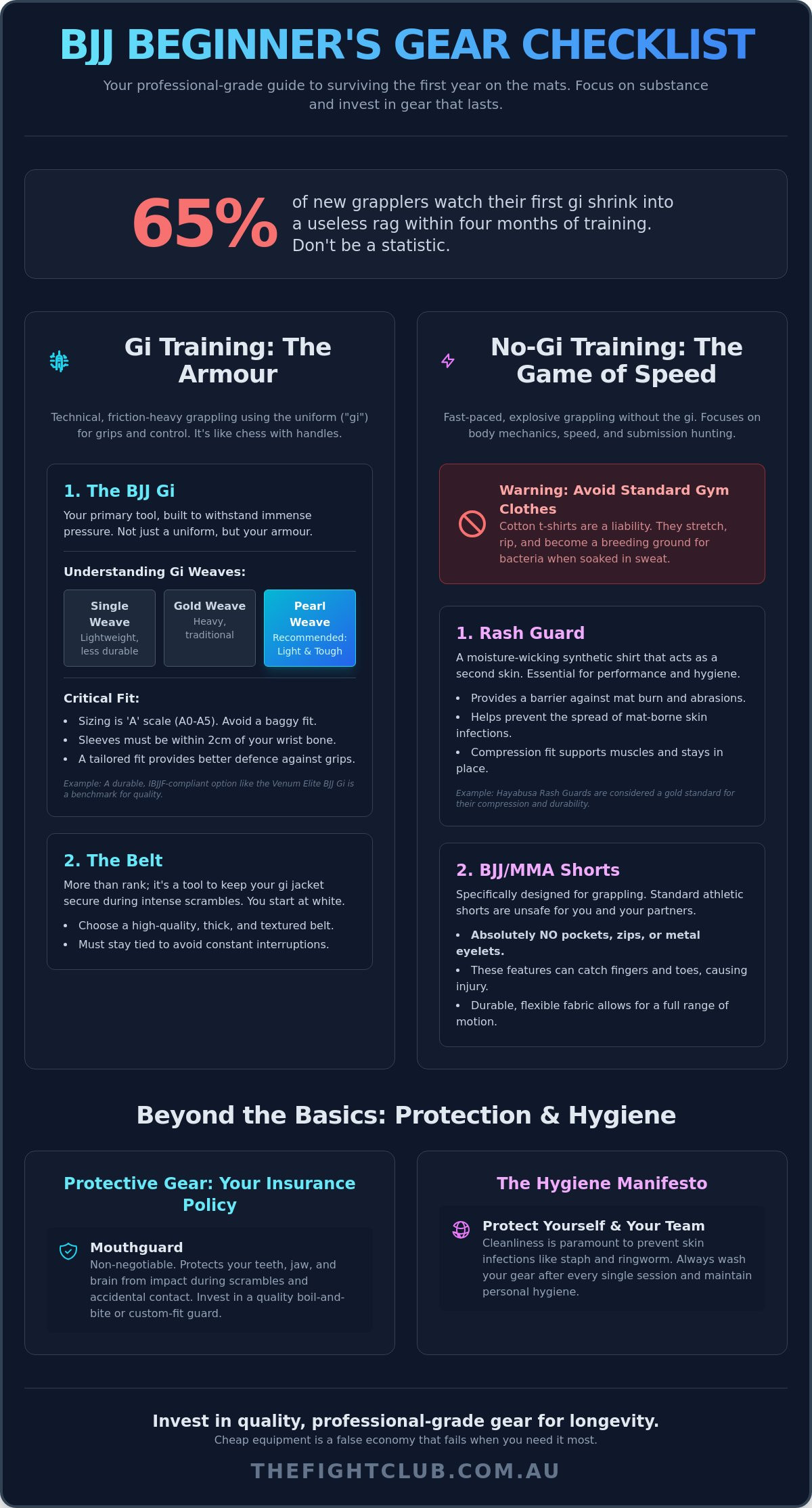
Weaves determine how your Gi feels and performs. Single weaves are lightweight but can be flimsy under pressure. Gold weaves are heavy and traditional. Most serious grapplers in Australia land on the Pearl weave. It strikes the perfect balance. It's light enough for the heat but tough enough to resist stretching. A durable, IBJJF-compliant option like the Venum Elite BJJ Gi is the benchmark here. It meets the 2026 regulations for jacket weight and fabric density, ensuring you won't be turned away at a tournament.
Sizing uses the 'A' scale, ranging from A0 to A5. A baggy Gi is a gift to your opponent. It provides endless handles for them to control your movement and finish chokes. Aim for a tailored fit. Your sleeves should reach within 2cm of your wrist bone when arms are extended. Don't give them an inch of extra fabric to work with. Proper fit equals better defense.
Choosing Your First BJJ Belt
You start at white. No ego. No shortcuts. Unless your coach specifies otherwise based on previous experience, own the white belt. This is where the foundation of your game is built. A high-quality belt is thick and textured. It needs to stay tied during intense sparring sessions. Constant interruptions to fix your kit break your rhythm and annoy your partners. Your belt reflects your commitment to the grind. Choose one that stays secure so you can stay in the fight. When you're figuring out what gear do you need for BJJ, remember that even the smallest details support your longevity on the mats.
Gi vs. No-Gi: Understanding the Two Disciplines
You've secured your Gi. Now you're looking at the No-Gi schedule. Don't make the mistake of thinking it's just grappling in your standard gym clothes. It is a different beast entirely. Gi training is technical and friction-heavy. It is chess with handles. No-Gi is about speed, explosive movement, and sweat-soaked scrambles. Because there are no lapels to grab, the game changes instantly. When you ask what gear do you need for BJJ in a No-Gi context, the requirements shift from heavy cotton to high-tech synthetics.
Cotton T-shirts are a liability on the mats. They stretch out when pulled. They rip under pressure. Most importantly, they act like a sponge for dangerous bacteria. In a high-contact environment, a sweat-soaked T-shirt is a breeding ground for infections. You need moisture-wicking synthetic fabrics that regulate your body temperature and shed moisture. This isn't about looking the part. It is about hygiene and performance. While most grapplers eventually develop a preference, training in both disciplines is the only way to build a complete game. For a broader look at the combat sports landscape, you can research beginner's MMA gear to see how these requirements overlap across disciplines.
Essential No-Gi Apparel: Rash Guards and Shorts
Mat burn is a brutal reality. Friction against the canvas will peel your skin back if you're unprotected. Technical rash guards act as a second skin. They provide a vital barrier against abrasions and help prevent the spread of mat-borne illnesses. Hayabusa Rash Guards are the gold standard here. They offer superior compression that stays in place during a heavy roll. Your shorts must be BJJ-specific. This means no pockets and no zips. A training partner's finger or toe getting snagged in a pocket is a guaranteed injury. Safety comes first.
Grappling Spats: The Under-Layer Advantage
Spats provide an extra layer of defense. Wear them under your shorts or even under your Gi. They offer a hygiene barrier that keeps your skin off the mats. There is also a psychological benefit to the compression. You feel "locked in" and focused. Practically, spats keep your muscles warm between rounds. This reduces the risk of minor strains and keeps you agile during long sessions. When considering what gear do you need for BJJ, don't overlook this layer. Ready to gear up for your first No-Gi session? Check out our range of professional grappling apparel designed for the Australian grind.
Protective Gear: Staying in the Fight and Avoiding Injury
Brazilian Jiu-Jitsu is often called the "gentle art." Don't let the name fool you. It is high-octane combat. While there is no intentional striking, the kinetic energy in a live roll is massive. You are dealing with explosive take-downs, heavy pressure, and erratic scrambles. When you ask what gear do you need for BJJ, protective equipment should be at the top of your list. It isn't about being soft. It's about being smart. Think of this gear as an insurance policy for your longevity. You can't improve if you're sidelined with a preventable injury.
Adopting a humble, ego-free approach to safety is the mark of a professional. Protecting your body allows you to train with more confidence and aggression. You don't want to hesitate during a transition because you're worried about your joints or teeth. Professional-grade protection removes that mental block. It lets you focus entirely on the technique. If you want to survive your first year on the Australian mats, you need to respect the physical toll of the sport. Every session is a challenge. Be prepared for it.
Mouthguards: Protecting Your Smile
Stray knees and elbows are a constant reality during transitions. One mistimed bridge or a sloppy scramble can result in a chipped tooth or a nasty laceration. It happens in a split second. We recommend the Damage Control Mouth Guard for its superior impact dispersion. A high-quality guard does more than just protect your teeth. It prevents you from biting your tongue or cheek during a hard take-down. It's a small investment that saves you thousands in dental bills. Stay in the fight. Keep your smile intact.
Knee Pads and Ear Protection
Your knees take a beating. Constant impact from shooting for take-downs or pivoting on the mats can lead to chronic inflammation. Knee pads provide the cushioning needed to keep your joints healthy over years of training. Then there's the ears. Cauliflower ear is caused by repeated friction and trauma to the ear cartilage. It's permanent. Headgear might not look "cool," but it's essential for those prone to ear sensitivity or anyone who wants to avoid permanent cartilage damage. While these items are often labeled as optional, they are vital for anyone serious about the grind. When deciding what gear do you need for BJJ, prioritize the equipment that keeps you on the mats day after day.
The Hygiene Manifesto: Protecting Your Skin and Your Teammates
Respect the mats. Respect your partners. Hygiene is the non-negotiable price of entry in any authentic training hall. When you are determining what gear do you need for BJJ, remember that your washing machine is just as vital as your Gi. Never step onto the training surface with a dirty uniform or an unwashed body. It is the ultimate sign of disrespect to the people who trust you with their safety. The "Golden Rule" is simple: if you wouldn't want to roll with a person who smells like a locker room, don't be that person.
High-contact sports carry inherent risks. Skin infections like staph and ringworm are aggressive. They aren't just inconveniences; they are setbacks that can sideline you for weeks and compromise the entire gym's health. Your skin is your first line of defense. Keeping it clean and covered is a professional responsibility. Wash your gear immediately after every class. Don't let it marinate in your gym bag. Bacteria thrives in dark, damp environments, and "the funk" is a sign of neglect. Never air-dry your Gi in the harsh Australian sun, as the UV rays will damage the cotton fibers and turn your armor into a brittle, sandpaper-like mess. Never wear your training shoes on the mat, and never step off the mat barefoot.
The Role of Rash Guards in Skin Protection
Rash guards aren't just for No-Gi sessions. Wear a tight-fitting rash guard even under your Gi jacket. It acts as a physical barrier against mat-borne bacteria and minimizes direct skin-to-fabric friction. This prevents the coarse Gi material from grinding into your shoulders and back, reducing the risk of abrasions that infections love to exploit. You need a rotation. Aim for at least 2-3 sets of rash guards and spats. You cannot rely on one set if you're hitting the mats multiple times a week. Build your rotation with professional-grade hygiene essentials from our collection.
Footwear and Off-Mat Etiquette
Flip-flops or slides are mandatory equipment. They are the bridge between the changing room and the mat edge. Tracking bathroom floor bacteria onto the training surface is the quickest way to lose respect in a serious gym. It's a communal responsibility to keep the mats sterile. We all sweat there, and we all put our faces on that canvas. If you step off the mat for any reason, put your shoes on. No exceptions. When you consider what gear do you need for BJJ, a reliable pair of slides is just as important as your belt. Keep the dirt on the street and the mats clean for the work.
Gearing Up for Longevity: Investing in Quality Over Flash
Don't get distracted by neon patches or bargain-bin price tags. Cheap gear is a false economy. It might save you a few dollars today, but it will fail you when the intensity spikes. When you're calculating what gear do you need for BJJ, look at the cost per roll. A budget Gi that rips in three months is far more expensive than professional kit that lasts three years. This isn't just about aesthetics. It's about engineering. High-performance gear is built to survive the friction, the sweat, and the constant tugging of a high-octane training environment. You need equipment that works as hard as you do.
As your technique evolves, your relationship with your kit will change. You'll start to notice the "cut" of a premium jacket. You'll feel the difference in how a tapered fit prevents your opponent from securing an easy grip. This is where brands like Venum and Hayabusa prove their worth. They don't just make clothes; they build equipment. See your gear as an investment in your new lifestyle. You're not just buying a uniform. You're equipping yourself for a transformative journey that demands grit and perseverance. Show up with tools that match your work ethic and respect the discipline.
Why Premium Brands Matter
The secret is in the details. Professional BJJ Gis utilize reinforced stitching at every stress point. They feature ripstop fabrics that stop small tears from becoming catastrophic failures mid-class. This technical focus extends across all combat gear. For example, the Hayabusa T3 range is famous for its engineering. It provides the kind of joint support and durability that entry-level brands simply can't replicate. Premium gear retains its shape and colour through hundreds of wash cycles. It stays professional while cheap alternatives fade, sag, and lose their structural integrity.
Building Your BJJ Wardrobe Over Time
You don't need a full closet to start. Begin with one high-quality Gi and two rash guards. This allows you to train, wash, and repeat without stress. As your mat time increases, expand your kit naturally. You might eventually add punching bags to your home setup to drill movement and conditioning. This is a marathon, not a sprint. While the right kit makes the journey smoother, the most important thing you bring to the mat is your willingness to learn. Gear up. Stay humble. Get to work. Now that you know what gear do you need for BJJ, you have no more excuses. The mats are waiting.
Step Onto the Mats Prepared
The mats don't lie. Neither does your gear. You now have the blueprint for your first year. You know exactly what gear do you need for BJJ to survive the grind and evolve your game. Prioritize quality over flash. A technical Gi and moisture-wicking rash guards are your baseline. Add protective gear to ensure you stay in the fight for the long haul. Above all, respect the hygiene manifesto. It's the ultimate sign of a professional grappler.
Don't settle for gear that quits before you do. Upgrade your BJJ kit with professional-grade gear at The Fight Club. As an Australian-owned and operated specialist, we stock elite brands like Venum and Hayabusa. We offer fast shipping across the country to get you back in the training hall quickly. We're here for the serious fighters who value substance over hype. We provide the tools; you provide the work ethic.
Leave the ego at the door. Put in the hours. We'll see you on the mats.
Frequently Asked Questions
Do I need a Gi for my first BJJ class?
Most Australian academies provide loaner uniforms for your first trial session. Contact the gym ahead of time to confirm availability. If you decide to commit to the grind, purchasing your own Gi should be your first priority. Having your own kit ensures a proper fit and better hygiene from day one. It shows you're serious about the work ahead.
Can I wear a normal T-shirt for No-Gi BJJ?
Avoid wearing standard cotton T-shirts on the mats. They are a major liability because they stretch, rip, and trap dangerous bacteria against your skin. Technical rash guards are the only professional choice for No-Gi training. They provide the necessary compression and moisture-wicking properties to keep you safe and mobile during intense scrambles. Don't let poor apparel choices stall your progress.
How many BJJ Gis should a beginner own?
Start with one high-quality Gi and expand your rotation as your training frequency increases. If you're hitting the mats more than twice a week, owning two or three uniforms becomes essential. This allows enough time for proper washing and air-drying between sessions. When determining what gear do you need for BJJ, remember that a clean rotation is the foundation of gym etiquette.
Do I really need a mouthguard for Jiu-Jitsu?
Yes, a mouthguard is mandatory for anyone who values their teeth. Accidental impacts from knees, elbows, and heads are common during transitions and live rolling. A professional-grade guard like Damage Control disperses impact and prevents you from biting your tongue during hard take-downs. It's a small investment that prevents massive dental bills and kept you in the fight.
What is the difference between a BJJ Gi and a Judo Gi?
BJJ Gis feature a more tailored fit with narrower sleeves and shorter skirts to limit an opponent's grip. They are also built with thicker, stiffer collars to make chokes more difficult to secure. Judo Gis are traditionally baggier to facilitate the big throws and grips central to that sport. For authentic Jiu-Jitsu training, stick to gear specifically engineered for the ground game.
How do I stop my BJJ Gi from shrinking in the wash?
Always wash your Gi in cold water and never use a clothes dryer. Heat is the enemy of cotton fibers and will cause significant shrinkage, even in "pre-shrunk" models. Hang your Gi to air-dry in a well-ventilated area away from direct sunlight. This preserves the structural integrity of the weave and ensures your armor fits perfectly for years of hard training.
Should I buy a long-sleeve or short-sleeve rash guard?
Long-sleeve rash guards are generally superior for beginners because they provide maximum skin protection. They offer a total barrier against mat burns on your elbows and reduce direct skin contact with training partners. Short-sleeve versions are slightly cooler in the Australian heat but leave your forearms exposed. When asking what gear do you need for BJJ, prioritize the hygiene and protection of long sleeves.
Is it okay to wear a cup/groin guard in BJJ?
Groin guards are a personal choice, but many academies discourage them during training. A hard cup can cause significant pain or injury to your training partners during certain movements, such as armbars or back control. Many high-level practitioners opt for compression shorts instead. Check your specific gym's policy and prioritize the safety of the community when making your choice.