

Punching Bags Australia: The Ultimate Fighter’s Guide to Home Training (2026)
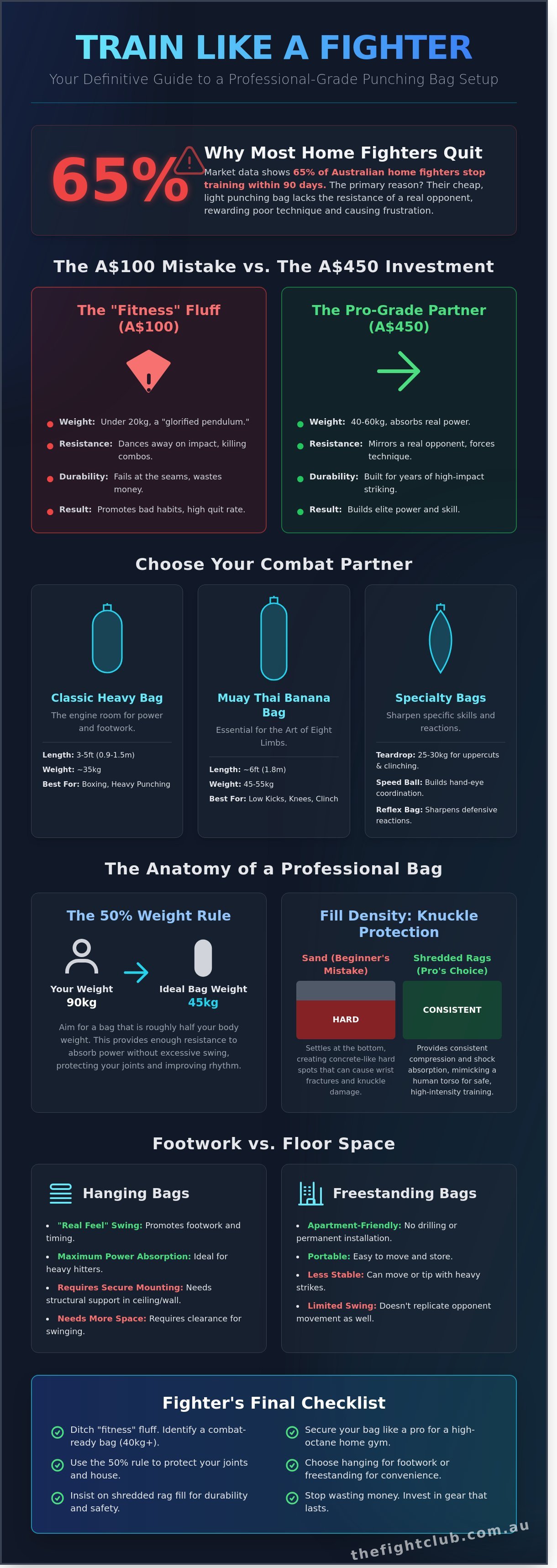
A cheap, 20kg floor-stock bag isn't a training partner; it's a glorified pendulum that rewards poor technique. Recent 2026 market data reveals that 65% of Australian home fighters stop training within ninety days because their gear lacks the resistance of a real opponent. You know the frustration. You're ready to throw heat, but your current punching bag dances away before you can land a second strike. You want the raw intensity of a professional gym without the Sydney traffic. It's about substance over flash. Realness matters.
You're right to be skeptical of those generic $100 specials that flood the market. You need gear that mirrors the "No Egos" environment of an elite camp. We're going to fix that. This guide ensures you master your striking by choosing, installing, and dominating a professional-grade setup that justifies a $450 investment. We're breaking down the latest weight-to-power ratios, structural mounting for Aussie homes, and the technical drills that build elite power. It's time to stop playing and start working. Train like a fighter.
Key Takeaways
- Ditch the "fitness" fluff and learn how to identify a combat-ready target that handles real power and repetitive high-impact striking.
- Protect your joints and your house by mastering the professional rules for bag weight and fill density to ensure injury-free sessions.
- Secure your punching bag like a pro using essential hardware and reinforcement techniques that turn any Aussie garage into a high-octane gym.
- Footwork or floor space? Decide between the "Real Feel" swing of a hanging bag or the apartment-friendly convenience of freestanding models.
- Train like a fighter and stop wasting money on cheap gear that fails at the seams by investing in professional-grade durability.
Choosing Your Combat Partner: The Different Types of Punching Bags
A punching bag isn't just a piece of gym equipment. It's a reinforced target designed for repetitive, high-impact striking. It takes the punishment so your body can find its power. Stop looking at the soft, foam-filled toys found in big-box retail stores. Real training requires material density. We distinguish between "fitness" bags, which often weigh less than 20kg, and "combat" bags designed for 40kg to 60kg of resistance. If the bag flies across the room when you hit it, you aren't training. You're just making noise.
Your chosen discipline dictates the bag shape. Boxing, Muay Thai, and MMA each demand specific gear to develop authentic technique. At The Fight Club, we live by a "No Egos" policy. This applies to your equipment too. Beginners often think they should start with a light, soft bag. That's a mistake. You need professional-grade resistance from day one. This protects your wrists by forcing correct alignment and builds the raw impact required in a real fight. Train like a fighter from the first bell.
The Classic Heavy Bag: The Gold Standard
The heavy bag is the engine room of power development. It's where you build foundational footwork and the grit to keep swinging when your lungs burn. In Australian home gyms, these typically range from 3ft to 5ft in length. A 4ft bag weighing approximately 35kg is the standard for Melbourne garages. It provides enough weight to resist heavy hooks while offering enough swing to keep you moving. It forces you to time your shots and manage distance. This is the primary tool for anyone focused on traditional boxing and heavy punching drills.
Muay Thai Banana Bags: For the Low Kickers
Traditional bags don't cut it for the Art of Eight Limbs. You need a Muay Thai banana bag. These stand 6ft tall and reach the floor. This extra length is mandatory for practicing low kicks and knee strikes safely. Because they weigh between 45kg and 55kg, they offer a much heavier overall mass. This density reduces excessive swing during high-volume combinations. It allows for a stable target during clinch work and leg conditioning. If your goal is MMA or Muay Thai, the banana bag is your essential partner for leg work.
Specialty Bags: Speed, Reflex, and Uppercuts
Technical precision requires specialized tools. Understanding the different Types of Punching Bags helps you target specific weaknesses in your game. Don't just mindlessly hit the heavy bag. Mix in these variations to sharpen your skills:
- Teardrop bags: These weigh roughly 25kg to 30kg. Their unique shape is perfect for perfecting clinching and uppercut technique. They allow for angles that a straight bag simply cannot offer.
- Speed balls: These focus on hand-eye coordination. They build the shoulder endurance needed for those final rounds. Spending 3 minutes on a speed ball is a test of discipline.
- Reflex bags: These mimic a moving opponent. They use a spring-loaded base to snap back at you. They sharpen your defensive reactions and keep your hands up.
Every bag serves a purpose in Melbourne’s premier training environments. Choose the one that matches your goals. Don't settle for superficial fitness gear. Get the right punching bag and start the real work. Discipline starts with the right tools.
The Anatomy of Impact: Weight, Fill, and Durability
Precision matters when choosing a punching bag. Don't guess. Use the 50 percent rule to protect your joints and maximize your output. If you weigh 90kg, aim for a 45kg bag. This weight provides enough resistance to absorb heavy strikes without the equipment swinging wildly like a pendulum. A bag that is too light forces you to chase it around the room, killing your rhythm. A bag that is too heavy feels like hitting a brick wall, which leads to wrist fractures and elbow tendonitis. Balance is everything.
Fill choice dictates how long you stay in the fight. Sand is a beginner's mistake. It settles. It turns the bottom of your gear into solid concrete while the top becomes hollow. Shredded rags are the gold standard for authentic training. They compress under impact. They absorb shock. They mimic the density of a human torso. This consistent feedback is vital for the health benefits of boxing, ensuring you can train at 100 percent intensity without risking a chronic injury. Professional gyms use rag fill because it lasts through years of daily abuse.
Why Fill Density Matters for Your Knuckles
Sand-filled bags suffer from settling. Gravity pulls small particles to the base, creating rock-hard spots that destroy your knuckles on impact. Professional shredded rag fill provides consistent compression across the entire surface area. Bag settling is the process where internal materials compact at the bottom over time; you can fix this by taking the bag down and rolling it firmly on the floor for five minutes. This redistribution keeps the impact surface safe and predictable for every round.
Durability starts with the skin. Australia has a harsh climate. A garage in Melbourne or a shed in Brisbane faces extreme temperature shifts and high humidity. Leather is the undisputed king of feel. It breathes. It stretches. A premium leather bag can last 12 years if you treat it with basic conditioner. However, high-grade synthetics have closed the gap. Brands like Venum use engineered microfibers that resist moisture and bacteria better than raw hide. If your training space is prone to dampness, synthetic is the smarter play to avoid mold and rot.
Synthetic vs. Real Leather: The Durability Debate
Real leather offers the most natural feedback and the longest lifespan in controlled environments. It is the authentic choice for those who value tradition and tactile response. High-grade synthetics are easier to clean and provide superior moisture resistance in high-humidity zones. Consider your training environment; garages need moisture-wicking materials to prevent the equipment from smelling like a locker room after three months. You can find gear that stands up to the heat at The Fight Club.
Look at the details. Reinforced stitching separates a professional tool from a cheap toy. A premium Hayabusa bag uses double-bonded nylon thread and reinforced D-ring straps. Cheap knock-offs use single-stitch cotton that snaps under a 110kg impact. Check the seams. If they are pulling apart while the bag is on the shelf, they will explode after your first power straight. True gear is built to be punished. Invest in quality once, or buy garbage three times. The choice is yours.
Hanging Bags vs. Freestanding: Which One Wins for Your Space?
Your garage or spare room is your arena. Choosing the right punching bag depends on whether you're chasing a pro-level sweat or just venting after a long shift. It's a choice between permanent grit and portable convenience. Don't settle for gear that doesn't match your intensity. You need to understand how each setup handles the impact of a 100-kg power shot before you tap your card at the register.
Space is the ultimate decider in the Australian home gym. A standard 4-foot heavy bag weighs roughly 35kg to 50kg. Hanging that weight requires structural integrity. If you're in a modern townhouse with thin steel frames, a ceiling mount might bring the roof down. Freestanding units solve this by keeping the weight on the floor. They use a base filled with 100kg of sand or water to stay upright. It's about physics, not just aesthetics. You want a target that stays put when you're throwing heat.
The Case for the Traditional Hanging Bag
Hanging bags are the gold standard for a reason. They don't just sit there. They fight back with movement. When you hit a 40kg bag, it swings. This forces you to move your feet. It builds your rhythm. You learn to time the shot as the target returns. Without that swing, you're just hitting a static object. That isn't boxing. That's a chore. A hanging bag allows 360-degree movement. You can circle, pivot, and angle out just like you're in the ring at the gym. It demands respect and better footwork.
- Better Timing: You must react to the bag's natural pendulum motion.
- Total Access: No base means you can work your low kicks and footwork without tripping.
- Durability: High-quality leather hanging bags can last 10 years or more with basic care.
When to Choose a Freestanding Punching Bag
Renters don't have the luxury of drilling into rafters. That's where the freestanding punching bag takes the win. These units are built for the apartment lifestyle. You can roll them into a corner when the session ends. Modern designs have come a long way from the flimsy toys of the past. High-end models feature neck springs that mimic the snap of a human head. They're perfect for high-volume cardio and "boxercise" drills where you're more focused on heart rate than heavy knockout power.
- Zero Damage: No holes in the ceiling means you keep your bond money.
- Portability: Move your workout from the garage to the patio whenever you want.
- Stability: Bases filled with dry sand provide a solid anchor for most fitness-level strikes.
Noise is the silent killer of home training. Ceiling mounts act like a speaker for your house. Every strike sends a vibration through the timber beams. In a 2023 study of residential noise levels, mounted bags produced vibrations felt three rooms away. Neighbors will notice. Freestanding bases thud against the floor, but a 20mm rubber gym mat can kill 40 percent of that sound. Consider your environment before you commit to a bracket.
Budget matters. A quality synthetic bag in Australia starts around $150. But the bag is only half the story. A heavy-duty wall bracket adds another $80 to $130 to your bill. If you can't drill into the brick, a steel tripod stand will set you back $250 minimum. Freestanding units often retail for $400 to $700. It's a higher upfront cost, but you save on structural repairs and mounting hardware. Choose the gear that lets you train without limits. No excuses. No egos. Just work.
Set Up for Success: Installation, Hand Safety, and Maintenance
Your home gym is a sanctuary. Don't ruin it with a half-baked setup. A 40kg punching bag creates massive kinetic energy every time you land a cross. Standard 90mm ceiling joists in Australian homes aren't designed to handle that localized, swinging stress. Hanging a bag directly from a single joist without reinforcement is a recipe for a $1,500 structural repair bill. You need a spreader beam. Bolt a thick timber across three separate joists to distribute the load. This is about discipline and doing the job right the first time.
The hardware matters as much as the bag itself. Invest in the essential kit. You need a heavy-duty swivel to prevent the chains from twisting and snapping under pressure. Add a high-tension compression spring between the mount and the chains. This spring absorbs up to 25% of the vibration that would otherwise rattle your windows and your joints. It turns a loud, disruptive workout into a focused session that respects the rest of the household.
Practical Installation Guide for Australian Homes
Garage setups are the gold standard for grit. For brick walls, use a steel wall-mount bracket with at least four 12mm dynabolts. If you're training outdoors, Sydney's 70% average humidity and intense UV levels will destroy a standard vinyl bag in less than 8 months. Use a weather-resistant cover or bring the bag inside after every session. Stop the rot before it starts. For noise reduction, rubber washers between the bracket and the wall can dampen sound by a further 10 decibels.
Hand Protection 101: Don’t Hit Naked
Hitting a bag without protection is ego, not toughness. Your hand contains 27 small, fragile bones. One misplaced hook can lead to a "boxer’s fracture" that sidelines you for 12 weeks. Always use 180-inch hand wraps to lock your wrist and knuckles into a single, solid unit. This isn't optional. It's the foundation of every strike. Follow our Boxing Wraps Guide to master the technique of securing your weapons.
Understand the difference between your tools. Bag gloves are built with high-density foam designed to withstand thousands of impacts against a dense punching bag. Sparring gloves are softer, designed to protect your partner. Using your $220 sparring gloves on a heavy bag will bottom out the padding in 3 months, making them dangerous for the ring. Keep your gear specialized. Respect the equipment and it will respect your progress.
Maintenance is where the real discipline shows. Sweat is acidic. It contains salts that degrade leather and synthetic materials over time. Wipe your bag down after every workout with a non-abrasive disinfectant. Don't let "gym funk" settle in. Open your gloves and let them air out in a ventilated space, never in your gym bag. This simple 2-minute routine extends the life of your gear by 200% and keeps your training environment professional.
Ready to build a setup that lasts as long as your drive? Get the professional gear you need at The Fight Club.
Train Like a Fighter: Why Premium Gear Matters
Stop buying toys. A cheap vinyl bag from a big-box retailer might save you $100 today, but it'll cost you triple in the long run. Professional gear is an investment in your technique and your safety. When you hit a high-grade punching bag, the feedback is consistent. There are no dead spots. There is no leaking sand or settling filler that turns the bottom of the bag into concrete. You get pure, predictable resistance every time you connect.
Durability equals economy in the fight world. Cheap seams fail under the pressure of a 100kg power shot. Pro-grade equipment uses reinforced nylon stitching and 1.2mm thick genuine leather or high-tensile synthetic shells. These bags handle 500 rounds a year without flinching. It is the difference between a bag that sags and splits in six months and one that stays firm for a decade. If you are serious about your progress, you need gear that can keep up with your output.
There is also a psychological edge to consider. A mental shift happens when you wrap your hands and face the same equipment used in the Octagon. It is about respect for the craft. You aren't just doing cardio. You are training. Using professional gear eliminates the "gym-at-home" feel and replaces it with the atmosphere of a high-performance facility. It keeps you accountable when the sweat starts to sting and your lungs begin to burn.
The Brands That Build Champions
Hayabusa leads the market with technical precision. Their gear focuses on patented wrist support systems to prevent injury during high-volume heavy bag sessions. Venum brings the raw energy of the UFC. It is gear tested by elite strikers and built to withstand the grittiest training environments. If you want professional performance without the brand-name markup, The Fight Club house brand delivers. We strip away the marketing fluff. You get 100% authentic, professional-grade quality designed specifically for the Australian market.
Ready to Throw? Get the Right Gear
Our "No Egos" policy is the foundation of everything we do. It means we don't care if you're a world-class contender or a first-timer starting in your garage. We only care that you have equipment that won't fail you when you're pushing your limits. Don't settle for mediocre equipment that ends up in a landfill after a season of use. Before you commit to your new home setup, run through this final checklist to ensure you are ready for round one.
- Mounting Point: Ensure your ceiling joists or wall brackets can support a 40kg to 60kg dynamic load.
- Floor Space: You need at least 1.5 metres of clearance around the punching bag for proper footwork and 360-degree movement.
- Hand Protection: Never hit the bag with bare knuckles. Use 180-inch hand wraps and 12oz or 16oz boxing gloves.
- Mindset: Leave the ego at the door. Every pro started with their first awkward jab.
Your journey starts the moment you decide to stop making excuses. Elite training requires elite tools. Buy it once. Buy it right. Join a community that values grit, discipline, and real results over vanity. It's time to put in the work and see what you're actually capable of achieving.
Claim Your Territory: Start Your Home Training Evolution
The difference between a workout and a transformation comes down to the gear you hit. You now understand that a high-quality punching bag is more than equipment; it's a silent coach that demands your best. We've covered why weight distribution matters and how professional-grade materials prevent injury during 12-round sessions. Don't settle for gear that fails after 3 months of hard graft. Real progress requires the same tools the pros use. You need durability that withstands thousands of strikes without sagging or splitting.
The Fight Club is 100% Australian owned and operated. We stock elite brands like Hayabusa and Venum to ensure your knuckles and shins stay protected. Every order ships fast from our Sydney warehouse, often arriving within 2 to 5 business days. There are no egos here, just the pursuit of better. It's time to stop thinking and start hitting. Upgrade your home gym with professional punching bags.
The grind doesn't care about your excuses. Lace up, step in, and show the world what you're made of. We'll see you on the mats.
Frequently Asked Questions
How heavy should my punching bag be?
Aim for a punching bag that weighs exactly 50% of your total body weight. If you are a 90kg fighter, you need a 45kg bag to provide the right resistance for power shots. Bags that are too light will swing excessively and ruin your rhythm. Heavier bags provide the necessary feedback to build real power and bone density in your shins and knuckles.
Can I hang a punching bag in my garage?
You can hang a bag in your garage as long as the overhead joists are structural timber measuring at least 100mm by 50mm. Use a heavy duty swivel mount and M8 coach bolts to secure the bracket. Garage gyms are where champions are built through sweat and grit. Just ensure you have 2 metres of clearance around the bag to move freely and practice footwork without hitting the walls.
What is the best material for a punching bag?
Genuine cowhide leather is the gold standard for any serious combat athlete. Leather bags typically last over 5 years of daily abuse, whereas cheap vinyl versions often crack or leak within 18 months. Leather feels more natural on impact and adjusts to temperature changes in your gym. It is an investment in your craft that rewards you with better texture and superior durability over thousands of rounds.
Do I need a stand for my punching bag?
Use a stand only if your rental agreement or ceiling structure prevents a permanent mount. A quality steel stand requires 1.5 square metres of floor space and usually needs 40kg of sandbags to stop it from walking across the floor. Ceiling mounts are superior because they offer 360 degree movement. Real training requires space to circle your opponent; don't let a steel pole dictate your footwork.
How do I stop my punching bag from swinging too much?
Attach a heavy duty bungee cord to the bottom D-ring of the bag and anchor it to a 5kg floor weight. This keeps the target centered so you can focus on high volume combinations rather than chasing the bag. Excessive swing is usually a sign of pushing your punches instead of snapping them. Tighten your technique, hit through the target, and use the anchor to keep the intensity high.
Is it okay to hit a punching bag without gloves?
Don't do it if you value your career. You have 27 small bones in each hand, and hitting a dense bag without protection is a fast track to a hairline fracture. Always use 180 inch hand wraps and at least 12oz boxing gloves for bag work. We have a No Egos policy here; being "tough" doesn't mean being reckless with your joints. Protect your tools so you can train again tomorrow.
What is the difference between a heavy bag and a punching bag?
A heavy bag is a specific category of punching bag designed for power development and weighs between 30kg and 60kg. The term punching bag is a broad label that includes speed bags, double end bags, and maize bags. Use a 40kg heavy bag to build the raw strength needed to finish a fight. Train like a fighter by selecting the specific tool that matches your session's objective, whether it is power or speed.