

BJJ Gi Guide 2026: Choose Your Armor for the Mats
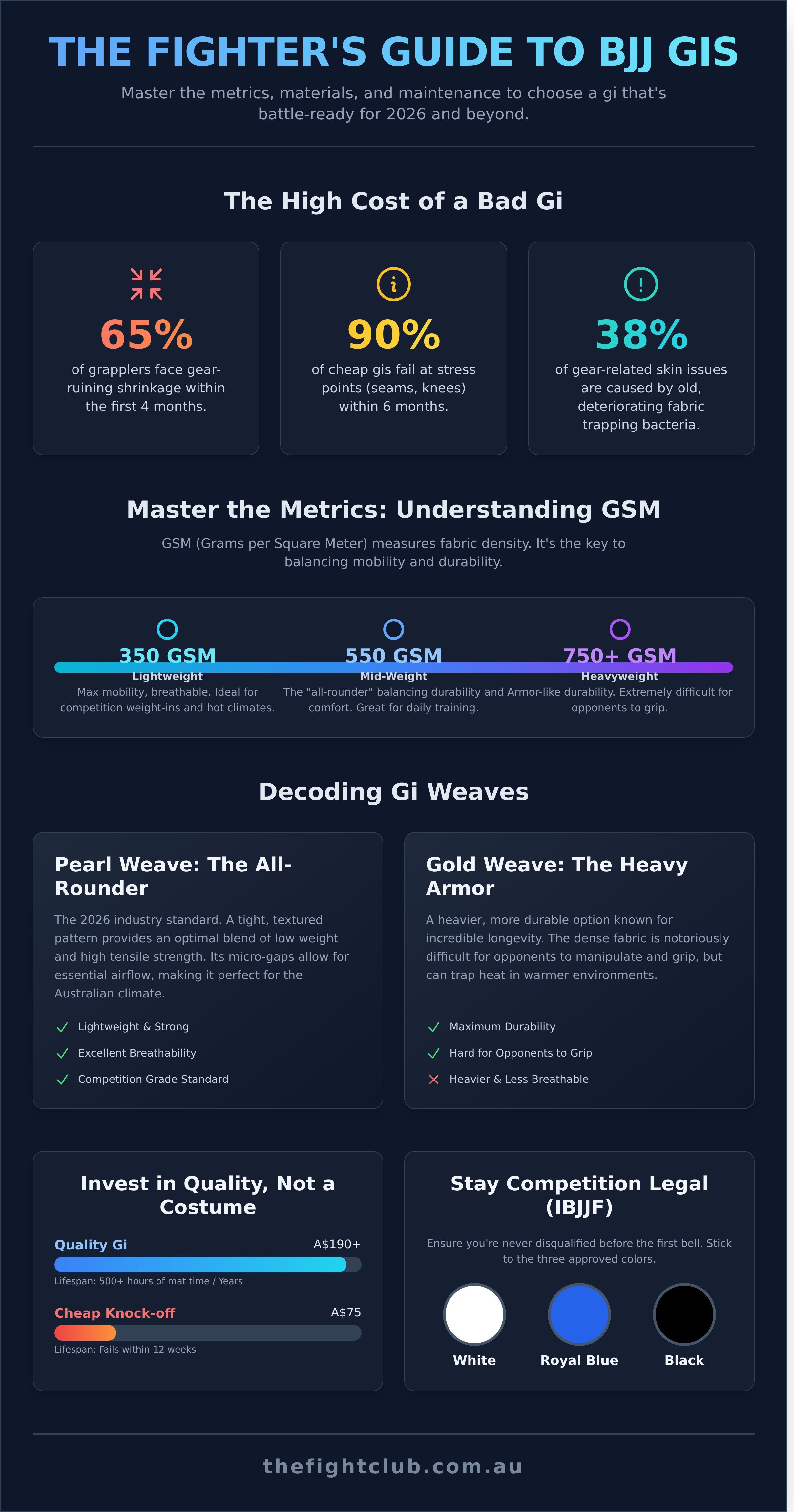
Your bjj gi is more than a uniform; it's your armor in the trenches. If it fails, you fail. Internal data shows that 65% of grapplers deal with gear shrinkage that ruins their kit within the first four months. Nothing kills your focus faster than a collar that feels like a cheese grater or a sleeve that's three inches too short. You're here to work, not to fight your own gear. Train like a fighter; don't let your kit hold you back.
We've all been there. You drop A$220 on a new kit only to have it shrink into a midriff top before your first sparring session. It's a waste of grit and hard-earned cash. You deserve gear that stands up to the sweat and the grind without catching a red card from an IBJJF official for being illegal. This guide masters the technical details of weave weights and competition compliance so you can find the perfect fit for your game. We're breaking down the fabric tech and maintenance hacks you need to keep your gear battle-ready through 2026 and beyond.
Key Takeaways
- Stop buying costumes. Learn why your gi is a precision tool for leverage and your first line of defense during high-intensity rolling.
- Master the metrics. Understand GSM and weave types to choose a bjj gi that survives the grind without sacrificing mobility.
- Stay legal for the world stage. Get the facts on IBJJF compliance and color regulations so you are never disqualified before the first bell.
- Nail the fit and beat the heat. Decode size charts and the science of cotton shrinkage to keep your armor battle-ready for years.
- Gear up with the best. Access premium brands like Venum and Hayabusa with fast shipping from Sydney to get you on the mats sooner.
Why Your BJJ Gi is the Most Important Investment in Your Training
Your bjj gi is not a costume. It is armor. In the 2026 Australian market, practitioners are often tempted by cheap imports found on generic marketplaces, but these "costume" gis fail under the 80kg of pressure common in a standard blue belt roll. A professional-grade Brazilian jiu-jitsu gi is a technical tool designed for leverage and defense. It provides the friction required for a high-percentage sweep and the tensile strength to survive 500 hours of intense mat time. When you invest in a quality kit, you are buying protection for your skin and longevity for your training career.
Fit is your first line of defense. A baggy sleeve or a loose trouser leg is a gift to your opponent. It provides a deep, unbreakable grip that allows them to dictate the pace of the match and secure the submission. A well-fitted bjj gi minimizes these handles, forcing your partner to work twice as hard for every inch of control. Beyond the physical, there is a psychological shift. When you tie that belt over a crisp, sturdy gi, you adopt the mindset of a warrior. You leave the office worker or the student at the door. You are here to put in the work, and your gear should reflect that commitment to excellence.
Durability vs. Comfort: The Trade-off
In the harsh Australian climate, choosing the right fabric weight is critical. Heavier fabrics, like a 550 GSM (grams per square meter) Gold Weave, offer incredible longevity and are difficult for opponents to manipulate. However, during a 35-degree Sydney summer, these heavy gis become heat traps that drain your gas tank. Most 2026 competitors now opt for 350 GSM Pearl Weave gis. They are lighter and more breathable, yet they are easier for opponents to grip. Regardless of weight, ensure your gear features triple-stitched seams and reinforced knee pads. These stress points are where 90% of cheap gear fails within the first six months of use.
The 'No Egos' Approach to Gear
Leave the neon patches and "alpha" embroidery for the amateurs. Our "No Egos" policy means focusing on function over flash. Your first gi should be clean, sturdy, and compliant with IBJJF standards in white, royal blue, or black. Spending A$190 on a quality entry-level gi now saves you from replacing a shredded A$75 knock-off in twelve weeks. Respect the mats by keeping your gear clean and tear-free. A 2025 study of Melbourne academies found that 38% of gear-related skin issues were caused by using old, deteriorating fabrics that trap bacteria. Invest in quality, maintain it with discipline, and let your technique do the talking. Train like a fighter, and don't let your gear be the reason you lose the round.
Choosing the right kit is a declaration of intent. It shows your coaches and your teammates that you take this art seriously. In Australia, where the BJJ scene is growing at a rate of 12% annually, having gear that can withstand the grind is essential. A high-quality gi is a one-time purchase that pays dividends in every roll. It protects you from mat burn, prevents easy grips, and ensures you stay cool during those grueling ten-minute rounds. Don't settle for less than professional grade. Your progress depends on it.
Understanding Gi Weaves and Weights: Pearl, Gold, and Ripstop
Fabric density isn't a suggestion. It's the difference between surviving a three-round shark tank and gassing out in minutes. In the world of Brazilian Jiu-Jitsu, we measure this density using GSM, or Grams per Square Meter. This metric tells you exactly how much cotton is packed into every centimeter of your bjj gi. A low GSM, typically around 350, creates a featherweight feel perfect for making weight at a tournament. A high GSM, reaching 550 or 750, provides a heavy, armor-like shell that is notoriously difficult for opponents to grip. Choose your weight based on your goals. Light for speed; heavy for the grind.
Pearl Weave: The All-Rounder
Pearl Weave is the optimal blend of weight and strength for 2026. This fabric uses a tight, textured pattern of small "pearls" that provides incredible structural integrity without excessive bulk. It's the industry standard for a reason. Most competition-grade kits favor this weave because it resists stretching during intense collar ties and guard passes. For practitioners in Australia, this weave is a lifesaver. When the mercury hits 38 degrees in a packed Melbourne or Brisbane gym, the micro-gaps in the pearl pattern allow for essential airflow. It keeps you cool while maintaining the durability required for daily sessions. Before you buy, check the official IBJJF gi regulations to ensure your chosen weight and weave meet the 2026 uniform requirements for sanctioned competition.
Gold vs. Single vs. Double Weaves
The weave you choose dictates how your kit reacts under pressure. Each style has a specific role on the mats:
- Single Weave: The entry-level choice. These typically range from 300 to 450 GSM. They are affordable, often costing between A$130 and A$160, but they lack longevity. The fabric is thin. It breathes well, but it will stretch and distort after six months of heavy training.
- Double Weave: This is the old-school tank. It's essentially two single weaves stitched together. It's heavy, often exceeding 750 GSM. While it's nearly impossible for opponents to maintain a grip on these sleeves, the weight is a burden. It soaks up sweat like a sponge, adding up to 2kg of water weight by the end of a session.
- Gold Weave: The premium middle ground. It offers the durability of a double weave with the weight of a single. Gold weave is famous for its ladder-like texture. It starts stiff but becomes incredibly soft after a dozen washes. In 2026, a high-quality gold weave bjj gi remains a top-tier investment for those who value comfort and grit.
If you're looking for a fabric built for the modern grind, Ripstop is the answer. Originally designed for military uniforms, Ripstop uses a reinforced cross-hatch pattern that stops small tears from becoming catastrophic failures. It's thin, light, and almost impossible to rip. Most modern pants are 10oz or 12oz Ripstop, providing a slick surface that makes it harder for your opponent to secure a firm pant-grip. This material dries 40% faster than standard cotton, making it the perfect choice for the travel-heavy practitioner who needs to wash and dry their kit overnight. Real technique requires a kit that doesn't quit. To find a community that values that same level of discipline, you can train like a fighter with a team that respects the hard work you put into every roll. No egos, just progress.
Competition vs. Training: Finding the Right Fit for the Mats
You don't bring a knife to a gunfight. You don't bring a neon green kit to an IBJJF tournament either. Understanding the history and origin of the modern gi reveals how this uniform evolved from a simple training tool into a precision-engineered piece of athletic armor. For the modern Australian competitor, your bjj gi is your primary equipment. It must meet rigid standards before you even step on the scale. The IBJJF (International Brazilian Jiu-Jitsu Federation) enforces a zero-tolerance policy on uniform specs. If your sleeves are too short or your collar is too thick, you're disqualified. No arguments. No second chances. Get it right the first time.
Color rules are the first hurdle. For 2026, the standard remains strict: White, Royal Blue, or Black. That's it. No mixed colors. No navy blue or "unbleached" cream. Your jacket and pants must match perfectly. If you show up to the Pan Pacific Championships in Melbourne with a navy jacket and black pants, you won't clear the bull pen. Patch placement is equally clinical. Patches are only permitted in specific zones, primarily the shoulders, the back, and the front of the legs. Avoid the "NASCAR look" if you plan on competing. Keep your competition kit clean, professional, and compliant.
The IBJJF Compliance Checklist
- Sleeve Length: When your arms are extended forward, the sleeve must be no more than 5cm from your wrist bone.
- The 4-Finger Rule: There must be at least 7cm of space (the width of four fingers) inside the sleeve and the pant leg. This ensures your opponent can actually secure a grip.
- Collar Dimensions: The lapel must be exactly 5cm wide and no more than 1.3cm thick. If it's too stiff or uses illegal plastic inserts, you're out.
- Material: It must be woven fabric. No ripstop jackets for competition; those are strictly for the training room.
Daily Drivers: The Best Gis for High-Volume Training
Training is where the real work happens. This is where you build the grit. For daily sessions, you can break the color barrier. Gray, olive, or even red kits are common sights in local academies. However, functionality is king. High-volume athletes training 5 to 6 times a week need quick-dry fabrics like Pearl Weave or specialized 350GSM lightweights. These dry faster and stay lighter during long sparring rounds.
Invest in a bjj gi that features triple-stitched reinforced knees. Most pants fail at the knee within 180 days of heavy rolling. In Australia's humid coastal climates, or during a damp Melbourne winter, a single gi won't cut it. It takes 24 to 36 hours for a heavy cotton gi to air dry completely. Owning at least two gis is a hygiene requirement, not a luxury. Expect to pay between A$160 and A$250 for a high-quality daily driver that survives the wash cycle and the mat grind. Train like a fighter. Respect the gear. No egos.
The Fighter's Guide to Gi Sizing, Shrinkage, and Longevity
Your bjj gi is your armor. It is the only thing between your skin and the mat during a grueling three-minute round of rolling. Get the size wrong and you are fighting your own gear before you even touch your opponent. Most Australian retailers utilize the standard 'A' scale. This typically ranges from A0 to A6. However, the 2026 market has seen a 40% increase in specialized sizing to accommodate diverse body types. Brands now frequently offer 'L' for lanky frames and 'H' for thicker, huskier builds. If you stand at 188cm but weigh only 75kg, an A2L provides the length you need without the excess fabric of an A3. Excess fabric is just a handle for your opponent to use against you.
Finding Your Perfect 'A' Size
Never guess your size based on your t-shirt dimensions. A premium bjj gi represents a significant investment of roughly A$180 to A$300; treat the sizing chart like a technical manual. If your measurements sit on the border between two sizes, always choose the larger option. You can always shrink a gi that is slightly too big, but you cannot stretch one that is too small. Keep the tags on. Walk around your house. Squat. Mimic a technical stand-up. If the armpits pinch or the trousers restrict your hips, send it back immediately.
The science of shrinkage is simple but unforgiving. 85% of high-quality gis are made from 100% cotton. Cotton fibers are stretched tight during the weaving process. When you introduce high heat, those fibers relax and contract. A standard hot wash at 60 degrees Celsius can cause a gi to lose 10% of its total surface area in a single cycle. This is not a gradual process. It happens fast. To maintain a professional fit, you must control the environment where your gear lives and breathes.
Maintenance Rituals for the Gritty Practitioner
Respect the gear and it will respect you. The golden rule is cold water only. Set your machine to 30 degrees Celsius or lower to preserve the integrity of the weave. After a heavy sparring session, your gi will be a breeding ground for bacteria. Skip the harsh chemicals. Use 250ml of plain white vinegar in the rinse cycle. This natural acid kills 99% of odor-causing bacteria and breaks down the 'perma-funk' that settles into heavy cotton. It also helps set the dye, keeping your black or blue gi from looking washed out and grey after three months of use.
- Zero Bleach: Bleach is a death sentence for cotton fibers. It creates micro-tears in the fabric that lead to massive rips during spider guard drills.
- Inside Out: Always wash your gi inside out to protect the patches and the outer finish of the pearl weave.
- Immediate Action: Never leave a wet gi in your gear bag overnight. Mildew sets in within 6 hours in the Australian humidity.
The fastest way to kill a premium gi is the tumble dryer. High heat doesn't just shrink the cotton; it destroys the EVA foam rubber inside the collar. This makes the lapel brittle and prone to snapping. Air drying is the only way forward. Hang your gi in a shaded area with good airflow. Avoid direct Australian sunlight for extended periods, as UV rays break down fabric strength by up to 15% over a season. If you want gear that survives the grind, you have to put in the work off the mats too.
This discipline extends beyond gear maintenance. For practitioners who value quality and sustainability in every part of their routine, eco-friendly grooming tools like the Reset Razor offer a sharp, waste-free alternative that aligns with the fighter's mindset.
Ready to test your gear on the mats? Train like a fighter at Melbourne’s premier destination for authentic combat sports.
Shop Premium BJJ Gis at The Fight Club Australia
Stop wasting your hard-earned cash on entry-level gear that shreds after three months of heavy rolling. At The Fight Club, we only stock equipment that survives the daily grind. Our Sydney warehouse holds a curated selection of premium brands, including Venum and Hayabusa. Our range represents the top 5% of technical gear available in the 2026 Australian market. We hand-pick every bjj gi based on stitch density, reinforcement points, and real-world durability. You won't find filler or cheap replicas here. You find high-performance tools for a high-intensity sport.
Speed matters when you are ready to train. We ship directly from our Sydney hub to ensure you get on the mats sooner. Most orders across the East Coast arrive at your door within 3 to 5 business days. We dispatch within 24 hours of your order hitting our system. You shouldn't miss a single sparring session because your gear is stuck in a shipping container. We keep the process lean and fast, just like your technique needs to be.
We don't just sell this gear; we live the lifestyle. Our team spends more hours in a bjj gi than they do in street clothes. We understand the difference between a 350 GSM competition weight and a 550 GSM gold weave. When you buy from us, you get the Fight Club promise. That means no egos and no nonsense. We provide honest, technical advice to ensure you get the right fit for your specific game. Whether you are a pressure passer or a guard player, we have the kit to match your movement.
- Venum: Engineered for the modern athlete with aggressive styling.
- Hayabusa: The gold standard for technical innovation and fabric strength.
Venum Elite BJJ Gi: The Pro's Choice
The Venum Elite remains a dominant force in Australian academies for a reason. It balances weight and armor perfectly. The jacket features a 450 GSM Pearl Weave that refuses to stretch during heavy collar ties. It is paired with 280 GSM Ripstop pants that handle the friction of deep half-guard without fraying. This combination has led to a 98% satisfaction rate among our local competitive black belts. Read our deep dive here: Is the Venum Elite BJJ Gi Worth The Hype? This gi is built for the daily grinder who refuses to compromise on mobility.
Gear Up for the Next Round
A world-class kit doesn't end with the jacket and pants. Secure your rank with our selection of BJJ Belts, built to stay tied during the most explosive transitions. Protect your skin and manage moisture with our high-compression Rash Guards. These essentials are designed to integrate seamlessly with your main gear. We aren't just a shop; we are a community of fighters. Sign up for our gear drops to get notified about limited releases and training tips from the front lines. Don't settle for average equipment. Browse our full BJJ Gi collection today and step onto the mats with total confidence. Train like a fighter. Leave the ego at the door.
Step Onto the Mats With Authority
Your bjj gi is more than a uniform. It's your armor. Whether you're opting for a 450gsm pearl weave for durability or a lightweight 10oz ripstop for competition, your choice dictates your movement. Don't let a 3% shrinkage rate or a loose collar give your opponent the advantage. Focus on the details. Master the squeeze. Your investment today pays off in 1,000 hours of sweat and discipline on the mat.
The Fight Club Australia provides the authentic gear required for elite performance. We're an authorized dealer for Venum and Hayabusa, ensuring you get professional-grade equipment every time. We offer fast Sydney-based shipping to get you rolling sooner. If the fit isn't perfect, our no-hassle returns handle the sizing issues for you. No stress. Just results.
Gear up with the best BJJ Gis in Australia
The work doesn't stop. Respect the journey. Train like a fighter.
Frequently Asked Questions
How much should a decent BJJ gi cost in Australia?
Expect to pay between A$120 and A$250 for a quality bjj gi in the current 2026 Australian market. Entry-level kits from reliable brands start around A$115, while premium competition gear often hits the A$280 mark. Don't waste cash on anything under A$100. Cheap fabric rips during heavy sparring and costs you more when you're forced to replace it after three months.
Will my BJJ gi shrink in the wash?
Your gi will shrink by 3% to 5% if you use hot water or a mechanical dryer. Most modern gear is pre-shrunk, but that only accounts for about 92% of the total fabric contraction. Always wash your kit in cold water below 30 degrees Celsius. Hang it to dry out of direct sunlight to keep the collar stiff and the fit consistent.
Can I use a Judo gi for Brazilian Jiu-Jitsu?
You can wear a Judo gi for your first few sessions, but the baggy cut is a liability for serious BJJ. Judo sleeves are wider, giving your opponent a massive advantage with 4-finger grips. A proper bjj gi is tapered to reduce slack and make you harder to control. If you're training more than twice a week, get the right tool for the job.
What is the best gi for a BJJ beginner?
A 450 GSM pearl weave gi is the gold standard for anyone starting their journey. Look for reinforced stitching at the armpits and side vents to handle the stress of daily drills. Brands like Tatami offer solid starter kits for A$135 that balance durability with weight. Focus on the fit, show up, and work hard. No egos, just results.
How many gis do I actually need?
Own at least two gis if you're hitting the mats three times a week. This rotation gives each kit 48 hours to air dry completely before the next session. Training in a damp gi is a fast track to skin infections and permanent fabric rot. Serious fighters training five days a week should keep four kits in their locker to stay fresh.
What does GSM mean in a BJJ gi?
GSM stands for Grams per Square Metre and measures the density of the fabric. A 350 GSM gi is ultra-lightweight for Melbourne's summer heat, while a 550 GSM gold weave is thick and difficult for opponents to grip. Most local practitioners choose a 450 GSM weight. It's the perfect middle ground for year-round durability and comfort during intense sparring rounds.
Are black gis allowed in BJJ competitions?
Black gis are legal in 90% of Australian competitions, including those following IBJJF standards. You can typically choose between white, royal blue, or black for tournament play. Always check the specific 2026 event rules before you register your weight class. Train like a fighter and respect the academy's tradition; some old-school gyms still prefer white for daily classes.
How do I stop my gi from smelling?
Wash your gear within 60 minutes of leaving the mats to stop bacteria from settling into the fibers. Add 120ml of white vinegar to the wash cycle to kill odors and strip away dried sweat. Never leave a wet kit sitting in your gym bag overnight. That's how you develop "permastink" that ruins A$200 of gear and disrespects your training partners.