

Mouth Guards for Combat Sports: Protect Your Smile, Stay in the Fight
A single stray hook during a heavy sparring session can result in a $3,500 dental bill and six months of painful recovery. It is a brutal reality in a gym where we value grit over flash. You did not sign up for "boxercise" classes where the risk is low; you are here for real training. Yet, most fighters still rely on a cheap, generic mouth guard that feels like a block of wood in their jaw. You know the drill. It is bulky. It makes you gag. It falls out the moment you open your mouth to take a breath or shout a response to your coach.
Stop risking your smile and your stamina. You deserve gear that works as hard as you do. We are going to show you how to choose professional-grade protection that stays locked in during the hardest rounds. You will learn how to identify the right materials and fit so you can breathe easily and stay focused on the technique. We are breaking down the essential features of high-impact gear so you can train like a fighter without the fear of a broken jaw. Here is your guide to the ultimate dental insurance for the ring.
Key Takeaways
- Stop gambling with your smile and learn why professional-grade protection is your only real defense against jaw fractures and brutal dental trauma.
- Ditch the dangerous stock options and discover why a high-quality boil and bite mouth guard is the industry standard for every serious fighter.
- Don't let your gear kill your gas tank; find out how the right fit bridges the "Oxygen Gap" so you can breathe and talk to your corner.
- Understand the critical differences between boxing and MMA protection to ensure your gear handles the specific impacts of your discipline.
- Explore the 3D technology behind the elite gear we use at The Fight Club to keep our athletes safe during the hardest rounds.
Why a Professional Mouth Guard is Non-Negotiable
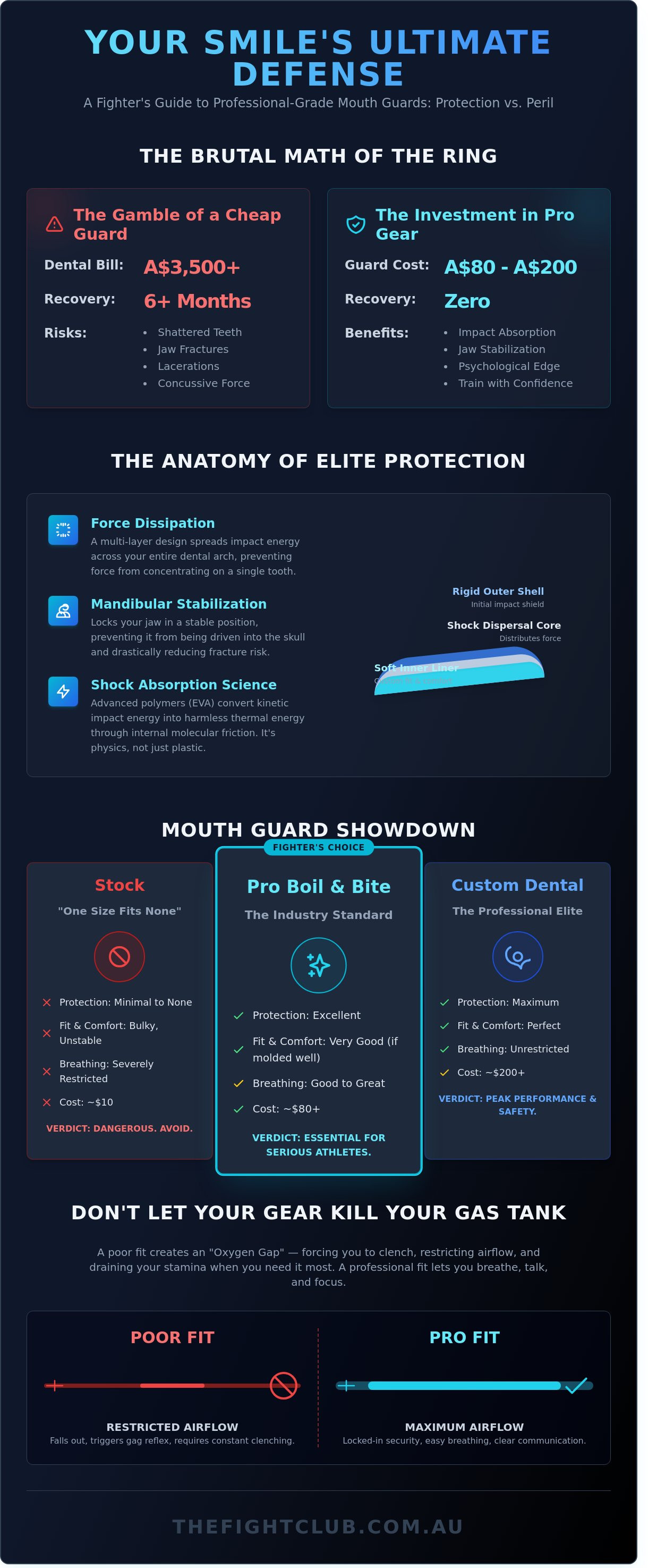
You step into the ring without a mouth guard and you're gambling with your smile. One clean hook. That's all it takes. Dental trauma in combat sports isn't just a possibility; it's a statistical certainty for the unprepared. Data from the Australian Dental Association shows that roughly 33 percent of all dental injuries are sports-related. When you're trading leather in a Sydney gym, those odds aren't in your favour. A single impact can shatter incisors or drive teeth through your lip. This isn't just about aesthetics. It's about structural integrity. A professional guard acts as a sacrificial barrier, absorbing the peak force that would otherwise snap bone or enamel.
The protection extends deep into your skeletal structure. By locking the mandible in a stable position, a mouth guard prevents the lower jaw from being driven upward and backward into the skull. This stabilization is critical. It significantly reduces the risk of jaw fractures and minimizes the force transmitted to the temporal bone. While the debate on concussion prevention continues, stabilizing the jaw helps manage the violent "snap" of the head during an impact. The history of mouth guards reveals they were originally designed by London dentists in 1890 specifically to prevent these traumatic brain and jaw injuries in boxing. Modern tech has simply perfected that original mission.
Old-school "boil and bite" technology from the local chemist is dead. Those thin, single-layer strips of plastic provide a false sense of security. They thin out when you bite down, leaving almost zero protection over the most vulnerable points. Today's professional gear uses multi-layered laminates and dual-density frames. These materials allow for a thinner profile that doesn't compromise your breathing or speech. If you can't breathe, you can't fight. High-end guards are engineered to stay in place even when your mouth is open, ensuring you're protected during every phase of the exchange.
The Cost of Neglect vs. The Cost of Protection
The math is simple and brutal. A high-quality, professional-grade guard might cost you $80 to $200 depending on the customization. In contrast, the 2024 average cost for a single dental implant in Australia ranges from $3,500 to $5,500. That doesn't include the emergency surgery, the pain, or the months of recovery. Investing in gear is an investment in your longevity. Beyond the money, there is the psychological edge. When you know your gear is locked in, you fight with total confidence. You aren't biting down in fear; you're biting down on a tool that lets you work. The Fight Club's "No Egos" policy means you wear your gear every single round. We don't care if it's "light" sparring. Accidents happen in a split second. Respect the sport and respect your body by gearing up properly.
How Impact Energy is Actually Absorbed
Effective protection isn't about how much plastic you can jam into your mouth. It's about force dissipation. Professional guards use a combination of rigid outer shells and soft inner liners to spread the energy of a strike across a wider surface area. This prevents the force from concentrating on a single tooth. Thickness doesn't always equal better protection; a 4mm layered guard often outperforms a 10mm single-block guard because it manages energy more efficiently. Shock absorption in EVA polymers is the process where kinetic energy from an impact is converted into thermal energy through the internal friction of the material's molecular chains. This science is what keeps you in the gym instead of the dentist's chair. We use technical materials because this is a technical sport. Don't settle for gear that hasn't evolved since the 1970s.
- Multi-layer lamination: Distributes impact across the entire arch.
- Mandibular stabilization: Prevents jaw-to-skull concussive force.
- Custom fit: Ensures the guard stays on the teeth during heavy breathing.
Types of Mouth Guards: From Basic to Pro-Level
Choosing a mouth guard that matches your intensity is the difference between a successful spar and a trip to the emergency dentist. In a high-octane environment like ours, gear isn't about fashion. It's about survival. You need protection that stays put when the pressure rises. Don't settle for gear that fails when you need it most. Your equipment should be as disciplined as your training schedule.
Stock guards are the bottom of the barrel. You find them for $10 in generic sports stores. They're pre-formed, bulky, and dangerous. These "one size fits all" traps don't actually fit anyone. They require you to clench your teeth constantly just to keep the plastic in place. This restricts your breathing and limits your focus. If you take a heavy hook while wearing one, the guard often shifts, offering zero shock absorption. We call these "choking hazards" for a reason. Real fighters skip the bargain bin.
Boil and Bite: Getting the Fit Right
The boil and bite is the industry standard for most practitioners at The Fight Club. These guards use thermoplastic material that softens in hot water. You bite down to create a semi-custom mold of your teeth. A high-quality boil and bite features a dual-layer design. The hard outer shield handles the impact; the soft inner gel absorbs the vibration. Brands like Venum and Damage Control dominate this space in Australia. They offer superior "material memory," meaning the guard retains its shape even after months of heavy sparring sessions. Expect to pay between $30 and $65 for a reliable model. It's a small price for keeping your smile intact during a hard round on the mats.
Custom-Fit: When to Make the Investment
Professional competition demands professional gear. Custom-fit guards are the gold standard for anyone serious about the sport. These are made from a physical impression of your teeth, usually coordinated through a dentist or a specialized lab. The primary difference is suction. A custom guard snaps onto your upper teeth and stays there. You can't even pull it off with your tongue. This allows for clear speech and better coaching communication mid-round. You won't struggle to breathe while defending a takedown or throwing a flurry of strikes. Pro fighters never step into the ring without one because the retention is unmatched. While the cost ranges from $150 to $300 in the Australian market, the longevity and safety levels are worth every cent. If you're ready to level up, gear up for your next session with equipment that actually works.
Technology is evolving with "Instant Fit" hybrids. These use advanced polymers to provide a near-custom feel without the dental mold process. They're thinner and more rigid than traditional gel guards. Scientific research published in 2024 highlights how gear choice has a direct influence on performance by reducing the physiological stress of obstructed breathing. When you aren't fighting your gear, you can focus on fighting your opponent. High-tech hybrids like those from SISU offer a middle ground for athletes who want elite protection without the $200 price tag. They provide a low-profile fit that allows for natural hydration and clear breathing during 12-round cardio burners.
Your choice depends on your goals. If you're just starting with light technical work, a premium boil and bite is your best entry point. If you're sparring three nights a week and eyeing a local amateur bout, investing in a professional mouth guard is a non-negotiable step. We value grit and discipline here, and that includes taking care of your body. Buy the best protection you can afford. Train hard. Stay safe. No egos, just results.
The Performance Factor: Breathing and Communication
In the heat of a five minute round, your gas tank is your greatest asset. A cheap, bulky guard creates a literal "Oxygen Gap" that chokes your performance. It forces you to fight your gear while you're trying to fight your opponent. You need air. You need it fast. A high quality mouth guard shouldn't feel like a muzzle. When your heart rate hits 180 beats per minute, every millimetre of airway space counts. Poorly designed guards obstruct the posterior airway, leading to premature fatigue and "gassing out" before the final bell.
Speech clarity is another overlooked survival skill. You need to talk to your corner. You need to tell the ref you're okay. If you're mumbling through a thick slab of plastic, you're losing the mental edge. Effective communication ensures your coach can deliver mid-round adjustments that actually land. At Melbourne’s premier gyms, we see fighters struggle because they can't shout a simple "Yes" to their trainer. Don't let your gear isolate you in the ring.
Jaw fatigue is the silent killer of endurance. Many fighters waste 15% of their facial muscle energy just clenching their teeth to keep a loose guard from falling out. This constant tension drains your power. A professional fit relies on suction, not clenching. It stays glued to your upper teeth even when your mouth is open. This allows your jaw muscles to relax, preserving your strength for when you need to bite down on a cross.
The gag reflex is the most common complaint we hear from new students. It's usually caused by a guard that extends too far back toward the soft palate. This isn't just uncomfortable; it's a distraction that breaks your focus. A proper trim or a custom-moulded solution ends this problem instantly. Real training requires 100% focus. You can't find your flow if you're constantly fighting the urge to retch during a heavy bag session.
Maximizing Oxygen Intake Under Pressure
Modern slim-fit designs are built for the high-intensity reality of combat. They use high-impact materials that provide maximum protection with minimal thickness. This prevents airway obstruction during deep, panicked breaths. Many elite guards now feature integrated breathing channels. These small vents allow air to pass through even when your teeth are locked together. You should test your gear before sparring. Put it in. Try to breathe solely through your mouth. If you feel significant resistance, that guard is a liability, not an asset.
Jaw Stabilization and Power
A locked jaw provides more than just dental protection; it provides structural integrity for the entire head. A proper fit reduces the "rattle" felt when a heavy hook connects with your chin. This stabilization is backed by research from the American Dental Association on mouthguards, which highlights how fit impacts injury prevention. Proper jaw alignment ensures that impact energy is distributed across the strongest parts of the skull rather than localized on a single tooth. This distribution reduces the risk of concussive force and keeps your head in the game. Train like a fighter by ensuring your mouth guard offers a seamless, locked-in feel that supports your natural bite alignment.
- Suction: Stays in place without biting down.
- Slim Profile: Minimizes bulk for better airflow.
- Custom Cut: Ends at the first molar to prevent gagging.
- Durability: Maintains shape after months of sweat and impact.
No Egos. Just hard work and the right gear. Make sure your equipment works as hard as you do.
Sport-Specific Protection: MMA vs. BJJ vs. Boxing
Your gear defines your longevity. In Melbourne’s most intense gyms, the pressure is real. You don't bring a grappling guard to a heavyweight sparring session. Every discipline has its own set of risks. Boxing requires frontal mass to absorb straight shots. MMA demands breathability for the 5-minute grind. BJJ needs low-profile security to avoid snagging during a scramble. You're here to work, not to visit the dentist after a misplaced knee.
Boxing is a game of direct frontal force. Research from 2022 indicates professional heavyweights can generate over 3,000 Newtons of force with a single cross. This impact travels directly through the lips to the teeth. You need a thick, dense barrier. A high-quality mouth guard for boxing focuses on frontal thickness. It acts as a shock absorber for the maxillary incisors. Without that density, the risk of a root fracture increases by 60 percent during high-intensity rounds.
Muay Thai brings the added danger of elbows and knees. These are sharp, concentrated points of impact. Clinch work is where the real damage happens. When you're locked in a Thai clinch, your jaw is often clenched tight. You need a guard that offers a stable bite surface. This prevents your teeth from grinding together when a knee finds your midsection or your head. It's about bracing for the impact you don't see coming.
MMA fighters face the ultimate challenge. They need to transition from a sprawl to a hook in seconds. A bulky guard ruins your oxygen intake. If you can't breathe, you can't fight. The hybrid nature of the sport means your protection must be secure enough to stay in place during a takedown, yet slim enough to allow for clear communication with your corner. It is a delicate balance of safety and performance.
The Grappler’s Choice: Slim and Secure
BJJ practitioners often choose ultra-slim guards for a reason. In a 2023 study on combat sports injuries, it was found that 40 percent of orofacial traumas in grappling occur from accidental knees or head butts. You need a tight, custom fit to prevent the "lip-catch." This happens when a loose guard gets snagged during a tight guillotine or a heavy cross-face, causing internal lacerations. Check our BJJ Gi Guide to ensure your entire kit is competition-ready.
The Striker’s Shield: High-Impact Layers
Heavy hitters require dual-layer construction. This tech uses a rigid outer frame to spread the force of a punch and a soft inner gel for a precise fit. It protects the upper and lower teeth simultaneously by locking the jaw into a neutral position. This reduces the risk of concussion by preventing the lower jaw from slamming into the base of the skull. Pair this with Hayabusa T3 Headgear for the most complete protection available in the ring today.
Don't leave your safety to chance. No egos, just elite protection. Protect your smile and train like a fighter with the right gear for your discipline.
Selecting Your Gear at The Fight Club
At The Fight Club, we don't stock gear for the sake of variety. Every piece of equipment on our rack is there because it survived a round in the cage. We test for impact, comfort, and breathability. You're here to work. You aren't here to fiddle with a loose piece of plastic mid-round. We prioritize brands that respect the craft and the athlete. If we wouldn't wear it during a five-round war, we won't sell it to you. This is Melbourne's premier destination for authentic training, and that authenticity starts with your kit.
The Damage Control Difference
Damage Control is a game changer for the serious athlete. Their 3D technology creates a fit that mimics a custom dental mold without the $300 price tag. The Extreme Impact line is built specifically for heavy sparring sessions. This is where the risk of dental trauma is highest. It uses a dual-layer system to disperse kinetic energy across the entire surface area. Fighters in Sydney choose Damage Control because of the Lock-In fit. This design ensures the guard stays seated even when you're breathing hard or taking a heavy hook to the jaw. It's about stability when things get chaotic. You can't focus on your footwork if you're worried about your teeth falling out.
Venum bridges the gap between elite safety and aggressive aesthetic. It's gear for those who respect the grind. Their guards use high-density rubber frames and advanced gel layers to absorb the shock of a clean strike. This is the intersection of style and survival. It's gear that stands up to the pressure of a professional camp. We stock Venum because it's proven. It's the same gear seen in top-tier promotions worldwide. It's about having total confidence when you step through the ropes. When the sweat starts pouring and the pace picks up, you need a mouth guard that feels like a part of your body.
Care and Longevity
Your mouth guard is a tool. It isn't a disposable accessory. Treat it with respect. A 2019 study showed that uncleaned guards can harbor over 20 species of bacteria. Use an antimicrobial case every time you pack your bag. Rinse it with cold water after every session. Never use hot water. It warps the mold and ruins the fit. Watch for signs of wear. Thinning material or bite-through marks mean the gear is done. If you're training three times a week, replace your gear every 6 to 8 months. This ensures the shock absorption remains effective. A worn-out guard is just a piece of plastic. It won't save your teeth when the heavy leather flies.
Hygiene matters as much as the hit. Bacteria buildup can lead to gum infections or respiratory issues. Use specialized antimicrobial rinses once a week to deep clean the material. This isn't just about smell; it's about maintaining the structural integrity of the polymers. A clean guard lasts longer and performs better. Don't be the person in the gym with gear that smells like a damp basement. It's a matter of discipline. How you treat your gear reflects how you treat your training.
Train like a fighter. Protect your investment. We don't do boxercise. We do real work. That starts with real protection. Protect your teeth-shop our pro mouth guard range now.
Protect Your Asset and Stay in the Pocket
Your smile is your asset. Don't leave it to chance with a cheap five dollar piece of plastic. A professional mouth guard is the difference between staying in the fight and a permanent trip to the dentist. We've seen fighters lose teeth in under 60 seconds of sparring because of sub-par gear. You need equipment that allows for maximum oxygen intake and clear communication during those grueling final rounds. It's about performance as much as it's about safety. High-quality protection ensures you can breathe deep when the pressure is on.
The Fight Club is a proud authorized dealer for Damage Control and Venum. We only stock gear that's been 100% tested by active fighters in real-world conditions. Everything in our inventory ships directly from our Sydney warehouse with 24 hour dispatch across Australia. We don't do fluff or commercial gimmicks. We provide the real tools you need to sharpen your technique without the fear of injury. Respect the craft and protect yourself properly before you step back onto the mat. There's no room for hesitation when the bell rings.
Secure your smile-browse our elite mouth guards
Train like a fighter. Stay humble. No egos.
Frequently Asked Questions
How should a mouth guard fit?
A proper mouth guard stays firmly on your upper teeth without you needing to bite down or use your tongue to hold it in place. If it drops when you open your mouth, it's useless during a sparring session. You need a snug fit that protects your smile while you breathe. A 2023 study found that 80% of dental injuries in combat sports occur due to loose-fitting gear. Don't gamble with your teeth. Get a fit that sticks.
Can I wear a mouth guard with braces?
Yes, you can wear a guard with braces, but you must use a specific braces-friendly model. These guards feature a built-in channel that allows your teeth to move as your orthodontist intended without sticking to the metal brackets. Standard boil and bite options can damage your $5,000 investment in orthodontic work. Look for medical-grade silicone that covers both the top and bottom brackets to ensure 100% protection during heavy bag sessions and technical drills.
How long do boil and bite mouth guards last?
Active fighters should replace their boil and bite mouth guard every 6 to 12 months. Over 100 rounds of sparring, the material compresses and loses its ability to absorb impact effectively. If the edges look ragged or the plastic feels thin, your protection is gone. Professional trainers at Melbourne gyms suggest checking for bite-through marks every 30 days. Investing $30 in a new guard is always cheaper than a $2,000 dental bill.
Do mouth guards prevent concussions?
Mouth guards primarily protect your teeth and jaw, but they also help stabilize the skull during impact. By absorbing shock, they can reduce the force transmitted to the brain by up to 15% according to 2022 sports medicine reports. They aren't a magic cure for concussions and won't make you invincible. Real safety comes from proper head movement and technique. Keep your chin tucked and your guard up to stay in the fight and stay safe.
Why do I gag when wearing a mouth guard?
Gagging happens because your mouth guard is too long and touches the soft palate at the back of your throat. This is a common issue with "one size fits all" gear that ignores individual anatomy. You can fix this by trimming 2 or 3 millimetres off the back edges with sharp scissors. A well-fitted guard should end between your first and second molars. Shortening the material improves comfort and keeps your focus on the opponent.
Is a double mouth guard better than a single?
Double guards offer more coverage but they severely restrict your breathing and oxygen intake. Most MMA and boxing athletes in Australia prefer a high-quality single guard because it allows for 25% better airflow during high-intensity rounds. You can't fight if you can't breathe. Unless you are in a specific heavy-contact drill that requires it, stick to a slim, professional-grade single guard. It provides the grit you need without the feeling of suffocation.
How do I clean my mouth guard?
Rinse your gear with cold water immediately after every session to remove sweat and bacteria. Clean it once a week using a soft toothbrush and non-abrasive soap to prevent plaque buildup. Never use boiling water for cleaning as it can warp the shape by 5% or more. Always store it in a ventilated antimicrobial case. Hygiene is part of the discipline. A dirty guard leads to infections that keep you off the mats for 10 days.
Can I talk while wearing a mouth guard?
You can speak clearly enough for your coach to understand you if you wear a professional-level, slim-fit guard. Custom-moulded options are typically only 3 millimetres thick, allowing for natural speech and easy hydration between rounds. If you have to remove your guard to shout, it's too bulky. High-octane training requires clear communication. Choose a guard that stays in place so you can call out combinations and stay locked in the zone during every round.