

How to Pack a Martial Arts Gym Bag: The Fighter’s Essential Guide
You’ve just finished a ten-hour shift and finally made it to the gym. Your heart is racing, the adrenaline is pumping, and you're ready to trade leather. Then you reach into your kit and realize your mouth guard is still sitting on the kitchen bench. The session is over before it even started. It's a gut-wrenching moment every Aussie fighter has faced, but it's entirely avoidable. A disorganized bag is more than a mess. It's a liability that kills your momentum and rots your gear from the inside out.
Mastering how to pack a martial arts gym bag is about discipline, not just storage. We’re going to show you how to build a streamlined routine that keeps you ready for the ring at a moment's notice. You'll learn how to protect the longevity of premium gear like your Hayabusa T3 gloves and maintain a professional, ego-free presence in the gym. This guide breaks down the essential kit list, critical hygiene hacks to kill the "gym stank," and the specific organizational zones used by elite practitioners to keep their focus where it belongs: on the fight.
Key Takeaways
- Stop scrambling. Treat your bag as your first line of defence to ensure you never miss a round due to forgotten kit.
- Speed is life. Learn how to pack a martial arts gym bag using the "Last In, First Out" method for maximum efficiency at the mats.
- Kill the stank. Use the "Wet/Dry" strategy to protect premium gear and maintain a professional, ego-free presence in the training hall.
- Gear up right. Identify the essential "hard gear" requirements for strikers and grapplers to ensure you’re always fight-ready.
- Choose your armour. Find the perfect balance of ventilation and durability by selecting the right bag for your specific discipline and commute.
Stop Scrambling: Why Your Gym Bag is Your First Line of Defence
The bell hasn't rung yet. You aren't even on the mats. But the training session has already started. Most amateurs treat their kit like an afterthought. They throw damp wraps and loose gloves into a dark void and wonder why they're always scrambling. Professional fighters know better. Your bag is your mobile locker; it is your base of operations. If it's a mess, your mind is a mess. You cannot find focus in chaos.
Mastering how to pack a martial arts gym bag is about mental preparation. When every piece of gear has a dedicated home, you eliminate the friction of getting ready. You arrive at the gym calm, focused, and ready to work. You aren't digging through a pile of laundry for your cup. You're already warming up. This discipline separates the hobbyists from the serious practitioners. It builds a ritual of readiness that carries over into your sparring and drilling—whether you are training for the ring or choose to explore Krav Maga classes for practical self-defense. Speed is life. Preparation is survival.
The Cost of Forgetting Gear
Forget your mouth guard? You’re out. No coach worth their salt in an Australian gym will let you spar without essential protective equipment. That’s a wasted night. You’re relegated to the heavy bag while your partners get the rounds that actually count. You lose the chance to test your skills, and you let your team down by being one less body for the rotation. It is a sign of disrespect to your coach and your partners.
It’s not just about the rounds you miss. Forgetting hand wraps is a fast track to a "boxer's fracture" or a chronic wrist strain. These injuries don't just hurt; they sideline you for months. The "walk of shame" back to your car because you forgot your shinguards ruins your psychological edge. You've already lost the battle before you stepped through the door. Stay in the fight by being prepared before you leave the house. Check your kit. Then check it again.
Gear Longevity Starts in the Bag
Combat gear is an investment. High-end equipment like Hayabusa T3 Boxing Gloves is built to last, but even the best gear fails if you treat it like rubbish. Shoving gloves into the bottom of a bag under heavy shinguards crushes the internal foam. Over time, that padding deforms. It stops protecting your knuckles and starts becoming a hazard to your training partners. Once that foam is compromised, the glove is dead.
Moisture is the silent killer. Leaving wet gear in a sealed bag creates a breeding ground for bacteria and mold. It rots the stitching on your Venum Elite BJJ Gi and cracks the leather on your headgear. Proper packing ensures ventilation. It keeps your gear dry and your investment secure. Respect the tools of your trade. They will protect you when the pressure is on. A clean, organized bag isn't just about vanity. It's about ensuring your armour is ready for the next war.
The Combat Essentials: Hard Gear You Can't Leave Behind
Your gear is your armour. It's the difference between a productive session and a trip to the physio. Amateur gear fails when the heat rises. Professional-grade equipment like Venum Elite Boxing Gloves or Hayabusa T3 gear is built for the daily grind. Knowing how to pack a martial arts gym bag starts with the "Big Three": protection, apparel, and hydration. If you're missing one, you aren't ready for the cage. Don't cut corners on the tools that keep you in the fight. Invest in quality once, and it will protect you for years.
Striking Essentials: Boxing and Muay Thai
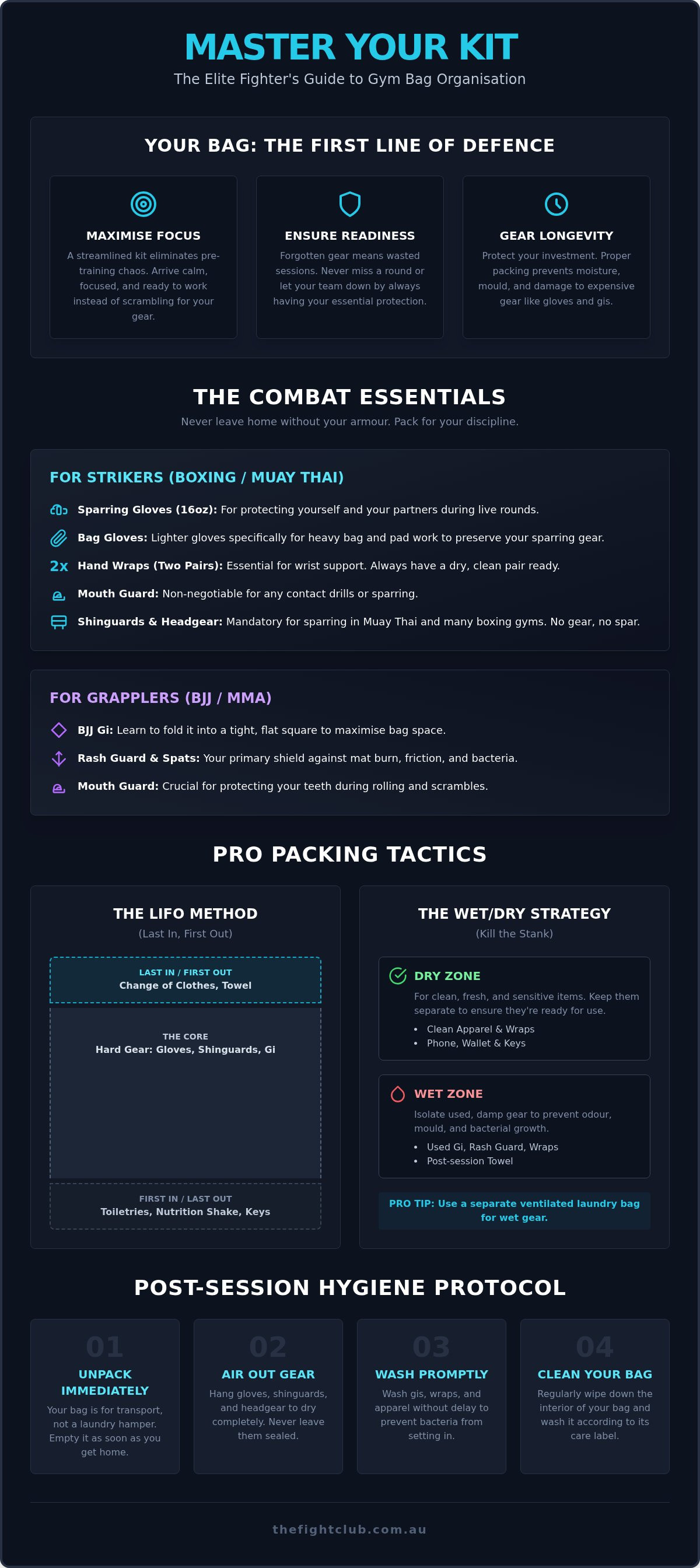
Strikers need specific tools for different drills. Don't be the person with one pair of crusty gloves for everything. You need 16oz gloves for sparring to protect your partners and your own hands. Use separate, lighter bag gloves for pad work and heavy bag drills. This preserves the soft sparring foam for when it actually matters. Always carry at least two pairs of hand wraps. Never train with wet wraps from yesterday's session. It's a fast track to skin irritation and a foul-smelling bag. If you’re heading into boxing gloves sessions, shinguards and headgear are mandatory. No gear, no sparring. It's that simple.
Grappling Essentials: BJJ and MMA
Grappling gear is bulky and difficult to manage. Space is your enemy here. Learn to fold your BJJ Gi into a tight, flat square to maximise room in your bag. Pack high-compression rash guards and spats. These aren't just for looking the part. They are your primary shield against mat burn and friction injuries. Quality fabrics from brands like Venum or Hayabusa wick sweat and stay in place during a heavy scramble. A good rash guard is a critical barrier between you and the grime of the mats.
Personal Protection and Hygiene
Your mouth guard is the most vital investment in your bag. Whether it's a basic model or a custom Damage Control Mouth Guard, it must be in your kit every single day. Always store it in a ventilated case. A sealed plastic box is a breeding ground for bacteria. Groin guards are also non-negotiable for live sparring. One stray knee can sideline you for weeks. Hygiene isn't just about smell; it's about preventing skin infections like staph or MRSA. Keep your kit dry. Keep your skin clean. If you need to refresh your "hard gear," explore the professional combat range at The Fight Club. Shop once, buy right, and stay on the mats.
The Post-Session Protocol: Managing Sweat, Odour, and Hygiene
The final bell has rung. You’re drained, drenched in sweat, and ready to collapse. But the most critical part of how to pack a martial arts gym bag happens right now. Combat sports are gritty. Sweat, blood, and skin cells are part of the game. If you treat your bag like a bin, it becomes a biohazard. Bacteria like staph and ringworm thrive in dark, damp environments. You owe it to your teammates and yourself to maintain high hygiene standards. A professional fighter is as disciplined with their laundry as they are with their footwork. Chaos in the bag leads to infection on the mats.
Implement a strict "Wet/Dry" strategy. Never let your clean post-training clothes touch your used wraps or Hayabusa Rash Guards. Use anti-fungal soaps immediately after the session to protect your skin from common gym-borne pathogens. The absolute rule is simple: never leave your bag zipped overnight. As soon as you hit the front door, dump the contents. Everything comes out. Everything gets air. If it stays in the bag, it rots. It is that simple. Respect your gear, and it will last through years of hard rounds.
The Wet Bag System
Your sweat-soaked gear needs total isolation. Use dedicated dry bags or separate waterproof compartments for your used kit. Never put a wet Venum Elite BJJ Gi directly back into the main compartment. The moisture will seep into the padding of your gloves and the fabric lining of the bag. This is where the infamous "gym stank" starts. It is the smell of neglect. Toss in some charcoal deodorisers to neutralise odour while you're commuting home. It’s about containment and control. A professional doesn't let their gear become a nuisance to others.
Disinfecting Your Hard Gear
Your "hard gear" requires a different level of care than your laundry. Wipe down your gloves and shin guards with disinfectant wipes after every single session. Salt from sweat is corrosive. It destroys leather and synthetic materials over time, leading to cracks and structural failure. Once wiped, air-dry your gear in a cool, shaded area. Direct Australian sun will crack the material, while a dark cupboard will grow mould. Finally, take care of your mouth guard. Rinse it with cold water and clean it with non-abrasive soap. Let it dry completely before sealing the case. Bacteria build-up on a mouth guard is a fast track to oral infections and bad breath. Stay clean. Stay in the fight.
Organisation Tactics: Packing for Speed and Efficiency
Efficiency isn't a luxury. It's respect. When the coach calls for shinguards, you have thirty seconds to be ready. Don't be the guy digging through a mountain of dirty laundry while the rest of the class is waiting. Learning how to pack a martial arts gym bag requires a tactical approach. Use the "Last In, First Out" (LIFO) principle. Gear you need first, like your hand wraps and mouth guard, must be on top or in external pockets. Heavy gear stays at the bottom. This keeps the session moving and shows you're here to work, not to faff around with zippers.
The Bottom-Up Build
Build from the base. Heavy, rigid items like shin guards go in first. They create a structural foundation for the rest of your kit. Place them flat or along the side walls of the bag. Use your Gi or a large towel as a protective buffer. Wrap your gloves inside your Gi to prevent the padding from deforming under the weight of other gear. For any high-capacity mma fight store bag, rolling is the gold standard. It saves significantly more space than folding. It also prevents deep creases from weakening the fabric of your BJJ Gi. Fill the gaps with rolled rash guards and shorts. Every centimetre counts when you're hauling a full kit.
Quick-Access Pockets
External pockets are your frontline. Keep your mouth guard in a mesh side pocket. It’s easy to grab and gets the ventilation it needs to stay hygienic. Hand wraps live here too. Don't bury them at the bottom. Every serious fighter also carries an "Emergency Kit" in a small internal zip. Include these essentials for every session:
- Athletic tape: Essential for protecting wrists and supporting fingers during grappling.
- Small scissors: To trim loose threads or cut tape quickly without using your teeth.
- Basic painkillers: For managing minor inflammation after a heavy sparring session.
- Nail clippers: Because long nails are a hazard to your partners on the mats.
Keep your hydration separate from your equipment. Store water bottles in upright external sleeves. A single leak can destroy expensive leather gloves in hours. Keep your phone, keys, and gym ID in a dedicated valuables pocket away from your sweat-soaked gear. Ready to streamline your routine? Grab a dedicated fighter’s bag from The Fight Club and stay battle-ready from the moment you step through the door.
Choosing Your Armour: Finding the Right Martial Arts Bag
A standard gym bag is a ticking time bomb. It isn't built for the abrasive Velcro of your wraps or the sheer weight of two pairs of 16oz gloves. If you want to master how to pack a martial arts gym bag, you need a vessel designed for the grind. Backpacks are the weapon of choice for the urban commuter. They keep your hands free on the Melbourne tram or the Sydney train. Duffle bags, however, are the king of volume. They are essential for those heavy days when you’re hauling shinguards, headgear, and a change of clothes. Choose your armour based on your discipline and your commute. Don't settle for a bag that fails when the pressure is on.
This choice is about substance over flash. A flashy bag won't bridge the gap in your skill, but a durable one ensures your gear stays intact. Look for technical fabrics that resist water and handle the Aussie humidity without becoming a petri dish. Dedicated fight bags offer specialized compartments that generic bags lack. They provide the structure required to keep your kit organized and your mind focused. Stop fighting your bag and start focusing on the round ahead.
Key Features to Look For
Ventilation is non-negotiable. Look for bags with integrated mesh panels. These allow airflow to reach your damp gear, slowing the growth of bacteria and preventing the "gym stank" from setting in permanently. High-capacity training requires reinforced stitching and heavy-duty zippers. Cheap hardware will pop the moment you try to force a thick Gi into a tight space. Finally, prioritize dedicated glove or shoe compartments. Keeping your dirty outdoor shoes away from your clean rash guards is a basic requirement for a sanitary, ego-free training environment.
Top Picks from The Fight Club
We stock gear that survives the trenches. For durability and technical design, Venum Australia gear bags are the industry standard. They feature the ventilation and compartmentalization needed for serious strikers and grapplers alike. If you are prepping for heavy punching bag sessions at home or hauling extra kit for a double-class night, an oversized duffle is your best bet. It provides the literal room to move. Gear up with the best at The Fight Club Australia and ensure your kit is as ready as your mindset.
The Final Pre-Flight Checklist:
- Mouth guard in its ventilated case?
- Two pairs of clean hand wraps?
- Full water bottle and post-training snack?
- Clean towel and anti-fungal soap?
- Nails trimmed and emergency tape packed?
Run the list. Pack the bag. Hit the mats. No excuses.
After you've put in the work, there’s nothing like decompressing with your teammates. If you’re in Sydney, Club9 provides a great environment to relax and catch the latest sports after a heavy training day.
Stay Ready for the Bell
Packing isn't just about storage; it's about mindset. You've mastered how to pack a martial arts gym bag with the precision required for the elite level. This means isolating sweat to prevent infections, using the LIFO principle for transition speed, and investing in armour that survives the daily grind. Discipline on the mats starts in the locker room. If your kit is a mess, your performance will follow. Respect your gear, respect your teammates, and respect the process. Authenticity isn't just about how you strike. It's about how you prepare.
Ready to upgrade your carry? Gear up for the grind at The Fight Club. We are an Australian owned and operated fight store stocking only premium brands like Hayabusa, Venum, and UFC. Get free Australian shipping on orders over $180, excluding bulky or heavy items. The mats are waiting. Pack your bag. Show up. Do the work.
Frequently Asked Questions
How do I stop my martial arts bag from smelling?
Stop the rot by unloading your bag the second you get home. Airflow is the only cure for "gym stank." Use charcoal deodorizer bags to absorb moisture and neutralise odours during your commute. Never let sweat-soaked wraps or rash guards sit in a zipped bag overnight. This is where bacteria thrive. Wipe down the interior of your bag with disinfectant once a week to maintain a professional, ego-free training environment.
Can I wash my boxing gloves in the washing machine?
Never put your boxing gloves in a washing machine. The saturation destroys the internal foam padding and cracks the leather or synthetic exterior. Instead, wipe the outside with a damp cloth and use specialized glove dogs or deodorizers to absorb internal moisture. For premium gear like Hayabusa T3 gloves, proper maintenance is essential for longevity. If they get soaked, air-dry them in a cool, shaded spot away from direct Australian sunlight.
What size gym bag do I need for BJJ?
You need a bag with a capacity of at least 40 to 60 litres for BJJ. A standard Gi is bulky and takes up significant volume even when folded tightly. You also need space for your belt, rash guards, and a towel. Look for bags with dedicated wet compartments to keep your clean clothes away from your sweat-drenched Gi after a heavy rolling session. A high-capacity duffle is usually the best choice for grapplers.
How many pairs of hand wraps should I have in my bag?
Keep at least two pairs of hand wraps in your kit at all times. Training with damp wraps from a previous session is a fast track to skin infections and "boxing glove rot." Having a fresh backup ensures you’re always ready if a session runs long or if you forget to wash a pair. It’s a small investment that protects your hands and keeps your gear sanitary. Always roll them after drying to save space.
Is a backpack or a duffle bag better for MMA?
A duffle bag is generally better for MMA due to the sheer volume of gear required. Between 16oz gloves, MMA sparring gloves, shinguards, and headgear, you need maximum internal space. However, if you commute via public transport, a specialized combat backpack with external attachment points for your shinguards might be more practical. The right choice depends on your transport and how much "hard gear" you carry daily. Discipline in how to pack a martial arts gym bag starts with choosing the right vessel.
What should I keep in my martial arts first aid kit?
Your kit must include athletic tape, nail clippers, antiseptic wipes, and fabric band-aids. Long nails are a hazard on the mats, and minor cuts need immediate cleaning to prevent infection. Keep a small stash of electrolyte tablets to manage dehydration after intense rounds. This isn't about being soft; it's about staying on the mats. A well-stocked kit ensures minor issues don't turn into sidelined time or missed training sessions.
How do I fold a BJJ Gi to save space in my bag?
Use the "Gi Roll" or the flat-fold method to maximise space. Lay the jacket flat, fold the sleeves across the chest, and place the folded trousers in the centre. Roll the entire unit into a tight cylinder. This method keeps your Gi compact and prevents it from becoming a tangled mess at the bottom of your bag. Mastering how to pack a martial arts gym bag efficiently starts with perfecting this basic grappling ritual.
Should I leave my gear in the car between sessions?
Never leave your gear in a hot car, especially in the Australian summer. Extreme heat deforms the foam in your gloves and accelerates the growth of bacteria in damp fabrics. It also causes leather to crack and adhesives to fail. Your bag will develop a permanent odour that is nearly impossible to remove. Take your kit inside, dump it out, and let it breathe. Discipline doesn't end when you leave the gym.