

How to Prevent Cauliflower Ear in BJJ: The Ultimate Fighter’s Guide
Did you know there is a 77% recurrence rate for cauliflower ear if you fail to get specialist medical care? While some people are reportedly paying $80 to have their ears cosmetically damaged for a "tough" look, a real grappler knows the throbbing pain of a heavy session is a serious injury. Learning how to prevent cauliflower ear BJJ athletes experience is about more than just vanity; it is about preserving your hearing and staying on the mats. You have felt that burning sensation after escaping a deep guillotine. It is a distraction you don't need.
We understand that you want to roll hard without sacrificing your professional appearance or dealing with clunky gear that slips. This guide delivers the tactical steps to protect your cartilage while maintaining your performance. You will learn the technical adjustments to minimise ear friction, discover headgear that actually stays in place, and understand the vital medical protocols to follow when things get rough. Protect your health and keep your focus on the technique. Let’s get to work.
Key Takeaways
- Understand the biological mechanics of a perichondral haematoma and why friction is the primary threat to your ears during a roll.
- Discover technical head positioning tactics to learn how to prevent cauliflower ear BJJ athletes often develop during high-intensity scrambles.
- Evaluate the essential differences between soft guards and hard-shell wrestling armour to find the right tactical headgear for your training style.
- Master the "Golden Hour" response to ear trauma, using immediate icing and medical protocols to stop permanent damage before it hardens.
- Shift your mindset to an ego-free approach where protecting your health is viewed as a vital component of long-term fighter longevity.
The Reality of the Grind: What is Cauliflower Ear?
You step off the mats. Your ear is throbbing. It feels like a hot coal pressed against your skull. This is the start of a perichondral haematoma, the clinical name for Cauliflower Ear. It isn't a badge of honour. While some people in 2026 are reportedly paying $80 to have their ears cosmetically damaged for a "tough" look, a real grappler knows better. In a professional, ego-free environment, a mangled ear is a sign of poor maintenance and a lack of technical discipline. It shows you aren't prioritising your longevity in the sport.
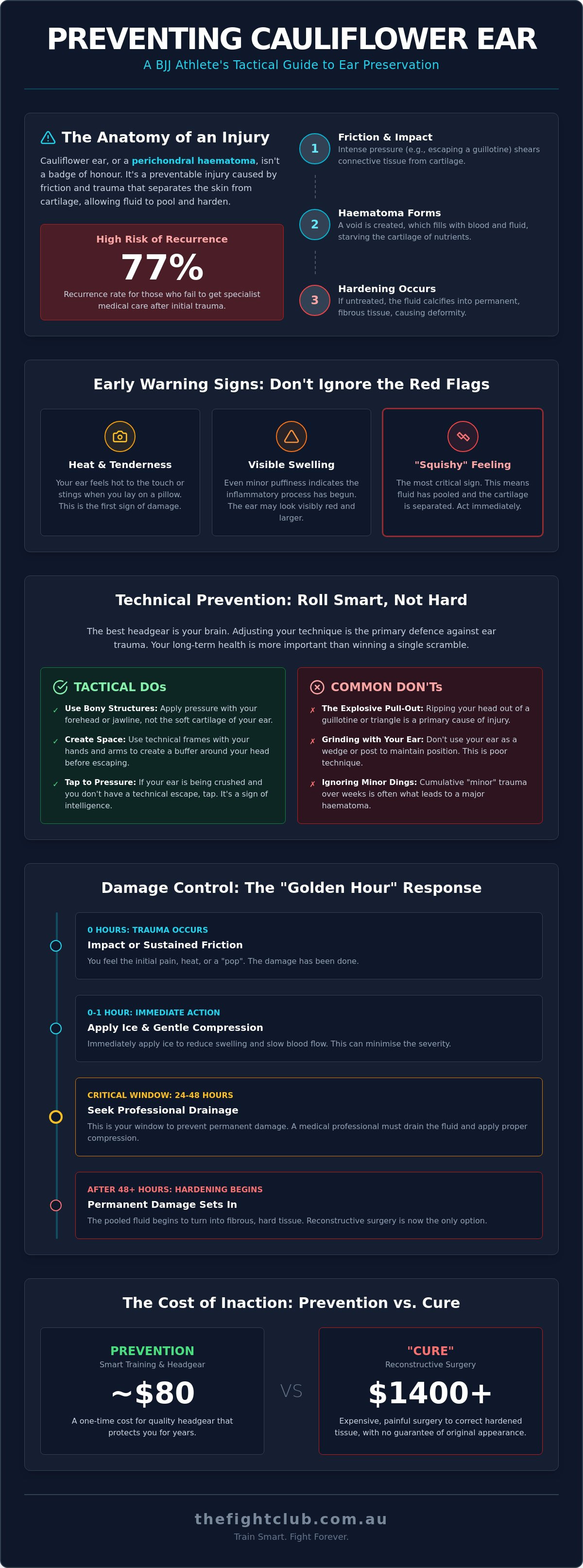
When you take a heavy cross-face or rip your head out of a tight triangle, the friction is intense. This mechanical force shears the perichondrium, the layer of connective tissue, away from the underlying cartilage. This separation creates a void where blood and fluid pool. Because cartilage has no internal blood supply, it relies on that perichondrium for nutrients. Once they are separated, the cartilage begins to starve and die. If you don't act fast, that liquid turns into fibrous tissue and eventually hardens into permanent, lumpy bone. Once it sets, your only option is expensive reconstructive surgery that can cost upwards of $1400.
Learning how to prevent cauliflower ear BJJ athletes face is about more than just vanity; it is about protecting your hearing. Understanding this biological process is the first step in learning how to prevent cauliflower ear BJJ practitioners often suffer from. It is about technical awareness as much as it is about gear.
Why BJJ is the Perfect Storm for Ear Trauma
The mats are a grinder. You are constantly moving through tight spaces where your head is a lever. Escaping a deep guillotine or a locked-in triangle involves massive force directly against the ear. Then there is the pressure. Heavy top control and grinding head-on-head wrestling during a shot entry create the perfect conditions for a haematoma. It isn't always one big hit that does it. Often, it is the cumulative effect of "minor" dings over months of hard training that finally causes the skin to give way.
Recognising the Early Warning Signs
Don't ignore the red flags. Heat and tenderness are your first indicators. If your ear feels hot to the touch or stings when you lay your head on a pillow after training, the damage has started. The real danger is the "squishy" feeling. This means fluid has already pooled under the skin and the separation is complete. With a 77% recurrence rate for those without specialist medical care, DIY drainage is a gamble you will likely lose. You must seek professional drainage and medical compression within a 24 to 48 hour window to stop the hardening process.
Technical Tactics: How to Roll Without Ruining Your Ears
Ear protection starts with your brain, not just your gear. We call this Technical Ear Preservation. It is a specific skill set designed to keep your cartilage intact while you work for the tap. Most grapplers think cauliflower ear is an inevitable tax paid to the mats. It isn't. If you are constantly using your ear as a wedge to maintain top control, you are failing the technical test. Stop grinding your head into your partner’s hip bone. Use your forehead. Use your jawline. Shift the pressure to bony structures that don't swell. This mindset shift is the foundation of how to prevent cauliflower ear BJJ athletes need to master for long-term health.
The "explosive pull-out" is the fastest way to ruin a healthy ear. When you get caught in a tight front headlock or a guillotine, your instinct is to rip your head back. Don't do it. That friction is a cheese grater for your perichondrium. Instead of panic, use technical frames to create space. If you don't have the technical answer yet, tap. In a humble, ego-free gym, tapping to ear pressure is respected. It means you value your longevity over a single training round. If you are looking to upgrade your training kit, consider a high-performance Venum Elite BJJ Gi to ensure your movement remains fluid and unrestricted.
Safe Escapes from Head-Centric Submissions
Escaping a triangle requires more than just posture. You must clear the arm across your face before you posture up. If you pull while the arm is still trapping your ear, you are asking for a haematoma. Use your hands to create a pocket of space around your ears during guillotine escapes. Focus on the jaw-line. If you can tuck your chin and create a frame with your hands, you reduce the direct friction on the cartilage. This tactical awareness is the most effective way to learn how to prevent cauliflower ear BJJ practitioners deal with daily. Even with perfect technique, accidents happen. If you feel that familiar squish, you need to seek medical treatment for cauliflower ear immediately to prevent permanent hardening.
Mat Culture and Ego-Free Rolling
Longevity in combat sports is built on communication. If your ears are tender from a previous session, tell your partner before the timer starts. A good partner will respect the "no head-grinding" rule for that round. "Toughing it out" through a neck crank or a brutal cross-face doesn't make you a lion; it makes you an injured athlete. Protect yourself at all times. This includes making smart choices about your equipment. While you focus on head position, ensure the rest of your gear is up to standard by reading our BJJ Gi Guide 2026: Choose Your Armor for the Mats. Stay technical. Stay humble. Keep your ears normal.
Armour for the Mats: Choosing the Right BJJ Headgear
Headgear isn't an optional accessory for the cautious; it's tactical armour for the dedicated. If you've already committed to technical head positioning, professional-grade gear is your second line of defence. When you are researching how to prevent cauliflower ear BJJ sessions can inflict, you will find that the right equipment allows you to roll with 100% intensity without the constant fear of a haematoma. Don't settle for cheap, generic guards that slip over your eyes the moment the pace quickens. You need gear that stays locked in place through every scramble and bridge.
There is a massive difference between standard wrestling headgear and BJJ-specific guards. Traditional wrestling gear often features hard plastic shells. While these offer great protection for you, they act like a cheese-grater on your training partners' faces during a heavy cross-face. In an ego-free, community-focused gym, you want soft-shell protection. Look for a low profile that doesn't provide your opponent with extra leverage during a front headlock. Secure strapping and skin-friendly, moisture-wicking materials are non-negotiable for anyone serious about their mat time.
Top-Tier Recommendations for BJJ
The Hayabusa T3 Headgear represents the pinnacle of combat sports protection. While the T3 line is legendary in the striking world, the same commitment to shock absorption and secure fit applies to ear preservation. Professional brands like Venum also offer sleek, high-performance ear guards designed specifically for the unique angles of Jiu Jitsu. These brands prioritise anti-microbial properties and advanced ventilation. This ensures you aren't just protecting your cartilage, but also maintaining skin health under the constant heat of the training hall.
Maintenance and Hygiene for Ear Guards
Don't be the person with the stinking gear. Ear guards are a prime breeding ground for "mat funk" and bacterial infections if they aren't cleaned after every single session. Wipe them down with a disinfectant or wash them according to the manufacturer's instructions to keep them fresh. Achieving a "set-and-forget" fit is essential. Spend time adjusting the straps before you step on the mat so you aren't fiddling with your gear mid-round. While you are securing your ears, don't forget the rest of your face. Pair your headgear with high-quality Mouth Guards for Combat Sports: Protect Your Smile to ensure complete protection from the grind. Stay protected. Stay in the fight.
Damage Control: Immediate Action for Swollen Ears
You failed to maintain head position. Your headgear was left in your gym bag. Now, your ear is a throbbing, squishy mess. You have entered the "Golden Hour" of ear trauma. In this window, every decision you make determines whether you keep your natural look or end up with a permanent deformity. This isn't about being tough. It is about being professional. Speed is your only ally when you need to know how to prevent cauliflower ear BJJ injuries from becoming permanent fixtures on your head. This is the moment where discipline replaces adrenaline.
Step one is immediate icing. Get an ice pack on that ear for 15 minutes at a time. This causes vasoconstriction, slowing the internal bleeding into the space between your skin and cartilage. Step two is compression. This is the most overlooked part of the recovery process. If you don't apply constant pressure, the void will simply refill with fluid as soon as you stand up. You need to keep the skin pressed against the cartilage so they can re-bond. Finally, seek professional aspiration. A GP or sports doctor should perform the drainage in a sterile environment. Once the fluid is out, you must take mandatory time off the mats. If you return to rolling before the skin has re-attached, the friction will tear it right back off, forcing you to start the process from zero.
The Dangers of the DIY Approach
Don't be a YouTube doctor. Draining your own ear with a needle in a gym bathroom is a recipe for disaster. You risk cellulitis and severe infections that can lead to hospitalisation. Draining the fluid is only half the battle. Without professional-grade compression and sterile conditions, you are just inviting the haematoma to return. Most grapplers who try the DIY route find the swelling returns within hours because they failed to manage the underlying pressure. Protect your health by choosing high-quality gear from the start; shop authentic combat sports equipment to avoid these injuries in the first place.
Compression Tactics That Actually Work
Post-drainage, you need constant pressure. Specialised magnets or clips are the gold standard here. They provide consistent, even force across the affected area without cutting off circulation. A common "mat hack" for sleeping is wearing a tight swimmer's cap. This prevents you from knocking the magnets off or aggravating the ear while you toss and turn during the night. You aren't cleared to return to light drilling until the tenderness is gone and the skin feels firmly attached. Jumping back into a live roll too early is a move driven by ego, not intelligence. Respect the healing process. Your ears will thank you for the discipline. This technical approach is the final piece in the puzzle of how to prevent cauliflower ear BJJ practitioners must solve to stay in the game.
The Fight Club Mentality: Consistency Over Ego
Longevity on the mats isn't about one explosive round or a single tournament win. It is about showing up year after year, decade after decade. To achieve that, you must protect your tools. Your ears are a vital part of your equipment. Embracing an ego-free approach means you realise that how to prevent cauliflower ear BJJ practitioners prioritise is a tactical choice, not a sign of weakness. In a professional training environment, we value the athlete who rolls smart and stays healthy over the one who seeks out avoidable damage. Mangled ears aren't a requirement for greatness; they are often the result of neglecting technical discipline.
True discipline is shown in your preparation before the timer even starts. You wouldn't spar with torn gloves or a cracked cup; don't roll with compromised ears. Protecting yourself is a sign of respect for your training partners and the art itself. It ensures that when you finally reach the rank of black belt, you do so with your health and your hearing intact. This mindset separates the hobbyist from the true practitioner. By prioritising your physical maintenance, you ensure that your focus remains on the technique rather than the throbbing pain of a fresh haematoma. Stay focused on the long game.
Building a Professional Training Kit
Cutting corners on your equipment is a false economy that will eventually catch up with you. Cheap, poorly designed gear often leads to higher medical bills, expensive reconstructive surgeries, and weeks of missed mat time. Sourcing from a professional combat gear guide is the first step in finding equipment that actually performs under pressure. Investing in high-grade, professional armour is a non-negotiable requirement for the 2026 athlete who demands elite performance without the permanent scars of poor maintenance. High-quality gear doesn't just protect you; it protects the culture of the gym by ensuring everyone can train hard and return the next day.
Commitment to the Craft
The journey from white belt to black belt is a marathon of perseverance and humility. Every session counts. Every technical adjustment matters. By mastering the tactics of how to prevent cauliflower ear BJJ can inflict, you are proving your commitment to the craft. You are choosing substance over flash. You are choosing the grind over the superficial vanity of "war scars." Respect the process and the people you share the mats with. When you value your health, you value your future in the sport. Protect your ears. Respect the mats. Stay in the game. Gear up with professional protection at The Fight Club and keep your focus where it belongs: on the roll.
Stay Sharp and Stay on the Mats
Protecting your health is a technical skill. It requires discipline. You've learned that mastering how to prevent cauliflower ear BJJ injuries starts with superior head positioning. It ends with professional-grade armour. Don't let an avoidable haematoma sideline your progress. Avoid the surgeon's office. You now possess the tactical blueprint to roll with 100% intensity. Keep your ears healthy. Keep your focus sharp. This is about longevity. It is about consistency. Respect the journey.
Elite performance requires the right foundation. We are an Australian owned and operated destination for authentic combat gear. We understand the grit needed to succeed. Upgrade your protection with professional-grade gear at The Fight Club and access premium brands like Hayabusa and Venum. We deliver fast national shipping for fighters who refuse to slow down. Get the protection you deserve. Focus on the tap. Forget the trauma.
Respect the grind. Respect your body. Stay technical. Stay humble. Push your limits with total confidence. The mats are waiting. We'll see you in the training hall.
Frequently Asked Questions
Is cauliflower ear permanent if I don't drain it?
Yes. If you don't drain the fluid within 48 to 72 hours, it begins to harden into solid, fibrous tissue. This results in a permanent deformity that can only be reversed through reconstructive surgery. Acting fast during the "Golden Hour" is the only way to keep your ears looking normal. Don't ignore the swelling; it won't disappear on its own.
Does wearing headgear in BJJ make you look like a beginner?
No. Professional grapplers prioritise their longevity over looking "tough." Wearing headgear shows you have the discipline to protect your health and stay on the mats for the long term. It is a technical choice that savvy practitioners respect. Understanding how to prevent cauliflower ear BJJ is part of being a smart, ego-free athlete who values substance over superficial appearances.
Can I still train BJJ if my ear is currently swollen?
No. Training with a haematoma is a massive risk. Any further friction or pressure will prevent the skin from re-attaching to the cartilage, making the deformity permanent. You need to stay off the mats until the swelling is gone and the area is no longer tender. Use this time to study film and focus on your recovery so you can return stronger.
How much does it cost to get cauliflower ear professionally drained?
Medical fees for professional aspiration vary by clinic and location. You will typically pay for a standard consultation plus the procedure cost. It is a small investment compared to the price of reconstructive otoplasty, which can cost upwards of $1400 once the cartilage has hardened. Consult your local GP or a sports medicine specialist to get an accurate quote for your area.
What is the best type of headgear for BJJ specifically?
The best choice for BJJ is low-profile, soft-shell headgear. Hard plastic wrestling guards can be abrasive and "cheese-grate" your training partners during close-quarter work. Look for guards with secure, adjustable straps and moisture-wicking materials. Brands like Hayabusa and Venum design equipment that stays locked in place during intense scrambles without sacrificing your partner's comfort or your own mobility.
How do I clean my BJJ headgear to prevent infections?
Hygiene is critical to avoid skin infections like cellulitis. Wipe your headgear down with disinfectant wipes immediately after every session. For a deeper clean, wash it with mild soap and warm water, then let it air dry completely in a well-ventilated area. Never leave sweaty gear in your bag. Proper maintenance ensures your equipment stays fresh and your skin stays healthy.
Can I get cauliflower ear from just one session?
Yes. A single high-friction event, like ripping your head out of a tight triangle, can cause an immediate haematoma. While some fighters experience a slow build-up of trauma over months, one heavy session is enough to separate the tissue and start the pooling of fluid. This is why you should prioritise technical escapes and protective gear from your very first day.
Will cauliflower ear affect my hearing long-term?
Yes. Leaving this condition untreated can lead to serious complications. Research indicates that wrestlers with cauliflower ear are significantly more likely to suffer from hearing loss than those without it. The deformity can also narrow the ear canal, making you more prone to wax build-up and infections. Learning how to prevent cauliflower ear BJJ is vital for your long-term sensory health.