

BJJ Ear Guards Review 2026: Protect Your Hearing Without Killing Your Game
Your ears shouldn't look like chewed bubblegum just because you're dedicated to the grind. You already know the struggle of choosing between permanent swelling and wearing a clunky plastic bucket that slides over your eyes. This BJJ ear guards review is for the practitioner who's tired of gear that traps heat and muffles the coach's voice. It's a distraction you don't need when you're fighting for position or finishing a takedown. You need protection that stays put without killing your game.
We've identified the most durable, mat-tested guards that offer total protection while maintaining your peripheral hearing. You'll learn which low-profile designs provide a secure fit that requires zero mid-roll adjustments, even during high-intensity scrambles. We're breaking down the top options for 2026 that balance breathable comfort with the rugged durability required for elite rolling. It's time to find gear that actually performs so you can focus on the tap, not your headgear.
Key Takeaways
- Realise why permanent cartilage damage is a one-way street and why immediate protection is non-negotiable for your long-term health.
- Navigate our BJJ ear guards review to find elite, mat-tested gear that maintains a low profile and stays secure during explosive scrambles.
- Master the "Lock-Down" fit and the "Shake Test" to ensure your equipment never shifts or requires mid-round adjustments during intense rolling.
- Identify high-performance guards that protect your hearing without muffling critical instructions from your coach or training partners.
- Learn why authentic, professional-grade brands are essential for maintaining your focus and protecting your game on the mats.
The Reality of Cauliflower Ear: Why Protection is Non-Negotiable
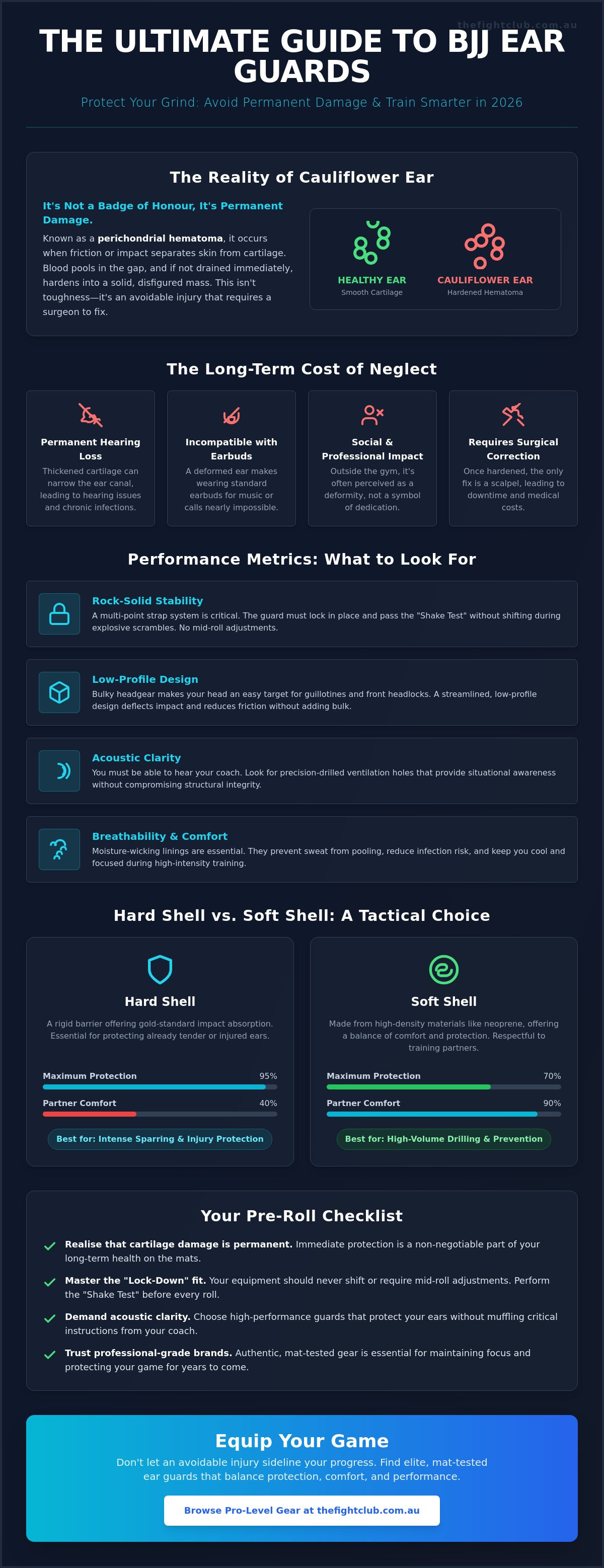
The mats don't care about your ego. Every time you grind out of a tight triangle or blast through a double leg, your ears take the hit. If you aren't careful, you'll end up with a permanent reminder of your mistakes. What is cauliflower ear exactly? In technical terms, it's a perichondrial hematoma. Friction or blunt force separates the skin from the cartilage, causing blood to pool. Without immediate drainage, that fluid hardens into a solid mass. Once it's set, you aren't looking at an ice pack. You're looking at a surgeon's scalpel to fix the mess.
Some gyms still treat this deformity as a "badge of honour." That's an outdated myth. It isn't a sign of toughness. It's a sign of avoidable trauma that can sideline your progress. This BJJ ear guards review shows that protecting your hearing is a tactical decision. You want to stay on the mats for decades. Don't let ego dictate your longevity. Hard work requires a smart approach to safety.
The Long-Term Cost of Ignoring Protection
Ignoring the swelling carries a heavy price. It isn't just about your looks. As the cartilage thickens, your ear canal can narrow. This leads to permanent hearing loss or chronic infections. Try wearing standard earbuds with a mangled ear. It's nearly impossible. Beyond the gym, the social and professional implications are real. People who don't roll won't see a warrior. They'll see a deformity. One bad scramble is all it takes to change your appearance forever. Don't let a single training session dictate how you look for the rest of your life.
Why Modern Grappling Demands Better Gear
Modern BJJ moves at a blistering pace. The intensity of modern scrambles increases the frequency of high-friction contact. You need gear that matches that energy. High-quality protection allows you to train through minor tenderness without escalating a small hematoma into a surgical emergency. Your safety kit should be comprehensive. Just as you wouldn't spar without a mouth guard to save your teeth, you shouldn't roll without ear protection when the pressure is on. This BJJ ear guards review highlights tools that keep you in the fight while others are stuck in the waiting room. Stay disciplined. Protect your assets. Focus on the roll.
Performance Metrics: What to Look for in BJJ Ear Guards
Choosing the right gear is a tactical necessity. You don't just grab the first piece of plastic you see. A proper BJJ ear guards review must prioritise stability above all else. If your guard shifts during an explosive takedown, it's useless. Worse, it becomes a liability that blocks your vision or slides down your neck. You need a multi-point strap system that locks in place. It should feel like a part of your body, not an accessory. Discipline on the mats starts with gear that doesn't require constant adjustment.
Profile is the next critical metric. A bulky guard makes your head a massive target. It gives your opponent more surface area to secure a front headlock or a guillotine. You want a low-profile design that deflects force without adding unnecessary bulk. This is backed by clinical necessity; an NCBI study on auricular trauma highlights how repeated friction is the primary driver of damage. Reducing that friction through a streamlined fit is your best defence. You can browse the latest performance-tested gear to see how modern designs tackle these technical challenges while keeping you in the fight.
Hard Shell vs. Soft Shell Construction
Hard shells are the gold standard for pure impact absorption. They create a rigid barrier that's essential when your ears are already tender. However, they can be abrasive. Your training partners might not appreciate a plastic wall rubbing against their face during a heavy cross-face. Soft shell guards, often made from high-density neoprene, are better for daily drilling in an ego-free environment. They provide a balance of comfort and protection that respects the communal bond of the gym while keeping your cartilage intact. Choose hard shells for maximum protection and soft shells for high-volume drilling sessions.
Acoustic Clarity and Breathability
Most reviews overlook the tactical advantage of hearing. If you can't hear your coach screaming instructions during a live roll, you're at a disadvantage. You need precision-drilled holes that allow sound waves through without compromising the integrity of the shell. Acoustic venting is the balance between protection and situational awareness. Breathability is just as vital for your focus. Moisture-wicking linings prevent sweat from pooling in the ear canal, which reduces the risk of infection and keeps you comfortable. This BJJ ear guards review emphasizes that if you can't hear or breathe, your performance will suffer long before your ears do.
Top BJJ Ear Guards for 2026: Pro-Level Reviews
Professional gear isn't a luxury. It's a requirement for anyone spending four nights a week on the mats. This BJJ ear guards review focuses on the elite tier of protection available at The Fight Club. We don't stock gear that falls apart after three wash cycles. You need equipment that survives the high-octane pressure of Australian BJJ gyms. We evaluate every piece of kit based on ease of cleaning, strap longevity, and partner safety. If your guard has sharp plastic edges that cut your teammates during a roll, it doesn't belong in a humble, technique-driven environment. Invest in gear that respects the grind and the community.
Venum Professional Protection
Venum delivers a masterclass in ergonomic design. Their latest protective line balances gritty substance with their signature aesthetic. The ear cups are contoured to sit flush against the head, which significantly reduces the leverage an opponent can gain during a front headlock. Their multi-point strapping systems ensure the guard stays locked during heavy collar ties and explosive escapes. For a deeper look at their brand philosophy and equipment standards, check out our Venum Australia guide. These guards are built for those who value authenticity and professional-grade durability over cheap, superficial alternatives.
Hayabusa T3 Headgear and Ear Protection
Hayabusa brings the same engineering excellence found in their world-class boxing gloves to the T3 series. The technical integration of high-impact foam technology is designed to disperse force instantly upon contact. While the T3 series is often recognised for full-face headgear, the ear protection components set the industry standard for stability. The inner lining is treated to resist odours and bacteria, making it one of the easiest pieces of gear to maintain after a punishing session. It is built for the disciplined fighter who refuses to compromise on safety when the intensity peaks.
The Minimalist Choice: Low-Profile Guards
No-Gi specialists require a specific type of protection. You need friction reduction and ultra-lightweight materials that won't absorb litres of sweat. These minimalist guards are designed for high-speed scrambles where every millimetre of clearance matters. They provide a slick surface that makes it harder for opponents to secure a grip on your head. We've tested these during high-intensity rolling to ensure they don't shift when you're working out of a tight spot. This BJJ ear guards review confirms that a low-profile design can offer elite protection without making your head a larger target for chokes. Focus on your movement and let the gear handle the impact.
Mat Survival Guide: Fitting and Maintenance
Buying the best gear is only half the battle. If your equipment shifts during a heavy roll, it's a liability, not an asset. This BJJ ear guards review wouldn't be complete without a masterclass in setup. Most practitioners slap their guards on and hope for the best. That's a mistake. You need a "Lock-Down" fit that stays secure through every explosive scramble and grinding pressure pass. Proper fitting ensures your head stays a small target while your hearing remains protected. Discipline in your preparation leads to confidence on the mats. Don't let poor setup kill your focus.
Step-by-Step Fitting for Maximum Stability
Start with the basics. Align the ear cup directly over your ear canal. It should sit flush against the side of your head with no gaps. Secure the chin strap first. It needs to be tight enough to prevent the guard from lifting, but it shouldn't restrict your breathing or jaw movement. This is crucial for those who already use a professional-grade mouth guard; the strap must complement your jaw position, not fight it. Next, tension the rear and crown straps. These are your primary defence against forward slippage. Once you're strapped in, perform the "Shake Test." Aggressively shake your head from side to side. If the cups move even a centimetre, tighten the rear straps. If it feels like part of your skull, you're ready to roll.
Hygiene and Odour Control
Ear guards are notorious breeding grounds for bacteria. The combination of sweat, heat, and skin cells creates a perfect environment for "gym funk" and infections. You must realise that washing your gear after every single session is non-negotiable. Use mild, anti-fungal soaps to protect the materials and your skin. Avoid harsh chemicals that can degrade the elastic or cause rashes during a roll. When it comes to drying, skip the tumble dryer. High heat destroys Velcro and makes neoprene stiff and abrasive. Air-dry your guards in a well-ventilated area away from direct sunlight. This keeps the materials supple and extends the life of the multi-point strap system. Proper maintenance is a sign of respect for your gear and your training partners.
Salt from your sweat is the silent killer of elastic gear. Over time, it crystallises and eats away at the fibres. Rinse your guards in cold water immediately after training to flush out the salt before it sets. This simple habit can double the lifespan of your equipment. If you want to ensure your kit is always mat-ready, you can shop authentic protective gear that's built to withstand the rigours of daily training. Treat your equipment with the same intensity you bring to your drilling, and it will protect you for years to come.
Equip Your Game at The Fight Club
The right gear is a tactical investment. At The Fight Club, we don't have time for commercial fluff or superficial trends. We only stock gear that's been dragged through the trenches and tested on the mats. This BJJ ear guards review has shown you the metrics that matter. Now you need a source that understands the grind. Our selection process is simple. If it doesn't survive high-intensity rolling, it doesn't hit our shelves. We're committed to a humble, ego-free environment where performance speaks louder than branding.
Success on the mats requires a total system. Your ear guards are vital, but they're part of a larger kit. From professional-grade BJJ Gis to the most durable rash guards, every piece of equipment must support your movement. We provide the tools. You provide the work. With fast shipping across Australia, we ensure you spend less time waiting and more time training. Get your kit sorted and get back to work.
Curated for the Australian Grappler
Australia is different. The heat is punishing. The intensity is raw. We select gear that manages moisture and resists the salt-heavy environments of local gyms. As an Australian-owned business, we understand the specific demands of our community. We aren't a faceless corporation. We're part of the same culture where you train. No fluff. Just authentic equipment that works when the pressure is on. Support a local business that lives and breathes combat sports.
Your Next Step: Secure Your Hearing
Don't wait for a "hot ear" to start taking protection seriously. By the time you feel the sting, the damage might already be done. This BJJ ear guards review is your signal to act. Realise that your hearing is an asset you can't replace. Invest in gear that grows with your journey from the first day to the podium. Secure your hearing today and stay focused on the next tap. Browse our full range of protective gear and step onto the mats with total confidence.
Lock Down Your Safety for the Long Haul
The mats don't forgive neglect. You've seen why cauliflower ear is a liability you can't afford to ignore. Protecting your cartilage isn't just about avoiding surgery; it's about staying in the fight for decades. This BJJ ear guards review has shown that you don't have to choose between hearing your coach and keeping your ears intact. Focus on gear that offers a low-profile fit and elite stability so you can roll without distractions. Realise that your equipment is a direct reflection of your discipline. Don't settle for gear that fails when the pressure peaks.
We are Australian owned and operated, providing fast national shipping to get you back to training. We stock only the most authentic, premium brands like Venum and Hayabusa to ensure your kit matches your intensity. Upgrade your protection with professional BJJ ear guards at The Fight Club and secure your future on the mats. It's time to stop worrying about injury and start focusing on the next submission. Keep grinding. Stay humble. Protect your game.
Frequently Asked Questions
Do BJJ ear guards actually prevent cauliflower ear?
Yes, they provide a physical barrier that absorbs impact and reduces the friction that causes hematomas. By preventing the separation of the skin from the cartilage, you stop fluid from pooling in the first place. It's the most effective preventative measure for long-term mat health. Consistent use during high-intensity rolling ensures your ears remain structurally sound and free from permanent deformity.
Can I wear ear guards in BJJ competitions in Australia?
Regulations vary by organisation, but most Australian tournaments allow ear guards if they don't have hard plastic or metal components that could injure your opponent. Soft shell guards are generally accepted in local IBJJF-style brackets. Always check the specific ruleset of the event organiser before you weigh in. Being prepared with a mat-tested, competition-legal pair ensures you don't get turned away at the bullpen.
How do I stop my ear guards from slipping during sparring?
Achieving a secure fit starts with a multi-point strap system that locks the cups over your ears. Tension the rear and crown straps first to create a solid anchor before securing the chin strap. If you find your gear still shifts during this BJJ ear guards review, try wearing a low-profile model with a wider head strap. This adds stability and keeps everything in place during explosive double-legs and scrambles.
Will wearing ear guards make it harder to hear my coach?
Only if you choose gear with poor acoustic design. Modern guards feature precision-drilled vents that allow sound waves to pass through without compromising protection. You need that situational awareness to catch technical cues during a live roll. This BJJ ear guards review highlights designs that prioritise acoustic clarity so you can stay responsive to your corner while keeping your cartilage safe from trauma.
What is the best way to clean my grappling headgear?
Rinse your guards with cold water immediately after every session to flush out salt and sweat. Use a mild anti-fungal soap to kill bacteria and prevent skin infections like ringworm or staph. Never throw them in a high-heat dryer as this destroys the elastic and Velcro. Air-dry them in a ventilated area to keep the materials supple and ready for the next round of heavy drilling.
Is it better to have a hard or soft shell ear guard for BJJ?
Hard shells offer superior impact protection, but soft shells are better for the overall gym culture. Hard plastic can be abrasive to your training partners during tight transitions or cross-faces. In a humble, technique-driven environment, high-density neoprene soft shells provide enough protection to prevent hematomas without causing unnecessary discomfort to your teammates. Choose the shell type based on your current injury status and intensity.
How tight should the chin strap be on my ear guards?
The strap should be snug enough to prevent the cups from lifting but loose enough to allow full jaw movement. You must be able to breathe comfortably and use your mouth guard without restriction. If the strap digs into your throat or limits your range of motion, it's too tight. A proper fit feels like a natural extension of your body, not a chokehold that distracts you from the roll.
Can I wear ear guards if I already have a hematoma?
You can, but the guard won't heal an existing injury; it only prevents further trauma. If your ear is already swollen, you must drain the fluid and apply compression before returning to the mats. Wearing a hard shell guard over a fresh hematoma can protect the area while you drill light. However, you should avoid high-intensity sparring until the cartilage has properly healed to prevent permanent hardening and deformity.