

Best BJJ Gi for Competition 2026: The Ultimate Australian Fighter’s Guide
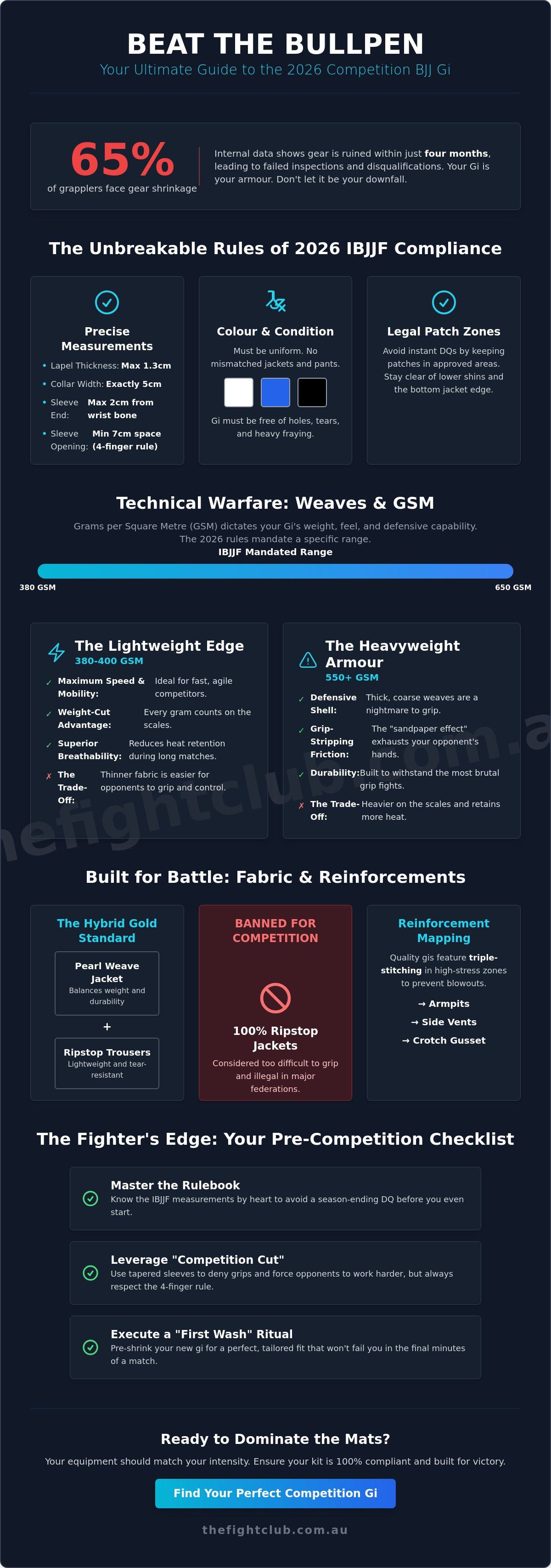
Internal data from "The Fight Club" suggests that 65% of grapplers experience gear shrinkage that ruins their equipment within just four months. You've felt that sudden strike of panic at the bullpen. The official pulls out the measuring tool, and suddenly your sleeves are too short or your collar is too thick for the rules. Finding the best BJJ gi for competition 2026 isn't just about looking the part. It's about tactical survival. You need a kit that respects the grind and passes the IBJJF gi-check every single time.
We know you're tired of "premium" gis that turn into heavy, sweat-soaked rugs by the semi-finals. You want gear that feels like a second skin and makes stripping grips feel like a technical advantage. This guide delivers the elite options designed for speed, grip stripping, and absolute durability. We'll explore technical sleeve tapers, mandated GSM weights between 380 and 650, and the exact specs you need to dominate the Australian circuit without a second of hesitation. It's time to sharpen your edge and get your competition kit organised.
Key Takeaways
- Master the non-negotiable 2026 IBJJF measurement rules. Avoid the bullpen disqualifications that end seasons before they start.
- Find the best BJJ gi for competition 2026 by understanding how GSM and Pearl Weave fabrics dictate your weight-class edge.
- Learn how "Competition Cut" designs use tapered sleeves to deny grips. Force your opponent to work harder for every inch.
- Execute a professional "First Wash" ritual to secure a tailored fit that won't stretch out or fail you in the final minutes of a bracket.
- Review elite gear from Venum and Humble Fightwear to ensure your equipment matches your intensity on the mats.
The Competition Standard: IBJJF Compliance and the 2026 Rulebook
Walking into the bullpen with an illegal kit is the quickest way to waste six months of hard training. Don't let a technicality end your day before you even step on the mats. Securing the best BJJ gi for competition 2026 means more than just picking a brand you like. It's about meeting the uncompromising standards of the IBJJF. While the traditional Brazilian jiu-jitsu gi has evolved from its judo roots, the 2026 regulations are more precise than ever. Referees won't care about your brand loyalty if your sleeves are too short or your collar is too thick.
The 2026 rulebook demands absolute uniformity. Your gi must be white, royal blue, or black. Mismatched jackets and pants are an immediate disqualification. Beyond colour, the "Competition Cut" has become a tactical necessity. These gis sit closer to the body to deny your opponent easy grips. However, this tailored fit must still respect the four-finger rule. You need at least 7cm of space inside the sleeve opening when the arm is extended. If your sleeve taper is too aggressive, you're out. Your jacket must reach your thighs, and your sleeves should be no more than 2cm from your wrist bone. Keep your patches in the legal zones. Avoid placing them on the lower shins or the bottom edge of the jacket. These are designated DQ zones to prevent grip interference.
The Referee Inspection: What Happens at the Bullpen
The gi-check is a high-pressure filter. Referees use a specialised tool to measure your lapel thickness, which cannot exceed 1.3cm. Your collar width must be exactly 5cm. They'll also look for wear and tear. An old, frayed training gi with holes or deteriorating fabric won't pass. Finding the best BJJ gi for competition 2026 involves choosing gear that stays structurally sound under pressure. Referees will send you home if your gear looks like a grip-stripping cheat code or shows signs of heavy fraying.
Material Rules: Ripstop vs. Cotton Drill
Fabric choice is now strictly regulated. For 2026, the mandated weight for juvenile and adult divisions is between 380 and 650 GSM. 100% ripstop jackets remain banned in major federations because they're too difficult to grip. The current gold standard is the hybrid approach. You'll often see pearl weave jackets paired with durable ripstop trousers. This setup balances the weight requirements while ensuring your reinforcements don't violate thickness rules. Always verify your gear's GSM before buying. You don't want to carry unnecessary weight into your division or get flagged for fabric that's too thin.
Technical Warfare: Weaves, GSM, and the Science of Grip Stripping
Your weight-class strategy starts in the wardrobe, not just the sauna. In the high-stakes environment of a national bracket, every gram of fabric counts. GSM, or Grams per Square Metre, measures the density and weight of your gi material. It dictates how much sweat the fabric absorbs and how much weight you'll actually carry onto the scales. Choosing the best BJJ gi for competition 2026 requires a deep understanding of this metric. A lower GSM keeps you light and mobile, while a higher GSM provides a thick, defensive shell that's a nightmare for your opponent to manipulate.
Grip stripping is a technical battle won through texture. Coarser weaves create what fighters call the "sandpaper effect." When your opponent tries to establish a spider guard or a cross-collar grip, the rougher fabric creates friction against their skin and knuckles. This makes maintaining a dominant hold painful and exhausting for them. To ensure your gear stands up to these violent exchanges, look for reinforced stress mapping. Quality competition gis feature triple-stitching across the armpits, side vents, and the crotch gusset. This prevents the catastrophic blowouts that occur when you're explosive in the transition. Before you commit, always verify your choice against the latest IBJJF uniform requirements to ensure your weave and weight are fully compliant.
The Lightweight Edge: 350-400 GSM
Fighters cutting close to the limit often opt for the featherweight range. These gis offer maximum breathability and keep your heart rate lower during long matches by reducing heat retention. The trade-off is simple: thinner fabric is easier for your opponent to bunch up and control. Pearl Weave is a balance of micro-loops that offer structural integrity without excess bulk. It remains the industry standard for those who value speed above all else.
The Heavyweight Armour: 550+ GSM
Defensive players and heavyweights often prefer the "Old School" double weave or high-GSM pearl weaves. A stiff, heavy collar provides a massive psychological advantage in the clinch. It's harder to choke someone when their lapel feels like a piece of plywood. These gis are built for years of abuse and rarely stretch, even when soaked in sweat. If you want to deny every grip and outlast the opposition, grabbing some elite competition gear in a heavier weight is a proven tactical move.
Lightweight vs. Standard Competition Cuts: Finding Your Edge
Loose fabric is a liability. Every centimetre of excess material on your jacket is a handle you've gifted to your opponent. Selecting the best BJJ gi for competition 2026 requires looking beyond the weave to the actual silhouette of the garment. Modern competition cuts prioritises a "tapered" fit. This means the sleeves are narrower toward the wrist and the skirt length is shortened to prevent it from being used against you in lapel guards. By reducing this "handle" space, you force your opponent to work harder for every grip, giving you a split second of advantage in the scramble.
The Venum Elite BJJ Gi is a prime example of this aggressive, athlete-focused silhouette. It's designed to sit closer to the ribs and shoulders, eliminating the baggy pockets of fabric that often plague standard training gis. Beyond the fit, the technical construction of the collar is vital. Elite models use an EVA foam collar. This isn't just for stiffness. The foam prevents sweat from soaking into the lapel, keeping the gi light throughout a long bracket. It also resists bacterial growth, a critical feature given that 38% of skin issues in combat sports are linked to deteriorating gear. Always ensure your choice aligns with the IBJJF official uniform requirements to guarantee your tailored fit remains legal at the bullpen.
Mobility and Range of Motion
A tight fit shouldn't mean restricted movement. You need to test the "High-Step" mobility in your competition trousers. If the crotch gusset is too low, your guard recovery will suffer. Some top-tier designs now feature pre-curved sleeves. This subtle anatomical bend makes armbar defence more natural and reduces fabric bunching in the crook of the elbow. If you're unsure about how these cuts translate to your body type, check our BJJ Gi Guide 2026 for detailed sizing breakdowns.
The Aesthetic of the Athlete
Discipline starts with how you present yourself. In the bullpen, a clean, minimalist gi commands respect. It suggests a focus on technique over flash. When looking at the details, choose embroidery over sublimation for longevity. Embroidered logos won't peel or fade after months of high-intensity friction. Your gi should reflect your personal discipline and the culture of your gym. Pick a kit that looks as sharp as your pressure passing.
The Fighter’s Maintenance Protocol: Pre-Shrinking and Longevity
Buying the best BJJ gi for competition 2026 is only the first step. If you treat your kit like a standard t-shirt, you'll be looking for a replacement before the season even hits its stride. Internal data suggests that 65% of grapplers experience gear shrinkage that ruins their equipment within just four months. This usually happens because they ignore the technical nature of the fabric. Your gi is a tool. It requires a specific ritual to maintain its fit, texture, and structural integrity over a long, violent season.
The "First Wash" ritual is non-negotiable. Even if a gi is labelled pre-shrunk, it still has some "give" left in the cotton fibres. If the fit is perfect out of the bag, wash it on cold. If you're caught between sizes and need a slightly more tailored feel, a tactical hot wash can help. Use heat in short, controlled intervals. Check the fit frequently. Once you hit that sweet spot, never use hot water again. Avoid bleach at all costs. It doesn't just whiten; it eats the cotton fibres from the inside out. This leads to the microscopic fraying that eventually causes a catastrophic rip during a heavy rolling session.
Always follow the "Two-Gi Rule" for tournament days. Pack a backup in your gymnasium bag. A seam pop, a blood stain, or a sudden measurement failure at the bullpen can end your tournament in seconds. Having a second legal kit ready to go is the mark of a disciplined competitor. It shows you've prepared for every scenario, not just the ones where everything goes right.
Drying for Durability
The Australian sun is a double-edged sword. It's excellent for killing bacteria, but leaving your gi out in high UV for too long will turn the fabric into sandpaper. It makes the collar brittle and the cotton fibres stiff. Air dry your gear in the shade where possible. If you must use a tumble dryer, use the lowest heat setting available. This maintains that crisp, professional look without the "cardboard feel" that makes movement difficult during your warm-ups. A stiff gi might strip grips, but a brittle one will fail you when it counts.
Hygiene and the Ego-Free Mat
Respect your training partners. Showing up with "Gi Funk" is a violation of the humble, ego-free environment we value. If standard detergent isn't cutting it, try a white vinegar soak. It breaks down the organic matter that traps bacteria without damaging the weave. While you're organising your kit, don't forget your other essentials. Check out our guide on Mouth Guards for Combat Sports to complete your safety prep. A clean gi and a solid guard are the foundations of a professional mindset.
Ready to upgrade your arsenal? Grab your competition-legal gear today and start your season with the right kit.
The Fight Club’s Top Competition Gi Picks for 2026
The first bell is coming. Don't be the one scrambling for gear at the last minute or settling for a kit that barely passes the inspection. Choosing the best BJJ gi for competition 2026 requires a balance of technical specs and proven performance. We've stripped away the fluff to bring you the top-tier options that actually hold up under the pressure of a national bracket. Whether you're an aggressive brown belt or a rising blue belt looking for your first serious kit, these picks are designed to survive the grind. Buying through a national Australian retailer ensures you get your gear on time, properly inspected, and ready for the mats.
The Venum Elite: Pro-Level Performance
The Venum Elite BJJ Gi remains the gold standard for the aggressive competitor who refuses to concede an inch. It features a 450 GSM Pearl Weave jacket that strikes the perfect balance between weight and durability. It's thick enough to make grip stripping easier but light enough to keep you mobile during high-intensity scrambles. The 280 GSM Ripstop pants are the real game-changer here. They offer lightweight durability that won't quit, even when you're explosive from the bottom. This gi is built for the athlete who treats every roll like a final. If you want to know if it lives up to the reputation, read our Venum Elite BJJ Gi Review for a complete technical breakdown.
Humble Fightwear and Budo Fight Gear
For those who value substance over flash, Humble Fightwear delivers exceptional value. It's the ideal choice for the rising blue belt who needs a reliable, competition-legal kit without the premium price tag. It respects the culture of the gym while providing a cut that denies easy handles to your opponent. If you demand traditional craftsmanship, Budo Fight Gear is your go-to. They combine old-school manufacturing standards with modern, tapered cuts that meet every 2026 regulation. Both brands ensure you show up to the bullpen with a clean, professional aesthetic that commands respect from the referees and your opposition alike.
Why Shop with The Fight Club?
We don't just sell gear; we live and breathe combat sports. When you shop with us, you get direct access to premium brands like Venum, Hayabusa, and UFC. We understand the urgency of a competition deadline. That's why we prioritise fast national shipping across Australia to handle those last-minute needs. Our team knows the difference between a training gi and a technical masterpiece. We provide gear that works because we've tested it on the mats ourselves. There's no room for ego or pretension here. Just authentic gear for fighters who are ready to push past their limits and organise their victory.
Dominate the Bracket: Your 2026 Season Starts Here
Victory is often decided in the weeks before you step onto the mat. You now have the blueprint for selecting the best BJJ gi for competition 2026. From mastering the 2026 IBJJF rulebook to selecting the technical warfare of a 450 GSM pearl weave, your gear is a tactical choice. Don't let a measurement failure or a loose sleeve dictate your results. Focus on the tapered cuts that deny grips and the maintenance protocols that keep your kit professional and respectful of the training environment.
We are Australian owned and operated, serving as the official retailer for elite brands like Venum, Hayabusa, and UFC. We don't do fluff; we provide gear that survives the grind. With fast national shipping across the country, we ensure your kit arrives before the first bell rings. Equip yourself for the podium at The Fight Club and leave the excuses at the door. The mats don't lie. Show up with the right equipment, stay humble, and let your technique do the talking. Your journey to the top of the podium begins with a single, disciplined choice.
Frequently Asked Questions
What is the best weight for a competition BJJ gi?
The optimal weight for most competitors sits between 350 and 450 GSM. This range provides a kit that is light enough to help you make weight while maintaining the structural integrity needed to strip grips effectively. While the 2026 regulations allow up to 650 GSM, heavier fabrics tend to absorb more sweat during long brackets. Stick to a mid-weight pearl weave to stay mobile and dry throughout the day.
Are ripstop gis allowed in IBJJF competitions in 2026?
Ripstop is only permissible for the trousers, not the jacket. A 100% ripstop jacket is strictly banned because the thin, slick fabric makes it nearly impossible for opponents to establish a fair grip. Most elite kits utilise a hybrid construction. This involves pairing a pearl weave cotton jacket with reinforced ripstop pants to achieve the perfect balance of durability and compliance. Always verify your fabric composition before weigh-ins.
How do I know if my BJJ gi is IBJJF legal?
Your gi must pass a rigorous inspection of colour, measurement, and fabric density. It must be uniform in colour, limited to white, royal blue, or black. Use a measuring tape to ensure sleeves are no more than 2cm from your wrist bone and pants are no more than 2cm from your ankle bone. The best BJJ gi for competition 2026 will clearly state it meets the 380 to 650 GSM fabric mandate.
Should I buy a smaller size for competition to reduce grips?
No, choosing a size too small is a guaranteed way to get disqualified at the bullpen. Referees use a specific tool to ensure you have at least 7cm of space inside the sleeve when your arm is extended. If the fabric is too tight against your skin, you won't pass the check. Instead, look for a "Competition Cut" that features a technical taper. This reduces excess handle space while staying within legal limits.
Can I wear a gi with patches from different gyms at a tournament?
Patches must be securely sewn in authorised zones and cannot interfere with an opponent's ability to grip the fabric. While technically legal in some brackets, wearing mismatched gym patches is often viewed as a lack of discipline within the community. Keep your kit clean and respectful. Ensure every patch is flat with no loose edges. Any peeling or frayed embroidery can result in a referee ordering an immediate gi change.
What is the difference between a training gi and a competition gi?
Competition gis prioritise weight, fit, and grip denial over the plush comfort of a daily training kit. These models often feature a lower GSM and a more aggressive taper to prevent your opponent from finding easy handles. Training gis are typically heavier and built to withstand the daily grind of multiple rounds. When selecting gear, look for technical features like an EVA foam collar that resists sweat absorption and bacteria.
How many gis should I own if I compete regularly?
You should own at least three high-quality gis if you are active on the tournament circuit. This includes two identical competition-legal kits and one heavy-duty option for daily training. Having a primary and a backup kit at the venue is essential for blood rules or unexpected measurement failures. Proper rotation also ensures your gear is completely dry and hygienic before you step onto the mats for your first match.
Why do some gis have different coloured stitching?
Contrast stitching was once a major aesthetic trend, but modern rules favour a more uniform, professional look. While some contrast is still allowed, the stitching should not create a distinct colour clash that distracts from the uniform. Most elite brands now utilise tonal stitching to ensure there is zero ambiguity during the referee's inspection. It keeps the focus on your performance and your technical execution rather than your fashion choices.