

Youth Punching Gloves: Professional Protection for Developing Fighters
Your kid isn't playing dress-up; they're stepping into the pocket. Most youth punching gloves are glorified toys that fail the moment a developing fighter starts to find their power. You want them to push their limits, but the fear of a fractured metacarpal or a collapsed wrist is a constant worry. It's frustrating to decode the mess of 4oz, 6oz, and 8oz sizing while trying to avoid gear that falls apart after a few weeks of bag work.
We're here to cut through the noise. You'll discover how to select professional-grade protection that mirrors the gear the elite use, ensuring your young athlete develops proper technique without compromising safety. This guide breaks down the 2026 USA Boxing regulations, explains exactly which weight your child needs for their division, and identifies the durable gear built for the long haul. It's time to stop buying toys and start investing in authentic equipment that respects the grind.
Key Takeaways
- Protect the future. Learn why professional-grade youth punching gloves are a non-negotiable requirement for shielding developing bone structures from high-impact injuries.
- Ditch the toys. Understand how multi-layered foam and genuine materials distribute force to keep wrists aligned during heavy bag sessions.
- Decode the weight. Master the ounce-to-age ratio to find the perfect fit for young strikers, ensuring they have enough padding without the unnecessary bulk.
- Secure the foundation. Learn how to pair premium gloves with essential hand wraps to create a stable, injury-resistant hitting surface.
- Choose the elite. Explore the technical specifications of pro-level gear like the Hayabusa T3 and Venum Challenger ranges built for the next generation of champions.
Why Professional Youth Punching Gloves are Non-Negotiable
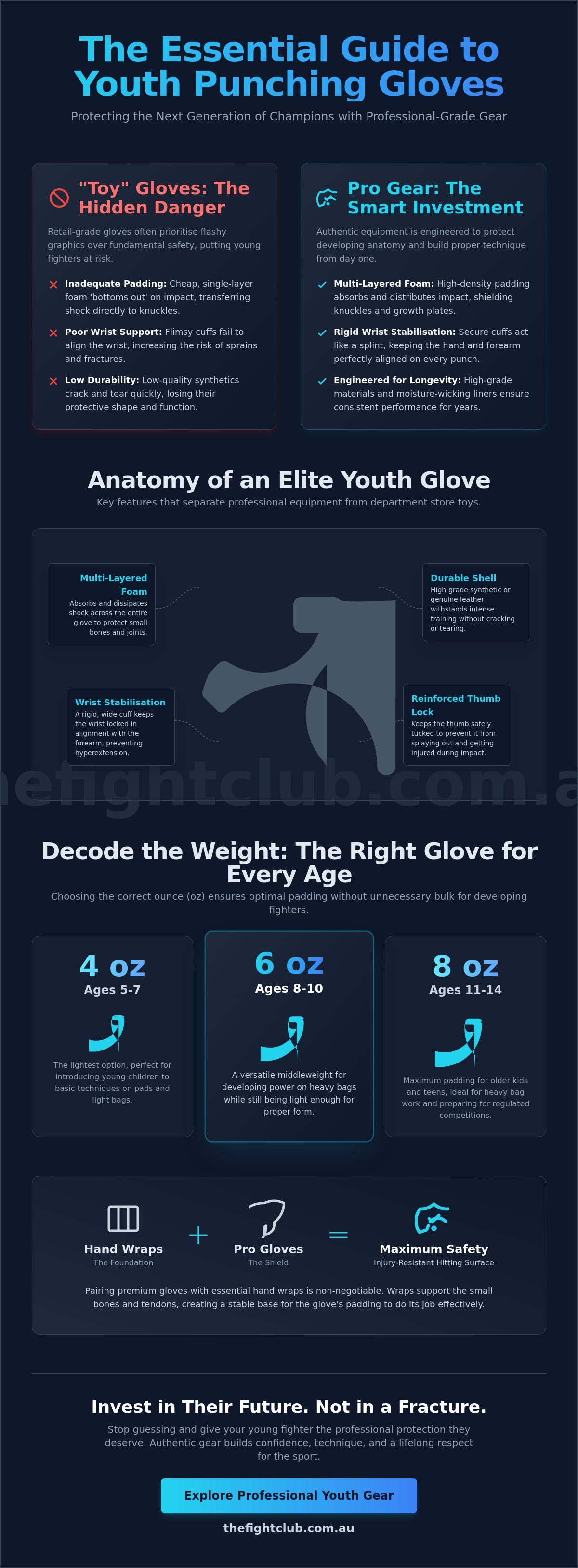
The ring doesn't care about age. Physics is indifferent to whether a fist belongs to a veteran or a ten-year-old. Every strike on a heavy bag sends a shockwave back through the knuckles, into the wrist, and up the forearm. Professional youth punching gloves are not just smaller versions of adult gear; they are specialised tools designed to manage these forces on a developing skeleton. Using 'toy' gloves found in department stores is a gamble with your child's physical future. It isn't just about comfort; it's about preventing long-term damage before it starts.
Retail-grade gloves often lack the structural integrity required for actual training. They rely on cheap, open-cell foam that bottoms out upon impact. This means the force isn't absorbed; it's transferred directly to the small, brittle bones of the hand. High-density, multi-layered foam is the standard for authentic equipment. It provides the necessary resistance to shield developing metacarpals and growth plates from the repetitive stress of intense bag work. Authentic gear ensures that every punch builds strength rather than causing a setback.
The Anatomy of Developing Hands
A child's hand is a work in progress. Their wrist joints are more flexible and vulnerable than an adult's, making them susceptible to hyperextension during a poorly landed hook. When you examine the Anatomy of a Boxing Glove, you'll see that professional gear prioritises wrist stabilisation. Unlike flimsy alternatives, elite youth gloves feature rigid cuffs that act like a splint, keeping the forearm and fist in a straight line. This alignment is critical. Pro gear also includes a reinforced thumb-lock. This feature prevents the thumb from splaying outward or getting 'stoved' during high-intensity exchanges. It's about creating a safe, compact hitting surface.
Grit Over Glamour: Choosing Performance Gear
It's easy to be distracted by neon colours and cartoon graphics. Don't be. Flashy designs are frequently used to mask poor construction and low-quality synthetic materials. Choosing authentic gear is a lesson in discipline. When a young fighter laces up 'real' equipment, their mindset shifts. They aren't playing a game; they're practising a craft. This transition fosters a sense of respect for the sport and themselves. The Fight Club provides a humble, ego-free environment where performance always outranks appearance. We believe every athlete deserves gear that works as hard as they do. Authentic youth punching gloves build the confidence to strike with power, knowing the hands are protected by the best tech in the game.
Anatomy of Elite Youth Gear: Padding, Support, and Durability
Professional gear starts with the shell. Most youth punching gloves utilise high-grade synthetic leather because it's lightweight and resists cracking under the pressure of humid gym bags. For those hitting the bags daily, genuine leather remains the gold standard for its natural breathability and ability to mould to a fighter's unique fist shape. Regardless of the outer skin, the internal engineering dictates the level of protection. Elite gloves use multi-layered foam to catch the impact and spread it across the entire surface area. This prevents the force from concentrating on a single knuckle. Research into Youth Martial Arts Safety highlights that appropriate equipment is the first line of defence against preventable impact injuries. You aren't just buying a glove; you're buying a shock absorber for your child's future.
Sweat is the enemy of longevity. Moisture-wicking liners and mesh palms aren't luxury features; they're essentials. These components allow heat to escape and prevent the salt buildup that leads to 'glove rot'. When gear stays dry, it stays structural. A glove that loses its shape loses its ability to protect. Keeping the interior clean ensures the padding remains effective for hundreds of rounds.
Injection Moulded Foam (IMF) vs. Layered Padding
Injection Moulded Foam is the modern standard for youth protection. It's a single piece of pre-shaped foam that ensures consistent density from the knuckle to the wrist. This eliminates 'dead spots' where padding might shift or thin out over time. Layered padding, by contrast, uses different foam densities stacked together. This often provides a softer, 'broken-in' feel that helps smaller hands close into a proper fist without straining. Padding density is the primary factor in injury prevention.
Closure Systems and Wrist Alignment
Stability is everything in a heavy session. Children often lack the forearm strength to keep their wrists rigid during heavy impact. Extra-wide hook-and-loop closures provide the necessary mechanical support to lock the wrist in place. The evolution of the D-ring closure allows for a tighter, more secure fit that won't slip mid-round. This prevents the common 'over-the-top' injury where the wrist buckles under a heavy load. Ensure the glove throat is wide enough to accommodate properly wrapped hands; a tight squeeze without wraps is a recipe for disaster. If you're ready to upgrade their kit, check out the professional youth range at The Fight Club.
Sizing and Weight Guide: Finding the Right Fit for Ages 5 to 14
Stop guessing. The ring isn't a place for "close enough." When you're choosing youth punching gloves, you aren't just picking a size; you're selecting a weight class for protection. In the combat world, gloves are measured in ounces (oz). This number represents the weight of the padding. More ounces mean more foam between the knuckles and the target. Buying a glove that's too heavy will fatigue a young fighter's shoulders and ruin their form. Buying one that's too light risks a season-ending hand injury. You need the exact balance of speed and safety to foster elite technique.
For the youngest strikers aged 4 to 6, 4oz gloves are the standard entry point. These provide enough cushion for light contact without weighing down small arms. As they move into primary school age, the transition to 6oz or 8oz gear begins. This range offers the structural integrity needed for serious bag work. By the time a teenager hits the 14-year mark or crosses the 65kg threshold, they're often ready for 10oz or 12oz adult-sized gear. Follow the data, not your gut.
The Youth Sizing Framework
To find the perfect internal fit, measure the circumference of your child's dominant hand just below the knuckles. Do this with their hand open. A snug fit is vital. Many parents make the mistake of buying gear with "growing room." This is a dangerous liability. If a hand slides inside the glove during impact, the wrist will roll. The glove must feel like an extension of the arm. Refer to the 2026 weight standards below to align their gear with their physical development.
| Age Group | Fighter Weight | Glove Weight (oz) |
|---|---|---|
| Pee Wee (8-10) | Under 45kg | 6oz - 8oz |
| Bantam/Intermediate (11-14) | Under 65kg | 10oz |
| Junior/Youth (15+) | Over 65kg | 12oz - 16oz |
Bag Work vs. Sparring Weights
The gear changes when the target changes. For bag work and pad drills, lighter youth punching gloves (6oz-8oz) allow for high-volume repetitions and speed. They help a fighter realise the importance of "snap" in their punches. However, sparring is a different game. When hitting a partner, safety is the only priority. Heavier gloves, typically 10oz or more for older youth, feature softer, pillowy padding designed to absorb impact and protect both fighters. Never let a child spar in bag gloves. The foam is too dense and the risk of injury is too high. Always consult a coach before moving up in weight. They see the power and technique first-hand and will know when your child is ready for the next level of resistance.
Training Essentials: How to Pair Gloves with Wraps and Bags
Buying elite youth punching gloves is only the first step toward a safe training environment. If you send a young fighter to the bag with bare hands inside those gloves, you're neglecting the foundation of their safety. Professional gear is designed to work as a complete system. The glove provides the external impact absorption, but the wrap provides the internal structural integrity. Without that support, the small bones in a developing hand are still at risk of shifting or fracturing during high-volume sessions. You need the full kit to ensure every round is productive.
Hand Wraps: The First Line of Defence
Hand wraps are mandatory, not optional. For toddlers and younger children, traditional cloth wraps can be difficult to manage. Quick-wraps or gel-infused sleeves are a practical alternative for those just starting out. They offer immediate knuckle protection and basic wrist stabilisation without the complexity of a full wrap. However, as a fighter finds their power, nothing replaces the custom tension of standard boxing wraps. These allow you to reinforce the specific areas where the child needs it most. Wraps fill the dead space inside a glove to create a seamless, locked-in fit. This prevents the hand from sliding and keeps the wrist from buckling when they catch the bag at an awkward angle.
Matching your gear to your punching bag is equally critical. A bag that is too heavy or too dense for a child's weight will cause excessive "bounce back" shock. This vibration travels through the arm and can lead to joint fatigue. Pair lighter, softer bags with 6oz or 8oz gloves for speed and form drills. Heavier bags should only be used once the athlete has moved into 10oz gear and has mastered a proper hand-wrapping technique. It's about matching the resistance to the fighter's current level of development.
Gear Care and Longevity
Respect the gear and it will respect the hands. Never leave damp youth punching gloves in a dark, zipped gym bag overnight. This is a breeding ground for bacteria and salt buildup that degrades the foam. Use cedar inserts or "glove dogs" to pull moisture from the inner liner after every session. This simple habit extends the life of the padding and prevents the dreaded "gym stank." Inspect the gear weekly for signs of wear. If the foam starts to feel soft or you can feel the knuckles through the padding, the glove has "bottomed out." Dead foam is dangerous foam. Replace equipment the moment it loses its structural integrity. Secure your premium youth training gear from The Fight Club to ensure they're always protected by the best.
The Fight Club Standard: Premium Youth Gloves for the Next Generation
The ring doesn't reward shortcuts. If you're serious about your child's development, you need gear that matches their ambition. At The Fight Club, we don't stock department store toys. We curate professional tools. Most generic fitness labels focus on bright colours and low price points, ignoring the physiological needs of a growing athlete. Our selection of youth punching gloves is built on a foundation of authenticity. We only offer brands that have been tested in the world's most demanding training environments. This ensures your young fighter has the protection they need to push past their limits every single session.
Hayabusa T3: The Gold Standard for Youth
The Hayabusa T3 Youth range is the undisputed leader in hand protection. This isn't a "junior" glove; it's a precision-engineered piece of equipment. The Dual-X closure system is the standout feature, providing adult-level wrist support that locks the joint in place. This mechanical stability is vital for preventing the injuries often seen with flimsy, single-strap alternatives. The 4-layer foam complex is a significant investment in safety. It absorbs the shock of heavy bag work without bottoming out, protecting those small metacarpals. The glove also encourages natural hand positioning. This reduces muscle fatigue and allows the fighter to maintain proper form even during the final rounds of a high-intensity circuit.
Venum: Style Meets Substance
Venum is a name synonymous with elite combat sports. The Venum Challenger series provides the perfect balance of durability and price for a growing fighter. These gloves feature reinforced palms, which offer superior shock absorption during parrying drills and defensive work. For younger athletes, the large velcro enclosure is a massive advantage. It's designed for small hands to manage, fostering independence and discipline in the gym. They can get their gear on and off without assistance, keeping the momentum of the class moving. You can learn more about the brand's commitment to quality in our comprehensive guide to Venum Australia.
Authentic gear is a statement of intent. It tells the coach and the gym community that your child is here to work hard and learn. We reject the vanity of the "fitness" world in favour of the gritty reality of the training hall. By choosing professional youth punching gloves, you're providing the best possible start for a lifetime of discipline and perseverance. We offer fast national shipping across Australia to get this elite gear into your child's hands as quickly as possible. Don't wait for an injury to realise the value of quality. Secure the best tech in the game today and watch them strike with confidence.
Build a Champion's Foundation Today
The ring doesn't wait for "someday." Every round counts. Protecting a developing athlete requires more than just enthusiasm; it demands the right equipment. You now understand that professional youth punching gloves are an essential investment in their long-term health and technical growth. From mastering the weight-to-age ratio to ensuring every knuckle is backed by multi-layered foam, you have the tools to make an informed decision. Don't settle for retail-grade toys that compromise safety for a lower price point.
Choose gear that respects the grind. At The Fight Club, we are proud to be Australian owned and operated, providing fast national shipping on premium brands like Hayabusa and Venum. We curate only the most authentic equipment because we believe every young striker deserves a humble, ego-free environment where they can push their limits safely. Equip the next generation with professional youth punching gloves at The Fight Club. The hard work starts now. Stay disciplined. Stay protected.
Frequently Asked Questions
What size boxing gloves should a 7-year-old use?
A 7-year-old typically requires 6oz gloves. This weight provides the necessary padding for their developing hands without being too heavy for their shoulders to manage during long drills. If the child is exceptionally small for their age, 4oz might be considered, but 6oz remains the standard for primary school athletes. Always prioritise a snug fit to ensure the wrist remains supported during impact.
Can my child use MMA gloves for boxing training?
No, MMA gloves are not suitable for dedicated boxing training. They lack the thick, multi-layered foam required to absorb repetitive strikes on a heavy bag or pads. Using them for boxing increases the risk of knuckle injuries and wrist strains. Stick to authentic youth punching gloves to ensure full coverage and protection for the entire hand during striking drills. Respect the sport by using the right tools.
How do I know if my child's punching gloves are too small?
Check the fingertips and the thumb position immediately. If your child's fingers are pressed hard against the top of the glove or their hand feels cramped and numb, the gear is too small. There must be enough internal volume to accommodate a hand wrap comfortably. A glove that is too tight restricts blood flow and prevents the fighter from forming a proper, relaxed fist before impact.
Should kids wear hand wraps under their gloves?
Yes, hand wraps are a mandatory requirement for any young fighter hitting a bag. Wraps provide the internal structure that gloves alone cannot offer, securing the small bones of the hand and stabilising the wrist joint. Even with premium youth punching gloves, bare hands are vulnerable to impact injuries. Use quick-wraps for younger kids or traditional cloth wraps as they find their power.
What is the difference between 4oz and 6oz youth gloves?
The primary difference is the volume of shock-absorbing foam contained within the glove. 4oz gloves are the entry point for toddlers and very young children, typically aged 4 to 6. 6oz gloves offer more substantial padding and a slightly larger hand compartment, making them the standard choice for kids aged 7 to 10. Moving up to 6oz ensures the protection keeps pace with their increasing physical strength.
Are leather youth gloves better than synthetic ones?
Genuine leather is superior for long-term durability and breathability. It moulds to the fighter's fist over time and handles moisture better than most basic plastics. However, high-quality synthetic leather used in professional brands is an excellent, cost-effective choice for growing kids. Synthetic gear is lightweight and resists cracking, which is often ideal for those just starting their journey in the gym.
How often should I replace my child's boxing gloves?
Replace the gloves as soon as the internal foam feels soft or "bottomed out." If you can feel your child's knuckles through the padding when pressing down with your thumb, the protection is gone. For an athlete training two to three times a week, a pair of quality gloves typically lasts between 6 and 12 months. Never compromise on safety. Dead foam leads to real injuries.
Can youth punching gloves be used on a heavy bag?
Yes, provided they are authentic training gloves and not toy versions found in department stores. Professional gear is engineered to withstand the resistance of a heavy bag. Ensure the bag weight is appropriate for the child's size; a bag that is too heavy will cause excessive shock regardless of the glove quality. Always pair the gloves with wraps to manage the impact of repetitive bag work.