

What Gear Do I Need to Start MMA Training? The 2026 Beginner’s Checklist
Walking into a gym with the wrong kit isn't just a rookie mistake. It's a sign you don't respect your own safety or your partner's health. You're likely asking, what gear do I need to start MMA training without overspending or looking like a walking billboard for a brand you can't justify yet? It's normal to feel anxious about the cost or the hygiene risks of using shared, sweat-soaked equipment. We've seen too many beginners stall their progress because they're confused between boxing gloves and MMA-specific sparring gear.
This guide delivers the definitive 2026 checklist to get you ready for the mats. We'll break down a tiered shopping list that separates the non-negotiables from the nice-to-haves. You'll gain the confidence to choose elite brands like Venum and Hayabusa while you realise the technical 'why' behind every piece of protection. No fluff. No ego. Just the essential kit you need to show up, work hard, and stay safe during every session.
Key Takeaways
- Identify the non-negotiable safety gear required to protect your teeth and brain before you even step onto the mats.
- Get the definitive answer to what gear do I need to start MMA training with a tiered checklist designed for your first session.
- Learn how specialised apparel like Venum rash guards shields your skin from mat burns and common gym infections.
- Understand the technical differences between striking gloves and grappling gear to ensure you're prepared for every training phase.
- Realise the long-term value of investing in professional-grade equipment from Hayabusa and Cleto Reyes to survive the daily grind.
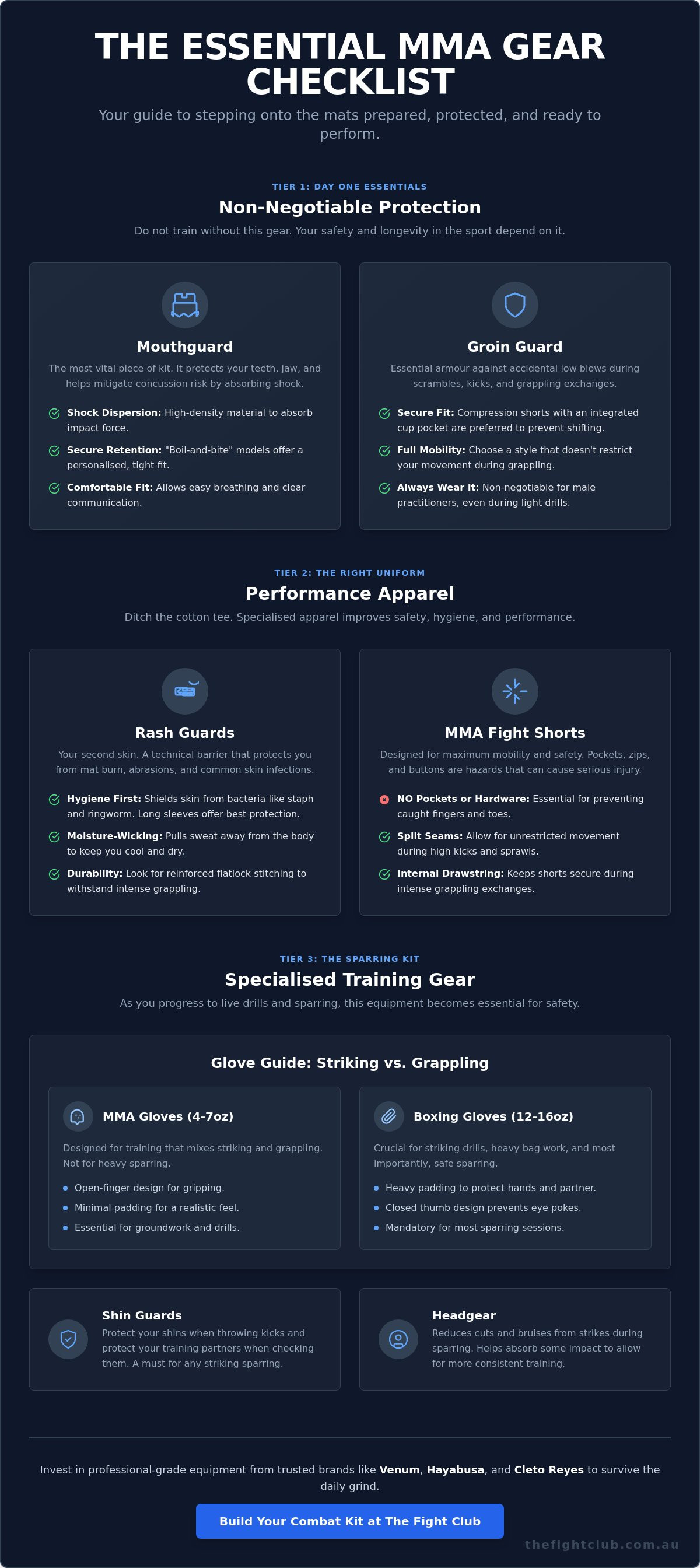
The Non-Negotiable Protection: Safety Gear for Your First MMA Session
MMA is raw energy. It's high-impact and unapologetic. If you're asking, what gear do I need to start MMA training, understand that safety isn't optional. Protection is the tax you pay for longevity in the cage. In the explosive world of Mixed martial arts (MMA), your body is the only tool you have. Treat it with respect. Showing up with the right kit isn't just about your own skin. It signals to your coaches and peers that you take the craft seriously. It shows you're a disciplined partner who values the community’s safety as much as your own.
Mouthguards: Protecting Your Smile and Brain
Your mouthguard is the most vital piece of kit in your bag. It’s the barrier between a productive session and an expensive trip to the dentist. A quality mouth guard does more than shield your teeth from impact. It provides essential shock absorption that helps prevent jaw fractures and mitigates the risk of concussions by stabilising the jaw during a strike.
For those just starting, a "boil-and-bite" model is the minimum standard. These guards use thermal-form technology to create a personalised fit to your dental structure. Look for options that allow for easy breathing and clear communication. If you're constantly fidgeting with your guard, you aren't focused on the technique. Check out these essentials for your first day:
- Shock Dispersion: High-density materials that soak up the force of impact.
- Retention: A fit so tight it won't fall out when you open your mouth to breathe.
- Comfort: Smooth edges that won't lacerate your gums or cheeks during a clinch.
Groin Guards: Essential Armour for Every Roll
The mats are unpredictable. A misplaced kick or a heavy scramble can lead to a session-ending injury in a split second. For male practitioners, a groin guard is a non-negotiable requirement. You have two primary styles to choose from: the classic jockstrap or compression shorts with an integrated cup pocket. Most MMA athletes favour compression shorts. They provide a secure, locked-in feel that prevents the cup from shifting during complex transitions on the ground.
A guard that slides out of place is worse than no guard at all. It becomes a hazard rather than a shield. When you're choosing your armour, prioritise a snug fit that allows for a full range of motion. Never skip this piece of gear. Even during light technical drills, the risk of a stray knee or accidental strike is always present. Discipline starts with your preparation. Wear the cup. Protect your future.
Performance Apparel: Choosing Your First MMA Training Kit
Your old gym shirt is a liability. It's a sponge for bacteria and a trap for stray fingers. When beginners ask what gear do I need to start MMA training, they often overlook the apparel. They think a baggy cotton tee and basketball shorts will suffice. They're wrong. In a high-intensity scramble, loose fabric is dangerous. It catches toes. It snaps fingers. It holds moisture that weighs you down and breeds infection. You need kit designed for the friction of the mats. Discipline starts with how you present yourself for work.
Rash Guards: Your Second Skin
A rash guard is more than just a tight shirt. It's a technical barrier. These garments use moisture-wicking synthetic blends to pull sweat away from the skin. This keeps you cool and prevents the fabric from becoming heavy and abrasive. Long sleeves provide the best defence against mat burn and common gym infections like staph or ringworm. Short sleeves are better for heat management during brutal striking rounds. Look for reinforced flatlock stitching. It prevents chafing and ensures the garment survives the constant pulling of a clinch. Choosing high-quality Venum rash guards ensures you have the durability required for daily sessions.
MMA Fight Shorts: Built for Mobility
Pockets are a safety hazard. In MMA, an open pocket is a hook for your partner’s toe or finger. It's a fast track to a snapped digit or a torn ligament. Genuine fight shorts are stripped of all external hardware. No zippers. No pockets. No buttons. They feature split seams on the outer leg. This design allows for unrestricted movement during high kicks and deep sprawls. An internal drawstring system is vital. It keeps your shorts locked to your waist during heavy grappling and takedown defence. Whether you favour board-shorts or compression-style, the focus must be on zero interference. You need to move without thinking about your clothes.
Authenticity matters on the mats. Don't show up in gear that hinders your progress or puts your partners at risk. Invest in apparel that works as hard as you do and reflects the respect you have for the sport.
MMA Gloves vs Boxing Gloves: Navigating the Striking Split
Don't fall for the myth that one pair of gloves does it all. It's a lie that leads to broken hands and stalled progress. When you ask what gear do I need to start MMA training, you're looking for a foundation. That foundation is split between two distinct tools. You need boxing gloves for the heavy impact and hybrid gloves for the transitions. Cheap equipment is a hazard. It offers no wrist support and the foam collapses when the intensity rises. Respect your hands. They are the only tools you have.
Boxing Gloves for Foundation Striking
Beginners spend at least 70 per cent of their striking time in boxing gloves. This isn't a suggestion; it's a safety requirement. You need the extra padding to build your punching mechanics without shattering your knuckles on a heavy bag. 16oz gloves are the universal gym standard for a reason. They provide the necessary resistance for conditioning while keeping your partners safe during technical sparring. High-calibre options like the Hayabusa T3 Boxing Gloves are essential here. They utilise a dual-strap system that locks the wrist in place. This prevents the common rolls and strains that sideline newcomers who settle for inferior "fitness" gloves. Get gear that survives the grind.
MMA Gloves: The Hybrid Choice
Eventually, the training evolves. You'll move from isolated striking into the "mixed" part of the sport. This is where MMA gloves become mandatory. You'll generally see two types: 4oz competition gloves and 7oz hybrid sparring gloves. For the daily grind, the 7oz hybrid is your best friend. It offers enough knuckle protection for light striking but keeps the palm open. This open-palm design is the key to the entire discipline. It allows you to transition from a lead hook straight into a clinch, a takedown, or a submission. You can't grapple in boxing gloves. Realising what gear do I need to start MMA training means knowing when to switch your kit based on the drill. Quality brands like Venum and Hayabusa dominate this space because their designs prevent the stiff, sharp edges found on cheap alternatives. Inferior gloves lead to accidental eye pokes and lacerations. Avoid the bargain bin. Your training partners will thank you for the professional choice.
The 'Sparring-Ready' Gear: Shin Guards and Headgear
Don't blow your budget on day one. Most beginners rush to buy everything at once, thinking a full kit makes them a fighter. It doesn't. When you're figuring out what gear do I need to start MMA training, you have to prioritise based on your current level. You don't need full sparring gear until you've mastered the basics of movement, distance, and defensive posture. Wait for your coach to give you the green light before investing in contact-ready equipment. Once you move past isolated drills and start live contact, shin guards become a mandatory requirement for your safety and your partner's health. Showing up to a sparring session without them isn't just dangerous; it's a lack of respect for the gym's standards.
MMA-specific shin guards are sleeker than traditional Muay Thai pads. You aren't just kickboxing; you're wrestling. Standard Thai pads are bulky, dense, and designed for standing exchanges. They're great for protection but they're anchors on the ground. MMA shin guards allow for the mobility required to shoot for a double-leg or work from the guard without the pads shifting or snagging on your partner's limbs. The debate usually sits between 'sock-style' and 'strap-on' designs. Sock-style guards offer the most mobility for grappling but often sacrifice the padding density needed for heavy striking. Strap-on guards provide high-density foam that is essential for protecting your tibia during checked kicks. Ensure your choice covers the instep completely. The small bones in your foot are fragile. One heavy impact against a knee or elbow can sideline you for months. Protect your tools so you can keep showing up to the grind.
Headgear is a layer of defence, not an invincibility cloak. A common mistake is believing headgear prevents concussions. It doesn't. It's designed to reduce surface trauma, preventing lacerations, facial bruising, and the dreaded cauliflower ear. If you're engaging in hard sparring sessions, it’s a wise investment for your professional appearance and long-term health. Choosing the right model involves a trade-off. Maximum protection usually means less visibility. In MMA, you need to see the takedown coming from the periphery. A low-profile design, like the Hayabusa T3 Headgear, is the professional standard. It provides the necessary padding without becoming a handle for your opponent to grab during a clinch or scramble. Stay light. Stay visible. Stay in the fight.
Understanding what gear do I need to start MMA training means knowing when to scale up your protection as your skills evolve. When you are ready to take the next step in your journey, explore our professional-grade shin guards and headgear to keep your training safe and effective.
Building Your Combat Kit with The Fight Club
Stop looking for shortcuts. In this sport, shortcuts lead to injuries and stalled progress. When you're asking what gear do I need to start MMA training, you aren't just buying equipment. You're investing in your ability to keep showing up. Cheap gear is a false economy. It fails exactly when the intensity rises. It tears during a heavy roll. It bottoms out during a hard striking round. You need kit that survives the grind. You need gear that reflects the discipline you bring to the mats. At The Fight Club, we provide the tools required for those who value substance over flash. We don't do superficial. We do authentic.
Why Quality Brands Matter for Beginners
Engineering matters. Brands like Venum and Hayabusa don't just sell aesthetics; they sell anatomical support and technical safety. Consider the cost-per-wear argument. A $150 pair of professional gloves will outlast three pairs of $50 alternatives. It's about longevity. It's about protecting your hands so you can train tomorrow. High-tier gear like the Hayabusa T3 range or Venum Elite series is built to support proper technique. It prevents you from developing bad habits caused by overcompensating for poor equipment. At The Fight Club, we provide the same professional-grade kit found in the MMA fight store used by active pros. Don't settle for gear that falls apart after a month of heavy bag work. Choose equipment designed for the reality of combat.
The Fight Club Advantage
We are Australian-owned and operated. We live in the local martial arts scene and understand the unique demands of the gyms across the country. Our inventory isn't a random collection of SKUs. It's a curated selection of gear we trust for our own sessions. We know you need your kit yesterday. That's why we prioritise fast shipping across Australia. You shouldn't have to wait three weeks to start your journey. We stock the essentials, from UFC Authentic Fight Night apparel to Damage Control mouth guards, ensuring you're protected from the first bell.
Join a community that values grit over vanity and humility over ego. Our mission is to provide a top-tier destination for authentic training gear that facilitates a shift in mindset. We strip away the fluff so you can focus on the work. This isn't about being seen; it's about being ready. Ready to commit? Grab your MMA essentials today and show up to your first session with the confidence of a professional. No excuses. Just hard work.
Master the Mats with Professional Gear
The confusion is over. You've got the definitive list. From the non-negotiable protection of a high-density mouthguard to the technical precision of 16oz boxing gloves, you now know exactly what gear do I need to start MMA training without wasting your budget. This journey is a marathon, not a sprint. Prioritise your safety first. Invest in performance apparel that protects your skin and move into sparring-ready equipment only when your coach gives the signal. Respect the process. Respect your partners. Authenticity on the mats begins with your preparation. If you're looking for a premier facility to apply these standards, learn more about Martial Arts Memberships to see how a professional environment can support your goals.
At The Fight Club, we don't stock fluff. We provide an expert-curated selection of premium brands like Venum and Hayabusa, engineered for durability and elite performance. We understand the urgency of the grind. That's why we offer fast national shipping across Australia to get you ready for your next session. Don't settle for gear that fails when the pressure is on. Gear up with professional MMA equipment from The Fight Club and show up to the gym with the right mindset. The work starts now. Stay humble. Train hard.
Frequently Asked Questions
Can I use my boxing gloves for MMA training?
Yes, you can and should use boxing gloves for technical striking and heavy bag sessions. They provide the necessary hand protection to build your foundation safely. However, they are useless for grappling or clinch work. You'll need to switch to hybrid gloves once your training incorporates wrestling and submissions to allow for hand dexterity. Discipline in using the right tool for the job is essential for progress.
Do I need a BJJ Gi to start MMA?
You don't need a BJJ Gi for standard MMA classes. Most modern MMA training focuses on "No-Gi" grappling using rash guards and fight shorts to mirror the reality of the cage. If your gym offers specific Brazilian Jiu-Jitsu classes under a Gi curriculum, you might need a Venum Elite BJJ Gi later. For your first day, stick to performance apparel that allows for friction and movement without the extra fabric.
How much should a beginner spend on their first set of MMA gear?
Focus your budget on the non-negotiables first. You don't need to drop a fortune on a full professional kit on day one. Invest in a high-quality mouthguard and a solid pair of 16oz boxing gloves to start. As you realise what gear do I need to start MMA training for advanced sessions, you can gradually add shin guards and headgear. Quality gear from brands like Hayabusa lasts longer and protects better than cheap alternatives.
Is it okay to buy used MMA gear to save money?
Avoid used gear at all costs. MMA is a high-contact sport where hygiene is a massive concern. Shared or second-hand equipment carries a high risk of staph infections, ringworm, and other bacteria. Beyond the health risks, used foam in gloves and shin guards often breaks down, losing its protective ability. Buy your own kit. Respect your health and the safety of your training partners.
What size MMA gloves should a beginner buy?
Beginners should start with 7oz hybrid sparring gloves. These offer more padding than 4oz competition gloves, making them safer for technical drills and light contact. They provide the necessary knuckle protection while keeping your palms open for clinching and grappling. Save the 4oz gloves for when you're ready for the cage or specific competition-style training sessions. Proper fit is vital for wrist stability.
How do I clean my MMA gear to prevent smells and infections?
Clean your gear immediately after every session. Use disinfectant wipes or a spray on your gloves, shin guards, and headgear to kill bacteria. Never leave your kit in a closed gym bag; air it out in a well-ventilated area. Wash your rash guards and fight shorts after every single use to prevent staph and foul smells. Discipline in hygiene is just as important as discipline in technique on the mats.
Do I need wrestling shoes for MMA classes?
Most MMA gyms train barefoot to mirror the conditions of a professional fight. Wrestling shoes are sometimes used for specific takedown drills, but they aren't a requirement for beginners. Check with your coach before buying them. Barefoot training helps you develop the necessary footwork and grip on the mats that you'll need during live scrambles and grappling. Leave the shoes for the wrestling specialists unless told otherwise.
Can I wear a normal t-shirt for my first MMA class?
You can wear a cotton t-shirt for your first day, but you'll quickly realise it's a liability. Cotton holds sweat, becomes heavy, and can easily tear during a clinch. More importantly, loose fabric catches fingers and toes during grappling. Switch to a compression-style rash guard as soon as possible. It protects your skin from mat burn and ensures you don't accidentally injure your training partners during a scramble.