

Rash Guard vs T-Shirt: Why Cotton is a Liability on the Mats
Your oversized cotton t-shirt is the most dangerous piece of gear on the mats. It's a liability to your safety and a direct threat to your training partners. When weighing up a rash guard vs t-shirt when training, the choice isn't about fashion; it's about professional standards. You might think a basic tee is fine for a few rounds, but that heavy, soggy fabric is a breeding ground for bacteria and a trap for stray fingers. It's time to stop acting like an amateur and start respecting the grind.
We know you're here to work, not to model. You've felt that heavy, wet cotton sticking to your skin during a scramble, and you've definitely felt the sting of mat burn. We promise that making the switch to a professional rash guard, typically priced between $30 and $80, is the single most important gear upgrade for your hygiene and performance. We'll break down the 2026 IBJJF regulations, explain how compression fabric prevents skin infections, and show you how to finally look like a serious athlete who has checked their ego at the door.
Key Takeaways
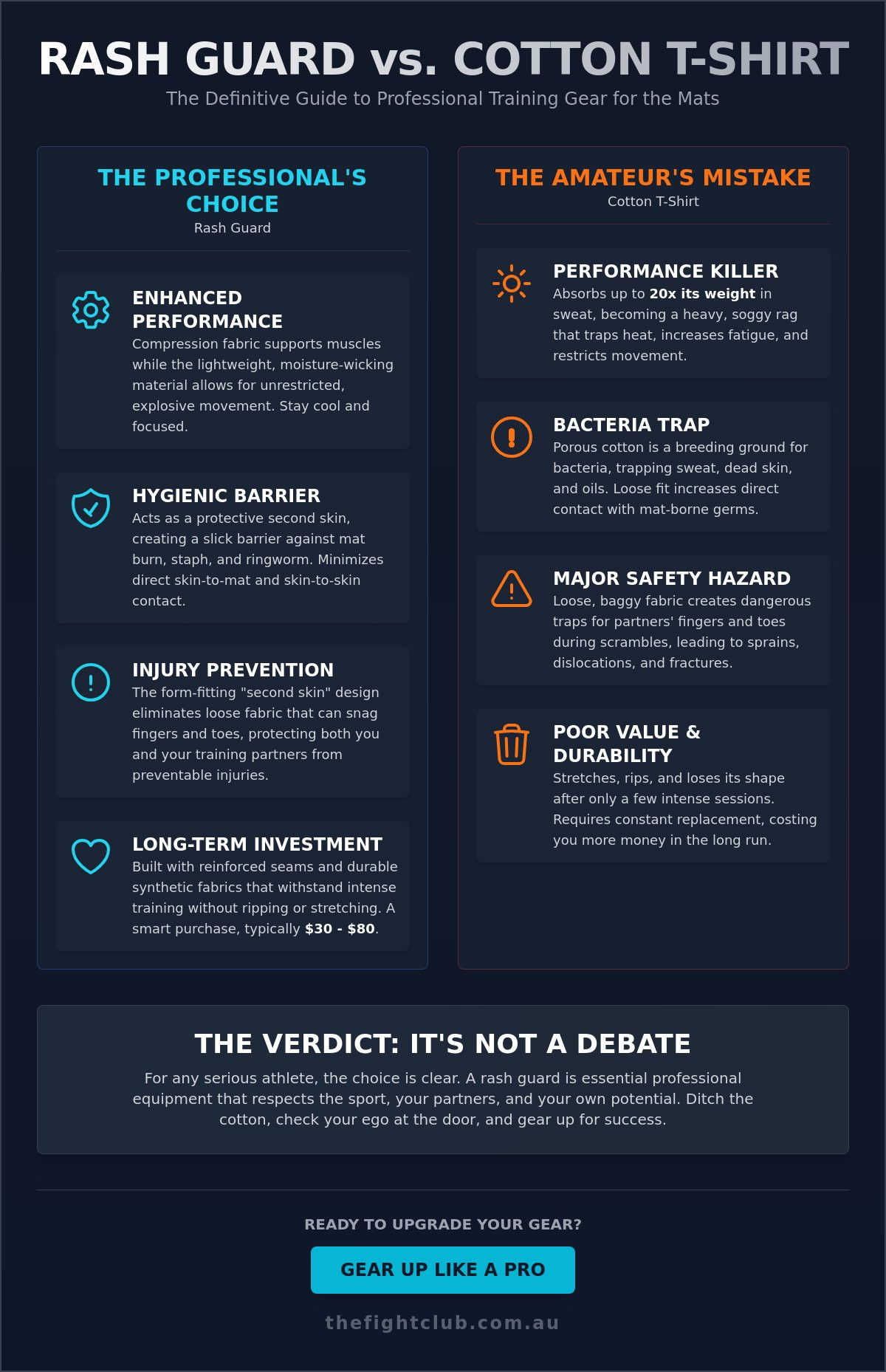
- Stop training in a heavy, wet sponge. Learn why cotton absorbs 20x its weight in sweat, making you slow, heavy, and unhygienic on the mats.
- Protect your partners from preventable injuries. Loose fabric acts as a trap for fingers and toes during technical scrambles, creating a safety hazard for everyone.
- Save money by investing in gear built for the grind. Professional fightwear features reinforced seams and durable fabrics that won't rip or stretch like a standard gym tee.
- Master the selection process for your next session. Look for silicone grippers and specific sleeve lengths to ensure your armour stays in place under pressure.
- Settle the debate of a rash guard vs t-shirt when training by choosing professional equipment that respects the craft and your teammates.
The Cotton Trap: Why Your T-Shirt is a Liability on the Mats
The mat doesn't lie. If you step onto the floor in a standard cotton tee, you've already compromised your performance. A t-shirt is a sponge designed for the couch, not the cage. When you're deciding between a rash guard vs t-shirt when training, you're choosing between professional equipment and a liability. To understand the technical difference, you have to look at what is a rash guard: a piece of high-performance compression gear built to withstand relentless friction and heavy sweat. It stays flush against your skin, moving with you as you transition from a sprawl to a shot. In contrast, cotton is a trap. By the end of your first round, that shirt has absorbed up to 20 times its weight in moisture. This "soggy towel" effect makes you heavy, slow, and dangerously slippery for your partners. At The Fight Club, we push a "No Egos" culture. Part of that means respecting the environment. Wearing a proper kit shows you're serious about the craft and the safety of the family training beside you.
Moisture Management: Wicking vs. Soaking
Success in combat sports is about managing your energy. Cotton is the enemy of efficiency. Standard t-shirts trap heat against your torso, causing your core temperature to spike and leading to premature fatigue. Professional gear utilises synthetic fibres like polyester and nylon that rely on capillary action. This process pulls sweat away from the body and pushes it to the surface of the fabric for rapid evaporation. When you're deep in the grind, staying dry provides a massive psychological edge. You stay cool. You stay focused on the technique rather than the heavy, wet rag clinging to your chest. If you're comparing a rash guard vs t-shirt when training, remember that one helps you breathe while the other suffocates your performance.
The Hygiene Factor: Protecting Your Skin
The gym floor is a shared space, and hygiene is a non-negotiable standard. Cotton is porous. It traps dead skin cells, oils, and bacteria, creating a perfect breeding ground for "mat funk" like staph and ringworm. Because t-shirts are loose, they allow direct skin-to-mat contact and skin-to-skin contact with your partners. A high-quality rash guard acts as a protective second skin. It provides a slick, durable barrier that prevents microbes from finding a home in your pores. It also shields you from the constant abrasions that lead to infections. Mat burn is a preventable friction injury caused by unprotected skin dragging across the mat surface. By choosing the right gear, you aren't just protecting yourself; you're ensuring the entire gym stays healthy and ready for the next round.
Physical Safety: Preventing Injuries to You and Your Partner
Training isn't just a solo mission. It's a pact of mutual respect between you and your partner. When you step on the mats, your gear choice dictates the risk level of every roll. Comparing a rash guard vs t-shirt when training reveals a massive gap in physical safety. Loose cotton creates "pockets." These are accidental traps for fingers and toes. During a high-speed transition or a double-leg takedown, a stray digit caught in a baggy sleeve can lead to a dislocation in a heartbeat. Professional gear eliminates these snag points. It follows the "second skin" philosophy. Nothing hangs loose. Nothing catches. You move as one unit. This streamlined profile is why Melbourne's premier gyms prioritise safety compliance through proper apparel. If you're transitioning to gi work, check out our BJJ Gi Guide 2026 to ensure your entire kit is up to standard.
Beyond snags, there's the danger of the "slip." A sweat-soaked t-shirt becomes a dangerously slick surface. You lose your grip. Your partner loses their balance. Sudden, uncontrolled movements are the leading cause of ligament tears and joint injuries. A rash guard provides consistent friction. It keeps your muscles compressed and warm, which is vital for preventing minor strains and pulls during explosive movements. Whether you're clinching in Muay Thai or fighting for position in BJJ, the right gear keeps the round controlled and professional. It's about maintaining the integrity of the technique.
Snags, Breaks, and Dislocated Joints
Think about a scramble. You're fighting for an underhook. Your partner's finger slides into your loose t-shirt collar. You pivot. They can't release. The result is a broken finger or a ruined season. This isn't theoretical; it's a consistent risk in gyms that allow casual attire. In MMA, where the clinch is tight and transitions are violent, loose fabric is an invitation for disaster. Your gear shouldn't be their injury risk. Investing in professional fightwear ensures that every movement is clean and every partner stays safe on the mat.
Friction Burn and Abrasions
Cotton is coarse. Under the pressure of a heavy cross-face or a tight triangle, that fabric acts like sandpaper. It causes "rug burn" on the neck, arms, and face. These abrasions aren't just painful; they're entry points for infection. Premium rash guards solve this with flatlock stitching. This technique creates seams that lie flat against the skin, eliminating chafing and irritation. It's the difference between leaving the gym with grit in your heart or leaving with raw, bleeding skin. Discipline requires focus. Don't let a cheap t-shirt distract you from the technique.
Performance and Durability: Why the 'Rashie' is Better Value
Stop buying gear twice. A standard cotton t-shirt might cost you $15 at a department store, but it's dead after three hard rounds of grappling. The mat is a meat grinder for cheap fabrics. When you evaluate a rash guard vs t-shirt when training, you have to look at the lifespan of the garment. Cotton necklines stretch out the moment someone secures a collar tie. The hem rips during a scramble. Before the month is over, your "cheap" training gear is a shredded rag. Professional fightwear is an investment in durability. It's built to survive the high-intensity friction that defines combat sports. This is about cost-per-wear. One high-quality rash guard will outlast a dozen t-shirts, making it the smarter financial move for any serious athlete.
Looking the part is about more than vanity; it's about discipline. At Melbourne’s premier training centres, showing up in professional gear signals that you've checked your ego and you're ready to work. It shows respect for the gym and your partners. You want to train like a fighter. That mindset starts the moment you put on your kit. When you feel "locked in," your focus shifts from your sagging shirt to your technique. Don't be the person constantly adjusting a loose collar while your partner is hunting for a submission. Gear up properly and stay in the fight.
Built for the Grind: Tensile Strength
The mat requires gear that can move in every direction without snapping. Standard gym shirts are designed for a light jog, not a 10-minute sparring round. They lose their shape after the first wash-and-dry cycle because the fibres aren't built for stress. Professional brands like Venum and Hayabusa use 4-way stretch fabrics that maintain their integrity under extreme tension. If you want to see how the world's best gear is engineered, check out our Venum Australia Brand Guide. These garments are designed to snap back to their original shape, round after round, year after year. They don't sag. They don't fail. They just perform.
Compression Benefits: Science or Hype?
Beyond the physics of durability, there's the science of performance. Compression technology isn't just a marketing buzzword. It serves a vital role in reducing muscle oscillation, the tiny vibrations that occur when your muscles impact the mat or take a strike. By limiting this movement, you reduce muscle fatigue and lower the risk of minor soft-tissue strains. A tight fit also eliminates "drag." In a rash guard vs t-shirt when training comparison, the t-shirt acts like a parachute, slowing down your transitions and giving your partner easy handles to grab. A rash guard makes you streamlined. You become harder to catch and faster to move, providing a clear edge in high-speed scrambles.
Choosing Your Armour: What to Look for in a Quality Rash Guard
The mat is a relentless teacher. If you show up with the wrong gear, you'll learn the hard way through skin infections or gear failure. Now that you understand the fundamental risks of a rash guard vs t-shirt when training, you need to know how to select your armour. Not all compression gear is built for the grind of a real gym. Professional-grade equipment is engineered with specific ratios and technical features that separate a serious athlete from a hobbyist. You're looking for a tool that survives the sweat, the friction, and the explosive movements of a five-minute round. Strip away the flashy marketing and focus on the technical specs that actually matter when the pressure is on.
Your first decision is the material blend. The industry standard for high-performance fightwear is an 80/20 or 85/15 split of polyester and spandex. This ratio provides the necessary tensile strength to resist tearing while offering enough elasticity to move with your body. Avoid "printed" logos at all costs. Standard screen printing cracks, peels, and scratches your training partners. Real gear uses sublimated graphics, where the ink is heat-pressed directly into the fabric fibres. This ensures the design never fades or fails, no matter how many times you hit the wash cycle. If you're ready to upgrade, explore our range of premium rash guards built for Melbourne's elite fighters.
Long Sleeve vs Short Sleeve: The Great Debate
Your choice of sleeve length should depend on your specific discipline. Long sleeves are the gold standard for Brazilian Jiu-Jitsu and grappling. They offer maximum skin-to-mat protection, reducing the risk of staph or ringworm by covering your forearms. They also provide extra friction, which can help you maintain a tight grip during a triangle choke or armbar. Short sleeves are often preferred for MMA and high-intensity striking sessions. They allow for better temperature regulation and prevent your arms from feeling restricted during clinching or heavy bag work. Choose based on your environment; if the gym is a furnace, go short. If you're rolling with twenty different partners, go long.
Technical Features Checklist
Before you commit to a piece of gear, run through this no-nonsense checklist. If it's missing these features, it belongs in a commercial fitness class, not a fight gym:
- Silicone Grippers: A non-negotiable waistband feature that prevents the rash guard from riding up to your chest during a scramble.
- Flatlock Seams: Reinforced stitching that lies flat against the skin to eliminate the chafing caused by traditional raised seams.
- Antimicrobial Treatment: Modern synthetic blends often include a coating that inhibits the growth of "mat funk" and keeps the stink at bay.
- Reinforced Panels: Look for double-stitched underarm and neck areas, as these are the primary failure points in lower-quality gear.
Discipline is about attention to detail. Every piece of kit you wear should serve a purpose. When you weigh up the technical build of a rash guard vs t-shirt when training, the winner is clear. One is a professional tool designed for survival; the other is a liability waiting to happen. Gear up, check your ego, and train like a fighter.
Gear Up at The Fight Club: Professional Kit for Real Fighters
The debate is over. You've seen the data on moisture absorption and the reality of finger-snag injuries. Choosing a rash guard vs t-shirt when training is the line between a hobbyist and a real athlete. At The Fight Club, we aren't interested in superficial fitness trends or commercialised "boxercise" aesthetics. We are Melbourne’s premier destination for authentic training gear because we live the lifestyle. Every brand we stock, from Budo Fight Gear to Humble Fightwear, has been vetted for its ability to survive the high-octane energy of a professional gym. We value substance over flash. If a seam can't handle a heavy clinch or a violent transition, it doesn't belong on our shelves. We provide the tools; you provide the grit.
Hayabusa and Venum: The Gold Standard
Hayabusa is built for the long haul. Their rash guards are the industry standard for durability, providing a compression fit that stays true through years of daily training. If you're a daily grinder, this is your kit. It's designed to withstand the "tough love" of a serious sparring session without losing its shape. Venum brings a different energy. It's about technical precision and a sharp, aggressive style that mirrors the intensity of a professional fighter. Whether it's the Venum x Mike Tyson collection or their standard elite range, the focus is on performance and protection. For a deeper dive into the technical requirements of modern combat gear, read our MMA Fight Store Guide. These brands aren't just names; they're the result of decades of engineering focused on keeping you safe and streamlined on the mats.
Ready to Roll?
The "No Egos" policy is our cornerstone. We treat every member of our community like family, providing the honest advice you need to make the right gear choices. We know that when you decide to upgrade, you want your gear now. That's why we promise fast shipping across Australia. Don't let another session go by in a heavy, bacteria-trapping cotton shirt. It's time to realise that your gear is an extension of your discipline. We carry everything from Venum Fight Shorts to Damage Control Mouth Guards to ensure your entire profile is professional. We've stripped away the fluff so you can focus on the technique.
Don't just show up to the gym. Gear up for the fight. The difference in how you feel, how you move, and how your partners respect you will be immediate. You've checked your ego at the door; now it's time to put on the armour that matches your mindset. Train like a fighter. The mats are waiting, and they don't care about your excuses. Start your transformation today.
Stop Compromising and Start Training
The mats are a place for discipline, not excuses. You've seen the risks. Cotton is a sponge for bacteria and a trap for stray fingers. Every round in a soggy tee makes you slower, heavier, and more prone to infections. Choosing a rash guard vs t-shirt when training is a commitment to your safety and the safety of your training partners. Professional armour provides the compression and durability needed to survive a real session. It's the difference between being a target and being a technician.
We are Australian-owned and operated. We only stock gear that survives the grind. From the technical precision of Venum to the legendary durability of Hayabusa, our range is built for serious athletes who value substance. We provide fast shipping on all fightwear orders to keep your momentum moving forward. Upgrade your training gear with professional rash guards at The Fight Club. Leave the ego and the cotton behind. Gear up. Train like a fighter.
Frequently Asked Questions
Can I wear a t-shirt for my first BJJ class?
You can wear a t-shirt for your first session, but don't make it a habit. Most gyms allow beginners to wear a basic tee for their trial class. You'll quickly notice it becomes heavy, wet, and restrictive within 10 minutes of live rolling. When deciding on a rash guard vs t-shirt when training for the first time, understand that cotton is a temporary fix. Swap to professional gear by your second week to ensure safety and hygiene.
Do rash guards actually prevent staph infections and ringworm?
Rash guards act as a critical physical barrier between your skin and the mat. While they don't kill bacteria, they prevent the direct skin-to-surface contact where staph and ringworm thrive. By reducing the frequency of mat burn and small abrasions, they eliminate the entry points for "mat funk." A 100% synthetic barrier is far more effective than porous cotton, which actually traps and holds bacteria against your body.
Should I buy a long-sleeve or short-sleeve rash guard for MMA?
Short sleeves are usually the better choice for high-intensity MMA striking. They allow for superior heat dissipation and prevent your arms from feeling restricted during clinching or heavy bag work. Long sleeves are the gold standard for BJJ and pure grappling sessions. They offer maximum coverage to prevent friction burn on your forearms and elbows. Base your choice on your primary discipline; if you're hitting the floor often, go long.
How should a rash guard fit? Should it be extremely tight?
Your gear must be skin-tight without restricting your breathing or range of motion. There should be zero loose fabric for a training partner's fingers or toes to catch during a scramble. A proper compression fit supports your muscles and ensures the silicone waistband stays locked in place. If the fabric is sagging or bunching up, it's a liability. It should feel like a second skin that moves with your technique.
How do I wash my rash guard to make it last longer?
Wash your gear in cold water immediately after every session. Never let a wet rash guard sit in your gym bag overnight; this allows bacteria to settle into the fibres. Hang the garment to dry in the shade rather than using a high-heat dryer. Excessive heat destroys the spandex and elastic components, leading to a loss of compression. Proper care ensures your kit survives the daily grind for years.
Are cheap rash guards from the department store good enough for training?
No, because they lack the tensile strength and reinforced stitching required for combat sports. Department store compression shirts are designed for light running or gym work. They will rip the moment someone secures a tight collar tie or attempts a takedown. Professional fightwear uses flatlock seams and specific 80/20 polyester blends to survive extreme friction. Investing in real gear now saves you from buying replacements every month.
Why do BJJ practitioners wear a rash guard under their Gi?
Wearing a rash guard under a Gi prevents the heavy cotton fabric from cheese-grating your skin during a roll. It manages moisture by wicking sweat away from your torso, preventing your Gi from becoming a heavy, waterlogged weight. This layer also provides an extra level of hygiene for you and your partners. It keeps the internal environment of the Gi cooler and more comfortable during long, technical sparring sessions.
What is the difference between a rash guard and a compression shirt?
Durability and construction are the primary differences. A rash guard is specifically engineered for the high-friction environment of grappling and MMA. It features reinforced panels, flatlock stitching, and sublimated graphics that won't crack. This distinction is critical when choosing a rash guard vs t-shirt when training; one is a professional tool built for the cage, while the other is a basic fitness garment. Stick to gear designed for the fight.