

How to Properly Tie a BJJ Belt: The Ultimate Step-by-Step Guide for 2026
Your belt is your first daily drill in discipline. Secure your rank, or you won't secure the submission. It's that simple. You've spent hours drilling the rear-naked choke, yet you're still fumbling with a loose knot that dies three minutes into the first roll. It looks sloppy. It breaks your focus. We've all been there, standing mid-mat looking like a day-one rookie because the gear won't stay put. Mastering how to properly tie a BJJ belt isn't a vanity project. It's about respect. It's about grit. It's about keeping your head in the fight.
We're here to fix the mess. This guide delivers a gritty, no-nonsense breakdown of the IBJJF-standard double knot to ensure your tails are even and your belt stays locked. We'll show you how to achieve perfect symmetry while honouring the traditions of the mat. You'll master the exact technique required to survive high-intensity sparring without your gi flapping open. Stop overthinking the basics. Learn the knot, secure your focus, and get back to the roll.
Key Takeaways
- Treat your rank with respect; a secure belt is the first step in mat discipline and mental focus.
- Master the fundamental mechanics of how to properly tie a BJJ belt to stop wasting time re-adjusting mid-roll.
- Level up with advanced locking methods like the Superlock to ensure your uniform survives the most aggressive sparring sessions.
- Achieve perfect symmetry and length to project confidence and maintain a technical edge over your opponent.
- Understand the difference between standard and premium armour so you can invest in gear that actually lasts.
The Foundation: Why Mastering Your BJJ Belt Knot Matters
Your belt is your history. It carries the sweat of every hard round and the grit of every defeat. It isn't just a strip of cotton; it's the physical record of your time on the mats. When you step into the gym, your gear speaks before you do. If your belt is hanging loose or dragging on the floor, you're projecting a lack of focus. Learning how to properly tie a BJJ belt is the first drill of the day. It’s a foundational skill that signals you're ready for the grind. This isn't about vanity. It's about establishing the discipline required to survive and thrive in a high-intensity environment. If you can't secure your own waist, you won't secure the win.
Tradition and Respect on the Mats
The Brazilian jiu-jitsu ranking system isn't just about the colour of the fabric around your waist. It represents a progression of skill, character, and perseverance. Tying your belt with precision is a sign of respect for your instructors and the lineage they represent. A messy uniform suggests a messy mind. In our world, we value substance over flash, but we never ignore the details. The simple act of tightening that knot acts as a mental trigger. It marks the transition from your daily life into training mode. You aren't just putting on clothes. You're armouring up for battle. This ritual helps you leave your ego at the door and enter the mats with a humble, ready-to-work mindset.
Functional Security During Sparring
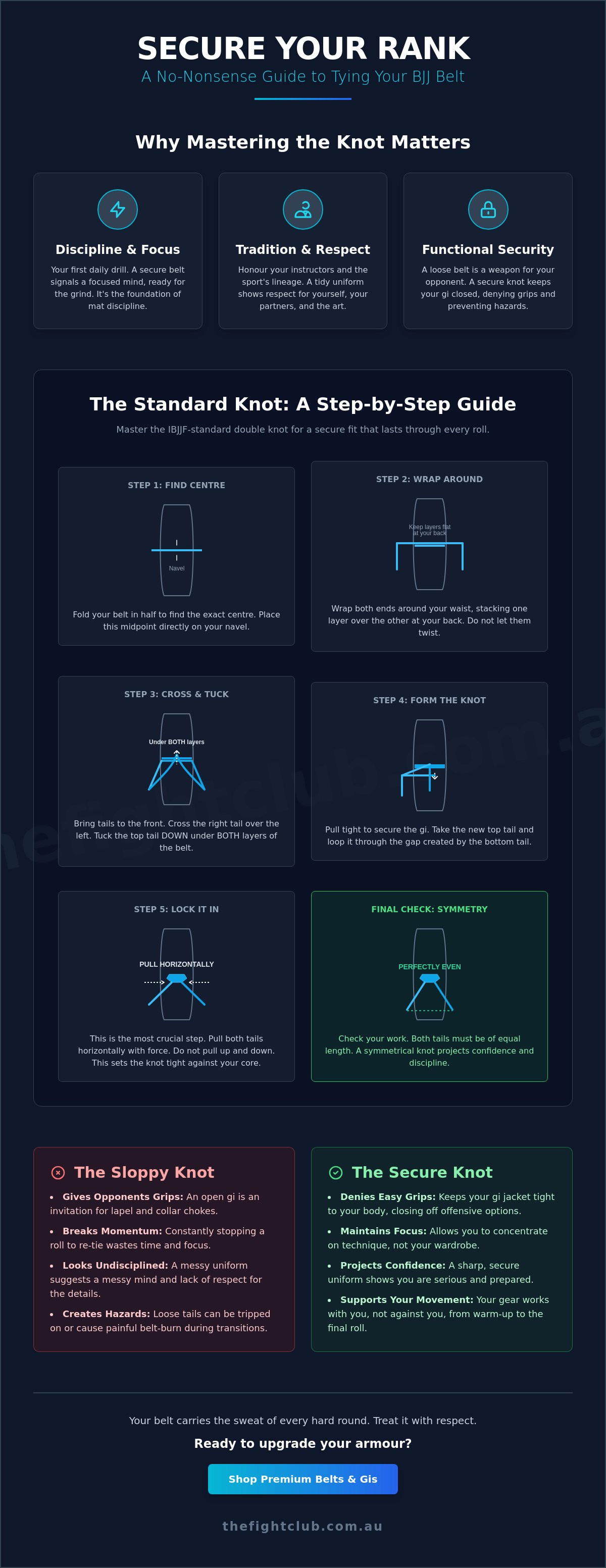
Function dictates form. A loose belt is a tactical error. When the knot fails, your Gi jacket opens up, giving your opponent immediate access to lapel grips. They'll use your own uniform to control your posture or set up a cross-collar choke with zero resistance. You're handing them weapons. A secure, properly tied belt keeps everything tight to your body. It prevents tripping hazards during wrestling exchanges and stops the annoying sting of belt-burn during ground transitions. Don't be the person who has to stop the roll every two minutes to fix their gear. It kills the momentum. It wastes your partner's time. Master how to properly tie a BJJ belt so you can keep your focus where it belongs: on the technique and the roll. Your gear should support your movement, not hinder it.
The Standard Knot: A Step-by-Step Guide for Beginners
The standard knot is your bread and butter. It is fast. It is simple. It is the universal baseline for every practitioner stepping onto the mats for technical drilling. While it might struggle to stay tight during a high-intensity shark tank, it is the go-to for daily classes and light rolling. Mastering how to properly tie a BJJ belt starts here. You need to ensure the belt stays flat against your lumbar spine. If the fabric is twisted or bunched, you will feel every lump the moment you play guard or take a heavy cross-face. Precision at this stage prevents distraction later.
Phase 1: Finding the Midpoint and Wrapping
Precision starts with balance. Fold your belt in half to find the exact centre point. Place that midpoint directly on your navel. Wrap both ends around your waist, passing them behind your back. Here is where most rookies fail: they let the belt criss-cross or twist at the rear. Do not do that. Keep the layers stacked directly on top of each other at the small of your back. This creates a single, clean band that provides consistent support and a professional appearance. This level of attention to detail is central to the Gracie Barra way and is expected in any elite academy. If your current kit is frayed or losing its structure, it might be time to upgrade your gear at The Fight Club before your next session.
Phase 2: The Over-Under and Final Lock
Bring both tails to the front. Cross the right tail over the left. Now, tuck that top tail under both layers of the belt, not just the top one. This is your anchor. If you only tuck it under the outer layer, the knot will disintegrate the moment you hit a shrimp or a bridge. Pull it tight to secure your Gi jacket. Next, take the top tail and loop it through the gap created by the bottom tail. This forms the heart of the knot.
The final step is the most important for security. Pull the tails horizontally with force. Do not pull up and down. Pulling out towards your sides sets the knot firmly against your core. Once locked, check your work. Both tails must be of equal length. Uneven tails look sloppy and suggest a rushed, undisciplined mind. When you are wearing high-tier armour like the Venum Elite BJJ Gi, you owe it to the craft to ensure your belt matches that standard. Mastering how to properly tie a BJJ belt with this method ensures you spend more time hunting submissions and less time fixing your clothes.
Beyond the Basics: The Superlock and Hollywood Knots
Standard knots are for warm-ups. When the round starts and the sweat pours, that basic knot becomes a liability. It slips. It trips you up. It forces you to stop and reset when you should be hunting for the back. If you want to master how to properly tie a BJJ belt for high-intensity sparring, you need to look beyond the beginner basics. Advanced knots aren't just about style. They are about engineering. You're building a friction lock that refuses to budge, no matter how many times you bridge, shrimp, or scramble. Choose your knot based on the mission. Use the Superlock for the grind and the Hollywood for the presentation.
The Superlock (Competition) Knot
The Hollywood (Symmetry) Knot
The Hollywood knot prioritises a clean, elite aesthetic without sacrificing the integrity of the hold. The key difference lies in the wrap. Instead of finding the midpoint, you start with one end at your navel and wrap the long end around your waist twice, stacking it perfectly. This ensures only one clean band of fabric is visible at the back. It eliminates the "criss-cross" look entirely. Once the wrap is complete, you finish with a standard or locking knot. This is the "pro" look. It is ideal for seminars, grading ceremonies, or high-profile photoshoots where you want your BJJ Gi to look its absolute best. Symmetry reflects a disciplined mind. When your gear is perfect, you project a level of confidence that rattles your opponent before the first grip is even taken. Mastering how to properly tie a BJJ belt using these advanced methods separates the hobbyists from the dedicated practitioners.
Troubleshooting Your Gear: Length, Symmetry, and Maintenance
Even if you know how to properly tie a BJJ belt, the wrong gear will fail you. Your belt is a tool. If it is too long, you are giving your opponent a free handle to control your hips. If it is too short, the knot will pop under the slightest pressure. Symmetry isn't just about looking sharp for the instructor. It is about tension. An uneven belt pulls on your Gi jacket inconsistently, creating gaps in your armour. You need gear that fits your body and your intensity. Don't settle for "close enough" when you're stepping into a high-stakes roll.
Selecting the Correct Belt Length
Fitment starts with the right size. Most manufacturers align belt sizes with Gi sizes, ranging from A0 to A5. However, body types vary. Use the "two-fist" rule: once tied, each tail should hang roughly 20 to 30 cm from the knot. This is the official IBJJF standard. It ensures the belt is long enough to stay secure but short enough to avoid being a tripping hazard during stand-up exchanges. If you are between sizes, always buy larger. High-quality cotton belts will shrink. Expect a 5% to 10% reduction in length after the first few wash cycles. If your current belt is dragging or barely reaching the second loop, it is time to upgrade your BJJ gear to ensure your performance isn't hindered by poor fitment.
- A0-A1: Typically for smaller frames or featherweights.
- A2-A3: The standard for average to athletic builds.
- A4-A5: Designed for heavyweights and ultra-heavyweights.
The Great Belt Washing Debate
Let's kill the myth right now. Washing your belt does not wash away your knowledge. Knowledge lives in your muscle memory, not in a strip of sweat-soaked cotton. Refusing to wash your belt is a fast track to spreading staph, ringworm, and MRSA. Hygiene is a non-negotiable part of the mats. A dirty belt is a biological hazard to you and your training partners. We value community and respect; that starts with showing up clean. There is no room for ego or superstition when it comes to the safety of the gym.
To maintain your rank without ruining the fabric, wash your belt in cold water with similar colours. Avoid the dryer at all costs. High heat will bake the sweat in and cause the internal stiffeners to warp or the rank bar to peel. Hang it to dry in a well-ventilated area. If you notice the ends starting to fray excessively or the core of the belt becoming visible, it has reached the end of its functional life. A belt that can't hold a knot is a belt that belongs in a frame, not on your waist. Knowing how to properly tie a BJJ belt includes knowing when to replace it.
Gear Up for the Mats: Quality Belts and Gis
Your gear is your armour. Don't settle for subpar equipment that fails when the pressure is on. You now know how to properly tie a BJJ belt, but that technical knowledge is useless if your belt is a flimsy strip of cheap cotton. High-quality gear is designed to withstand the daily grind of the Australian BJJ scene. It holds its shape. It stays locked. It reflects the respect you have for your journey and your training partners. Buy for durability. Train for longevity. When you step onto the mats, your equipment should be the last thing on your mind.
Choosing a Belt that Lasts
Not all belts are created equal. Stiff competition belts offer maximum security once the knot is set. They take time to break in, but they refuse to budge during a heavy scramble. Soft pro belts are more pliable from day one. They are more comfortable but often require an advanced knot like the Superlock to stay put. Look for reinforced stitching along the edges to prevent the fabric from rolling or folding over itself. Check the rank bar. That black sleeve needs to be durable enough to hold your stripes through years of friction and laundry cycles. A premium belt doesn't just represent rank; it provides the structural integrity needed for high-intensity training. It is a tool of the trade. Treat it as such.
The Ultimate Kit: Combining Your Belt and Gi
A secure knot requires a solid foundation. Pairing your belt with a Venum Elite BJJ Gi creates a fortress. This Gi is built for the professional combat environment. It is pearl weave, lightweight, and incredibly tough. When the fabric of the Gi is high-tier, the belt has more surface area to bite into, ensuring the knot stays centred. Ritualise your preparation before every class. Ensure your mouth guard is in before you even touch your belt. This sequence prepares your mind for the work ahead.
Every piece of gear should be checked and secured before you step into the light. When you are fully equipped with authentic, technique-driven gear, you can push past your limits with total confidence. Final check: is your gear ready for the intensity of The Fight Club? If there is any doubt, fix it before the timer starts. Mastery of how to properly tie a BJJ belt is only the beginning of your technical evolution. Secure your rank. Secure your Gi. Secure the win.
Lock in Your Focus and Dominate the Roll
Tying your belt is more than a pre-class requirement. It is a commitment to the details. You've learned how to properly tie a BJJ belt using both foundational and competition-ready methods. You now understand that symmetry reflects a disciplined mind and that a secure knot prevents tactical disadvantages during a scramble. Don't let your gear be the reason you lose a position. Respect the mats by maintaining your kit and replacing worn-out equipment before it fails you. Discipline starts before you step onto the mat.
We are Australian owned and operated, dedicated to providing the grit and authenticity the local combat community demands. We stock heavy hitters like Venum, Hayabusa, and UFC gear to ensure your armour matches your ambition. With fast shipping across Australia, you won't be waiting long to upgrade. Secure your rank with premium BJJ gear at The Fight Club. Get back to the grind. The mats are waiting.
Frequently Asked Questions
How long should a BJJ belt be after it is tied?
Each end of your belt must hang between 20 to 30 cm from the knot according to IBJJF standards. This length ensures the knot is secure without becoming a tripping hazard or giving your opponent too much material to grab. Measure from the edge of the knot to the tip of the belt to confirm you are within the legal competition range.
Can I wash my BJJ belt, or will it lose its 'power'?
Wash your belt after every single session to eliminate the risk of staph, ringworm, and MRSA. The idea that washing a belt removes your "knowledge" or "power" is a dangerous myth that compromises gym hygiene. Respect your training partners by showing up with clean gear. Use a cold wash and hang it to dry to prevent the inner core from warping.
What is the difference between a Standard knot and a Superlock knot?
The standard knot is a quick, traditional tie suitable for technical drilling, whereas the Superlock feeds the tails between the belt layers to create a friction-based anchor. The Superlock is virtually impossible to undo during a scramble. Use the standard version for light days and the Superlock when you are heading into high-intensity sparring or a tournament.
Why does my BJJ belt keep falling off during training?
Your belt falls off because you are likely pulling the tails vertically rather than horizontally when finishing the knot. Pulling out toward your sides locks the fabric against your core. If you use a thin, low-quality belt, the lack of structural integrity also contributes to knot failure. Switch to a locking knot and pull with maximum force to set the tie.
What size BJJ belt should I buy if I wear an A2 Gi?
An A2 belt is the standard choice for an A2 Gi, but you must account for potential shrinkage. Most high-quality cotton belts will shrink by roughly 5% to 10% after several wash cycles. If you are at the upper limit of the A2 weight class, consider sizing up to an A3 to ensure you have enough tail length for a proper hang.
Is there a specific way to tie a belt for BJJ competitions?
IBJJF regulations require the belt to be wrapped twice around your waist and secured with a double knot. While the Superlock is legal and highly recommended for its security, the official focus is on the knot staying tied and the tails being the correct length. A belt coming undone repeatedly can result in penalties or a loss of focus during the match.
Do I need a different knot for a thick competition belt versus a thin one?
Thick competition belts require a more aggressive locking technique because the stiff fabric naturally resists staying coiled. Learning how to properly tie a BJJ belt with a Superlock is almost mandatory for premium, heavy-weave belts. Thinner belts are easier to tie with a standard knot but they offer less protection and can feel flimsy during heavy grip fighting.
What should I do if my BJJ belt is way too long?
Use the Hollywood wrap method to take up the extra slack by wrapping the belt twice around your waist before finishing the knot. This consumes more material than the standard midpoint wrap and provides a cleaner look. Never cut your belt. Cutting ruins the reinforced stitching and destroys the rank bar, making the belt functionally useless and disrespectful to the tradition.