

How to Air Out Sweaty Gear: Fighter's Guide to Longevity
Your gear is an extension of your discipline. If you don't respect it, it won't respect you when the rounds get tough. That sharp, stinging stench inside your gym bag isn't a badge of honour. It's the smell of bacteria eating through your investment. Whether you're rocking Hayabusa T3 Boxing Gloves or a Venum Gi, letting moisture sit is the fastest way to ruin expensive leather and compromise protective foam. It's time to treat your kit with the same level of focus you bring to the mats.
We know the frustration of skin irritation and the embarrassment of a bag that reeks before you even unzip it. Learning how to air out sweaty gear is not just a chore; it's a protocol for longevity. This guide provides the essential steps to eliminate foul odours and stop microbial growth in its tracks. You'll master the specific drying techniques and maintenance habits used by professionals to keep their equipment fresh. From immediate post-training care to deep cleaning cycles, we're stripping away the fluff to give you a clear, no-nonsense roadmap for gear survival. At The Fight Club, we're committed to helping you protect your kit with the best advice and fast shipping across Australia. We even offer free shipping on orders over $180, though this excludes bulky or heavy items.
Key Takeaways
- Stop bacterial colonies from rotting your foam padding by understanding the science behind the perma-stink.
- Respect the 30-minute window and learn why your gym bag is for transport only, never for long-term storage.
- Master the essential protocols for how to air out sweaty gear to ensure internal linings and finger pockets dry completely.
- Discover which advanced tools, from cedar inserts to antimicrobial sprays, actually protect your investment from the inside out.
- Learn why gear built with superior ventilation, like the Hayabusa T3 range, is the ultimate defence against moisture breakdown.
The Science of Stink: Why Sweaty Gear Rots
That sharp, vinegary smell in your gym bag isn't a badge of honour. It's a warning. When you finish a heavy sparring session, your gloves and shin guards are saturated. If you don't know how to air out sweaty gear, you're essentially building a petri dish for microbes. Sweat itself is mostly water and salt, but it provides the perfect environment for microscopic life. Understanding the science of body odor helps you realise that bacteria are the real culprits. They consume the proteins and lipids in your sweat, releasing foul gases as a byproduct. This "perma-stink" isn't just a surface issue. It's a thriving bacterial colony embedded deep within your equipment.
Moisture is the primary enemy of gear performance. High-density foam, found in premium brands like Venum and Hayabusa, has a specific cellular structure designed to disperse impact. Constant dampness causes these cells to soften and lose their structural integrity. Your gloves become flat, offering less protection for your knuckles and your partner's face. Salt adds another layer of destruction. As sweat evaporates, it leaves behind abrasive crystals. These salts strip the natural oils from leather surfaces, leading to brittleness and deep cracks. You aren't just fighting an opponent; you're fighting chemical decay from the inside out.
Bacteria vs. Materials
Synthetic fabrics often trap odours more aggressively than natural leather. While moisture-wicking linings in gear like the Hayabusa T3 are engineered to pull sweat away from your skin, they don't make that moisture disappear. It has to go somewhere. If that moisture stays trapped in the fibres, it creates a stagnant, swampy environment. Salt acts as a desiccant, pulling vital moisture out of the leather exterior while keeping the internal padding damp. This creates a destructive cycle where the outside of your gear cracks while the internal foam rots. Proper maintenance is the only way to break this loop.
The Hygiene Factor
Neglected gear is a breeding ground for more than just bad smells. Staph infections, ringworm, and impetigo thrive in the dark, warm corners of a damp gym bag. These aren't just minor inconveniences. They are serious medical issues that can sideline your training for weeks or spread through your entire gym community. Masking the scent with a basic deodoriser is a dangerous habit. You're simply layering fragrance over a biohazard without neutralising the bacteria. The danger zone for bacterial growth is any damp, unventilated space kept between 20 and 40 degrees Celsius.
The Immediate Post-Session Protocol
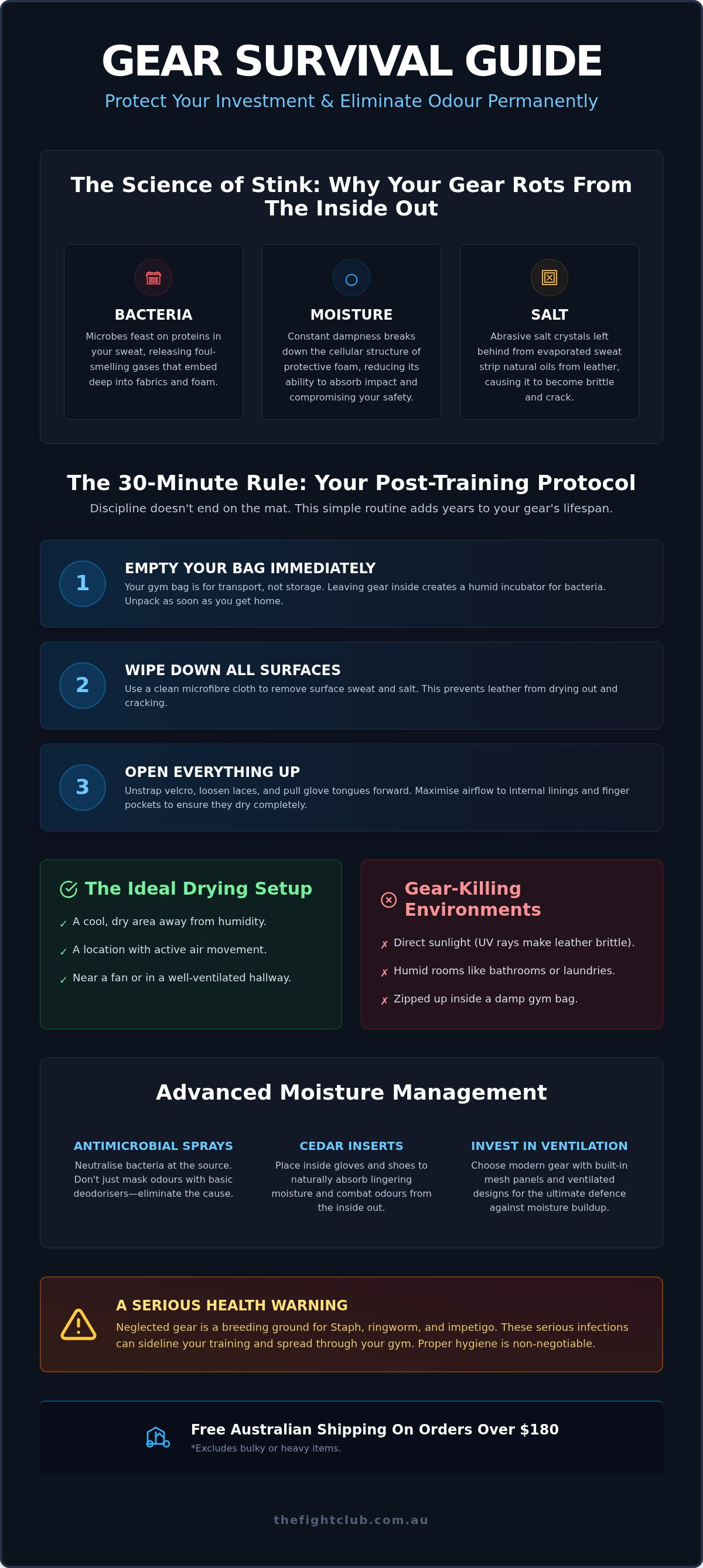
The final bell rings. You're drained. Your first instinct is to throw your soaked gear into your bag and head for the shower. Stop. Your gym bag is a transport tool, not a locker. Leaving your kit zipped up in a dark, damp bag is a death sentence for high-quality materials. It creates a humid microclimate where bacteria thrive and foam begins to break down. You have a 30-minute window to get your equipment out and exposed to the air before the "perma-stink" takes hold permanently.
Discipline doesn't end when you leave the mats. Mastering how to air out sweaty gear requires a consistent post-training habit. Start by wiping down every surface. Sweat contains high concentrations of salt that, if left to dry, will strip the oils from your leather and cause deep, irreparable cracks. This attention to detail is as vital as cleaning and disinfecting your child's equipment or your own pro-grade kit. Clear the surface moisture first, then focus on the internal drying process.
The "Five-Minute" Routine
Integrate these steps into your daily training flow. First, empty your bag completely as soon as you get home. Don't leave your wraps bunched up inside your gloves. Second, use a clean microfibre cloth to buff away surface sweat. Third, open every closure. Pull the tongues of your gloves forward. Unstrap every Velcro piece on your shin guards. If you use lace-up gloves, loosen them entirely to allow the finger pockets to breathe. This simple routine adds months, if not years, to the lifespan of your equipment.
Finding the Right Drying Spot
Location is everything. While it's tempting to leave your gear on the porch, direct sunlight is a silent killer. UV rays are excellent at killing bacteria, but they also bake the leather, making it brittle and prone to peeling. You need a cool, dry area with active air movement. Avoid humid environments like the laundry or bathroom. A spot near a fan or a well-ventilated hallway is ideal. If you're looking to upgrade to more breathable equipment, you can find the latest combat sports gear at The Fight Club. Remember, we offer free shipping across Australia on orders over $180, excluding bulky or heavy items. Keep your kit dry, and it will keep you protected.
Gear-Specific Airing Techniques
Every piece of equipment has its own breaking point. You can't treat a BJJ Gi like a pair of shin guards. Each item requires a tailored approach to ensure the internal components dry as fast as the exterior. If you want to know how to air out sweaty gear properly, you must understand where moisture hides. For boxing gloves, it's the finger pockets. For shin guards, it's the synthetic lining. For headgear, it's the ear and chin guards. Neglect these spots, and you're just inviting rot to settle in. Discipline doesn't stop at the gym door. It follows you home to the gear rack.
Deep-Drying Boxing Gloves
Boxing gloves are the hardest to maintain. The internal padding is dense. Airflow is minimal. To combat this, use glove dogs or cedar inserts. These tools pull moisture from the deep thumb and finger pockets where your hand generates the most heat. The Hayabusa T3 Boxing Gloves are specifically designed with advanced moisture-wicking linings and ventilation holes to assist this process. Don't just leave them on the floor. Prop them open in front of a fan. This "fan method" creates a constant stream of dry air into the glove cavity without using heat, which can damage the leather or foam integrity.
Shin Guards and Headgear
Shin guards often rot from the back. The strike surface is usually fine, but the lining that touches your skin absorbs litres of sweat over a month of training. Lay them flat with the lining facing up. This exposes the absorbent material to the air. Headgear is similar. The areas around the ears and chin are notorious sweat-traps. Wipe down the internal padding after every single round. Ensure the straps are not folded over damp sections during the drying process. If you're looking for a fresh kit, we offer fast national shipping and free Australian shipping on orders over $180, though this excludes bulky or heavy items.
The BJJ Gi and Rash Guard
Never leave a wet Gi in a ball. It's the fastest way to develop a "mildew funk" that never leaves the fabric. Hang your Gi on a heavy-duty hanger immediately to prevent "stiff-drying." Air-drying is always superior to machine drying for longevity. High heat shrinks the fabric and ruins the structural integrity of the collar. If you're choosing your next kit, check out our BJJ Gi Guide 2026 to find the right armour for the mats. Protecting the fit is as important as protecting the hygiene. A well-maintained Gi stays soft, moves with you, and lasts for years of hard rolls.
Advanced Tools for Moisture Management
Mastering how to air out sweaty gear requires more than just a well-ventilated room. Sometimes, the environment needs a push. If you're training multiple times a day or living in high humidity, passive drying isn't enough. You need tools that actively fight bacterial bloom and strip moisture from the deep padding of your Venum Elite Boxing Gloves or shin guards. It's about efficiency. It's about protecting your kit so it can protect you. High-performance gear deserves high-performance maintenance. Don't let your investment rot because you relied on luck instead of a protocol.
Absorbents are your first line of secondary defence. While silica gel is a common desiccant, it's often too clinical for the rugged needs of a fighter. Cedar chips are the superior choice. They don't just absorb liquid; they release natural oils that kill bacteria on contact. If your gear has already developed a deep-seated funk, charcoal is the king of neutralisation. It acts as a molecular filter, trapping odours that sprays simply can't reach. These aren't just "hacks." They are essential components of a professional gear-care kit.
Cedar and Charcoal Inserts
Cedar inserts, often called "glove dogs," are non-negotiable for anyone serious about longevity. The cedar pulls moisture out of the internal lining while leaving a fresh, natural scent. It's a massive upgrade over synthetic deodorisers. Charcoal bags offer a similar benefit but focus on the heavy-duty removal of volatile organic compounds. For fighters on a budget, you can create DIY inserts by filling clean socks with cedar shavings or activated charcoal pellets. It's a low-cost solution that prevents high-cost damage to your leather and foam.
Mechanical Airflow
Passive air is slow. Active air is fast. Positioning a dedicated floor fan in front of your gear rack can cut drying time by 60 percent. This rapid evaporation prevents bacteria from colonising the damp interior of your headgear or gloves. Avoid the temptation to use hair dryers or space heaters. Intense, concentrated heat is a silent killer for premium leather; it cooks the fibres and leads to immediate cracking. The optimal temperature for drying fight gear is a consistent room temperature between 18 and 24 degrees Celsius with active ventilation. This range preserves the flexibility of the material while ensuring the moisture is gone before your next session. Much like how a high-end electric humidor UAE provides the precise climate control needed for luxury items, maintaining these specific conditions for your gear is the only way to prevent structural decay.
Stop settling for gear that smells like a biohazard. Buy professional-grade maintenance tools and equipment at The Fight Club to ensure your kit lasts the distance. We offer fast national shipping across Australia, with free shipping on orders over $180, excluding bulky or heavy items.
Cheap gear is a false economy. Entry-level equipment often uses low-grade synthetic materials that act like a sponge for bacteria. These materials lack the structural integrity to handle constant moisture. The result is a permanent stench that no amount of cleaning can fix. Professional-grade equipment is engineered with the fighter mindset in view. It is built to breathe. It is built to last. When you invest in quality, you are buying time and performance. Even if you follow every protocol on how to air out sweaty gear, low-grade synthetics will eventually fail under the pressure of daily training.
The Hayabusa T3 Boxing Gloves represent the pinnacle of this engineering. They feature XT2 antimicrobial linings that don't just sit there; they actively inhibit the growth of odour-causing bacteria. Combined with strategic ventilation holes, they allow for rapid moisture evaporation. These design choices give you a massive head start in the fight against decay. Similarly, the Venum Elite series uses high-quality leather that resists the abrasive effects of salt and high Australian humidity. This gear is designed to survive the toughest sessions while maintaining its shape and hygiene.
Features to Look For
- Antimicrobial inner linings that stop bacteria from colonising the deep foam padding.
- Perforated palms and mesh panels that create natural cross-ventilation during and after your workout.
- Genuine leather or high-grade semi-leather that maintains breathability without cracking under salt stress.
The Fight Club Standard
We don't stock gear that can't handle the grind. At The Fight Club, we specialise in professional-grade equipment because we respect the effort you put in on the mats. Quality gear requires less daily maintenance, but it still demands respect. We are an Australian-owned and operated retailer dedicated to bringing you the best from brands like Venum and Hayabusa. Our commitment is to provide gear that lives up to the intensity of your training hall, not a standard commercial gym.
Elevate your training and stop fighting the funk. Upgrade your kit with Hayabusa T3 Boxing Gloves today. We provide fast national shipping across Australia to get you back in the cage or on the mats quickly. Plus, enjoy free Australian shipping on orders of $180 or more. Just remember that this specific offer excludes bulky or heavy items. Your gear is your armour. Choose the kit that survives the grind.
Protect Your Armour
Respecting your gear is a fundamental part of the fighter mindset. You now understand that the perma-stink is a living bacterial colony and that the 30-minute window after training is your most critical time for maintenance. By mastering how to air out sweaty gear with active airflow and absorbent tools like cedar inserts, you ensure your kit stays as sharp as your technique. Discipline doesn't end when you leave the mats. It continues until your gear is dry and ready for the next round.
Don't let poor maintenance or low-quality materials sideline your progress. The Fight Club is a proud Australian owned and operated retailer stocking world-leading brands like Hayabusa and Venum. We provide fast national delivery so you can stay focused on the grind. We also offer free Australian shipping on orders over $180, though this offer excludes bulky or heavy items. Treat your equipment with the respect it deserves. It'll protect you when the pressure is on.
Shop Premium Fight Gear at The Fight Club today. Keep training hard, stay humble, and let your work do the talking.
Frequently Asked Questions
Can I put my boxing gloves in the washing machine?
Never put your boxing gloves in a washing machine. The saturation destroys the cellular structure of the high-density foam and causes leather to peel or crack. Submerging them leads to water being trapped deep inside the padding, which is impossible to dry before rot sets in. Instead, focus on how to air out sweaty gear using the manual wipe-down and fan methods discussed earlier. Stick to surface cleaning and internal absorbents to maintain integrity.
How long does it take for fight gear to fully air out?
Most combat equipment requires 24 hours to dry completely in a well-ventilated room. If you are training twice a day, you need a second set of gear to ensure rotation. High humidity can extend this timeframe significantly. Using active airflow from a floor fan can cut this duration by up to 60 percent. Never pack your gear back into a bag until it is bone dry to the touch, especially in the finger pockets.
Will direct sunlight kill the bacteria in my sweaty gear?
Direct sunlight kills bacteria through UV exposure, but it's a death sentence for your gear. UV rays bake the natural oils out of leather and synthetic materials, leading to brittleness and deep cracks. It also compromises the adhesives used in the foam layers. The best way to manage how to air out sweaty gear is in a cool, dry indoor spot with a fan. Save the sun for your laundry, not your gloves.
Is it okay to use disinfectant wipes on leather shin guards?
You can use disinfectant wipes on shin guards, but choose alcohol-free options to protect the material. Harsh chemicals strip the protective finish from the surface, making the guards more susceptible to moisture absorption over time. Always wipe away any chemical residue with a damp cloth afterward. For premium leather guards, follow up with a leather conditioner once a month to keep the material supple and resistant to the salt in your sweat.
Why do my gloves still smell even after I air them out?
Gloves that still smell after airing usually have a deep-seated bacterial colony living inside the foam padding. Once bacteria penetrate the core, surface cleaning won't reach them. This often happens if you've left gear in a zipped bag for too long. You can try charcoal inserts to neutralise the odour, but if the foam has started to soften or crumble, it's a sign that the structural integrity is gone. At this point, the gear is a biohazard.
What is the best way to dry a heavy BJJ Gi without a dryer?
Hang your BJJ Gi on a wide, heavy-duty plastic or wooden hanger to maximise surface area exposure. Avoid thin wire hangers that can stretch the shoulders of a heavy, wet Gi. Position it in a doorway or in front of a fan to ensure air moves through the thick lapels and underarms. Never leave a wet Gi folded or bunched up. This prevents the "stiff-dry" texture and stops mildew from forming in the heavy cotton weave.
Should I use fabric softener on my rash guards?
Never use fabric softener on your rash guards or compression gear. The chemicals in softeners leave a waxy coating on the fibres that clogs the moisture-wicking channels. This makes the fabric less breathable and traps sweat against your skin, increasing the risk of irritation and infections. Stick to a high-quality detergent and air-dry them. This preserves the elasticity and technical performance of the fabric for hundreds of sessions without compromising the fit.
How often should I replace my combat gear if it smells?
Replace your gear when the smell becomes a permanent "bio-funk" or when the padding fails to protect you. If you can feel your knuckles through the foam or if the shin guard straps no longer hold, the equipment is compromised. Most professional-grade gear lasts 1 to 2 years with heavy use and proper maintenance. If you need an upgrade, we offer fast national shipping and free shipping on orders over $180, excluding bulky or heavy items.