

Complete Jiu Jitsu Belt Guide for Adults and Kids (2026)
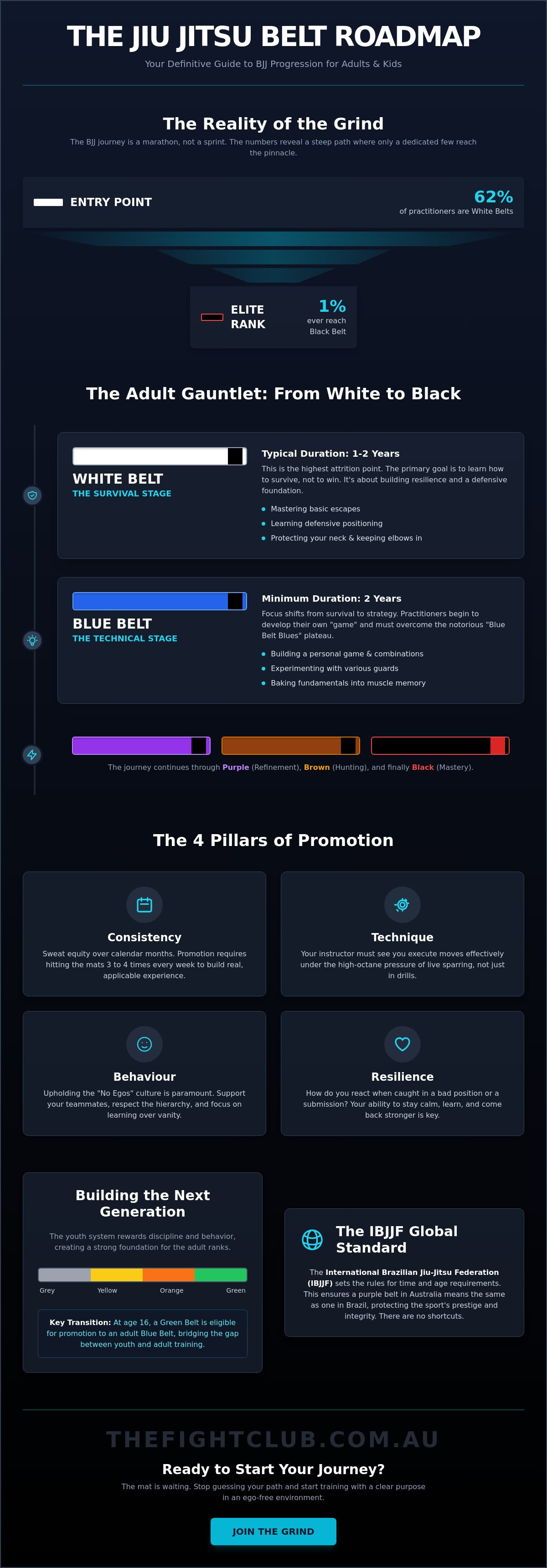
Did you know that 62% of practitioners currently hold a white belt, yet only 1% ever reach the elite rank of black belt? That is a brutal reality check for anyone stepping onto the mats in 2026. You are likely feeling the grind already. Perhaps you are confused by the complex youth belt colours or worried about being stuck as a "forever white belt" without a clear path forward. It is normal to feel lost when the requirements for your next stripe seem like a guarded secret. This Complete Jiu Jitsu Belt Guide for Adults and Kids is your definitive roadmap. No fluff; just the raw facts you need to progress.
We agree that the ranking system should be transparent, not a source of anxiety. We promise to break down the IBJJF standards so you know exactly what is expected at every level, from the initial white belt basics to the disciplined brown belt hunt. You will learn the specific age requirements for kids, such as the transition from green to blue at age 16, and the minimum timeframes required for adult promotions. We also preview the essential gear you need to buy for each stage, ensuring you look like a professional while you train like a fighter. Let’s get to work.
Key Takeaways
- Define your rank through technical proficiency and mat time, moving from the survival grind of white belt to building a personal game at blue.
- Decode the youth ranking system from grey to green to ensure your kids are rewarded for their discipline and behaviour on the mats.
- Master the promotion process and the "Four Stripe" rule using this Complete Jiu Jitsu Belt Guide for Adults and Kids to map your journey.
- Protect your progress by selecting durable, high-quality armour that survives the sweat and friction of daily training without fraying or fading.
- Shift your mindset from a beginner to a disciplined practitioner by understanding the technical milestones required to move through the ranks.
Table of Contents
- Understanding the Brazilian Jiu Jitsu Ranking System
- The Adult BJJ Belt Order: From White to Black
- The Kids Jiu Jitsu Belt System: Building the Next Generation
- Stripes, Promotions, and the Reality of the Grind
- Choosing Your Armour: Quality Belts for Every Rank
Understanding the Brazilian Jiu Jitsu Ranking System
The Brazilian Jiu-Jitsu ranking system is the most rigorous ranking hierarchy in martial arts. Period. Unlike other disciplines where you might collect a black belt in three years, BJJ demands a decade of your life. This Complete Jiu Jitsu Belt Guide for Adults and Kids exists because this sport is notoriously conservative with promotions. We don't hand out belts for showing up. We hand them out for technical integrity. Your belt is a living record of every submission you've escaped and every round you've fought. It is a symbol of technical proficiency forged through thousands of hours on the mat. In 2026, even with the massive boom in popularity, the standard remains unshakable. You must earn every inch of progress.
At the core of this journey is our "No Egos" policy. A belt colour is just a piece of dyed cotton if there is no skill behind it. You might see a white belt tap a blue belt. It happens. The Brazilian Jiu-Jitsu ranking system prioritises realness over vanity. If you focus on the colour around your waist instead of the technique in your hands, you've already lost the fight. We value grit and discipline over social media status. We expect you to support your teammates, respect the hierarchy, and keep your head down. Train like a fighter; the rank will follow naturally as your game evolves.
The Role of the IBJJF
The International Brazilian Jiu-Jitsu Federation (IBJJF) sets the global standard that Australia's premier academies follow. These rules ensure that a purple belt in Australia means the same thing as a purple belt in Brazil or the United States. Most Australian gyms adhere to specific IBJJF timeframes and age requirements to protect the sport’s prestige. While a "competitive" rank might require a certain number of tournament medals, "hobbyist" progression still demands the same technical mastery. There are no shortcuts here. The IBJJF framework provides the structure, but your performance on the mats provides the proof.
Mat Hours vs. Calendar Months
Time served is not the same as work done. You cannot simply wait out the months to get your blue belt. You need sweat equity. Showing up consistently is the only way to move forward. In the Australian BJJ community, we value the grind over the calendar. If you train once a week, those "minimum time" rules don't apply to you. Your instructor’s word is final. They see your grit, your discipline, and your evolution during sparring sessions. They decide when you are ready to lead the next generation. Consider these factors for your promotion:
- Consistency: Are you hitting the mats 3 to 4 times every week?
- Technique: Can you execute moves under the high-octane pressure of live rolling?
- Behaviour: Do you uphold the "No Egos" culture of the gym?
- Resilience: How do you handle being caught in a submission?
The Adult BJJ Belt Order: From White to Black
The adult ranking system is a gauntlet. It starts at white belt, the survival stage. You will spend your first 1 to 2 years learning how to breathe while someone much heavier tries to crush your spirit. You focus on basic escapes and defensive positioning because you can't attack if you can't survive. This Complete Jiu Jitsu Belt Guide for Adults and Kids identifies this as the highest attrition point in the sport. If you survive the pressure, you earn your blue belt. This is the technical stage. You begin building a personal game and experimenting with various guards. But beware of the "Blue Belt Blues." Many practitioners quit here when the "newness" wears off and the real work begins. You must push through the plateau to reach the elite ranks.
White and Blue: The Foundation
Success at the lower ranks is built on grit. White belts must master the art of being uncomfortable. You learn to protect your neck and keep your elbows in. When you transition to blue, you start to realise which techniques actually work for your body type. The IBJJF Graduation System mandates a minimum of 2 years at blue belt for a reason. You need that time to bake the fundamentals into your muscle memory. Don't rush the process. If you are ready to test your foundation in an ego-free environment, join our Sydney community and start the grind.
Purple, Brown, and Black: The Elite Ranks
Purple belt is where the game becomes systemic. You are no longer just reacting; you are orchestrating the fight. You refine your attributes, such as speed, pressure, and timing, to create unstoppable combinations. Expect to spend at least 2+ years at purple belt before moving up. Brown belt is the mastery stage. At this level, you are looking for the smallest leaks in your game and plugging them with clinical precision. You are a dangerous specialist. Finally, the black belt arrives. This rank is a testament to a decade of discipline, sweat, and thousands of rounds on the mats. It marks the moment you truly understand that the fight is personal. You aren't finished; you've simply mastered the basics well enough to finally start learning the real Jiu-Jitsu. Only 1% of practitioners reach this elite status. Use this Complete Jiu Jitsu Belt Guide for Adults and Kids to stay the course when the mats get tough. Be the 1%.
Coral and Red: Beyond the Black Belt
The journey doesn't end at black belt, it evolves. After decades of dedication, a select few earn the coral belt, a striking red-and-black or red-and-white band that recognizes a lifetime spent advancing the art. The seventh-degree coral belt (red and black) requires a minimum of 31 years at black belt, while the eighth-degree coral belt (red and white) demands even more time on the mats. At the very pinnacle sits the red belt, reserved for ninth- and tenth-degree grandmasters whose contributions have shaped Brazilian Jiu-Jitsu itself. Fewer than a handful of living practitioners hold this rank at any given time. These belts aren't chased, they're bestowed by the community on those who have dedicated their entire lives to teaching, competing, and pushing the art forward. If the black belt means you've mastered the basics, the coral and red belts mean you've become part of the art's living history.
The Kids Jiu Jitsu Belt System: Building the Next Generation
Building a fighter starts early. The youth ranking system is a crucible for discipline, designed to forge character before technical mastery even takes full shape. This Complete Jiu Jitsu Belt Guide for Adults and Kids highlights a fundamental truth: we don't do participation awards. Kids earn their stripes through sweat, grit, and consistent behaviour on the mats. The youth system features more "in-between" colours than the adult ranks to provide frequent milestones. This keeps the momentum high and the focus sharp. Because our youth practitioners roll with high-octane energy, they need gear that survives the grind. High-quality BJJ Gis for kids are built with the same technical integrity as adult armour. If they are going to train like a fighter, they need to dress like one.
The Youth Colour Hierarchy
The progression for children aged 4 to 15 is granular. It rewards the effort required to show up when others stay home. Everyone starts at white belt no matter what the age. Each colour group is a new level of technical proficiency. Within each group, students move through three distinct phases: a white-stripe belt, a solid colour belt, and a black-stripe belt. This hierarchy ensures the "No Egos" policy is reinforced through constant, earned progress. The order is as follows, along with minimum ages required before coloured belts can be obtained:
- Grey Group (Ages 4-6): The entry level where kids learn to move. It starts with Grey/White at age 4 and moves to Grey/Black by age 6.
- Yellow Group (Ages 7-9): Focus shifts to basic submissions and control. Progression moves from Yellow/White to Yellow/Black.
- Orange Group (Ages 10-12): The intensity ramps up. Students refine their personal game from Orange/White to Orange/Black.
- Green Group (Ages 13-15): The elite youth rank. This is the final stage before the adult transition, ending at Green/Black at age 15.
The Age 16 Transition
The jump from the youth system to the adult ranks is the ultimate test of technical maturity. When a student turns 16, their journey resets in the adult deep end. If a practitioner holds a Green/Black belt at age 15, they are eligible for an immediate promotion to an adult Blue belt on their 16th birthday. This is not a gift. Instructors evaluate whether the student has the discipline to handle the increased pressure of adult sparring. Those who started later or haven't yet mastered the fundamentals may transition to an adult White belt with four stripes. This ensures they aren't thrown into the fire before they are ready. It's a shift in mindset. You leave the youth pond and enter the real fight. This Complete Jiu Jitsu Belt Guide for Adults and Kids serves as the roadmap for that transition, ensuring every young athlete is prepared for the technical demands of the elite adult ranks.
Stripes, Promotions, and the Reality of the Grind
The grind is where the real work happens. Between the major belt colours discussed in this Complete Jiu Jitsu Belt Guide for Adults and Kids, you will find stripes. These are sub-ranks. They are small pieces of athletic tape that represent massive chunks of mat time and technical evolution. Most academies follow the standard "Four Stripe" rule. You must earn four stripes on your current belt before you are even considered eligible for the next rank. This is a slow, deliberate process. It is meant to be. Promotion ceremonies vary across the Australian BJJ landscape. Some schools still honour the tradition of the "gauntlet," while others have moved to modern, seminar-based evaluations. Regardless of the method, the belt isn't there to hold up your pants. It is there to hold up your standards. If your skill doesn't match the colour around your waist, the mats will expose you in seconds. There is no hiding in live sparring.
Earning Your Stripes
Stripes are awarded based on three pillars: attendance, attitude, and technical skill. You can't just show up and expect a reward. You have to perform. If you feel stuck at two stripes for six months, don't complain. Look at your game with total honesty. Are you skipping the heavy rounds? Are you avoiding the partners who challenge you? Staying humble is the most important part of the promotion process. Your instructor sees the grit you put in during the final minutes of a high-octane session. They know when your technique is sharp enough to represent the academy at the next level. If you want to earn that next stripe, you need to book your next session and put in the work.
The Promotion Mindset
Chasing belts is a recipe for frustration and eventual burnout. It is a hollow goal that ignores the essence of the sport. When you focus on the colour, you lose sight of the roll. The goal is the grind. The goal is the sweat. This Complete Jiu Jitsu Belt Guide for Adults and Kids is a roadmap, but you still have to drive the car. When you finally receive a new belt, expect the pressure to increase immediately. Every lower rank will want to test the "new" blue belt or purple belt. This is where your discipline is truly tested. Don't let the new rank inflate your ego. Handle the transition with the same "No Egos" mindset that got you through your first day as a white belt. The fight is personal, and the belt is simply the evidence of your transformation. Keep showing up. The rank will follow the sweat.
Choosing Your Armour: Quality Belts for Every Rank
Your belt is more than a trophy. It is a piece of technical equipment. A cheap, flimsy belt is a liability on the mats. It frays under pressure. It fades after a few sessions. Most importantly, it loses its "bite," making it easier for your opponent to manipulate your gi. This Complete Jiu Jitsu Belt Guide for Adults and Kids wouldn't be complete without addressing the gear that holds your journey together. You need armour that matches your grit. Whether you are a white belt starting the survival phase or a brown belt tightening the final leaks, your gear must reflect your standards. For those seeking the best in the game, check out our guide on Venum Australia for premium options that survive the grind.
Material and Durability
Not all belts are created equal. You have choices. Standard cotton belts are common, but they often lack the structural integrity required for high-octane sparring. Professional practitioners often opt for pearl weave or ripstop materials. These fabrics offer superior durability and a specific texture that resists being grabbed. A stiffer belt is a strategic advantage. It makes grip breaking more efficient. It stays tied during the most intense rounds. While some love the aesthetic of a "weathered" belt that shows years of sweat and friction, ensure the core remains strong. A belt that falls apart suggests a lack of respect for the craft. Look for reinforced stitching and a thickness that feels substantial in your hands. You want gear that honours the work you've put in.
Belt Maintenance and Hygiene
Let’s kill the myth right now. Wash your belt. The "old school" idea that washing a belt washes away your knowledge is dangerous nonsense. In a real combat environment, hygiene is a non-negotiable part of the "No Egos" policy. A dirty belt is a breeding ground for staph, ringworm, and other nasty infections. It puts you and your teammates at risk. You don't lose your technique in the laundry; you lose it when you're sidelined by a skin infection. Wash it after every single session. Use a cold cycle to prevent shrinking and air dry it to maintain the integrity of the fabric. If you have stripes, the adhesive might loosen over time, but a quick fix with athletic tape keeps your rank intact. Clean gear is a sign of a disciplined fighter. Now that you've mastered the Complete Jiu Jitsu Belt Guide for Adults and Kids, it's time to ensure your equipment is ready for the next round. Gear up for your next promotion at The Fight Club and keep the grind alive.
Own Your Journey on the Mats
The path from white belt to black belt is a decade-long hunt that demands grit, sweat, and a total rejection of ego. This Complete Jiu Jitsu Belt Guide for Adults and Kids has provided the definitive roadmap for your progression. You now understand the adult stages of survival and technical refinement, along with the structured milestones that build character in the youth system. The standards are high because the mats don't lie. Every stripe and every colour change is a testament to your discipline and technical integrity. It is about the person you become during the grind.
Success requires more than just showing up; it requires the right mindset and the right equipment. We have been Australian owned and operated since 2023, supplying the local community with professional-grade gear from elite brands like Venum and Hayabusa. Don't let inferior gear hold you back during a high-octane sparring session. Upgrade your gear and train like a fighter at The Fight Club and enjoy fast national shipping for all your fightwear needs. Respect the hierarchy, support your teammates, and keep your head down. The grind never stops. We will see you on the mats for the next round.
Frequently Asked Questions
How long does it take to get a black belt in BJJ?
Earning a black belt typically takes 8 to 12 years of consistent, high-octane training. The IBJJF mandates minimum timeframes at each rank, such as 2 years at blue and 1.5 years at purple. Only 1% of global practitioners reach this elite status. It is a decade-long hunt that rewards grit and discipline over everything else.
Is there a minimum age for BJJ belts?
Minimum age requirements are strictly enforced for adult ranks. You must be at least 16 years old to receive a blue belt, 18 for a brown belt, and 19 for a black belt. Children can enter the youth system at age 4. This Complete Jiu Jitsu Belt Guide for Adults and Kids ensures you know exactly when you or your child are eligible for the next level.
Do I have to compete to get promoted in jiu jitsu?
Competition is not a mandatory requirement for promotion at a majority of Australia's premier academies. Your rank is defined by technical proficiency and mat hours. While tournaments test your grit under extreme pressure, your instructor evaluates your daily performance during sparring. Focus on the roll and the technique, not just the medals.
How many stripes are on a BJJ belt before the next rank?
Most academies use a four-stripe system to track progress between major belt colours. These stripes act as sub-ranks that signify you are hitting your technical milestones and putting in the sweat equity. Once you earn your fourth stripe, you are eligible for the next belt. Your instructor's word is final on when that tape is earned.
Can I lose a belt rank in BJJ?
You cannot lose your rank once it has been officially awarded. BJJ ranks are permanent markers of your achievement. However, your technical edge will dull if you stop training. If you return after a long break, have the humility to train like a beginner until your skills catch up to the colour around your waist.
What is the hardest belt to get in Brazilian Jiu Jitsu?
The blue belt is the hardest rank to reach because it requires surviving the initial survival grind. Data from February 2026 indicates that 62% of the community are white belts. Many practitioners quit during this stage. Reaching blue proves you have the discipline to push past the white belt phase and start building a real game.
Should I wash my BJJ belt?
Wash your belt regularly. This is a non-negotiable hygiene rule to protect yourself and your teammates from staph and skin infections. The myth that washing a belt removes your knowledge is a lie. Realness in combat sports means keeping your gear clean and your training partners safe.
What is the order of jiu jitsu belts for adults?
The adult ranking order follows a disciplined path from beginner to master. The sequence is White, Blue, Purple, Brown, and Black. This Complete Jiu Jitsu Belt Guide for Adults and Kids identifies each stage as a distinct shift in technical maturity. You start by learning to breathe under pressure and end by mastering a personal system.