

Brazilian Jiu Jitsu Gi Guide 2026: Choose Your Armour for the Mats
What if the reason you're gassing out at the four-minute mark isn't your cardio, but the five kilograms of sweat-soaked cotton you're dragging across the mats? Choosing the wrong brazilian jiu jitsu gi is a fast track to overheating and gear failure. You know the frustration of a sleeve ripping mid-roll or a collar that feels like sandpaper on your neck. It’s a waste of time and money to step onto the mats in gear that wasn’t built for the intensity of a real fight. At our gym, we value grit over flash, and your gear needs to reflect that same discipline.
This guide ensures you find the perfect fit for your game. You’ll master the technical specs of modern armour, from 350 GSM pearl weaves to the exact 2026 IBJJF requirements for competition legality. We strip away the marketing fluff to help you choose a kit that survives years of punishment. We’re breaking down weave types, sizing hacks for the Australian market, and the durability markers that separate professional gear from gym-wear pretenders so you can train like a fighter with zero distractions.
Key Takeaways
- Master the technical grit of GSM and weave weights to choose a suit that handles the heat and the hustle of the mats.
- Lock in your competition readiness by learning the strict IBJJF rules on legal colours and uniform specifications.
- Decode the 'A' scale to secure a brazilian jiu jitsu gi that fits like armour, regardless of the brand.
- Understand why specialized BJJ gear is the only way to survive the rigours of the ground game without equipment failure.
- Get the lowdown on premium, Australian-tested gear built for those who leave their ego at the door and train like fighters.
What is a Brazilian Jiu Jitsu Gi and Why it Matters
The mats are a cold place for the unprepared. When you step into the gym, your brazilian jiu-jitsu gi is the only thing between you and the abrasive friction of the floor. It is your armour. This is not just a standard uniform. It is a technical tool designed for the high-intensity reality of ground fighting. Every thread is engineered to survive the pull, the tug, and the relentless grind of a heavy sparring session. In 2026, the standards for durability have never been higher. You need gear that matches your grit.
A proper gi provides a massive psychological edge. You feel the weight of the fabric. You feel the discipline of the craft. It changes how you carry yourself before the timer starts. When your gear fits correctly, your mind follows suit. You stop worrying about fabric tearing and start focusing on the sweep. You aren't just a student. You are a fighter. This uniform represents your commitment to the grind and your respect for the "No Egos" policy that defines our community.
BJJ Gi vs. Other Martial Arts Uniforms
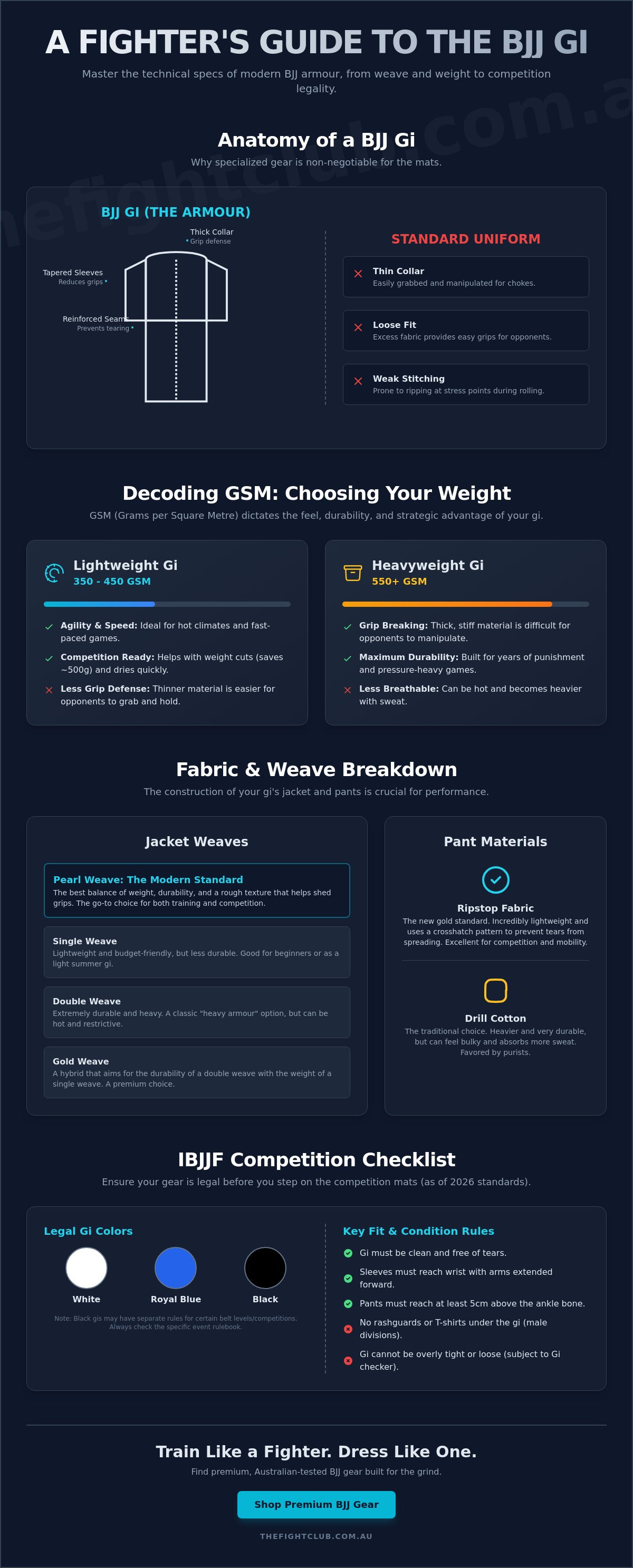
Don't bring a knife to a gunfight. A standard Karate or Judo gi will fail you on these mats. BJJ demands specific engineering. The collars are significantly thicker to prevent easy chokes and maintain structural integrity under load. We use tapered sleeves and trousers. This specific cut reduces the grip opportunities for your opponent, making it harder for them to control your limbs. Every armpit and crotch seam features reinforced stitching. Standard uniforms rip in seconds during a technical stand-up. A dedicated BJJ gi endures the pressure.
- Thicker Collars: Harder to grab, easier to defend.
- Tapered Fit: Minimal excess fabric for opponents to exploit.
- Reinforced Stress Points: Triple-stitching at the armpits and side vents.
The Essential Components of Modern Armour
Cotton remains the king of the mats. It provides the essential balance of comfort and durability needed for daily sweat. Most modern jackets use a pearl weave, which offers a lightweight feel without sacrificing strength. This is vital for maintaining mobility during complex transitions.
Pants have seen a massive shift in 2026. While traditional drill cotton is still favoured by purists for its heavy feel, Ripstop has become the gold standard for many active rollers. Ripstop is incredibly lightweight and uses a crosshatch pattern to stop small tears from spreading. Look for double-layered knee pads as a non-negotiable feature. Your knees take the brunt of the impact during takedowns and guard passing. Protect them. High-quality drawstring systems ensure your trousers stay put, even when the pace hits its peak. Train like a fighter. Dress like one too.
Understanding Weaves and GSM: Choosing Your Weight
Your brazilian jiu jitsu gi is more than a uniform. It is your equipment. To choose the right one, you must understand GSM. This stands for Grams per Square Metre. It measures the fabric density. A lower GSM means a lighter, thinner jacket. A higher GSM means a thick, heavy shield. This number dictates how you feel on the mats and how your opponent feels when they try to control you.
Lightweight gis typically fall between 350 and 450 GSM. These are the gold standard for Australian summers. When the gym temperature climbs past 30 degrees, you want a 350 GSM jacket that breathes. These are also the primary choice for competitors. If you are cutting weight to hit a specific bracket, a light gi can save you 500 grams on the scale. They dry fast. They pack small. They keep you moving.
Heavyweight gis start at 550 GSM and can go much higher. This is the heavy armour of the BJJ world. They are built for maximum durability and grip breaking. A thick collar is harder to manipulate. Stiff sleeves are harder to pocket. While a 550+ GSM gi is less breathable, it becomes a tool of frustration for your opponent. It absorbs sweat, gets heavier as the round progresses, and stays put. It is about grit and resilience. Choose your weight based on your game. If you rely on agility, go light. If you play a pressure-heavy game, go heavy.
The Pearl Weave: The Modern Standard
Australian practitioners overwhelmingly choose the pearl weave for their daily training. It features tiny, tightly woven hills of fabric that look like pearls. This construction provides a unique balance. It is light enough for high-intensity sparring but strong enough to resist tearing. The texture is rough, which helps in shedding grips. Pearl weave is the industry standard for competition. It offers a consistent fit that does not stretch mid-round, keeping your technique sharp. Most members at The Fight Club find this weave provides the best longevity for the price.
Gold, Single, and Double Weaves
- Single Weave: The budget-friendly starter. It is ultra-light, often weighing under 1.6kg for a full set. It is comfortable but lacks the long-term durability of denser weaves.
- Double Weave: The old school tank. These are two layers of fabric woven together. They are nearly impossible to grip, but they can weigh over 2.8kg when soaked. They are the ultimate "tough love" choice for training.
- Gold Weave: A hybrid that offers the softness of a single weave with the heavy-duty strength of a double. It is a premium choice but prone to shrinkage. A gold weave gi can shrink by as much as 6% if you are not careful with the wash.
Before you commit to a specific weave, check the IBJJF uniform regulations to ensure your choice is legal for the 2026 season. Standards regarding fabric weight and reinforcement are strict. You don't want to be turned away from the bullpens because your collar is too thick or your weave is non-compliant. Real gear requires real knowledge. Train like a fighter and choose the weight that supports your journey.
IBJJF Compliance and Competition Standards
You've put in the hours. You've bled on the mats. Don't let a basic gear violation end your tournament before the first whistle. The International Brazilian Jiu-Jitsu Federation (IBJJF) maintains strict uniform requirements that every competitor must follow. These rules ensure a level playing field. They prevent athletes from using gear that is too thick to grip or too short to control. If your kit doesn't pass the check, you have minutes to find a replacement or face a DQ. It's that simple. Referees aren't there to negotiate. They have a job to do. You need to meet the standard or you're out.
Colour and Aesthetic Rules
IBJJF standards are rigid for a reason. You have three choices: white, royal blue, or black. Any other colour is strictly for your home academy. Red, yellow, or camouflage gis will see you escorted off the competition floor. Mismatched uniforms are also banned. Your jacket and pants must be the same colour and material. This isn't about style; it's about tradition and clarity for the officials. Your belt must also meet the grade. It needs to be 4cm to 5cm wide and tied with a double knot that keeps the jacket closed. Leave the vanity at the door. Focus on the fight.
The Measurement Test
The "four-finger rule" is the most common point of failure. Referees use a physical gauge to measure the space between your skin and the fabric. You need a minimum of 7cm of clearance at the sleeve and trouser cuffs when your limbs are extended. If your brazilian jiu jitsu gi is too tight, your opponent can't secure a grip. That's an unfair advantage. The jacket must also reach down to your thighs, and the sleeves should be no more than 5cm from your wrists when arms are out.
Lapel thickness is another critical factor. Your gi must be constructed from durable BJJ gi materials that allow for flexibility. If the collar is too stiff or thick for a referee to fold, it will be rejected. Patch placement is equally regulated. Branding is allowed on the chest, shoulders, and back, but "no-go" zones exist. You cannot place patches where they might impede a grip, such as the very bottom of the jacket or the sleeve cuffs. For a full breakdown of legal gear, see our BJJ Gi Guide 2026 competition checklist. Train like a fighter. Respect the rules. No egos.
Checking your brazilian jiu jitsu gi before you travel to a tournament is the mark of a professional. A quick measurement at the gym can save you the stress of a last-minute scramble at the venue. If you're unsure, ask your coach. They've seen the gauges come out a thousand times. They know what passes and what gets tossed.
Sizing and Fit: Navigating the 'A' Scale
Your Brazilian jiu jitsu gi is more than a uniform. It is your armour. If it fits poorly, you are giving your opponent a massive advantage. The industry uses the 'A' (Adult) scale to categorise sizes. This range typically starts at A0 for smaller grapplers and climbs to A5 or A6 for the heavyweights. A0 usually caters to those around 50 to 60kg, while an A5 is built for the 120kg powerhouse. Do not assume these sizes are universal. A Venum A2 fits differently than a Hayabusa A2. One brand might favour a slim, athletic cut while another provides a traditional, boxy fit. Always check the specific brand size chart before you drop your cash.
Precision matters in the gym. Excess fabric is a liability. It gives your opponent easy handles for collar chokes and sleeve grips. A properly fitted gi stays close to the body, making it harder for others to control your movement. You want to be a difficult target. Stripping away that extra cloth means your technique has to do the work, not your laundry. This is about efficiency and grit on the mats.
Understanding L and H Sizes
Modern brands now offer intermediate sizes to solve the "between sizes" dilemma. Tall, lanky grapplers should look for 'L' (Long) sizes like A2L. These provide extra length in the sleeves and trousers without adding unnecessary bulk in the torso. If you carry more muscle or weight in the chest and shoulders, 'H' (Huskie) sizes like A2H provide the required room. A fitted gi should never restrict your mobility. You need a full range of motion in your hips to play guard effectively. If you cannot squat or move your legs freely, the gi is too tight. Humility in the dressing room prevents disaster during sparring.
The Shrink Factor: Cotton vs. Pre-Shrunk
Cotton is a natural fibre. It reacts to heat. A 100% cotton Brazilian jiu jitsu gi can shrink by as much as 10% if you are not careful. Some veterans use this to their advantage. They buy a slightly larger size and use a targeted dryer cycle to "custom fit" the sleeves. However, this is risky business. Most premium gear now comes pre-shrunk. This does not mean it is immune to change. Expect a pre-shrunk gi to still settle by 2 or 3% after the first ten washes. To keep your gear in top shape for years, follow the golden rule: cold wash and hang dry every single time.
- A0 to A2: Ideal for flyweight to middleweight builds.
- A3 to A5: Built for the heavy hitters and ultra-heavyweights.
- L Sizes: Adds roughly 5 to 8cm of length for long limbs.
- H Sizes: Provides extra girth for broad shoulders and thick trunks.
Don't let a baggy gi hold you back during your next session. Get the fit right and stay sharp.
Ready to test your gear against the best? Train like a fighter at The Fight Club
Premium BJJ Gear: Top Picks for Australian Mats
Respect the mat. Leave the ego at the door. At The Fight Club, we don't do fluff. We do results. Our "No Egos" policy isn't just a sign on the wall; it is how we train every single day. Choosing the right brazilian jiu jitsu gi is the first step toward that disciplined mindset. You need gear that stands up to the grind of a Melbourne winter or a humid Queensland session. Cheap kits fail. They rip at the seams during heavy rolling. They shrink after one wash. A quality gi survives the daily battle and keeps you in the game longer.
The Venum Elite Series
The Venum Elite series represents professional-grade performance for serious competitors. It features a heavy-duty gold weave jacket that provides the durability needed for high-level sessions without the excessive weight of traditional double weaves. The pants utilise ripstop fabric, which resists tears and abrasions better than standard cotton twill. One standout feature is the inner sublimated neck lining. This smooth fabric prevents friction burn on your neck during intense collar ties and chokes. It also adds a layer of skin protection against mat-borne bacteria. You can find more details on their range in our Venum Australia Guide.
Investing in premium equipment saves you money. A high-quality brazilian jiu jitsu gi often lasts three times longer than budget alternatives. When you factor in the cost of replacements, buying right the first time is the smarter financial move. High-end fabrics maintain their shape and fit after hundreds of wash cycles. They don't become sandpaper-rough or lose their structural integrity. Train like a fighter with gear that respects the effort you put in.
Essential Accessories for the Gi
Your armour isn't complete without the right support. A proper belt signifies your journey and must withstand years of tugging and sweat. Choosing the right length and thickness is vital for security during live rounds. Check our BJJ Belts Guide to find the perfect fit for your rank.
Don't skip the rash guard. It's your first line of defence against staph infections and painful gi burn. A good compression top wicks moisture away from your skin, keeping you cool when the round intensity peaks. It also prevents the coarse gi fabric from chafing your torso during north-south transitions. Wear it every time. Protect your skin. Stay on the mats.
Ready to upgrade your kit? Shop the full BJJ Gi collection at The Fight Club and get the gear that matches your grit.
Step Onto the Mats With Absolute Authority
Your gi is your armour. It's the only thing between you and the raw friction of the mats. Choosing the right brazilian jiu jitsu gi comes down to the technical details. Focus on the weave. A 450 GSM pearl weave offers the durability needed for daily rolls, while a lightweight ripstop keeps you agile for the 2026 competition circuit. Get the fit right. Use the 'A' scale to eliminate excess fabric that gives your opponent an easy grip. Ensure your kit meets IBJJF standards to avoid any drama at the tournament check-in.
Stop wasting time with gear that fails when the pressure mounts. We've been Australian owned and operated since 2023, providing authentic equipment for those who live for the grind. We carry premium brands like Venum and Hayabusa because they're built for real combat. You bring the discipline; we provide the tools. With fast shipping across Australia, your gear arrives ready for battle. No excuses. No egos. Just results.
Gear up with Australia's best BJJ Gi collection at The Fight Club
Train like a fighter and earn every inch of progress on those mats.
Frequently Asked Questions
How do I choose the right size BJJ gi?
Consult the specific brand size chart immediately. Most manufacturers use a scale from A0 to A6 based on height and weight. For example, a 180cm practitioner weighing 82kg usually fits an A2. If you fall between sizes, buy the larger option and shrink it slightly in a warm wash. A proper fit prevents opponents from securing easy grips on excess fabric. Don't settle for baggy gear.
What is the difference between a pearl weave and a gold weave?
Pearl weave is the modern industry standard for durability and weight. It uses tight, circular stitches that resist stretching during hard sparring. Gold weave is a traditional, heavier alternative that offers a coarser texture. It provides more friction but can shrink by 10% more than a pearl weave. Most Australian competitors choose pearl weave for its breathability in the summer heat. It stays light when you sweat.
Are black BJJ gis legal for IBJJF competitions?
Yes, black is one of the three legal colours allowed on the mats. IBJJF Rulebook Article 8.1.3 states that competitors must wear a white, royal blue, or black brazilian jiu jitsu gi. Ensure your patches don't obstruct the collar or the 15cm space at the bottom of the jacket. Showing up in unapproved colours like red or grey will result in immediate disqualification at the weigh-in. Stick to the rules.
How many gis do I need if I train three times a week?
Own at least two gis to maintain a clean rotation. Training three times weekly requires one kit to be in use while the other washes and dries. In the humid Melbourne climate, cotton takes 24 to 48 hours to air dry completely. Never wear a damp gi to class. It breeds bacteria and disrespects your training partners. Two sets of armour keep you fresh and ready for every round.
Can I wash my BJJ gi in hot water?
Never use hot water unless you intend to shrink the garment. Stick to cold cycles at 30 degrees Celsius or lower. High temperatures break down the cotton fibres and cause the rubber collar inserts to warp. Cold water preserves the life of your brazilian jiu jitsu gi and keeps the colours from fading. Protect your gear so it can protect you on the mats. Keep the heat for the training.
Why is my BJJ gi so stiff after air drying?
Stiffness occurs when water evaporates and leaves mineral deposits on the cotton fibres. It is a sign of a clean, chemical-free dry. Don't worry about the crunch. Shake the gi vigorously before putting it on. Your body heat and movement will soften the fabric within the first 5 minutes of your warm-up. It beats the fabric damage caused by a tumble dryer. Wear it with pride.
Should I buy a lightweight or heavyweight gi for my first class?
Start with a mid-weight pearl weave between 350 and 450 GSM. Lightweight gis are easier to move in while you master the fundamentals of the guard. Heavyweight options, often 550 GSM or higher, are harder for opponents to grip but can feel restrictive for beginners. Focus on mobility first. You can upgrade to a heavier "tank" style once your defensive technique improves and your grit is tested.
How do I stop my BJJ gi from shrinking too much?
Keep your gear away from the tumble dryer. 90% of significant shrinkage happens during high-heat drying cycles. Hang your gi on a heavy-duty rack in a shaded, well-ventilated area. Avoid direct Australian sunlight as UV rays can make the fabric brittle over time. Consistency in cold washing and air drying ensures your fit remains competition-ready for years. Treat your kit with respect and it will last.