

Boxing Hand Wraps Tutorial: Protect Your Weapons Like a Pro (2026)
The difference between a real fighter and a fitness tourist is what happens before the gloves even go on. Most beginners treat wrapping as an afterthought, only to end up with knuckle abrasions or loose fabric bunching inside their gloves. This boxing hand wraps tutorial provides the technical foundation you need to avoid those nagging wrist injuries and realise your full power on the heavy bag. You know the feeling of a joint that doesn't quite feel stable during sparring. It's a distraction you can't afford when you're trying to push past your limits and train with professional intensity.
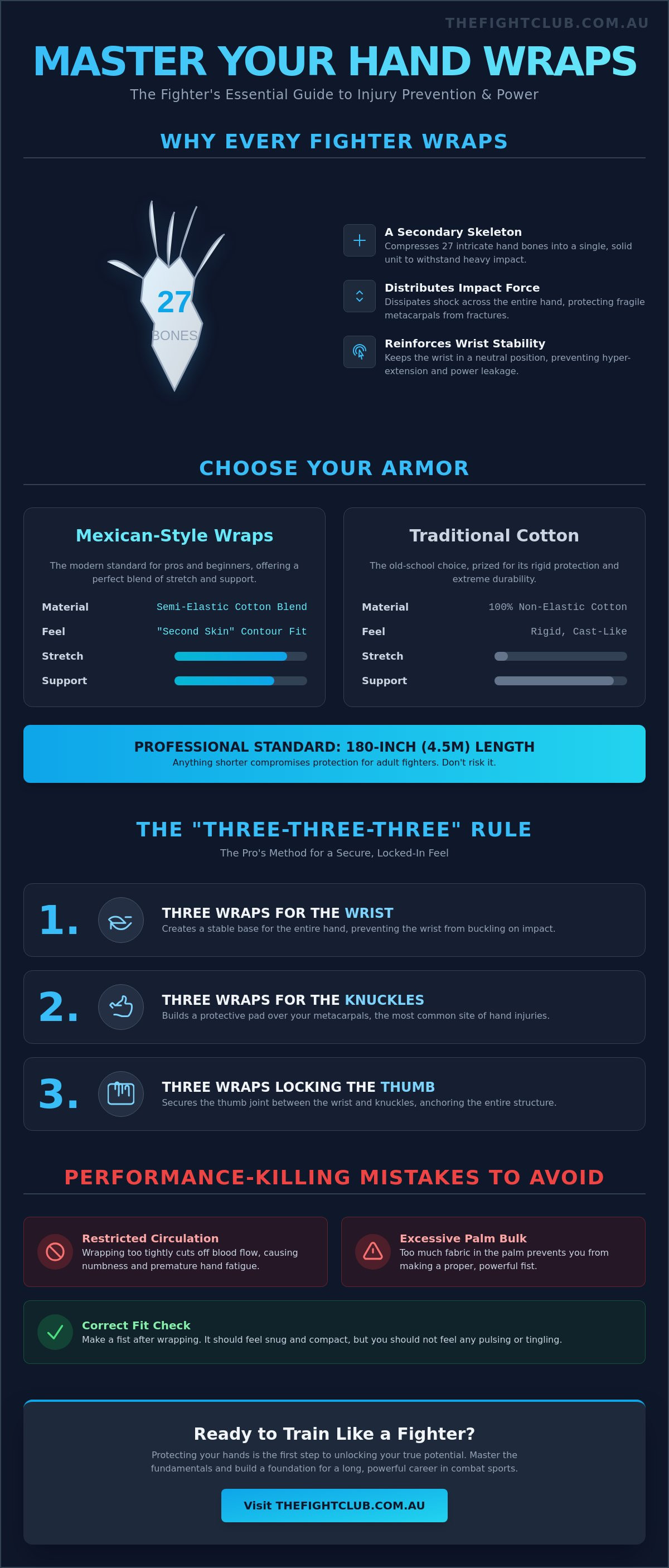
We've all been there, struggling with wrap length or wondering if your 180-inch Mexican-style wraps are actually doing their job. You'll master the essential ritual that safeguards your 27 hand bones and supports your metacarpals through every heavy round. We are going to break down the exact technique used in the gym to give you that secure, locked-in feeling. From choosing the right material to the final velcro strap, it's time to train like a fighter and protect your weapons with discipline.
Key Takeaways
- Protect your 27 hand bones by treating your wraps as a secondary skeleton that distributes heavy impact force.
- Master the "Three-Three-Three" rule in our boxing hand wraps tutorial to secure your wrists, knuckles, and thumbs with professional stability.
- Choose 180-inch Mexican-style wraps for the perfect blend of stretch and support without compromising your ability to close a proper fist.
- Eliminate performance-killing mistakes like restricted circulation and excessive palm bulk to maintain focus during intense sparring rounds.
- Optimise your hand protection by pairing a disciplined wrap technique with the advanced dual-strap support of gear like the Hayabusa T3.
The Science of Hand Protection: Why Every Fighter Wraps
The ritual begins before the first bead of sweat hits the floor. It starts with the crackle of velcro and the rhythmic spiral of fabric. A Hand wrap isn't just a piece of cloth; it's a secondary skeleton. Your hand contains 27 small, intricate bones. These bones aren't naturally designed to collide with a heavy bag at full velocity. When you follow a professional boxing hand wraps tutorial, you aren't just covering skin. You're reinforcing your anatomy for the impact to come.
The wrap works by compressing these small bones into a single, solid unit. Without this compression, the impact force is concentrated on individual joints. With it, the shock dissipates across the entire structure of the hand and wrist. This distribution of force allows you to throw with 100% intent without fearing a break. It also fills the negative space inside your glove. A snug fit ensures the glove doesn't shift during impact. This prevents the friction that causes knuckle abrasions and the instability that leads to sprains.
Anatomy of an Impact: Protecting Your Metacarpals
Your metacarpals are the long bones in your hand that lead to your knuckles. They are surprisingly fragile under load. Under the pressure of a power punch, these bones want to spread or collapse. Proper wrapping keeps them aligned and bound together. A Boxer’s Fracture is a break of the fifth metacarpal bone near the knuckle, often caused by striking a hard object with a closed fist without adequate protection or technique. Don't let an avoidable injury sideline your progress and keep you off the mats.
Wrist Stability and Alignment
Power comes from the ground, through the hips, and out the fist. If your wrist is weak, that power leaks. Wraps keep your wrist in a neutral, reinforced position. This prevents hyper-extension when you catch a shot on the pads or land a hook slightly off-centre. Stable wrists mean better alignment, which translates to more "thud" on impact. Over years of training, this discipline reduces the wear and tear on your joints. It keeps your cartilage intact and your movement fluid.
In our gym, we live by a "No Egos" policy. It doesn't matter if you're a world-class pro or a first-timer; nobody is too tough for hand protection. Skipping the wrap is the mark of an amateur mindset. Real fighters respect their tools. They understand that longevity in combat sports is built on the foundation of technical preparation. Master this boxing hand wraps tutorial to ensure your weapons stay sharp and your training stays uninterrupted. Wrap up. Lock in. Get to work.
Choosing Your Armor: Mexican Wraps vs. Traditional Cotton
Pick your tools with purpose. The gear you choose dictates how hard you can train and how long your career lasts. For any adult fighter, the 180-inch (4.5m) length is the absolute professional standard. Anything shorter is a compromise that leaves your metacarpals exposed to unnecessary risk. You need that extra fabric to create the "Three-Three-Three" structure we'll cover in our boxing hand wraps tutorial. Shorter wraps might be cheaper, but they won't save your hands when you're digging in on a heavy bag.
Your choice of material should reflect your training intensity. If you are in the gym five days a week, breathability and stretch become non-negotiable. High-quality wraps typically range from $9.00 to $20.00. For instance, Venum wraps are often found around $9.48, while Hayabusa Perfect Stretch options retail near $19.99. Investing an extra ten dollars is a small price to pay for equipment that doesn't lose its shape after three washes. Cheap fabric bunches up, creates pressure points, and eventually leads to the very injuries you're trying to avoid.
The Mexican Style: Elasticity and Comfort
Mexican-style wraps are the gold standard in modern combat sports. They use a semi-elastic blend of cotton and synthetic fibres that allows the wrap to contour to the unique geometry of your hand. This elasticity creates a "second skin" feel that stays tight as your hand expands and contracts during a session. Most pros prefer this style because it offers a more customised fit than rigid cotton. If you want to learn how to wrap your hands properly, starting with a semi-elastic material makes the learning curve much flatter. It provides a secure, locked-in sensation without cutting off your circulation.
Traditional Cotton and Inner Gloves
Traditional cotton wraps are thick, non-elastic, and built for durability. They offer a rigid feel that some old-school fighters swear by for maximum bone protection. However, they lack the "give" of Mexican wraps and can feel bulky inside a modern glove. You might also see "quick-wrap" gel gloves in the gym. These are fine for a light technical session or when you're pressed for time, but they are no substitute for a real 180-inch wrap during hard sparring. They simply cannot provide the same level of wrist and thumb stability. Just as you wouldn't step into the ring without mouth guards to protect your teeth, you shouldn't rely on shortcuts for your hands. Real training requires real preparation. Check out the professional range at The Fight Club to find the armor that fits your fight.
The Step-by-Step Boxing Hand Wraps Tutorial
Don't rush the ritual. Start by locating the "This Side Down" tag on your wraps. If you get this wrong, you'll reach the end only to find the Velcro facing the wrong way. It’s a rookie mistake that wastes time and breaks your focus. This boxing hand wraps tutorial follows the "Three-Three-Three" rule: three wraps for the wrist, three for the knuckles, and three for the thumb. It’s a simple, rhythmic system that ensures no part of your weapon is left vulnerable. Tension is everything. You want the wrap tight enough to feel like a second skin, but loose enough to maintain full circulation during a ten-round session.
Foundation: The Wrist and Thumb
Hook the loop over your thumb and pull the fabric across the back of your hand. Never start by going across the palm; this causes the wrap to bunch up and slide as soon as you start throwing. Execute three firm rotations around the wrist to create a solid anchor. From there, bring the wrap up and around the thumb once. This single loop is vital to prevent "hitchhiker" injuries, where the thumb gets caught on an opponent’s shoulder or the edge of a heavy bag. You’re building a base that supports your technique and keeps your joints aligned.
Protection: The Knuckles and Fingers
Move the wrap up to the knuckles. Keep your fingers spread wide as you go. If you wrap with a relaxed or closed hand, the fabric will be far too tight once you actually form a fist. Thread the wrap between each finger to create an X-pattern across the back of the hand. This technique separates the metacarpals and provides scientific evidence for hand protection by stabilising the bones most prone to fractures. These finger loops are the secret to a professional fit; they prevent the padding from sliding up your hand when you land a heavy hook.
The Finish: Securing the Wrap
Bring the remaining material back down to the wrist. This is where you finalize the support. Finish with the Velcro strap, ensuring it sits flat and secure. It should be snug but allow for a full range of motion in your wrist. Test the fit immediately. Make a tight fist. Your knuckles should feel heavily padded and your wrist should feel "locked" into place. If you feel any tingling or numbness in your fingertips, you’ve gone too tight. Unwrap and go again. Discipline in this boxing hand wraps tutorial leads to discipline in the ring. Protect your tools and get to work.
Common Wrapping Mistakes That Kill Your Performance
Mistakes in the ritual lead to disasters in the ring. Even if you have followed a boxing hand wraps tutorial to the letter, you can still fall into the "Too Tight" trap. Restricted circulation isn't a sign of a secure fit; it’s a performance killer. If your fingers start tingling mid-round, your hands are telling you to stop. Numbness leads to poor punch placement and weakened grip strength. You can't throw with conviction if you can't feel your knuckles hitting the target. Real power requires blood flow and sensory feedback.
Then there's the danger of "Palm Bulk". Beginners often cycle too much material through the palm instead of the back of the hand. This creates a thick pad inside your grip that prevents you from closing a proper fist. A loose fist is a fragile fist. Impact force should be met with a solid, rock-like structure, not a soft, crowded palm. Another common error is using wraps that are simply too short. A 120-inch wrap is a toy for a child. For a grown adult, anything less than 180 inches (4.5m) is a liability. You need that extra length to execute the technical foundations that keep your metacarpals from spreading under load.
Troubleshooting Tension and Fit
Always perform the "Fist Test" before you slide into your gloves. Close your hand tightly. If you feel excessive pressure on the palm or if your fingers can't reach the base of your thumb, you've over-wrapped the wrong area. A proper wrap should feel like a cast on the outside but allow for a natural grip on the inside. If it feels "off" during your warm-up, don't ignore it. Strip the wrap and start again. Discipline in the gym means refusing to settle for "good enough" when it comes to your safety.
Maintenance: Keeping Your Wraps Fresh
Neglecting hygiene is the final sin of the amateur. Sweaty wraps don't just smell; they lead to skin infections and "glove rot" that destroys your expensive gear from the inside out. Moisture breaks down the foam and leather of your gloves, shortening their lifespan significantly. Use a mesh laundry bag to wash your wraps after every single session. This prevents the "spaghetti mess" that happens when long strands of fabric tangle in the machine. Air-dry them to protect the elasticity of the synthetic fibres. If your wraps are frayed or have lost their "snap," retire them immediately. Your hands are worth more than a $20 pair of old fabric. Upgrade your protection and buy professional hand wraps to keep your weapons in peak condition.
The Perfect Fit: Pairing Wraps with Hayabusa T3 Gloves
High-end equipment is a waste of money if you haven't mastered the basics. You can buy the best kit in the world, but if your hands are loose inside the leather, you're a liability to yourself. Professional gear like the Hayabusa T3 is engineered to work in tandem with a high-volume wrap. These aren't "boxercise" mitts; they are precision tools. When you follow a technical boxing hand wraps tutorial, you create the exact internal volume required for these gloves to perform. The T3’s interior is designed to accommodate the 180-inch standard, ensuring a snug, zero-shift fit that protects your metacarpals from the first bell to the last.
The Dual-X closure system is where the magic happens. While your wrap provides the internal "skeleton" for your 27 hand bones, the T3’s dual interlocking straps provide the external splint. This combination virtually eliminates wrist collapse. It’s a level of security you won't find in entry-level boxing gloves. You need that synergy to throw with full power without hesitation. Remember: the gear facilitates the technique, but the discipline to wrap correctly is what keeps you in the fight. Realness in training starts with how you treat your tools.
Optimising the Hayabusa T3 Experience
The T3 features a world-leading splinting system that aligns your wrist with your forearm. When you layer a disciplined wrap underneath, you create an unbreakable line of force. The inner lining of these pro gloves is moisture-wicking and designed to grip the wrap material, preventing any internal sliding during heavy bag work. This is how you train like a fighter. It’s about the details. It’s about the grit to do things right every single time you step into the gym. No shortcuts. No excuses.
Your Next Step: Beyond the Wraps
Wrapping is just the entry point. Once your hands are secure, you need a target that can handle your power. A professional-grade punching bag is the next essential piece of your home training kit. Don't settle for superficial fitness trends. Build a setup that respects the sport and your safety. Shop our range of professional wraps, gloves, and combat equipment at The Fight Club. No egos. Just work. Lock your wrists, find your rhythm, and let's see what you’ve got. The fight is personal. Make sure you're ready for it.
Protect Your Weapons for the Long Game
Mastering this boxing hand wraps tutorial is the first step toward a long, injury-free career. You've learned that your 27 hand bones require the secondary skeleton of a 180-inch wrap to survive heavy impact. You know that choosing the right Mexican-style elastic blend prevents the circulation issues and palm bulk that kill performance. Real training isn't just about how hard you hit. It's about the discipline you show before the first bell rings. Skipping the wrap is an amateur move that leads to fractures and wasted potential. Real fighters respect the ritual.
As Australia’s home for Hayabusa and Venum, we provide expert-tested equipment for those who take their craft seriously. Don't settle for cheap fabric that loses its snap after two sessions. Get the gear that matches your grit with fast national shipping on all combat gear. Shop Professional Hand Wraps and Protect Your Hands today and step into the gym with the confidence of a pro. Your weapons are your livelihood. Treat them with respect. Train like a fighter. No egos. Just work.
Frequently Asked Questions
How long should boxing hand wraps be for adults?
Adults should always use 180-inch (4.5m) wraps. This length is the professional standard because it provides enough fabric to secure the wrist, thumb, and knuckles according to the "Three-Three-Three" rule. Shorter 120-inch wraps are generally reserved for children or those with exceptionally small hands; they simply don't offer enough material to bind the 27 bones of the hand effectively.
Can I wash my hand wraps in a washing machine?
Yes, but you must use a mesh laundry bag to prevent a "spaghetti mess" in your machine. Washing them loose will cause the long strands to tangle around the agitator or other clothes, which can ruin the fabric. Always air dry your wraps. Tumble drying is a mistake that destroys the elastic fibres and kills the "snap" required for a secure fit.
Is it okay to use gel hand wraps instead of traditional ones?
Gel wraps are a convenient shortcut for light technical drills, but they don't replace traditional wraps for real training. They lack the customised bone-binding compression that a 180-inch wrap provides during heavy impact. If you are hitting the heavy bag or sparring, stick to the ritual. Real protection requires the structural integrity of a manual wrap.
How tight should my hand wraps be?
Your wraps should feel like a firm second skin. They should be snug enough to stay in place when your hand is open and feel tight and "locked" when you make a fist. If you can't fully close your hand or if your fingers start to tingle, you've gone too tight. Finding the balance between support and circulation is a key part of any boxing hand wraps tutorial.
Do I need to wrap my hands for a heavy bag workout?
You must wrap your hands every time you hit the bag. The heavy bag is a dense, unforgiving target that puts massive stress on your metacarpals and wrist joints. Protective gear isn't just for when someone is hitting you back. It’s a requirement for every session where you throw with power to ensure you don't end up with a Boxer's Fracture.
What is the difference between boxing wraps and MMA wraps?
MMA wraps are typically shorter and thinner to fit inside the smaller profile of 4oz or 7oz gloves. Boxing gloves have more internal volume, allowing for the full 180-inch length. While the wrapping technique is similar, the goal in boxing is maximum bone and wrist stabilisation, whereas MMA wraps must also allow for the finger dexterity needed in grappling.
Why do my hands go numb when I wrap them?
Numbness is a sign that you've restricted your circulation. This usually happens because the wrap is too tight around the wrist or you've bunched too much material in the palm. If you feel tingling mid-round, stop immediately and re-wrap. Using a boxing hand wraps tutorial to master the X-pattern through the fingers will help distribute pressure more evenly.
How often should I replace my boxing hand wraps?
Replace your wraps every 3 to 6 months depending on your training frequency. Once the fabric frays, the Velcro loses its grip, or the material loses its elasticity, the wrap can no longer protect your weapons. Training with "dead" wraps is a risk you don't need to take. If the fabric feels thin and has no "give," it’s time to retire them.