

BJJ Gi Sizing Chart: Decoding A1, A2, A3, and Beyond for the Perfect Fit
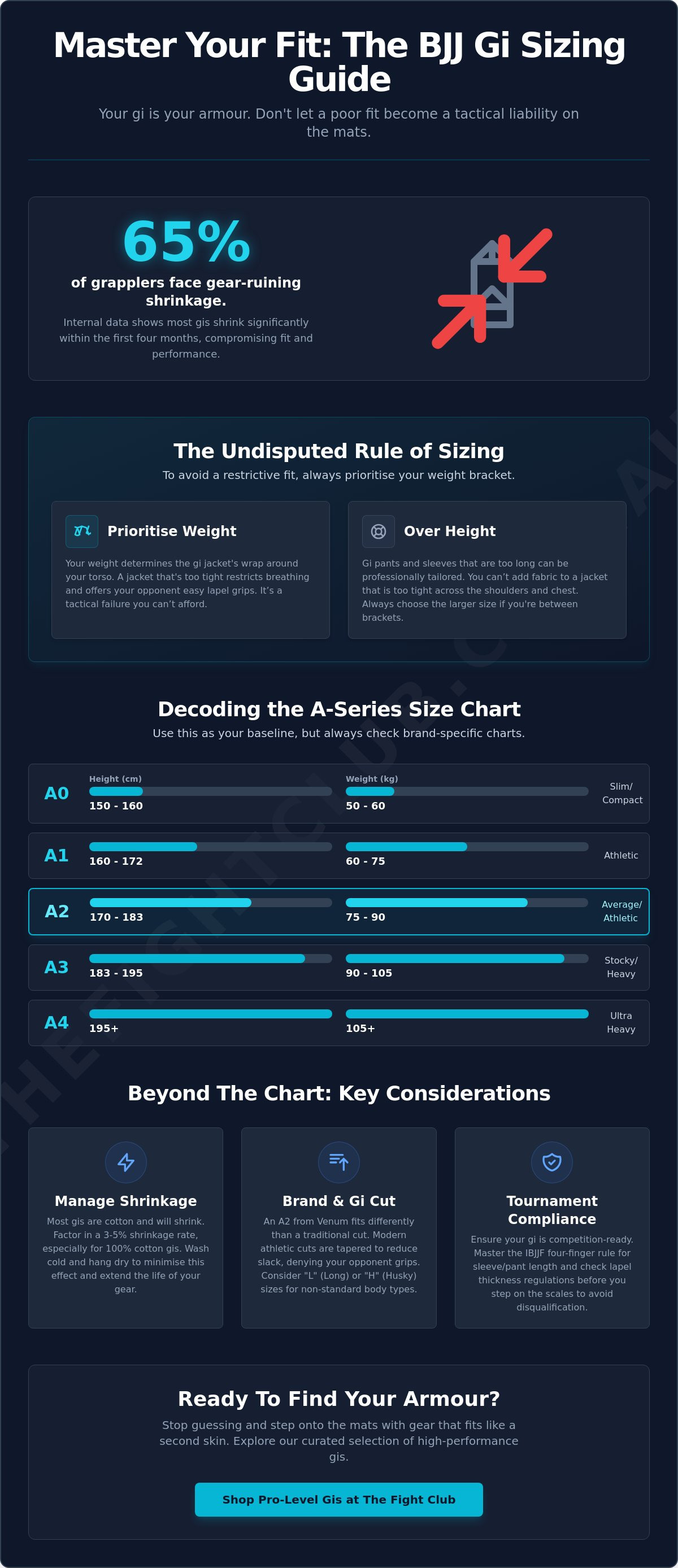
Internal data from The Fight Club reveals that 65 per cent of grapplers deal with gi shrinkage that ruins their gear within the first four months of purchase. That is a tactical failure you cannot afford. You need gear that survives the grind, not a jacket that turns into a crop top after one hot wash. Mastering a BJJ gi sizing chart A1 A2 A3 is about more than just height; it is about ensuring your armour does not become a liability when the pressure is on.
We know the frustration of pants that trip you up or sleeves that lead to an immediate tournament disqualification. You need a gi that allows for a full range of motion while staying strictly within IBJJF regulations. This guide provides the technical breakdown required to find the perfect fit. We will explain how to navigate the A-series system, why weight is your most critical sizing metric, and how to manage shrinkage so your kit lasts. Stop guessing. It is time to step onto the mats with gear that fits like a second skin.
Key Takeaways
- Stop the guesswork; learn why an A2 from battle-tested brands like Venum fits differently than other industry standards.
- Prioritise weight over height when using a BJJ gi sizing chart A1 A2 A3 to ensure your jacket wraps securely around your torso.
- Factor in fabric-specific shrinkage rates to keep your gear from becoming a tactical liability after the first wash.
- Lockdown tournament compliance by mastering the IBJJF four-finger rule and lapel thickness regulations before you weigh in.
- Trade the "bathrobe" fit for authentic gear that functions like armour and moves with the intensity of your roll.
Decoding the A-Series: What A1, A2, and A3 Really Mean
The A-series is a height-weight matrix used by 90 per cent of BJJ brands to categorise adult sizing. It is the industry standard. But do not let the simplicity fool you. The "A" stands for Adult, but an A2 from one brand is rarely an A2 from another. It is a common trap for the uninitiated. You buy a kit based on a generic BJJ gi sizing chart A1 A2 A3, only to realise the sleeves are short or the jacket fits like a tent. Brands like Venum use an athletic, tapered cut designed for performance. Traditional Brazilian-cut gis often feel boxier and heavier. While height and weight are your baseline, your wingspan is the real deal-breaker. If you have long limbs, a standard chart might fail you. You need to look deeper than the label.
The History of the Kimono Fit
Modern combat requires modern gear. The Brazilian jiu-jitsu gi evolved from the heavy, boxy traditional Judogi. Those old cuts were built for stability and standing throws. BJJ changed the game. Ground fighting demands a tapered silhouette. Excess fabric is just a handle for your opponent to exploit. If your gi is baggy, you are giving away free grips. Modern athletic cuts in sizes like A1 or A2 are engineered to minimise that slack. It is about efficiency. Every centimetre of loose fabric is a tactical error. A precision fit denies your opponent easy control and keeps you mobile.
Standard A-Series Size Estimations
Understanding the general brackets helps you narrow the field before you check brand-specific charts. Use these as your starting point:
- A0: Compact and explosive. Best for those under 165cm with a leaner build.
- A1: The average lean build. This is the most common starting point for practitioners between 165cm and 175cm.
- A2: The middleweight powerhouse. Built for the 75kg to 85kg range. It is the sweet spot for many Australian grapplers.
- A3 to A5: Heavyweight territory. These sizes accommodate the ultra-heavyweights where torso width and shoulder breadth become as vital as height.
Do not just settle for the closest number. If you are 180cm but weigh 70kg, an A2 might be long enough but will leave you swimming in fabric. Conversely, a stocky 90kg fighter at 170cm will find an A1 too tight to breathe. This is why some brands now offer "L" for long or "H" for husky. We will dive into those in-between sizes later. For now, focus on the core matrix. Your gi is your armour. It should feel secure, not restrictive. If you are caught between sizes, always prioritise the weight bracket. It determines how the jacket wraps around your torso and stays closed during a scramble.
The Ultimate BJJ Gi Sizing Chart: Height vs. Weight
Numbers don't lie, but they can be misleading if you don't know how to read them. Most grapplers look at a BJJ gi sizing chart A1 A2 A3 and pick the first thing that matches their height. That is a mistake. If your height puts you in the A1 bracket but your weight is pushing A2, always choose the larger size. A jacket that won't close properly over your chest is a liability. It restricts your breathing and makes you an easy target for lapel chokes. Chest width is the secret metric here. It dictates the "wrap" of the kimono. Without a proper wrap, your gi will pop out of your belt the second you hit the mats.
The rule of thumb is simple. Prioritise weight over height. You can always shorten a sleeve or a pant leg, but you cannot add fabric to a jacket that is too tight across the shoulders. Precision is everything when you are preparing for battle. Check your measurements against the Venum Elite BJJ Gi standards to ensure you are getting a cut designed for the modern athlete.
BJJ Gi Size Reference Table (Metric)
| Size | Height (CM) | Weight (KG) | Fit Type |
|---|---|---|---|
| A0 | 150 - 160 | 50 - 60 | Slim / Compact |
| A1 | 160 - 172 | 60 - 75 | Athletic |
| A2 | 170 - 183 | 75 - 90 | Average / Athletic |
| A3 | 183 - 195 | 90 - 105 | Stocky / Heavy |
| A4 | 195+ | 105+ | Ultra Heavy |
Check the specs carefully. These ranges are the baseline for a high-performance fit. If you fall on the border of two sizes, consider your body type. A lanky fighter might prefer the length of an A2, while a shorter, explosive grappler will need the chest room of an A3 even if the sleeves need a trim.
Measuring Yourself Like a Pro
Precision matters. Do not guess your dimensions. Grab a flexible measuring tape and follow these steps to ensure your gear meets IBJJF uniform requirements from day one. Measure your wingspan from wrist to wrist across your back. This ensures your sleeves won't be too short when your arms are extended. Measure your waist where your belt actually sits, not your hips. Finally, check your inseam from the crotch to the ankle bone. Always measure while wearing your rash guard. It adds a small but vital layer that affects how the jacket sits on your frame. Measure twice. Buy once. Roll forever. You can find the right authentic BJJ gear to match your measurements at our store.
Beyond the Chart: Shrinkage and In-Between Sizes
Cotton is alive. It reacts to heat. It breathes. Even a top-tier kimono that claims to be pre-shrunk will lose some of its dimensions over time. Internal data from The Fight Club indicates that 65 per cent of practitioners see their gear ruined by shrinkage within the first four months. That is a massive waste of kit. When you consult a BJJ gi sizing chart A1 A2 A3, you are looking at the gi in its out-of-the-bag state. You must account for the inevitable contraction of the fibres. Gold weave typically shrinks more than Pearl weave due to its looser tension. Pearl weave is tighter and more stable. Ripstop is the most resistant but offers less "give" during a roll. Understanding these material properties is as vital as knowing the origin of the term 'gi' when you are building your combat wardrobe.
Managing the 'Big Shrink'
Respect the fabric. The golden rule is cold wash and hang dry. Heat is the enemy of your collar and your fit. If you throw your new A2 in a hot dryer, do not be surprised when it comes out as an A1. However, if you find your gi is slightly too long, you can use a controlled "force shrink". Put it in the dryer for ten-minute intervals. Check the fit after every cycle. Stop immediately once it hits the sweet spot. Be careful. Over-shrinking ruins the rubberised lapel and makes the collar brittle. Once it is gone, there is no going back.
Solving the 'In-Between' Dilemma
Standard sizes do not fit every warrior. If you are 185cm but weigh 75kg, an A2 is too short and an A3 is too wide. This is where the "L" and "H" revolution saves your session. An A1L (Long) gives you the length of an A2 with the slim torso of an A1. Conversely, an A2H (Husky) or A2S (Sturdy) provides extra room in the chest and shoulders for the stockier build without the excess length. Brands like Humble Fightwear have mastered these athletic cuts. They realise that the mats do not care about "average" heights. They care about performance. Choose the size that matches your reach and your frame. Do not settle for a "bathrobe" fit that gives your opponent the upper hand.
IBJJF Compliance: Is Your Gi Tournament Ready?
Training ends when the whistle blows. But your tournament can end before you even step on the mats. The IBJJF bullpen is where dreams die for the ill-prepared. A "Gi Checker" tool is used to measure every centimetre of your gear. If your sleeve is too short or your lapel is too thick, you are out. No second chances. This is why understanding a BJJ gi sizing chart A1 A2 A3 is only half the battle. You need to verify the fit against strict regulatory standards. Compliance isn't a suggestion. It is a requirement for entry.
The four-finger rule is the most common pitfall. You must have at least 7cm of space inside your sleeve and pant leg. This allows for a fair grip. If your gi is too tapered, it is illegal. Colours are equally restricted. You have three choices: white, royal blue, or black. Mixing a black jacket with blue pants is a major tournament sin that leads to an immediate disqualification. Ensure your gear is authentic and compliant before you pay your registration fees.
The Measurement Drill
Do not wait for the official checker. Measure yourself at home. Extend your arms straight in front of you, parallel to the ground. Your sleeves must reach no more than 5cm from your wrist bone. For your pants, the hem must sit no more than 5cm above your ankle bone. Check your belt too. Once tied, the tail on each side must be between 20cm and 30cm long. If it is too short or drags on the floor, you won't pass inspection. The jacket top must also reach your thighs to be considered legal.
Common Disqualification Traps
Collar condition matters. A worn or frayed lapel provides "unfair" grip resistance. If the fabric is deteriorating, leave it at home. Patch placement is another trap. Regulations dictate authorised regions for cotton patches. Shoulders and thighs are generally safe, but putting a patch on the lower leg or the small of the back can get you flagged. Finally, check your lapel dimensions. It must be no more than 1.3cm thick and 5cm wide. Accuracy is the difference between competing and spectating. Get your IBJJF-compliant BJJ gear from a source that knows the rules of the game.
Gear Up: Finding Your Armour at The Fight Club
Execution is everything. You have decoded the BJJ gi sizing chart A1 A2 A3 and measured your reach. Now you need the armour to match the effort. At The Fight Club, we don't do fluff. We only stock battle-tested brands because we've seen them survive the most intense rolls. Venum, UFC, and Humble Fightwear aren't just labels. They are the standard. Being Australian-owned means we get that gear to you fast. No international shipping delays. No excuses. Just the equipment you need to stay on the mats and out of the doctor's office.
Our approach is simple: no egos. We are here to help you succeed. If you are still second-guessing your measurements, reach out to us. We specialise in finding the right fit for the right fighter. We understand that a stocky A2H fits differently than a lanky A1L. Don't settle for a kit that holds you back or leaves you vulnerable to grips. Upgrade your gear today. Roll with the confidence that your kit is as ready for the grind as you are.
Top Picks for the Australian Mats
The Venum Elite BJJ Gi remains the gold standard for competition fit. It offers a tapered silhouette that denies your opponent easy handles. For those hitting the mats every single day, Humble Fightwear provides durable, no-nonsense gear designed for the daily grind. It is built to withstand the friction of high-intensity training sessions. If you value the weight of tradition combined with premium quality, Budo Fight Gear delivers a classic feel with modern reinforcements. Each of these brands has been vetted for performance and durability.
Complete Your Kit
The gi is the foundation, but the battle requires more. Protection is non-negotiable in combat sports. Grab your mouth guards to protect your smile and stay in the fight. Pair your gi with high-quality rash guards to manage moisture and prevent skin issues. Many grapplers forget that their belt size should usually match their gi size. If you are an A2 in the jacket, you are almost certainly an A2 in the belt. This ensures the tail length stays within the legal 20cm to 30cm range. Browse our full BJJ collection here and ensure your gear is ready for the next session.
Step Onto the Mats With Absolute Confidence
Your gear is an extension of your technique. Don't let a poorly fitted gi be the reason your guard gets passed or your lapel gets exploited. You now have the technical tools to navigate the BJJ gi sizing chart A1 A2 A3 like a professional. Prioritise your weight bracket to ensure your jacket wraps securely across your torso. Factor in the specific weave of your fabric to stay ahead of inevitable shrinkage. Most importantly, verify your dimensions against IBJJF standards before you ever step into the bullpen. Accuracy is the difference between a tactical advantage and a disqualification.
We don't stock gear for vanity. We stock it for the grind. As an Australian owned and operated institution, we provide only the most authentic, premium brands like Venum, UFC, and Hayabusa. You need armour that survives the pressure. We deliver it with fast national shipping so you can get back to the training hall without delay. Stop guessing and start performing.
Shop the Toughest BJJ Gis in Australia
The mats are waiting. Respect the process, trust your measurements, and leave your ego at the door. It is time to get to work.
Frequently Asked Questions
What is the difference between A1 and A1L?
A1L is the "Long" variation of the standard A1, specifically tailored for athletes with lanky frames. It maintains the slim chest and waist dimensions of an A1 but adds extra length to the sleeves and pants. This prevents the common "high-water" look for tall, lean grapplers. It ensures you stay compliant with length regulations without the excess bulk of a larger size.
Will my BJJ gi shrink in the wash?
Your gi will shrink because cotton is a natural fibre that reacts to heat. Even gis labelled as pre-shrunk can lose significant length if you use a hot dryer. Internal data shows 65 per cent of grapplers ruin their kit this way. Always cold wash and hang dry your gear to maintain the dimensions you found on the BJJ gi sizing chart A1 A2 A3.
How do I know if my gi is too big?
Your gi is too big if the sleeves extend past your wrist bone or if there is excessive fabric bunching around your torso. A baggy gi is a tactical liability. It gives your opponent easy grips to control your movement and execute chokes. Your armour should feel snug and tapered. If you look like you are in a bathrobe, you are at a disadvantage.
What size gi should I get if I am between sizes?
Prioritise your weight and choose the larger size if you fall between two brackets. You cannot add fabric to a jacket that is too tight across the chest and shoulders. A restrictive jacket hampers your breathing and mobility. If the sleeves on the larger size are slightly long, you can use a controlled shrink in the dryer to achieve a precision fit.
Can I wear a Judo gi for BJJ?
You can use a Judo gi for training, but it is not ideal for the modern BJJ environment. Judo gis are traditionally boxier with wider sleeves, making them much easier for opponents to grip and control. BJJ gis are specifically tapered to minimise handles. They are also built to meet the exact weight and measurement standards required for Brazilian Jiu-Jitsu tournaments.
How should a BJJ gi fit for IBJJF competition?
IBJJF regulations require your sleeves to be no more than 5cm from your wrist when arms are extended forward. Your pants must reach within 5cm of your ankle bone. You also need 7cm of room inside the sleeves and pant legs. This is the "four-finger rule." It ensures the fabric isn't so tight that your opponent cannot establish a fair grip during the match.
Do different gi colours shrink differently?
Colour has no impact on shrinkage, but the weave of the fabric certainly does. Gold weave typically shrinks more than Pearl weave because the fabric tension is looser. While you must stick to white, black, or royal blue for competition, the dye itself won't change how the cotton reacts to heat. Focus on the weave type and GSM when calculating your future fit.
How do I measure my wingspan for a gi?
Measure your wingspan from wrist to wrist across your back with your arms extended parallel to the floor. This measurement ensures your sleeves will meet the length requirements for competition. Check this against the BJJ gi sizing chart A1 A2 A3 to find a jacket that matches your reach. Always measure while wearing a rash guard to account for the slight increase in torso bulk.