

Best Length for Boxing Hand Wraps: The Fighter’s Guide to Total Protection (2026)
Your 120-inch wraps are likely the reason your knuckles are bruised and your wrists feel like glass after a heavy bag session. It's a common mistake that leaves fighters vulnerable. You buy the gear. You show up. But you skip the most critical foundation of your strike. We've all been there; standing at the end of a wrap with no fabric left to secure the wrist loop, or feeling your protection shift mid-round because there wasn't enough material to lock it down. Finding the best length for boxing hand wraps isn't just about comfort. It's a calculated decision based on hand size, glove volume, and the violence of your impact.
This guide helps you identify the exact length needed to secure your joints and hit with maximum confidence. You'll learn why the 180-inch wrap is the professional standard for training and how it differs from competition gauze. We'll show you how to achieve the perfect fit inside your Hayabusa T3 or Venum Elite gloves. Get total wrist stability without the excessive bulk that ruins your form. Stop guessing. Protect your weapons. Respect the craft.
Key Takeaways
- Secure the 27 small bones in your hand by creating a structural "cast effect" that prevents bone displacement during impact.
- See why the 180-inch (4.5 metre) wrap is the professional standard for achieving a secure X-pattern between every finger.
- Determine the best length for boxing hand wraps to create a perfect seal inside your Hayabusa T3 or Venum Elite gloves.
- Recognise when to break the 180-inch rule and opt for 120-inch or 210-inch wraps to suit your specific hand size.
- Realise that length is useless without discipline. Master a consistent wrapping technique to keep your protection locked in place.
Why Hand Wrap Length is Your First Line of Defence
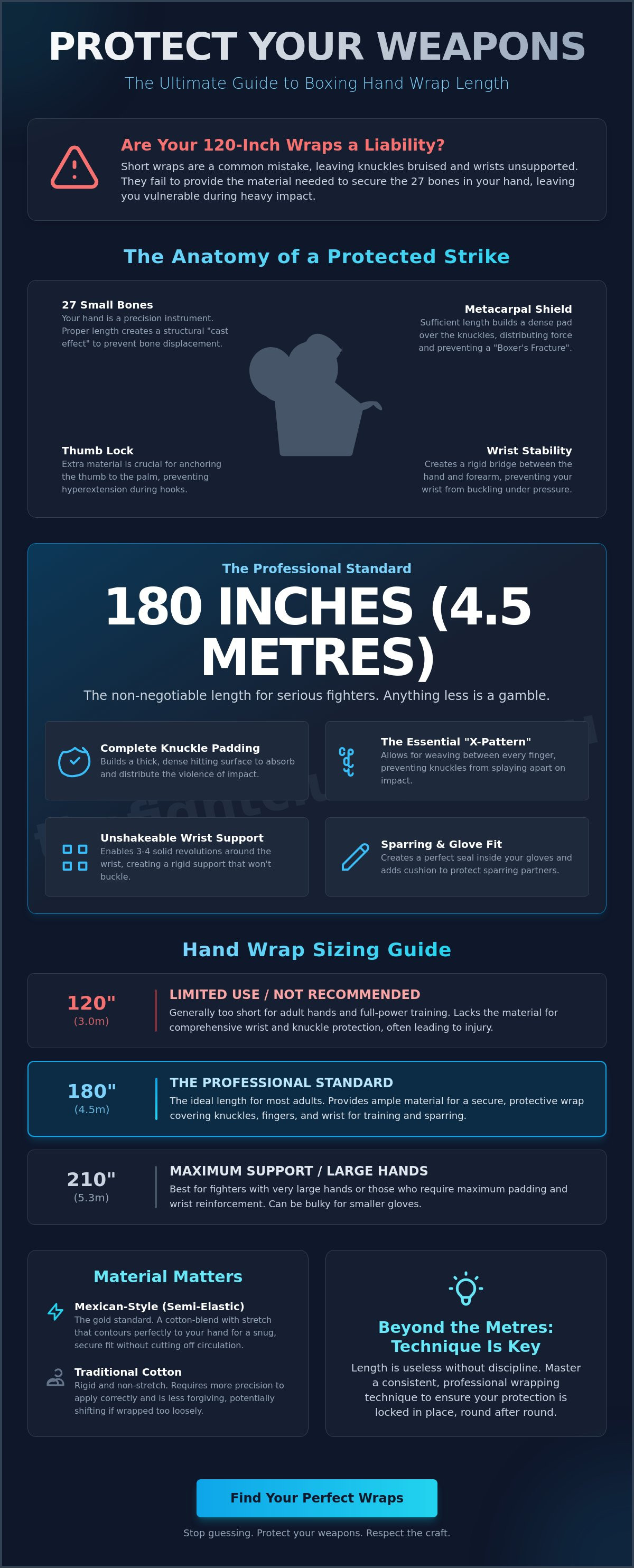
Your hand is a precision instrument. It houses 27 small bones, each one a potential point of failure when you're unloading on a heavy bag. A Hand wrap isn't just a layer of fabric to keep your gloves from smelling; it is structural reinforcement. Choosing the best length for boxing hand wraps determines whether those bones stay aligned or shatter under pressure. Short wraps leave gaps in your armour. Excessive length creates a bulky, sweaty mess that ruins your fist's profile. You need the "cast effect." This is where the hand and wrist move as one solid, immovable unit.
Professional fighters don't compromise on their tools. They reach for the 180-inch standard because it provides enough runway to cover the knuckles, the thumb, and the wrist without thinning out. If you're hitting with intent, anything less is a gamble. You want enough material to create a dense pad over the metacarpals while still having enough left to lock the wrist into place. It's about creating a foundation that can withstand high-velocity impact round after round.
The Anatomy of a Protected Strike
Protecting your strike starts with the metacarpals. The best length for boxing hand wraps allows you to build a solid hitting surface that distributes force evenly. This is your primary defence against the "boxer's fracture," a break in the neck of the fifth metacarpal. You also need enough fabric for a dedicated thumb lock. The thumb is the most vulnerable joint in the hand. It must be anchored to the palm to prevent hyperextension during a hook. Extra length ensures you have the metres required to secure this joint without sacrificing wrist stability.
Cotton vs. Mexican Style: How Material Affects Length
The material you choose dictates how that length behaves on your skin. Mexican-style wraps are the gold standard for authentic training. They use a semi-elastic blend that contours to the unique shape of your hand. This stretch allows you to make more passes over the knuckles and wrist without cutting off circulation. Traditional cotton wraps are rigid. They require more precision because they don't give. If you wrap too tight with cotton, your hand goes numb. If you wrap too loose, the protection shifts mid-round. Prioritise the stretch of a Mexican-style wrap to get a professional, secure fit that stays put through the most intense sessions.
The 180-Inch Standard: Why 4.5 Metres is the Pro Choice
180 inches. 4.5 metres. This is the non-negotiable standard for the serious fighter. While 120-inch wraps exist, they often fail the test of a full-power training session. The 180-inch length provides the necessary real estate to execute a professional wrap. You aren't just covering skin; you're building a structural support system. This length allows for the essential "X-pattern" between every finger. This technique keeps your knuckles from splaying apart when you land a heavy cross. It's the only way to effectively protect the tendons and ligaments that hold your hand together.
Stability requires volume. With 4.5 metres, you can afford three to four solid revolutions around the wrist. This creates a rigid bridge between the hand and the forearm. If you're throwing with intent on punching bags, this bridge is what prevents your wrist from buckling. The best length for boxing hand wraps ensures you never have to choose between protecting your knuckles or securing your wrist. You have enough material for both. It's about being prepared for the violence of impact, not just going through the motions.
The 180-Inch Advantage for Sparring
Sparring is about respect and technical growth. It isn't about hurting your partner. The extra material in a 180-inch wrap allows you to build a thicker pad over the knuckles. This extra cushion reduces the risk of cutting your sparring partner through your boxing gloves. It also ensures the wrap stays tight during high-intensity clinching. Sweat and friction can cause shorter wraps to unravel. A full-length wrap provides the surface area needed for the Velcro to bite and hold through every round.
Is 180 Inches Too Long for Small Hands?
Don't fall for the myth that smaller hands need shorter wraps. Protection doesn't scale down just because your hands are small. If you find yourself with excess fabric, don't just bunch it up in the palm. That makes your glove feel like a torture device. Instead, wrap the extra material further up your forearm. This adds even more stability to the wrist joint. We prioritise safety over convenience every time. Even for smaller adults, the 180-inch length is the superior choice for preventing injury. Consistency builds champions. Before you step into the ring, ensure your foundation is solid. You can find the right gear to match your dedication at The Fight Club.
When to Break the Rules: 120-Inch vs. 210-Inch Wraps
180 inches is the gold standard. Every coach knows it. But training isn't one-size-fits-all. Some days are for technical speed. Others are for pure, unadulterated power. Determining the best length for boxing hand wraps requires you to match your armour to the mission. You wouldn't wear a tuxedo to a street fight. Don't wear the wrong wrap for the drill. Using a 120-inch wrap for a heavy bag session is an invitation for injury. Conversely, trying to jam 210 inches of fabric into a tight competition glove is a recipe for numbness. Match the tool to the task.
120-Inch Wraps: The Speed and Tech Choice
The 120-inch (3-metre) wrap is the minimalist's choice. It is reserved for kids or adults with exceptionally small hands. In a professional environment, we use these for speed bag work or light shadow boxing. When the impact is low, you don't need the bulk. You need movement. You need to feel the air. However, many beginners make the mistake of using "junior" wraps for full-power bag sessions because they're faster to put on. Don't do it. A 120-inch wrap lacks the length to create a secure thumb lock or enough wrist revolutions. It offers a false sense of security. You might feel fast, but you're one misaligned hook away from a hospital visit.
210-Inch Wraps: Maximum Bulk for Maximum Power
On the opposite end of the spectrum, we have the 210-inch (5-metre plus) wraps. These are for the heavy hitters. If you have a history of hand injuries or brittle knuckles, this is your solution. While the standard hand wrap length serves most, the extra metre allows you to create a dedicated knuckle pad. Fold the excess fabric over your knuckles four or five times before you start your inter-finger wraps. This creates a dense, shock-absorbing cushion that traditional lengths can't match.
This extra protection comes with a caveat. You must ensure your gloves have the internal volume to accommodate the mass. Jamming a 210-inch wrap into a compact glove like a Venum Elite can restrict blood flow. It makes your hand cramp before the second round. If you're a heavyweight or a power puncher, the best length for boxing hand wraps might be this extended version, but only if your gear allows it. Test the fit. If your fingers go tingly, you've overpacked. Strip it back. Respect the anatomy of the fist. Work hard. Stay humble.
Matching Wrap Length to Your Boxing Gloves
Your hand wrap is only half the equation. The other half is the glove. You need to understand the internal volume of your gear before you start winding fabric. High-tech gloves change the rules of protection. You aren't just wrapping for safety anymore; you're wrapping for a precision fit. The best length for boxing hand wraps is the one that fills the dead space in your glove without cutting off your pulse. If your glove is loose, your hand moves. If your hand moves, you get injured. It is that simple.
Wraps and the Hayabusa T3 System
The Hayabusa T3 is a masterpiece of engineering. It features a Dual-X closure system that provides world-class wrist alignment right out of the box. Because the glove handles the heavy lifting on stability, you don't need to overcompensate with 210 inches of fabric. Stick to the 180-inch standard. Use the material to focus on knuckle padding and finger spacing. This combination creates a "pro feel" that is tight, responsive, and secure. Overstuffing a T3 ruins the ergonomic design. It forces your hand into an unnatural position and negates the glove's built-in support. Keep it streamlined and trust the gear.
Venum Elite Boxing Gloves offer a different internal profile. They have a more traditional, contoured pocket that demands a specific type of fill. A 180-inch Mexican-style wrap is the perfect partner here. The elasticity of the wrap fills the natural contours of the glove, creating a seamless seal. When choosing between 12oz and 16oz gloves, remember that 16oz sparring gloves have significantly more internal room. If you have smaller hands, you might find a 180-inch wrap leaves too much wiggle room in a 16oz glove. In that case, use the extra length to build more volume around the palm and wrist to take up the slack.
Internal Volume and Hand Fatigue
Don't choke your hand. It's a common rookie error to confuse "tight" with "secure." If your hand feels strangled before you even hit the bag, you're going to cramp. Hand fatigue kills your technique. Your punches get sloppy, your chin goes up, and your power vanishes. The best length for boxing hand wraps should feel like a second skin. If you find yourself struggling with bulk, look for wraps with moisture-wicking properties. These maintain a consistent thickness even when soaked in sweat. They ensure your fit doesn't change from the first bell to the last.
Ready to upgrade your kit? Secure your pair of Hayabusa T3 Boxing Gloves and feel the difference that professional-grade stability makes to your training.
Beyond the Metres: Technique for Maximum Support
You have the gear. You have identified the best length for boxing hand wraps. Now, you must execute. Length is merely potential energy; technique is what converts that fabric into a functional exoskeleton. An amateur wrap on a professional-length strip is a waste of resources. It creates soft spots. It allows shifting. It leads to the very injuries you are trying to avoid. Consistency is your best friend in the gym. You must wrap your hands the same way every single session to build the muscle memory required for a perfect, battle-ready fit.
The 'Fight Club' Pro Wrap Method
Start at the thumb. Use the loop. This is your anchor. From there, move immediately to the wrist. If the wrist foundation isn't solid, the rest of the wrap will fail under the torque of a heavy hook. We recommend three to four revolutions here before moving to the knuckles. Pay attention to your finger spacing. Keep your hand active. Spread your fingers wide as you pass the material between them. This ensures that when you clench your fist, the wrap tightens into a rigid shield rather than cutting off your circulation. Finish with the palm check. You should be able to make a proper, tight fist with zero internal sliding. If it feels mushy, strip it off and start again. Do it right or don't do it at all.
Caring for Your Wraps
Respect the gear and it will respect you. Wraps are subjected to salt, sweat, and extreme tension. Over time, they can "bunch" or shrivel. This effectively shortens your wrap, turning a 180-inch strip into a useless, tangled mess. Use wash bags to prevent them from knotting in the machine. Always air dry. The high heat of a dryer destroys the elastic fibres in Mexican-style wraps. Once that "snap" is gone, the wrap is dead. It can no longer provide the contoured fit required for high-level training.
Retire your wraps when they lose their elasticity or the Velcro becomes unreliable. Safety is a holistic game. While you focus on the best length for boxing hand wraps to protect your hands, don't ignore the rest of your kit. Your hands are your weapons, but your jaw is your life. Complement your hand protection with a professional mouth guard to ensure full-body readiness. Show up. Wrap up. Work hard. This is the only way to stay in the fight for the long haul.
Protect Your Weapons and Dominate the Session
Your hands are the only tools that matter in the ring. You now understand that 180 inches isn't just a number; it's the professional benchmark for structural integrity. Whether you are building a dense knuckle pad for heavy bag work or seeking a streamlined fit for technical drills, the best length for boxing hand wraps ensures your metacarpals stay aligned. Don't let a lack of material be the reason your training stops short. Respect the anatomy of your strike. Master your wrap technique. Maintain your gear with the same discipline you bring to the mats.
Success in combat sports is built on a foundation of quality and humility. As an Australian owned and operated destination for authentic fighters, we provide the elite equipment you need to stay in the fight. We stock premium brands like Hayabusa and Venum to ensure your protection never falters. With fast shipping across Australia, your next session can be your safest one yet. Gear up with professional hand wraps at The Fight Club. Show up, put in the work, and leave the ego at the door. Your journey to total protection starts now.
Frequently Asked Questions
Is 180 inches too long for a beginner's hand wraps?
No. Beginners are often more prone to injury because their technique isn't yet refined. The 180-inch wrap is the best length for boxing hand wraps because it allows for a larger margin of error. It ensures you have enough material to cover every joint even if your wrapping technique is still developing. Don't sacrifice your safety for a shorter, faster wrap.
Can I use 120-inch wraps for heavy bag training?
Avoid using 120-inch wraps for heavy bag sessions. These shorter wraps lack the fabric needed to create a dense knuckle pad and a secure wrist anchor. Heavy bag impact is violent and repetitive. You need the full 180 inches to prevent bone displacement and keep your wrist from buckling under the force of a power shot. Keep the 120s for light drills.
What is the best hand wrap length for MMA vs. boxing?
MMA fighters typically use 120-inch wraps to accommodate the smaller internal volume of 4oz gloves. These wraps must be thin enough to allow for grappling and finger dexterity. Boxing requires a 180-inch standard because the gloves have larger pockets and the sport involves a much higher volume of high-impact strikes. The extra metres are essential for the "cast effect" needed in boxing.
How do I know if my hand wraps are too long for my gloves?
Your hand will feel strangled or your fingers will go numb mid-round. If you cannot make a natural, tight fist inside your glove, you have overpacked the internal volume. The wrap should feel like a supportive second skin, not a bulky obstacle. If you have excess fabric, wrap further up your forearm rather than bunching it in your palm or over your knuckles.
Do I need longer wraps if I have large hands?
Yes. Heavyweights and fighters with larger hands often move to 210-inch wraps. Larger hands have more surface area to cover across the metacarpals and wrist. You need more fabric to achieve the same number of protective revolutions as a smaller fighter. If 180 inches feels thin or leaves your thumb exposed, upgrade to the 210-inch "Heavy Hitter" length for better coverage.
Why do professional boxers use such long hand wraps?
Professionals throw with elite force and require maximum structural reinforcement to stay in the fight. In sanctioned professional bouts, fighters don't use reusable cloth. They use up to 20 yards of soft gauze and 8 feet of adhesive tape. This creates a custom, rigid cast that is legally monitored. For their daily training, they stick to the 180-inch reusable standard to mimic that professional level of support.
Should I choose Mexican style or traditional cotton wraps?
Choose Mexican-style wraps for a more authentic, contoured fit. These use a semi-elastic fibre blend that stretches to the unique shape of your hand. This stretch allows you to maintain a high level of tension without cutting off your circulation. Traditional cotton wraps are rigid and tend to loosen as you sweat. This causes the protection to shift and leaves your joints vulnerable mid-session.
How many times should I wrap my wrist with 4.5-metre wraps?
Aim for three to four solid revolutions around the wrist joint. This creates a stable bridge between your hand and your forearm. If you have finished your knuckle and finger wraps and still have fabric left, use the remaining length to add extra stability to the wrist. It is the most common point of failure, so prioritise that reinforcement. Stay disciplined. Protect your weapons.