

Rash Guards: The Ultimate Fighter’s Buying Guide for 2026
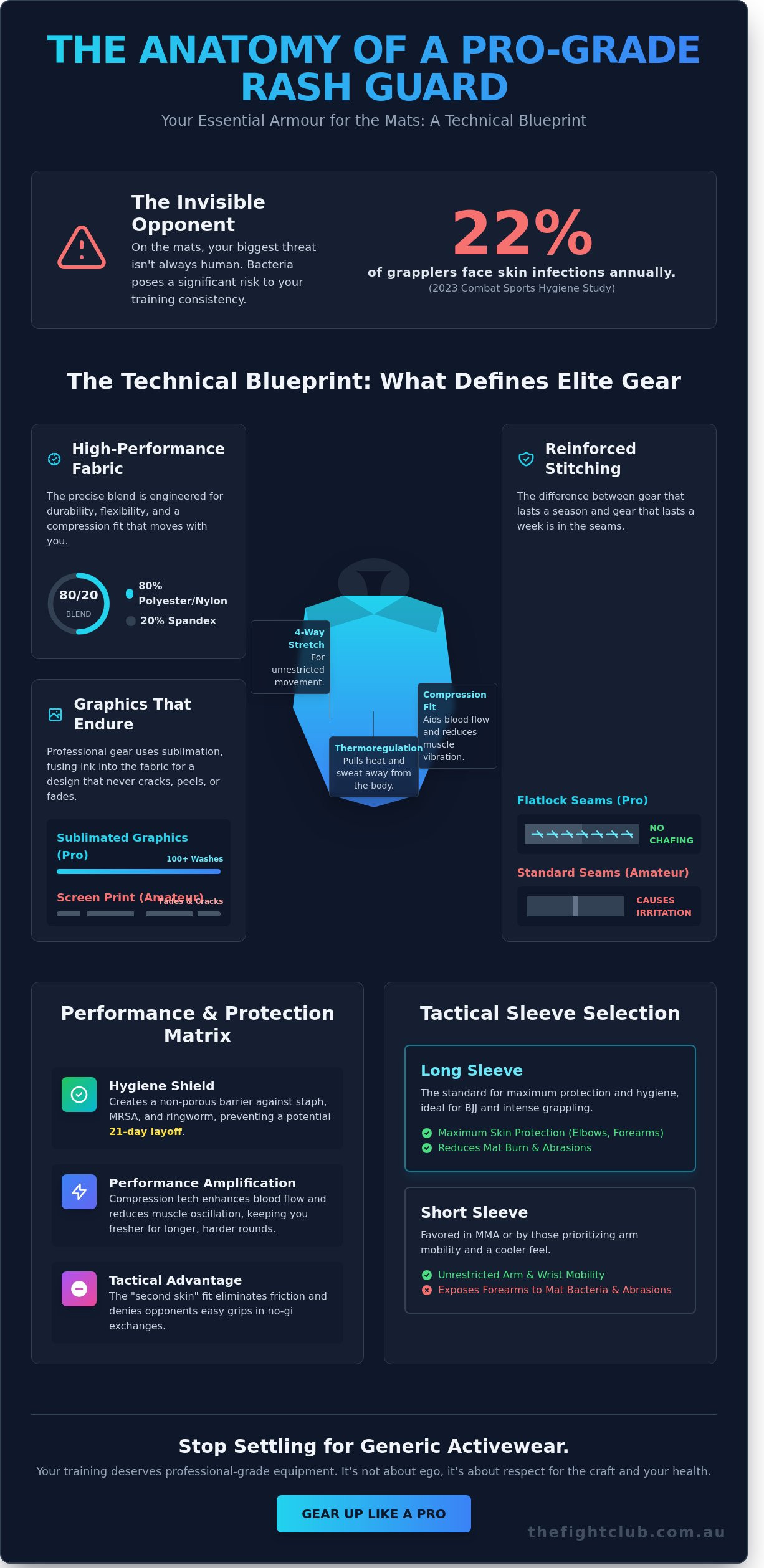
What if your toughest opponent isn't the guy across from you, but the invisible staph bacteria lurking on the mats? A 2023 study on combat sports hygiene found that 22 percent of grapplers deal with skin infections every year. You're here to train. You aren't here to sit out for three weeks with ringworm or staph. You know the grind. You show up. You sweat. You leave it all on the floor. But low quality rash guards that ride up during a double leg or chafe your neck make the work harder than it needs to be. Stop settling for gear that fails when the pressure is on.
We are going to master the technical details of professional fightwear so you can find the perfect gear to shield your skin and enhance your performance. You will learn how to choose a rashie that survives 200 wash cycles without fading. You'll keep your body temperature optimised during a heavy 10 minute sparring round. This guide breaks down the 2026 fabric standards, reinforced flatlock seam construction, and the gear that stays in place while you work. No egos. Train like a fighter. Just real gear for real fighters who value their skin's defence.
Key Takeaways
- Stop settling for generic activewear and discover why professional-grade rash guards are the essential armour you need to survive the mats.
- Master the technical blueprint of elite gear, from 4-way stretch technology to high-performance fabric blends engineered for total durability.
- Strategise your sleeve length by analysing the tactical trade-offs between maximum skin protection and unrestricted mobility for your discipline.
- Dial in the perfect "second skin" fit with sizing techniques that ensure your gear stays secure without restricting your breathing or movement.
Armour for the Mats: Why Real Fighters Never Train Without a Rash Guard
Leave the baggy cotton t-shirts for the weekend runners. On the mats, that fabric is a liability. It gets heavy. It holds sweat. It tears during a heavy roll. Real fighters step up in professional rash guards. This isn't just clothing; it's a high-performance compression garment engineered specifically for the grind of 2026 combat sports. It's the difference between staying in the fight and sitting on the sidelines with a preventable injury.
The distinction between authentic gear and generic activewear is immediate. Generic shirts lack the reinforced stitching required for high-intensity grappling. They slide up. They lose shape. A professional Rash guard provides the necessary grip and durability to survive 100 rounds of sparring. It offers a level of protection that superficial fitness trends can't match. When you wear professional-grade kit, your mindset shifts. You're not here to be seen. You're here to train like a fighter. It provides a psychological edge that screams discipline and respect for the craft. No egos. Just grit.
The Hygiene Factor: Protecting Your Skin
Your skin is your largest organ. During a sweat-heavy session, your pores open wide. This makes you vulnerable. In high-contact BJJ, you're constantly exposed to bacteria. High-density synthetic fabric acts as a non-porous barrier. It blocks staph, MRSA, and ringworm from entering your system. Full-body coverage is the standard for a reason. One skin infection can lead to a 21-day mandatory layoff from the gym. Don't risk your progress. Cover up and keep the mats clean for the whole family.
Compression Technology and Performance
Elite performance requires smart tech. Compression fabric aids blood flow and reduces muscle vibration during explosive movements. This keeps your limbs fresh for the final bell. These garments also master thermoregulation. They pull heat away from your core when the round intensifies. A high-quality rashie functions as a second skin that eliminates friction and denies your opponent any easy grips during no-gi exchanges. It's about efficiency and hard work.
The "Fight Club" way is about substance over flash. We don't do gimmicks. We do what works. In 2026, the tech has evolved, but the grit remains the same. Choosing the right rash guards is your first step toward a professional training standard. It shows you're serious about your health and your technique. No excuses. Just the right gear and the will to improve. Respect the mats. Respect your partners. Get the kit that handles the heat.
The Technical Blueprint: Anatomy of a Professional-Grade Rashie
Your gear is your second skin. On the mats, there is no room for vanity. There is only performance. Professional rash guards are not just gym shirts. They are engineered tools designed for the grind. Most high-tier options utilize a blend of 80% polyester or nylon with 20% spandex. This specific ratio provides the 4-way stretch required for a deep armbar or a sudden sprawl. It does not just sit on your torso. It moves with you. This tight fit serves a purpose beyond aesthetics. Research into the benefits of compression therapy shows that targeted pressure improves blood flow and reduces muscle oscillation during 90-minute shark tank sessions. At The Fight Club, we operate on a No Egos policy. Your gear should reflect that mentality. It works as hard as you do. No excuses.
Flatlock Stitching: The Hero of Comfort
Standard seams fail under pressure. They chafe your skin. They rip during heavy rolling. Flatlock stitching is the industry standard for a reason. The fabric layers overlap and are sewn perfectly flat against the body. This eliminates the ridges that cause "mat burn" during 10-minute rounds. It provides a level of durability that basic gym wear cannot match. If you are serious about your kit, you should apply the same scrutiny here as you would when using a BJJ Gi Guide 2026 to select your armour. Quality stitching ensures your gear survives the season.
Sublimated Graphics vs. Fading
Screen printing is for casual wear. On the mats, screen-printed logos crack and peel. They feel heavy. Sublimation is the professional choice. This process involves heat-fusing the ink directly into the fabric fibres. The design becomes part of the material itself. It will never fade, even after 100 washes. Brands like Venum use this technology because it maintains breathability. Your fight identity stays sharp. Your gear looks as dangerous in month twelve as it did on day one. Train like a fighter. Look like one too.
Anti-Slip Waistbands
Nothing kills focus like a rashie riding up to your armpits during a double-leg takedown. It is a distraction you do not need. Premium models feature silicone waist strips or rubberised hems. These internal grips lock the garment to your waist or shorts. This small piece of tech is a major differentiator. It is often what separates a $30 budget top from $80 professional equipment. It ensures you stay covered while you work. If you value focus over fluff, it is time to upgrade your training kit with gear built for the Melbourne mats. Respect the craft. Invest in the right tools.
Long Sleeve vs. Short Sleeve: Tactical Selection for BJJ and MMA
Choosing your sleeve length isn't a fashion statement. It's a tactical decision based on your discipline, your environment, and your survival on the mats. You're here to work. Your gear should facilitate that work, not hinder it. Professional practitioners don't guess; they prepare. Most fighters at the elite level keep a rotation of both styles in their kit bag because they know a Tuesday night technical BJJ session requires different protection than a high-intensity MMA sparring round on a Friday. Your choice impacts your temperature regulation and your skin integrity.
The Case for Long Sleeves: Maximum Armour
Long sleeves are the gold standard for No-Gi BJJ. They provide a 100% barrier between your skin and the mat, which is vital when you're grinding through 10-minute rounds. Friction burns on the elbows can sideline you for a week if they get infected. These rash guards act as a second skin, offering a 30% reduction in skin-to-mat friction compared to bare arms. Hygiene is non-negotiable. Staph and ringworm don't care about your ego; they look for open pores and broken skin. Covering your entire arm is a disciplined move for long-term health. There is also a psychological edge. Pulling on long sleeves creates a "fully geared" mindset. It signals that you're ready for the deep waters of a heavy rolling session. Train like a fighter; protect your tools.
Short Sleeves: Cooling and Freedom
Short sleeves are the go-to for MMA training. When you're working the clinch or shooting for double-legs, you need your forearms clear for maximum friction and grip. Fabric can sometimes act as a lubricant when soaked in sweat, making it harder to secure a tight wrap. Short sleeves eliminate that variable. They are also essential for the Australian reality. Melbourne gyms in mid-January can reach internal temperatures of 38 degrees Celsius. Without air-con, a long-sleeve rashie becomes a heat trap. Short sleeves allow for better thermoregulation and airflow during explosive heavy bag work. If you've put in the hours and built the physique, short sleeves let the results of your discipline show. No Egos, just results.
Ranked Rash Guards for BJJ Competitors
If you plan on competing, you need to understand the rules. The IBJJF (International Brazilian Jiu-Jitsu Federation) update in 2024 reinforced strict requirements for apparel. You cannot just wear any colour. Your gear must reflect your current belt rank. Tournament regulations dictate that at least 10% of the garment must match your rank colour. White belts wear white; purple belts wear purple. Showing up to a tournament in the wrong gear results in an immediate disqualification before you even touch the mat. Brands like Venum have mastered this balance of aesthetics and regulation. For a deeper look at how the pros gear up, check out this Venum Australia Guide to ensure your kit meets the standard for 2026.
Standout Gear: Top Rash Guard Picks from The Fight Club Collection
Your gear is your armor. It protects against mat burn, prevents staph, and manages sweat during grueling five-minute rounds. We only stock what we trust for the Melbourne mats. Our rash guard collection features brands that have survived the world's toughest sessions. These picks are for the disciplined. They are for those who show up every day and leave their ego at the door. No fluff. Just performance.
Venum: The Gold Standard of Fightwear
Venum remains a powerhouse in the combat world for a reason. The Elite and Challenger lines define durability for modern grapplers. These rash guards utilise Venum Dry Tech technology to move moisture away from the skin rapidly. It keeps your body temperature regulated when the sparring intensity peaks. The Venum x Mike Tyson range is a standout. It offers an aggressive, anatomical cut that fits like a second skin. The graphics are fully sublimated so they never peel or crack. Reinforced seams characterise the entire Venum line, ensuring the garment survives heavy collar ties and scrambles. Expect to invest between $85 and $115 for these pieces.
Hayabusa: Engineering Perfection
Hayabusa is gear for the technician. Their products represent a peak in technical sophistication. Every piece uses multi-directional stretch fabric that never restricts your range of motion. The fabric weight is noticeably heavier than entry-level options. This provides genuine compression that supports muscle blood flow and speeds up recovery. A silicon waistband is often integrated to ensure the hem stays locked down during a double-leg takedown. It is the daily grinder's choice because it handles the wash cycle without losing its structural integrity. For this level of engineering, prices typically range from $110 to $140. It is a calculated investment in your training longevity.
UFC Authentic Gear: Train Like the Pros
The UFC Authentic Fight Night series carries a specific prestige. This is the same kit worn by world-class octagon veterans. The aesthetic is minimalist and professional. It rejects loud patterns for functional excellence and a clean look. The official UFC line focuses on a locked-in fit that provides the stability required for elite MMA training. The fabric blend is designed for maximum breathability under pressure. Wearing this gear says you are here to work, not to be seen. Most official UFC pieces sit between $95 and $125. It provides a professional-grade experience for anyone serious about their craft.
Don't settle for cheap substitutes that tear after a month of hard training. Choose gear that matches your work ethic and helps you push past your limits.
Sizing, Maintenance, and Getting Your Gear Game Right
Your gear is your armour. It needs to move with you, not against you. A proper fit feels like a second skin. It stays in place during a heavy roll or a fast sparring session. Respect the kit and it will respect you back. This isn't just about looking the part. It is about performance and hygiene. Follow the rules. Train hard. Keep your gear in the fight.
The Perfect Fit: Compression vs. Restriction
A rashie should be tight. It should hug your muscles and stay put. However, it must never hinder your lung expansion. Take a deep breath while wearing it. If you feel a squeeze that limits your intake, it is too small. Check the armpits and shoulders. You need full range of motion for underhooks and strikes. There should be no bunching or loose pockets of fabric. If the material becomes transparent or the print fades when you pull it on, you have gone down a size too far. If you are between sizes, choose the larger option. Mobility is more important than a slightly tighter look. Don't let ego dictate your sizing. A restricted fighter is a slow fighter.
Maintenance: Killing the Gym Funk
Gym funk is a silent killer in combat sports. Bacteria thrives in the sweat trapped in synthetic fibres. You must be disciplined with your laundry. Wash your gear immediately after every session. Use cold water only. Avoid bleach at all costs. It eats the fabric and destroys the sublimated prints. The dryer is the number one killer of high-quality spandex. High heat snaps the elastic fibres and ruins the compression. Hang your gear to air dry in the shade. To eliminate deep-seated odours, add half a cup of white vinegar to the wash. You can also use specialised detergents designed for athletic wear. Clean gear shows respect for your teammates and the mat.
Upgrade Your Kit Today
Cheap gear is a false economy. It rips. It stretches. It fails when the pressure is on. Top-tier rash guards are an investment in your skin safety and your longevity. High-quality compression helps prevent mat burn and reduces the risk of staph or ringworm. You aren't just buying a shirt; you are building your fight identity. We provide the tools. You provide the grit. Stop settling for basic equipment that lets you down. Step up to professional standards and feel the difference in your next round. Browse our range and find the kit that matches your discipline.
Ready to level up? Shop the full Rash Guard collection at The Fight Club and get the gear you deserve.
Lock In Your Armour for the Next Round
Success on the mats isn't about luck. It's about the technical blueprint of your gear and the discipline you bring to every session. You've seen how the right compression supports your muscles and how reinforced stitching prevents mid-roll disasters. Choosing between long and short sleeves comes down to your tactical needs in BJJ or MMA. Don't settle for inferior kits that fail when the pressure mounts. Professional-grade rash guards are your first line of defence against mat burn and infection.
The Fight Club has been Australian owned and operated since 2023. We don't stock fluff. As an official stockist for Venum, Hayabusa, and the UFC, we provide gear that's been tested by professional fighters in the heat of sparring. We understand the grit required to improve every day. You focus on the technique; we'll handle the armour. It's time to gear up with equipment that matches your intensity. Leave the ego at the door and put in the work.
Secure your armour: Browse the Rash Guard Collection
The fight is personal. Every drop of sweat brings you closer to your goals. We'll see you on the mats.
Frequently Asked Questions
Can I just use a normal compression shirt instead of a rash guard?
No, a standard compression shirt won't survive the intensity of the mats. Combat-grade gear uses 220 to 280 GSM fabric, whereas gym shirts usually sit around 150 GSM. The thinner material tears easily during heavy clinch work or wrestling transitions. You need reinforced flatlock stitching to handle the constant tugging. Don't waste money on gear that fails after three sessions; buy for durability.
How tight should my rash guard actually be?
Your gear should fit like a second skin with zero loose fabric. If you can grab more than 2 centimetres of material at your waist, it's too loose. Excess fabric gives your opponent an illegal grip and lets fingers get snagged during rolls. A tight fit also keeps your muscles warm and reduces the risk of skin abrasions during high-intensity rounds.
Do I need a different rash guard for BJJ and MMA?
You can use the same gear for both, but technical needs often vary. MMA fighters often prefer short sleeves to keep their forearms free for better grip during neck ties. BJJ practitioners usually opt for long sleeves to maximise skin protection against mat-borne bacteria. Both styles must be rugged. At our club, we value function over fashion; choose what keeps you on the mats.
How many rash guards should a beginner own?
Every beginner should own at least three rash guards to maintain a proper training rotation. You need a fresh one for every session to ensure hygiene. If you train three times a week, three shirts ensure you always have a clean, dry kit ready. Hygiene is a sign of respect for your training partners. Showing up in a dirty kit violates our "No Egos" policy.
What is the best way to wash my rash guard to make it last?
Wash your gear in cold water and never use a clothes dryer. High heat destroys the elastic fibres and ruins the compression fit. Turn the shirt inside out to protect the sublimated graphics from peeling over time. A 2023 industry report showed that air-drying extends the lifespan of polyester blends by 40% compared to machine drying. Treat your gear with the same discipline you bring to training.
What does "IBJJF legal" mean for rash guards?
IBJJF legal means the shirt meets the International Brazilian Jiu-Jitsu Federation's strict competition requirements. The design must be at least 10% the colour of your current belt rank. The remaining fabric must be black or white. If you're a blue belt, your rash guards must display that blue clearly. Check these specifications before buying if you plan to compete in 2026.
Are long sleeve rash guards hotter than short sleeve ones?
Long sleeves aren't significantly hotter, but they offer superior skin protection. Research indicates core temperature differences between sleeve lengths are less than 0.5 degrees Celsius during active sparring. Long sleeves prevent mat burn on your elbows and provide a barrier against skin infections. Short sleeves remain a solid choice for peak summer heat in Melbourne gyms without air conditioning.
Should I wear a rash guard under my BJJ Gi?
You should always wear one under your Gi for hygiene and comfort. It wicks sweat away from your torso and prevents the heavy Gi fabric from chafing your skin. This extra layer also keeps your sweat from soaking directly into your partner's Gi during close-guard work. Most professional academies require this to keep the training environment clean. It's about being a professional teammate.