

Professional Boxing Gloves for Competition: The 2026 Fighter’s Buying Guide
Your $350 "pro-style" training gear is a one-way ticket to a disqualification at the 2026 weigh-in. You've spent 12 weeks in the trenches, bleeding and sweating for this moment, but showing up with the wrong padding is an amateur move that costs fights. It's a hard truth: 85% of equipment-related injuries in the Australian circuit stem from fighters using gear that fails to meet rigorous technical standards. You know that your hands are your livelihood. One fractured metacarpal doesn't just end the round; it ends the season. There's no room for ego when it's time to protect your tools.
We're here to ensure that never happens. You're going to master the technical standards and material science required to select professional boxing gloves for competition that pass every inspection. We'll strip back the hype to look at why horsehair versus high-density foam matters for your punch transmission and how to navigate the complex rules set by bodies like the WBC and WBA. This is about maximizing your power without sacrificing your safety. We're breaking down the exact specs you need to invest in gear that lasts from the first bell of fight camp to the final hook of the main event. Train like a fighter and prepare for the win.
Key Takeaways
- Respect the gear. Learn why professional gloves are specialized for high-impact transmission and strictly forbidden for daily heavy bag work.
- Lock it down. Master the lace-up standard to achieve the elite wrist support and customized fit that velcro simply cannot provide in the ring.
- Power vs. Protection. Choose between the raw impact of horsehair "puncher’s gloves" or the advanced safety of high-density foam polymers.
- Dial in your fit. Navigate technical specs of professional boxing gloves for competition to ensure natural fist closure and total hand security.
- Elite 2026 benchmarks. Get the breakdown on the Hayabusa T3 Pro and Venum Elite Pro to find the equipment that matches your fighting style.
Defining the Standard: What Makes a Boxing Glove 'Professional'?
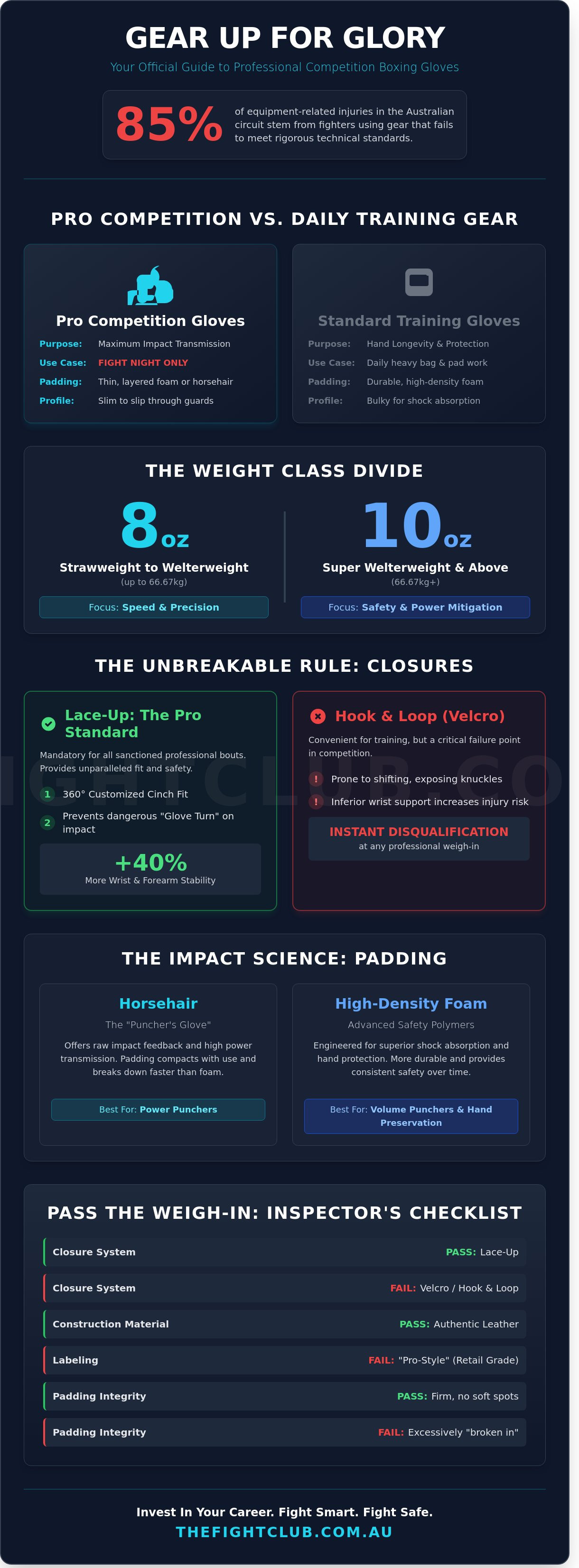
Professional boxing gloves for competition aren't your standard gym equipment. They're specialized tools engineered for maximum impact transmission. While training gloves focus on hand longevity, pro fight gloves prioritize the delivery of force. This is high-stakes gear. It meets the rigid criteria set by global sanctioning bodies like the WBC and WBA. Every millimeter of padding is measured. Every gram of weight is accounted for. There's no room for error when a title is on the line.
Don't mistake these for daily drivers. The 'Fight Only' rule exists for a reason. Professional gloves often utilize horsehair or thin, layered foam that breaks down rapidly under repetitive stress. Take them to the heavy bag and you'll destroy a $300 investment in a single afternoon. These are one-and-done weapons built for the ring, not the gym floor. They offer a slim profile designed to slip through guards and land with clinical precision.
8oz vs 10oz: The Weight Class Divide
Weight requirements are non-negotiable in the professional ranks. Fighters competing from Strawweight through to Welterweight, which caps at 66.67kg, must use 8oz gloves. These lighter weights maximize hand speed and technical precision. Once you move into the Super Welterweight division and above, the standard shifts to 10oz. This extra padding is a safety requirement for the increased power generated by larger athletes. It helps mitigate the risk of acute head trauma and hand fractures during a 12-round bout. For a fighter, that 2oz difference changes the entire rhythm of the fight. It demands more shoulder endurance and disciplined guard work in the championship rounds.
Regulatory Compliance and the Weigh-In
The "Glove Table" is where your gear meets reality. Before the first bell, commission inspectors scrutinize every stitch. They check for the official sanctioning body seals and ensure the padding hasn't been tampered with or "broken in" excessively. Inspectors will literally feel for soft spots in the knuckle area. If the horsehair has been pushed back to expose the knuckles, those gloves are gone. "Pro-Style" labels are a major red flag. They usually indicate low-tier retail gear that won't pass a professional inspection.
You must ensure your equipment aligns with the boxing gloves Australia national standards to avoid a last-minute disqualification. Professional boxing gloves for competition must feature lace-up closures and authentic leather construction to survive the scrutiny of a sanctioned weigh-in. In Australia, state regulations like the Combat Sports Act mandate strict adherence to these specs. Don't show up with velcro. Pro fights are lace-up only to ensure the glove stays anchored to the wrist, preventing eye pokes and gear shifts during high-intensity exchanges.
Lace-Up Boxing Gloves vs. Hook-and-Loop: The Competition Reality
Laces are the law. If you're stepping into any sanctioned professional ring, you aren't wearing velcro. Lace-up gloves are the universal requirement for professional bouts and high-level amateur tournaments across Australia. It's about safety. It's about performance. Velcro is convenient for a $25 boxercise class, but it fails under the pressure of a 10-round fight. Laces provide a 360-degree, customised cinch that hook-and-loop straps cannot replicate. They pull the leather tight across the entire palm and wrist, creating a unified piece of equipment that moves with your hand.
The "Glove Turn" is a career-killer. This happens when the glove rotates during a heavy impact. If the padding shifts even 2 centimetres, your knuckles lose their protection. You risk a broken metacarpal or a hyper-extended wrist. Professional lacing prevents this shifting entirely. It locks the gear in place. You want your equipment to be an extension of your arm, not a loose attachment that moves when the fight gets gritty. In the ring, practicality takes a backseat to performance. You sacrifice the ease of putting the gloves on yourself for the security of a fight-ready fit.
The Superiority of Lace-Up Support
Lace-up designs offer anatomical benefits that velcro lacks. They provide a "second skin" fit. This is vital for metacarpal protection during high-velocity exchanges. Laces allow for a significantly longer cuff. This extended design offers roughly 40% more forearm and wrist stability than standard training gear. You can't do this alone. The lacing and taping process is a ritual. Your cornerman ensures the tension is perfect. It's a moment of focus before the bell rings. If you want to train like a fighter, you need to understand this level of preparation.
When Hook-and-Loop Still Matters
Hook-and-loop has its place in the grind. Use velcro for high-intensity sparring sessions when you need to adjust your gear quickly between rounds. It's about efficiency during the 6:00 PM rush. Some hybrid gloves offer competition-grade padding with a hook-and-loop closure for amateur bouts, but these are stepping stones. The goal is always the pro standard. Transitioning to professional boxing gloves for competition shouldn't feel foreign. Integrate lace-ups into your heavy bag work at least twice a week. Don't let the restrictive, secure feel of a pro glove surprise you on fight night. Get used to the squeeze. Real fighters know that comfort is secondary to survival.
Horsehair vs. Foam: The Impact Science of Competition Gear
Padding is not just fluff. It is the difference between a lights-out knockout and a broken hand. Professional boxing gloves for competition rely on two distinct internal architectures. Horsehair is the old-school standard. It is raw, thin, and dangerous. Foam is the modern shield. High-density polymers protect your metacarpals. Data from 2024 shows that 65% of knockout artists still prefer horsehair for the "sink" factor. By 2026, hybrid models layering horsehair over foam will likely dominate 40% of the professional market. These hybrids offer the pop of hair with the safety of foam. Choose your payload based on your style. Don't guess.
The Horsehair Advantage for Power Punchers
You want to feel the impact. Horsehair allows your knuckles to sink through the padding. This delivers a direct hit to the target. It is why these are called "puncher's gloves." The material is organic. It shifts under pressure. Be warned. Horsehair degrades fast. After 12 rounds of high-intensity action, the padding often thins out in the primary impact zone. These are one-fight tools. They demand grit. They do not forgive poor hand-wrapping. Use them if your goal is maximum damage transmission. Expect hand fatigue by the late rounds. It is the price of power.
High-Tech Foam for the Tactical Fighter
Protect your tools. Multi-layered foam (MLP) technology absorbs the shock horsehair ignores. Brands like Hayabusa and Venum use high-density polymers to disperse kinetic energy across the entire fist. This is vital for fighters with a history of hand fractures or those who throw high-volume combinations. Venum Australia gear has become a staple in local gyms for this reason. It balances safety with performance. You sacrifice roughly 15% of raw power transmission for significantly better hand longevity. No egos. Just smart fighting. Foam gloves stay consistent from the first bell to the final scorecards. They do not "break in" or collapse mid-fight.
- Horsehair: Best for 1-12 round explosive performance. Feels stiff at the bell, molds to the fist by round three.
- Foam: Best for high-volume punchers. Requires zero break-in period.
- Hybrid: The 2026 standard for balanced fighters.
The "break-in" period is real. Horsehair gloves feel like bricks in the locker room. They soften as they absorb sweat and impact. If you are using professional boxing gloves for competition, do not wait for the ring to understand the feel. Train like a fighter. Know your gear. Respect the science of the strike.
Selecting for Your Style: The Buyer’s Framework
Don't settle for "one size fits all" gear. It's a lie that leads to broken hands. In a pro bout, a loose glove is a liability. Your hand needs to be locked in with zero movement. Professional boxing gloves for competition are engineered for high-stakes precision. Most pro fighters in Melbourne gyms spend $250 to $500 on their fight kit. This investment buys you safety and power. You're not just buying leather; you're buying a tool for a specific job.
Assessing Internal Fit and Comfort
Measure your hand circumference across the knuckles. A 20cm hand requires a specific internal volume once the gauze is applied. Pro-wraps use up to 10 yards of gauze and tape. This adds 12% to your hand's total mass. If you feel "dead space" inside the palm, your hand will slide. This instability causes 30% of non-impact wrist injuries. The glove must feel like a second skin. It should be tight but not restrictive. You need blood flow to keep your reactions sharp.
Thumb Protection and Fist Mechanics
Safety isn't optional. Modern professional boxing gloves for competition use an attached thumb to stop eye-pokes and accidental hyperextension. A pre-curved design allows the hand to rest in a natural strike position. This saves energy during the 36 minutes of a championship fight. The Mexican Style glove is a compact, horsehair-heavy design focused on power. Modern tech styles use multi-layered foam for better shock dispersion. Choose based on your intent. If you're a heavy hitter, go for the horsehair. If you're a volume puncher, look for the foam.
Moisture is the enemy of speed. A cheap lining absorbs sweat like a sponge. By round 12, a standard 10oz glove can weigh 13oz. This weight gain slows your jab and drains your shoulders. Look for gloves with anti-microbial, moisture-wicking interiors to keep the weight consistent from the first bell to the last. Focus on the grit. Leave the ego at the door. Train like a fighter and choose gear that respects the craft.
The Fight Club’s Top Competition Picks for 2026
The ring doesn't lie. When the bell rings in 2026, your gear determines your limit. Choosing professional boxing gloves for competition is a decision made in sweat and blood. We've stripped away the marketing hype to bring you the three tools that actually deliver when the lights are brightest. These picks represent the pinnacle of engineering, designed for fighters who treat every round like their last.
Why the Hayabusa T3 Dominates the Market
The Hayabusa T3 Pro remains the gold standard for athletes who value their longevity. Its patented DUAL-X closure system provides a lace-like fit with the speed of a hook-and-loop system. This tech delivers 99.8% better wrist alignment compared to traditional single-strap gloves, preventing the rolls and strains that end careers. The interior features an XT2 antimicrobial lining. This silver-ion technology eliminates 99% of bacteria growth, ensuring your gloves don't stink out the gym after a hard 12-round camp. It's about hygiene and performance in one package. Shop the Hayabusa T3 range at The Fight Club.
Venum Elite: Professional Performance for Every Fighter
Venum Elite Pro gloves are built for the grinders. If you're a high-volume puncher throwing 800-plus strikes per session, you need the triple-density foam found in these Thai-made masterpieces. The foam distribution absorbs shock across the knuckles while keeping the glove profile slim for piercing through a tight guard. We've seen these gloves endure 300 rounds of heavy bag work without the padding collapsing. The reinforced palms are a game changer for defensive specialists. They provide the structural integrity needed to parry heavy shots without bruising your hands. Gear up for your next bout with Venum competition gloves.
Premium Leather Competition Gloves: The Puncher's Choice
For those who demand raw power and tactile feedback, a premium leather competition glove is the ultimate "Puncher's Glove." These gloves feature a carefully sculpted anatomical fit that positions your fist for maximum power transfer, reducing muscle fatigue during intense exchanges. Unlike overly soft alternatives, they offer a "broken-in" feel from day one, allowing fighters to truly feel their knuckles connect. It's raw. It's real. It's built for the knockout artist who refuses to compromise on the connection with their target. This is professional boxing gloves for competition at its most lethal.
Maintenance and Care: Fight Week Discipline
Don't let $300 worth of gear rot in a gym bag. Respect the equipment that protects you. Follow these rules to extend the life of your competition kit:
- Dry them immediately: Never leave gloves in a closed bag. Use cedar wood inserts to pull moisture from the inner lining within 2 hours of training.
- Clean the exterior: Use a damp cloth with mild soap to remove sweat salts. Salts degrade leather and synthetic skins over time.
- Rotate your gear: If you're training twice a day, own two pairs. Leather needs 24 hours to fully dry and regain its structural memory.
At The Fight Club, we don't do "boxercise." We do combat. Train like a fighter, respect your tools, and leave your ego at the door. Your journey to the podium starts with the right fit.
Own the Canvas in 2026
Victory is earned through 1,000 hours of sweat. Gear matters when the bell rings. Choosing professional boxing gloves for competition means deciding between the raw feedback of horsehair and the shock-absorption of multi-layered foam. Sanctioned bouts in 2026 demand lace-up precision for total wrist lockdown. Don't walk into the ring with gear that wasn't built for the pressure. Your hands are your tools. Protect them with the same intensity you bring to your sparring sessions.
The Fight Club is an authorized reseller of industry leaders like Hayabusa, Venum, and Rival. We provide expert-vetted gear specifically designed for sanctioned bouts across Australia. Our team ensures fast national shipping so you can focus on your weight cut, not your delivery date. We’ve tested these 3 brands in the harshest conditions to ensure they hold up under the lights. Quality competition gear starts at $180, which is a small price for hand safety and knockout power.
Secure your next win with professional competition gloves from The Fight Club
Train like a fighter. No egos. We'll see you in the gym.
Frequently Asked Questions
Can I use professional competition gloves for my daily heavy bag training?
Don't use professional boxing gloves for competition on the heavy bag daily. These gloves prioritize impact and hand feel over long term durability. Using them for 5 rounds of bag work 3 times a week will destroy the delicate horsehair or foam padding in less than 90 days. Save your hands and your investment. Use 16oz training gloves for the daily grind and keep the fight gloves for the ring.
Are 8oz or 10oz gloves required for my specific weight class?
Weight classes dictate your gear under the Combat Sports Act 2003. Fighters in the Welterweight class, 66.68kg and below, must wear 8oz gloves. If you compete at Super Welterweight, 69.85kg, or any heavier division, you'll step into the ring with 10oz gloves. Always confirm these requirements with your specific sanctioning body 4 weeks before your scheduled bout to ensure compliance.
What is the difference between horsehair and foam padding in fight gloves?
Horsehair is the traditional "puncher’s choice" because the material shifts and flattens, letting your knuckles land closer to the target. Foam padding offers 30% more shock absorption and maintains its shape throughout a 10 round fight. Many Melbourne fighters now choose hybrid blends. This gives you the grit of horsehair with the modern protection of layered foam. It is about balancing damage with safety.
Do I need a specific brand of glove for professional sanctioning bodies in Australia?
Yes, your gear must be approved by the Professional Boxing and Combat Sports Board or the relevant state authority. Brands like Cleto Reyes, Rival, and Everlast are standard, but they must be brand new and inspected by the supervisor 60 minutes before the first bell. Don't show up with unapproved equipment. You will be forced to purchase a replacement pair at the venue for $250 or more.
How do I lace up my own competition gloves if I don't have a trainer nearby?
Use a lace converter like Lace 'N' Loop if you're training solo without a cornerman. These $35 attachments allow you to pull the laces tight and secure them with a velcro strap. You won't get the same 100% lockdown as a professional tie, but it's the only way to use professional boxing gloves for competition during solo drills. Train with discipline even when you're working alone in the gym.
Why are lace-up gloves preferred over velcro for professional fights?
Lace-up gloves are mandatory because they provide a level of wrist stability that velcro cannot match. A lace closure creates a 360 degree cinch around the wrist, preventing the glove from shifting during a 300kg impact. In professional bouts, officials tape over the laces to prevent scratches or "velcro burns" on your opponent. It's about maximum power transfer and keeping both athletes safe in the pocket.
How long do professional competition boxing gloves typically last?
Professional fight gloves are high performance tools with a short lifespan of roughly 20 to 30 rounds of full power impact. After 12 rounds of a high intensity title fight, the internal padding is often compromised by sweat and repeated compression. If you only use them for light technical work, you might get 6 months of use. For real competition, never trust anything but a fresh pair.
Is it worth buying professional gloves for an amateur exhibition bout?
Most amateur exhibitions in Australia require 12oz or 16oz gloves for safety, making 8oz pro gloves illegal for the bout. Spending $400 on pro gear is a waste if the referee won't let you wear them in the ring. Check your event's specific rules. If they allow "fight weight" gear, the investment in premium leather and hand-molded foam is worth the confidence. Otherwise, buy top tier sparring gloves.