

Muay Thai Shin Guards Australia: How to Choose Professional Protection
You're three rounds into a heavy sparring session, you go to check a kick, and your shin guard spins 180 degrees around your calf. It's a distraction you don't need when you're trying to focus on technique and timing. We've all felt the sting of a poorly placed block that leaves a haematoma despite wearing protection. Finding the right Muay Thai shin guards Australia practitioners rely on is about more than just picking a brand; it is about securing your weapons so you can train without hesitation.
Investing in premium gear is a commitment to your training longevity. Choosing budget equipment is a false economy. Cheap foam collapses under heavy impact. Low-grade straps lose their grip after a few months of sweat. Premium gear costs more upfront, but the ROI is measured in years of service and a significant reduction in avoidable injuries. To read more about how professional Thai gear is constructed, you can explore the design of high-density guards. Whether you want the raw feel of a Thai-made guard or the high-tech stability of Western design, your choice must reflect your training intensity. Don't settle for "good enough" when your weapons are on the line.
We understand the grind. You want gear that stays put during explosive movements and won't stink after a month of sweat. This guide will show you how to choose professional protection that balances mobility with high-density padding. We will break down the ROI of premium leather and explain how to match your gear to Muaythai Australia (MTA) competition standards, from mandatory cloth guards for C-Class to the density needed for B-Class sparring. Stop settling for gear that fails when the intensity rises and start training with the confidence of a professional.
Key Takeaways
- Identify the critical layers of professional protection to separate bone-saving density from useless padding.
- Execute a foolproof sizing protocol to find Muay Thai shin guards Australia practitioners can rely on for a secure, slip-free fit.
- Master the "Dry and Defend" maintenance rule to stop gear rot and keep your equipment fresh through every session.
- Evaluate the performance differences between genuine leather and high-tech synthetics to maximise your protection and durability.
- Compare top-tier engineering from brands like Hayabusa and Venum to find the perfect balance of mobility and impact resistance.
Why Your Choice of Muay Thai Shin Guards Matters
Your shins are your primary weapons. In a sport defined by the "art of eight limbs," leaving your legs unprotected is a fast track to the sidelines. Choosing the right Muay Thai shin guards Australia practitioners trust isn't just about comfort; it's about survival. Professional-grade guards act as essential armour. They absorb the impact that would otherwise rattle through your bone and connective tissue. Without them, you're not training; you're just counting down the days until an avoidable injury stops your progress.
Don't confuse conditioning with stupidity. You condition your shins on the heavy bag and Thai pads to build bone density over years of disciplined work. You wear guards during sparring to prevent micro-fractures and debilitating haematomas. Real training requires longevity. If you're limping after every Tuesday night session, you aren't getting tougher. You're just getting broken. High-quality protection allows you to throw kicks with conviction and check strikes without fear.
There's a community aspect to your gear choice, too. Sparring is a partnership, not a fight to the death. When you wear high-density padding from reputable brands like Venum or Hayabusa, you're protecting your partner's ribs and arms from the raw edge of your tibia. Cheap, flimsy imitations from big-box retailers offer a false sense of security. They shift on impact, leave gaps in coverage, and provide a hard, unforgiving surface that injures everyone involved. Authentic Muay Thai shin guards Australia athletes use are designed to keep both fighters in the gym and off the physio table.
The Consequences of Poor Protection
Inadequate padding leads to more than just a few bruises. Deep-tissue haematomas can sideline you for weeks, stalling your development. Worse, gear failure creates defensive hesitation. If you don't trust your gear, you won't throw that roundhouse with full commitment. You start flinching. You develop bad habits that are hard to break. Investing in quality protection ensures you stay in the fight longer and maintain the technical focus required for elite performance. It's about respecting your body and your craft.
Muay Thai vs. MMA Shin Guards
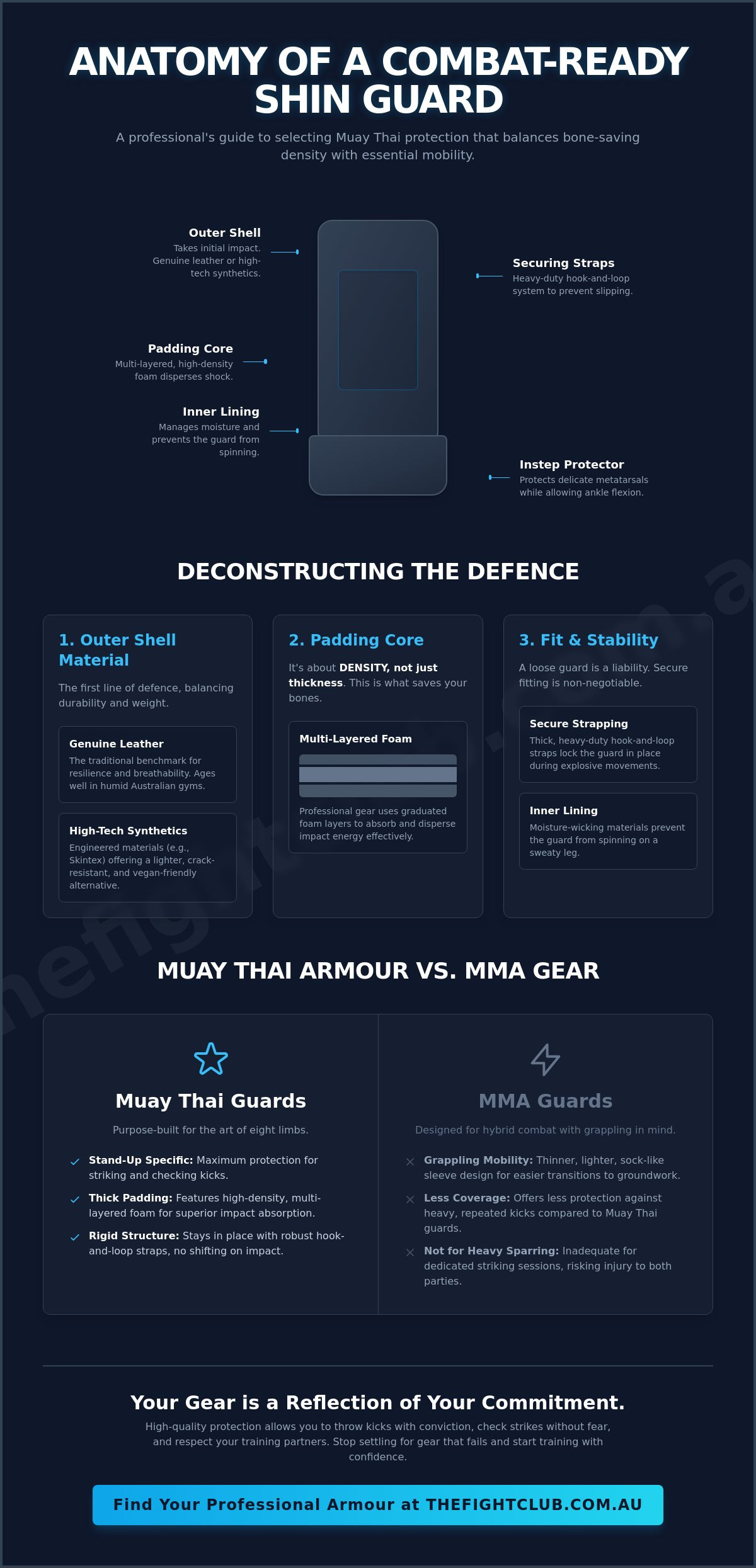
Context matters in the gym. Understanding the Anatomy of a Combat-Ready Shin Guard helps you realise why Muay Thai designs differ from MMA gear. MMA guards are often sock-like sleeves designed for grappling mobility. They're thinner and lighter. Muay Thai guards are stand-up specific, featuring thick, multi-layered foam and rigid hook-and-loop straps. They offer superior instep and side-shin protection for checking heavy kicks. Unless you're spending half your round on the floor, stick to the dedicated stand-up protection that authentic Muay Thai shin guards Australia retail options provide.
Understanding the Anatomy of a Combat-Ready Shin Guard
Professional protection isn't an accident. It's engineering. To find the best Muay Thai shin guards Australia offers, you must look beneath the surface. A combat-ready guard is a composite of three critical layers. First, the outer shell takes the initial impact. Second, the shock-absorbing foam disperses energy before it hits the bone. Finally, the inner lining manages moisture and prevents the guard from spinning. If any of these layers fail, the whole system collapses. You aren't just buying pads. You're investing in the integrity of your skeleton.
Stability depends on the hook-and-loop system. Thick, heavy-duty straps are non-negotiable. They must lock the guard in place through high-volume roundhouses and aggressive checks. A loose guard is a liability. It exposes your shins and trips your footwork. The instep protector must be seamlessly connected to the shin plate. This bridge protects the delicate metatarsals of your foot while allowing the ankle to flex naturally. Selecting high-performance Muay Thai shin guards Australia retailers provide requires an eye for these technical details.
Outer Shell Materials: Leather vs. Synthetic
Genuine leather remains the industry benchmark for a reason. It's resilient. It breathes. In the humid heat of Australian gyms, leather ages better than cheap plastic. However, high-grade synthetics like Syntek or Skintex are closing the gap. These materials are engineered specifically for high-intensity training. They don't crack easily and offer a lighter profile for speed-focused fighters. If you're looking for a vegan-friendly option that doesn't sacrifice performance, brands like Venum provide synthetic shells that rival traditional hide in both durability and texture.
Padding Density and Distribution
Padding is about density, not just thickness. Multi-layered foam technology is what separates professional gear from toys. Brands like Hayabusa use graduated layers to manage impact. The outer layer is firm to deflect, while the inner layers are softer to cushion the limb. Look for a pre-curved design. This ergonomic shape follows the natural contour of your leg. It eliminates the "break-in" period and ensures the padding stays centred on your tibia. Don't buy bulky pillows that slow your kicks. Seek the sweet spot where protection meets mobility to keep your movement sharp.
How to Size and Secure Your Guards for Heavy Sparring
Sizing is not a suggestion. It is a requirement for safety. Most fighters guess their size based on height, but that is a rookie mistake. A guard that is too long will bite into your kneecap every time you check a kick. A guard that is too short leaves your ankle or upper shin exposed to bone-on-bone impact. Finding the right Muay Thai shin guards Australia athletes rely on starts with a tape measure, not a guess. You need a fit that feels like an extension of your leg, not a clunky attachment.
The Measurement Protocol
Precision prevents injury. Follow this five-step protocol to ensure you are ordering the correct equipment for your build. Sit in a chair with your feet flat and your knees at a 90-degree angle. This mimics the tension in your legs during a fight. Use a flexible tape measure for these steps:
- Measure the Length: Start from the top of your ankle crease and measure to the bottom of your kneecap. The guard should end just below the knee to allow full flexion.
- Check Calf Circumference: Measure the widest part of your calf. Heavy-duty straps need enough surface area to grip without overstretching.
- Verify the Instep: Ensure the foot protector covers your metatarsals but does not extend past your toes.
- Apply the Two-Finger Rule: Once strapped, you should be able to slide two fingers between the strap and your leg. Any tighter and you will restrict blood flow; any looser and the guard will spin.
- Cross-Reference: Compare your centimetre measurements against brand-specific charts, as Thai brands often run smaller than Western designs.
Testing the Fit in Motion
Before you ever step onto the mats, you must test for "slip." Put your gear on and perform ten rapid-fire roundhouses on a heavy bag. If the guard shifts even a centimetre, the straps are either too loose or the shell is too wide for your leg profile. Perform several knee-to-elbow checks. If the top of the guard hits your thigh or pinches your knee, it is too long. This restriction will slow your defensive reactions and lead to bad habits.
Before you even strap on your legs, ensure your mouth guard is securely fitted. Gear checks should happen from the top down to ensure total focus. Securing the best Muay Thai shin guards Australia has to offer means nothing if they move when the pressure is on. If you feel pinching or restricted movement during shadowboxing, adjust the strap placement. The goal is a locked-in feel that allows you to move with total aggression and zero hesitation.
Gear Maintenance: How to Extend the Life of Your Protection
Sweat is an acid. It eats through high-density foam and rots genuine leather from the inside out. If you finish a session and leave your Muay Thai shin guards Australia gear inside a zipped gym bag, you are effectively marinating your equipment in bacteria. This is how gear becomes a biohazard. Rotting gear doesn't just smell; it loses its structural integrity. Follow the "Dry and Defend" rule. The second you get home, pull your gear out. Open the straps wide. Let them breathe. This simple discipline can double the lifespan of your professional protection.
Cleaning requires a specific approach based on the material of your shell. For genuine leather, avoid harsh chemical cleaners that strip natural oils and cause cracking. Use a damp cloth with mild, pH-neutral soap. Modern synthetics like those used in Venum or Hayabusa equipment are more resilient to moisture but still require a post-training wipe-down to remove salt deposits. The inner lining is the primary breeding ground for odour. Use a specialised gear spray or a light mist of water and white vinegar to neutralise bacteria without damaging the fabric.
Daily Cleaning Rituals
Consistency beats intensity in maintenance. Wipe down the outer shell and inner lining after every single session. Use a non-abrasive microfibre cloth to prevent scratching the finish. Once cleaned, air-dry your guards in a cool, shaded area with plenty of airflow. Never leave your gear in the direct Australian sun. While UV rays kill bacteria, they also make leather brittle and cause foam to lose its shock-absorbing properties. If you train in high-humidity environments, consider using cedar wood inserts or silica gel packets to pull deep-seated moisture out of the padding overnight.
Inspecting for Failure
Protection has an expiry date. You must inspect your padding monthly for "bottoming out." Press your thumb firmly into the centre of the shin plate. If the foam feels mushy or you can feel the hard surface of the floor through the pad, the cellular structure has collapsed. The protection is gone. Check the hook-and-loop straps for fatigue. If the Velcro is clogged with lint or the elastic is frayed, the guards will shift during impact. This creates a safety risk for you and your partner. Don't let your ego stop you from replacing compromised gear. If your current pair is failing, it is time to upgrade your armour and stay in the fight.
Top Muay Thai Shin Guard Brands Available in Australia
The market is flooded with gear. To find the best Muay Thai shin guards Australia has to offer, you must distinguish between heritage craftsmanship and modern engineering. Both have their place on the mats. Heritage Thai brands like Fairtex and Yokkao remain community staples because they are built for the relentless grind of Bangkok camps. They are rugged, thick, and reliable. However, if you want to push the limits of performance, modern brands are redefining protection through technical innovation and ergonomic design. You aren't just buying a brand; you're choosing a philosophy of protection.
Investing in premium gear is a commitment to your training longevity. Choosing budget equipment is a false economy. Cheap foam collapses under heavy impact. Low-grade straps lose their grip after a few months of sweat. Premium gear costs more upfront, but the ROI is measured in years of service and a significant reduction in avoidable injuries. Whether you want the raw feel of a Thai-made guard or the high-tech stability of Western design, your choice must reflect your training intensity. Don't settle for "good enough" when your weapons are on the line.
The Venum Elite Range
Venum has mastered the intersection of style and impact resistance. Their Elite series is handmade in Thailand, ensuring that every stitch meets the standards of professional combat. These guards are specifically designed for the fast-paced striker who values mobility above all else. They are remarkably lightweight without sacrificing the density required to check heavy kicks. For more on how this brand leads the industry, check out the Venum Australia guide. The Elite range features a pro-concave shape that locks onto your leg, making it a top-tier choice for those who rely on speed and volume.
Hayabusa T3 Innovation
If you have struggled with gear shifting during heavy sparring, Hayabusa is the definitive answer. Their T3 range features a patented dual-strap system that provides a level of stability unmatched by traditional designs. It completely eliminates the need for constant adjustments mid-round. This focus on precision engineering is consistent across their entire line, including the Hayabusa T3 boxing gloves. The T3 shin guards offer world-class impact dispersion. They are the premier choice for fighters managing previous shin injuries or those who simply demand the most secure fit possible. It is no-nonsense equipment for those who value performance over flash.
Secure Your Weapons and Master the Mats
Don't let gear failure dictate your performance. You now have the blueprint for selecting Muay Thai shin guards Australia fighters trust to survive heavy rounds. Precision sizing and consistent maintenance aren't just chores; they are part of the discipline required to reach the next level. If your current pads are slipping or the foam has bottomed out, you're a liability to yourself and your sparring partner. It's time to upgrade your armour.
We are Australian owned and operated, serving as an authorised retailer for world-class brands like Venum, Hayabusa, and UFC. We understand the urgency of the grind. That's why we provide fast national shipping across Australia to get your gear to the gym without delay. Stop settling for subpar protection. Choose equipment designed for the elite and focus on your technique instead of your straps.
Shop the Full Range of Muay Thai Shin Guards at The Fight Club and stay in the fight longer. Your journey to the top starts with the right foundation. Keep working hard. Stay humble. Show up for the next round.
Frequently Asked Questions
Do I need different shin guards for Muay Thai and Kickboxing?
You don't need separate pairs for Muay Thai and Kickboxing. Most modern stand-up guards are designed to handle the impact of both disciplines. However, authentic Muay Thai guards often feature reinforced padding on the side and instep to handle the unique impact of checking roundhouse kicks. If you are training both, a professional Muay Thai guard is the most versatile and protective option for your kit.
How tight should my Muay Thai shin guards be?
Your guards should be snug enough to stay centred during a roundhouse but loose enough to avoid cutting off your circulation. Use the two-finger rule. If you can't slide two fingers under the strap, it's too tight. Proper tension ensures the guard moves as an extension of your leg rather than acting as a tourniquet during high-intensity sparring sessions.
Can I wash my shin guards in a washing machine?
Never put your shin guards in a washing machine. The agitation and heat will destroy the cellular structure of the shock-absorbing foam and cause leather shells to crack or peel. Instead, use a damp cloth and a specialised gear spray after every session. Maintaining your Muay Thai shin guards Australia equipment this way prevents them from becoming a biohazard without compromising their structural integrity.
How long do professional Muay Thai shin guards usually last?
Professional guards typically last between one to three years depending on your training frequency and maintenance habits. You'll know it's time to upgrade when the internal foam "bottoms out" or the hook-and-loop straps lose their grip. If you can feel the hard surface of your partner's shin through your padding, the gear is compromised. Don't risk your safety on expired equipment.
Should I buy leather or synthetic shin guards for training in Australia?
Leather is the gold standard for durability in the harsh Australian climate. It breathes better and moulds to your leg shape over time. However, high-grade synthetics like those found in the Venum Elite range are excellent for high-humidity gyms because they don't absorb moisture as easily as hide. Both are viable if you commit to a strict post-training drying routine away from direct sunlight.
What is the difference between "stand-up" and "grappling" shin guards?
Stand-up guards are rigid, multi-layered shields designed for maximum impact dispersion during striking. They use thick straps for a secure, heavy-duty fit. Grappling guards are usually thin neoprene sleeves meant for MMA transition work and ground fighting. If you are focused on the art of eight limbs, you need the heavy-duty protection of a dedicated stand-up guard to prevent haematomas and micro-fractures.
Why do my shin guards keep sliding to the side during sparring?
Sliding usually happens because the guards are too wide for your leg profile or the straps have lost their elasticity. If your guards spin mid-round, check your sizing against the manufacturer’s specific chart. Often, practitioners buy guards that are too large, leading to a loose fit that shifts on impact. High-tech dual-strap systems are engineered specifically to solve this problem and keep you focused on the fight.
Is it worth paying over $150 for a pair of shin guards?
Investing over $150 in a pair of professional guards is a smart move for any serious practitioner. Premium gear from brands like Hayabusa or Venum offers superior foam density and ergonomic fits that cheaper alternatives simply cannot match. You are paying for bone safety and equipment that won't fall apart after six months of hard use. It's a small price for training longevity and peace of mind on the mats.