

MMA Shin Guards for Kickboxing: The Ultimate Guide to Hybrid Protection (2026)
What if your protection is actually your biggest handicap? You're mid-combination, eyes on the target, but your pads have rotated forty-five degrees and your footwork feels like you're wading through mud. It's a common frustration on the mats. You want the heavy-duty shielding of traditional Thai pads, but you need the agility to sprawl and scramble. Choosing the right MMA shin guards for kickboxing shouldn't mean sacrificing your movement for safety.
We know the grind. You're tired of adjusting straps between rounds or nursing bruised shins because inferior padding failed during a hard spar. You need gear that stays put. This guide will help you master the balance between speed and safety by identifying the ultimate hybrid protection for your shins. We're stripping away the fluff to focus on equipment that offers a secure fit without the unnecessary bulk.
You'll learn how to select professional-grade gear that provides maximum mobility for head kicks and a fit that doesn't shift. We'll preview 2026 technical standards and sizing techniques to ensure your equipment feels like a second skin. Stop fighting your gear. Start focusing on the technique that matters.
Key Takeaways
- Bridge the gap between grappling and striking. Learn how hybrid gear boosts your speed and technical accuracy without sacrificing safety.
- Decode the anatomy of protection. Compare high-density EVA foam and gel-infused padding to find the right impact dispersion for your fight style.
- Master the "Golden Rule" for sizing MMA shin guards for kickboxing. Get the perfect fit by measuring exactly 2cm below the kneecap for total coverage.
- Keep your gear locked down. Use the "Double-Sock" method and pro maintenance tips to stop guards from shifting during high-intensity rounds.
- Upgrade to elite-tier engineering. See why authentic gear from brands like Venum and Hayabusa is the standard for ego-free, professional-grade training.
MMA Shin Guards for Kickboxing: Why Mobility Changes the Game
In the ring, speed is a form of armour. If your gear turns you into a slow, clunky target, it isn't doing its job. Hybrid MMA shin guards serve as the essential bridge between the heavy striking of Muay Thai and the fluid movement required for grappling. They offer a streamlined profile that allows you to move with intent. You aren't just wearing pads; you're wearing a tactical advantage. You're choosing to be a predator, not a stationary target.
Modern strikers are moving away from the "pillows" of the past. Those massive, bulky pads might absorb impact, but they also hinder your technical accuracy. Every extra centimetre of foam adds drag to your high kicks and slows down your recovery time. By choosing MMA shin guards for kickboxing, you trade unnecessary bulk for a significant increase in footwork speed. It's about being sharp. It's about being first to the strike and having the agility to reset before your opponent can react.
Don't mistake a slimmer profile for a lack of safety. When you invest in premium brands like Venum or Hayabusa, you're getting elite engineering. These guards use advanced materials that provide high-level impact dispersion without the weight. Looking back at the History of shin guards, we see a shift from basic wooden or leather slats to the sophisticated, multi-layered foams used today. This evolution means you can stay protected while maintaining the agility of a lightweight fighter. You get the protection you need for hard sparring without the footprint of a traditional shin pad.
The Hybrid Advantage in Kickboxing
The clinch is where bulky gear fails. Traditional pads often snag or shift when you're fighting for head control or working knees. Hybrid guards allow for a seamless transition into clinch work without gear interference. You'll also notice a massive reduction in drag during rapid-fire switch kicks. Because the guard is closer to the bone, your proprioception improves. You feel the connection of the strike more accurately. This allows you to realise exactly where your shin is landing and adjust your power in real-time.
When to Choose MMA Guards Over Muay Thai Pads
Reach for MMA-style guards during technical sparring sessions where precision outranks raw power. They are the superior choice for K-1 or Sanda-style training that involves catches or trips. If you have a narrow stance and find that traditional Thai pads constantly bang together, these streamlined alternatives solve that problem instantly. They are built for the fighter who values movement over mindless tanking. Work hard. Stay light. Hit first. Don't let your gear hold you back from the next level of your progression.
Grappling vs. Sparring: The Technical Anatomy of a Guard
Your gear isn't just a layer of foam. It's a piece of technical equipment designed to survive the chaos of the cage. When choosing MMA shin guards for kickboxing, you need to understand the structural differences that dictate your performance. Traditional Muay Thai pads are built like shields. Hybrid guards are built like precision tools. The anatomy of a guard determines whether you're fighting your opponent or fighting your equipment. You need gear that responds to your nervous system, not gear that acts as an anchor.
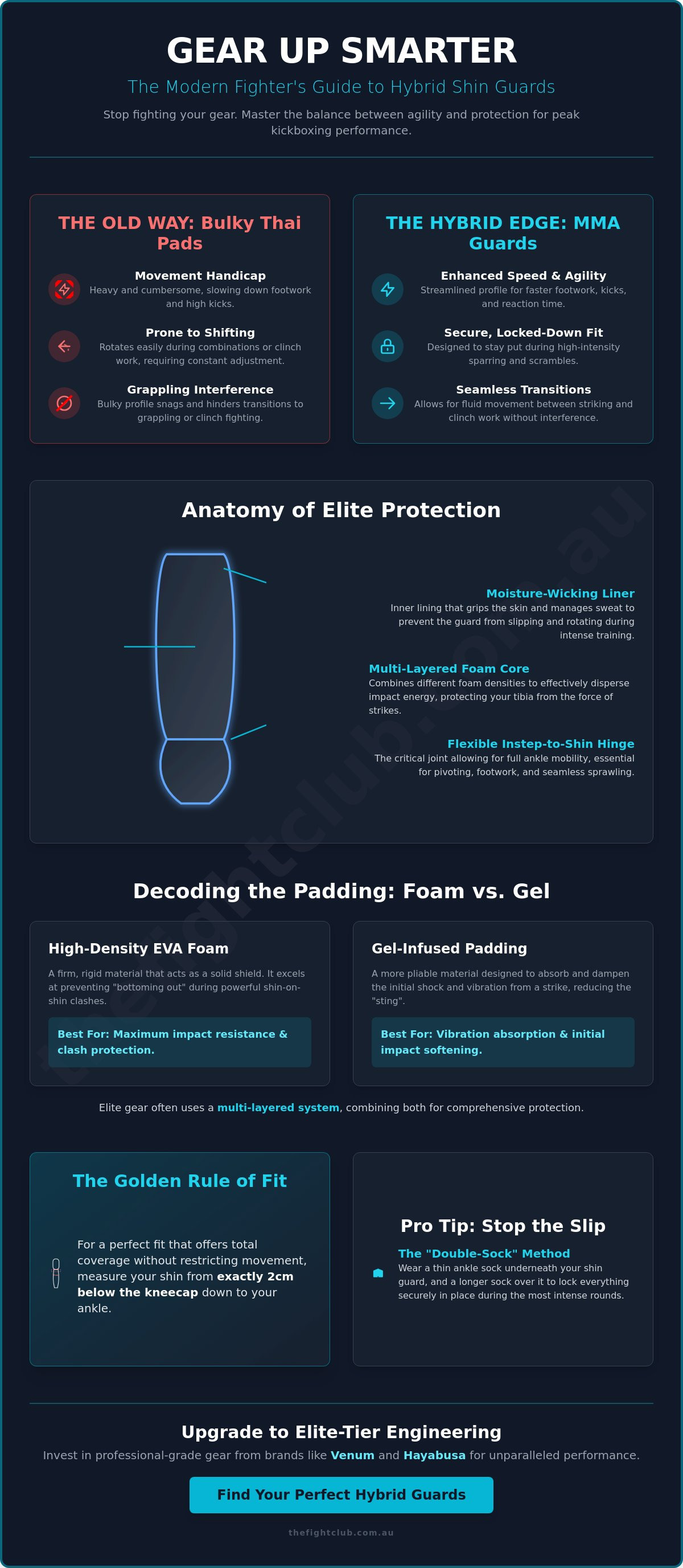
The instep-to-shin hinge is the most critical joint in your protection. Without a flexible transition, your ankle becomes locked. This kills your ability to pivot or sprawl. High-end guards utilise a flexible bridge that allows the foot to move independently of the shin. Inside, moisture-wicking liners are essential. Sweat is the enemy of stability. A quality liner maintains a secure grip against your skin. This ensures the pad doesn't rotate when you're throwing a heavy roundhouse. It keeps the gear locked in place so you can focus on the strike, not the slip.
Padding Densities and Impact Distribution
Not all foam is created equal. High-density EVA foam provides a rigid barrier. It prevents "bottoming out" when you clash shins with a partner. Gel-infused padding offers a different advantage. It absorbs the initial vibration of the strike. Multi-layered systems combine both to ensure the energy doesn't travel straight into your tibia. Impact distribution is the mechanical process of dissipating kinetic energy across the pad surface to minimise localised force on the bone. This is a core component of martial arts injury prevention. Choosing an MMA style doesn't mean you're settling for less protection; it means you're choosing smarter protection.
Closure Systems: Sleeve vs. Hook-and-Loop
The "Sock-Style" neoprene sleeve is the gold standard for security. It provides a 360-degree compression fit that feels like a second skin. This is a primary reason why many favour these MMA shin guards for kickboxing. Conversely, the "Hybrid-Strap" system uses hook-and-loop fasteners for a customisable fit. These are faster to rip off between drills. Look for reinforced stitching at the strap base. If the stitching is weak, the strap will fail under tension. If you're ready to upgrade, you can find professional-grade MMA equipment at The Fight Club that stands up to this level of scrutiny.
The Fighter’s Fit: How to Size Your MMA Shin Guards Correctly
Sizing is the difference between a clean check and a cracked bone. Most fighters guess. They pick a size based on what looks "about right" on the shelf. That’s a mistake. A guard that’s too long will bite into your knee during a sprawl. One that’s too short leaves your lower leg exposed to a punishing low kick. The Golden Rule is simple. Your guard must end exactly 2cm below the kneecap. This gap ensures your knee joint moves freely while your tibia remains fully shielded. Accuracy is safety.
Don't ignore the calf factor. Standard sizing charts often rely solely on height. This fails athletes with muscular legs. If you've got heavy calves, a standard "Medium" might not close properly. The straps will strain. The velcro will pop mid-round. Look for MMA shin guards for kickboxing that offer extended strap lengths or high-stretch neoprene. If the padding pinches your skin or leaves large sections of your instep exposed, you're wearing the wrong size. Protective gear isn't just about comfort; it's backed by science. Recent research on combat sport injuries proves that properly fitted shin and foot protectors significantly reduce trauma during high-impact exchanges.
Measuring for a No-Slip Experience
Strip away the guesswork. To get an accurate reading, sit in a chair with your feet flat on the floor. Measure the distance from the top of your ankle to the base of your kneecap. This is your true shin length. When you try on MMA shin guards for kickboxing, perform the "squat test." Drop into a deep squat. If the top of the guard pushes against your thigh or forces the bottom of the pad to slide down your foot, the guard is too long. The foot protector should cover the bridge of your foot without extending past the base of your toes. If it hangs over, you'll trip during footwork drills.
Sizing Chart: General Height vs. Shin Length
While every brand varies, use this framework as your starting point for a professional fit:
- Small: Height under 165cm; Shin length 30-33cm.
- Medium: Height 165-175cm; Shin length 34-37cm.
- Large: Height 175-185cm; Shin length 38-41cm.
- Extra Large: Height 185cm+; Shin length 42cm+.
Be aware of the brand's origin. Some brands, often referred to as "Asian fit," may run slimmer and shorter. Conversely, "Western fit" brands tend to offer more room for larger calves and longer shins. Check out The Fight Club's professional combat gear guide for brand-specific sizing details and expert recommendations. Get the fit right the first time. Your shins will thank you when the sparring intensity picks up.
Staying Strapped: Preventing Slip and Gear Maintenance
Australian summers turn training halls into furnaces. Heat isn't just a physical test; it's a gear killer. When the humidity hits, sweat becomes a lubricant. If your MMA shin guards for kickboxing start sliding mid-round, your focus breaks. You're no longer thinking about the counter-strike. You're thinking about your kit. This is where technical discipline meets practical maintenance. You have to be as disciplined with your equipment as you are with your footwork. Gear that shifts is gear that fails.
The 'Double-Sock' method is a pro-level hack for total security. Slide a thin compression sleeve over your shin before putting on the guard. Then, pull a second sleeve over the top of the guard itself. This creates a friction sandwich that locks the equipment in place. It also helps manage moisture before it reaches the padding. Tensioning your straps is equally vital. They must be tight enough to resist movement but loose enough to avoid restricting blood flow. If your feet go numb, your balance is gone. Look for the under-foot elastic strap. It’s not an optional extra. It’s the anchor that prevents 'lift' during high-velocity kicks.
Battle-Tested Tips for a Secure Fit
Friction is your best friend in a sweaty gym. Wearing compression sleeves under your guards increases the surface area for the liner to grip. It also wicks moisture away from the skin, preventing that greasy feeling that leads to gear rotation. Proper strap tensioning requires a fine balance. You want a secure fit that doesn't pinch the back of your calf or cut off circulation to your feet. Check the under-foot elastic strap regularly for wear; it’s the primary defence against the guard riding up your leg during impact.
Maintenance: Extending the Life of Your Armour
Hygiene isn't just about the 'stink.' It's about gear longevity. Bacteria and salt from your sweat eat away at synthetic and real leather. Use non-toxic, anti-fungal sprays after every session. Avoid harsh chemicals that can degrade the padding. Wipe down the exterior and interior with a damp cloth, then let them air-dry in a cool, ventilated space. Never leave your kit in a hot car. Australian car interiors can reach over 60 degrees Celsius in minutes. This extreme heat kills the adhesive bonds and causes the foam to lose its shape. Direct sun-drying is the enemy of shin guard foam because UV rays accelerate the breakdown of synthetic materials and cause the padding to become brittle. If you're looking for gear that lasts, check out the premium combat equipment at The Fight Club and treat it with respect.
Elite Armour: Why The Fight Club Stocks the Best Hybrid Guards
Your training environment is sacred. It’s a place of humility and hard work. At The Fight Club, we mirror that ethos in every piece of equipment we stock. We aren't a commercial fitness chain. We are a technique-driven institution. We only sell gear that survives the daily grind of professional sparring. When you invest in MMA shin guards for kickboxing from our range, you’re buying gear tested by people who actually step onto the mats. No vanity. No pretension. Just authentic protection for serious athletes. We understand that your gear is an extension of your discipline. It has to perform when the pressure is on.
Choosing the right kit is a sign of respect for your partner and yourself. Cheap, flimsy pads lead to unnecessary injuries and halted sessions. We curate our selection to ensure every fighter, from the beginner to the seasoned pro, has access to professional-grade armour. Our focus is on substance over flash. We prioritise durability, anatomical fit, and impact dispersion. By sourcing MMA shin guards for kickboxing that meet these high standards, we help you stay focused on your progression rather than your equipment's limitations.
Brand Spotlight: Venum and Hayabusa
Venum Elite series guards are a staple in Australian kickboxing gyms for a reason. They offer the perfect weight-to-protection ratio. They feel light but hit like a shield. This balance is essential for the hybrid movement required in modern combat sports. Then there is Hayabusa. Their T3 engineering is technically superior. The dual-strap secure-fit closure systems ensure zero rotation during high-intensity scrambles. This is the professional standard for fighters who refuse to adjust their gear mid-round. While you’re upgrading your lower-body kit, don't overlook your dental safety. Protect your smile while you protect your shins with a mouth guard from our collection. Complete your kit with gear that matches your intensity.
The Fight Club Guarantee
We are Australian-owned. We hold our own stock right here. This means fast shipping across Australia. You won't be waiting weeks for an overseas shipment while your shins take a beating. Our team consists of fighters and coaches. We provide expert advice because we’ve felt the impact of a poorly fitted guard ourselves. We know the difference between a guard that works and a guard that just looks good. If the fit isn't 100% perfect, we offer a no-nonsense return policy. We want you protected, not just sold. Our community is built on trust and perseverance. We stock the best gear to reflect those values. Upgrade your armour today. Push your limits. Leave the ego at the door and get to work. Your next level is waiting.
Master Your Movement on the Mats
You've done the work. You've sharpened the technique. Now, don't let inferior gear dull your edge. Mastering the balance between speed and safety comes down to choosing the right MMA shin guards for kickboxing. You need the agility to strike and the stability to scramble without your pads rotating mid-round. Remember the golden rule: fit your guard 2cm below the kneecap. Prioritise high-density foam that dissipates force without the bulk of traditional pillows. Your gear should feel like a second skin, not an anchor.
We are Australian owned and operated. We understand the intensity of local training halls and the grit required to progress. Our collection features only curated premium brands like Venum, Hayabusa, and UFC. We provide fast national shipping to ensure you're never sidelined for long. Stop fighting your equipment and start focusing on the fight. Secure your shins-Shop our pro-grade MMA guards now.
The mats don't lie. Put in the effort, respect the process, and stay humble. We provide the armour. You provide the heart. Get after it.
Frequently Asked Questions
Can I use MMA shin guards for Muay Thai sparring?
You can use MMA shin guards for Muay Thai sparring during technical drills or light sessions. They offer superior mobility for catching kicks and working in the clinch. However, they lack the massive density of traditional Thai pads. If your gym holds heavy-hitting sparring sessions, you might feel the impact of a full-power roundhouse. Use them when speed and precision are the priority.
Are sleeve-style shin guards better than strap-on ones?
Sleeve-style guards are better for security, while strap-on guards are better for convenience. Neoprene sleeves provide a 360-degree compression fit that won't shift during a scramble. Strap-on systems allow you to adjust the tightness mid-session. For high-intensity kickboxing, the locked-in feel of a sleeve usually wins. It eliminates the distraction of loose straps and keeps you focused on the round.
How do I stop my shin guards from sliding down during a round?
Stop your guards from sliding by using the Double-Sock method or compression sleeves. Friction is the key. Ensure the under-foot elastic strap is positioned correctly under the arch of your foot. If your MMA shin guards for kickboxing still rotate, your straps are likely worn out or the size is too large. Sweat management with a moisture-wicking liner also helps maintain a secure grip.
How thick should MMA shin guards be for kickboxing?
Look for a thickness between 15mm and 25mm of high-density EVA foam. This range provides enough protection to prevent bone-on-bone trauma without the bulk of a traditional pad. You want enough density to disperse the force of a checked kick. Anything thicker starts to add drag and slows down your switch kicks. It is about maintaining technical precision while staying protected.
Should I choose leather or synthetic MMA shin guards?
Choose synthetic materials like Skintex for high-volume training in humid Australian climates. Synthetic leather often resists moisture and salt better than natural cowhide. It won't crack as easily if you neglect the conditioning. Genuine leather offers a premium feel and long-term durability if you're willing to maintain it. For most daily grinders, high-grade synthetic is the smarter, no-nonsense choice for longevity.
How do I know if my shin guards are too big?
Your guards are too big if the top edge touches your thigh when you drop into a deep squat. This indicates the guard is too long for your tibia and will hinder your mobility. Another sign is constant rotation; if the pad moves freely when you throw a light kick, the circumference is too wide for your leg. A perfect fit ends exactly 2cm below the kneecap.
Can you wash MMA shin guards in a washing machine?
Never put your shin guards in a washing machine. The immersion in water and the mechanical agitation will break down the internal foam and ruin the adhesives. This compromises your safety and the guard's structural integrity. Use a non-toxic anti-fungal spray and a damp cloth for cleaning. Air-dry them in a cool, ventilated area away from direct sunlight to preserve the specialised padding.
Do I need to wear socks under my hybrid shin guards?
Wearing compression socks or sleeves under your MMA shin guards for kickboxing is highly recommended for hygiene and stability. It prevents the greasy feeling of sweat against the guard's liner. This extra layer increases friction, helping the guard stay in place during explosive movements. It also absorbs moisture, making your post-training cleanup much easier and preventing the build-up of bacteria inside the gear.