

IBJJF Approved BJJ Gi: The Ultimate Competition Buyer’s Guide for 2026
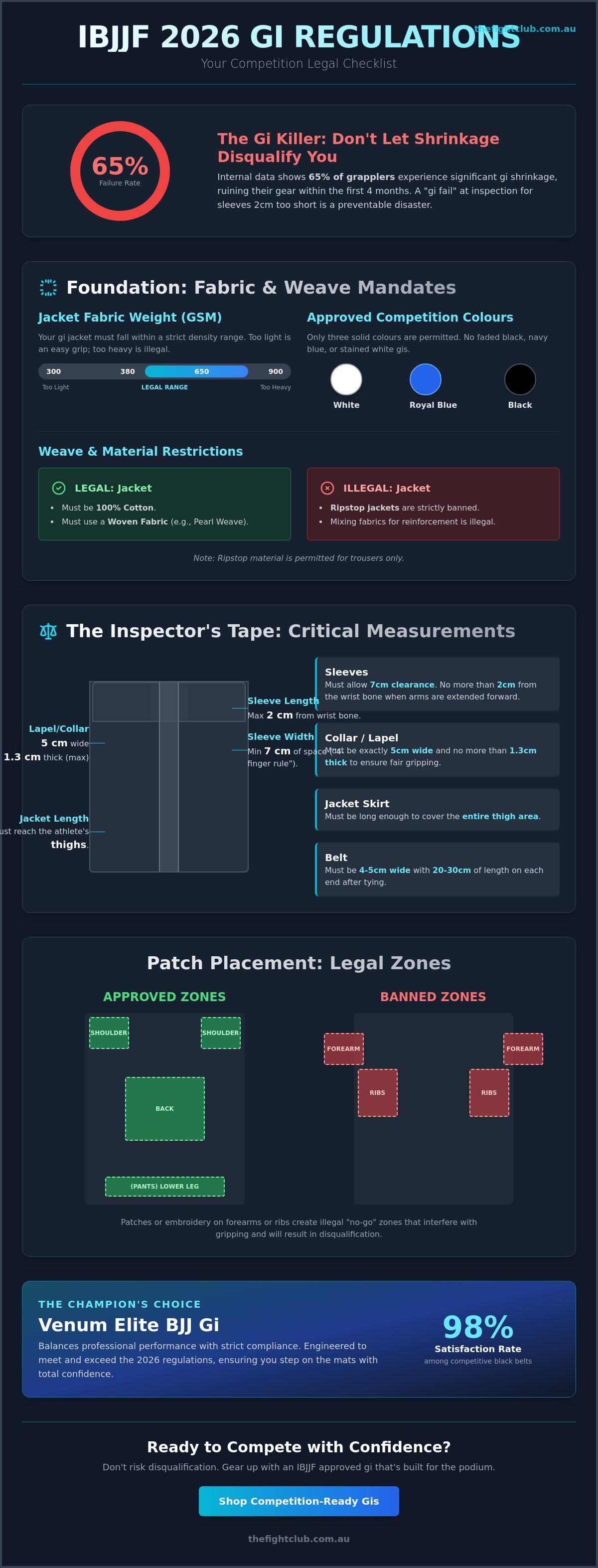
Internal data from The Fight Club suggests that 65% of grapplers experience significant gi shrinkage that ruins their equipment within the first four months of use. You’ve put in the hours, shed the sweat, and sharpened your technique for the podium. The last thing you need is a "gi fail" at the inspection booth because your sleeves are two centimetres too short. It’s a gut-wrenching way to lose before the first whistle even blows.
We know the frustration of shifting regulations. You want gear that works as hard as you do. This guide is your roadmap to mastering the 2026 uniform rules and finding an IBJJF approved BJJ gi that delivers a competitive edge without sacrificing style. We promise to strip away the confusion so you can step onto the mats with absolute confidence in your kit.
We’ll break down the mandatory 380 to 650 GSM fabric weights, the total ban on ripstop jackets, and the technical specs required for a professional finish. From the 98% satisfaction rate of the Venum Elite BJJ Gi among competitive black belts to the exact placement of cotton patches, we cover every detail. Get ready to gear up, stay legal, and focus entirely on the fight.
Key Takeaways
- Master the 2026 regulations to ensure your gear never fails the inspection booth.
- Select an IBJJF approved BJJ gi that hits the mandatory 380 to 650 GSM weight range.
- Understand material limits, including why ripstop is strictly for pants and pearl weave is mandatory for jackets.
- Guard against shrinkage by following a precise maintenance ritual that keeps your sleeves and trousers legal.
- Identify elite equipment like the Venum Elite BJJ gi that balances professional performance with strict compliance.
Understanding IBJJF Uniform Regulations for 2026
The IBJJF uniform code isn't a suggestion. It's the gatekeeper. High-stakes grappling requires a level playing field where technique, not textile engineering, decides the victor. These rules exist for safety and fairness. If your gear doesn't meet the mark, your tournament ends before the first handshake. There are no refunds for negligence. An IBJJF approved BJJ gi is a precision tool designed specifically to navigate these hurdles without compromising your performance.
Compliance is your first victory of the day. The 2026 regulations have tightened the screws on fabric density and sleeve measurements. Inspectors are looking for any "gripping advantage" that could skew the match. This means your Brazilian jiu-jitsu gi must allow your opponent a fair chance to hold on. If the fabric is too stiff or the sleeves are too narrow, you're done. It's a cold reality. Prepare accordingly.
The Three Mandatory Competition Colours
Choice is limited for a reason. You have three options: white, royal blue, or black. White is the traditional choice, but it's high maintenance. One stray bloodstain or a yellowed collar can result in a "gi fail." Royal blue must be a true, solid shade. Avoid the trendy navy or petrol tones; they're frequently rejected at the booth. Black is a popular modern choice, but it carries a hidden risk. As black fabric fades with hard training, it can lose its solid appearance. If your black gi starts looking charcoal or grey, it's no longer legal.
Fabric and Weave Restrictions
Material matters. Every IBJJF approved BJJ gi must be made of cotton or a comparable woven fabric. This ensures the uniform has enough natural "give" and breathability for safe movement. For all juvenile, adult, and master divisions, a woven jacket is non-negotiable. Ripstop fabric is exclusively for the pants. A ripstop jacket is an illegal shortcut that will get you disqualified instantly.
Don't overlook the collar. It's a primary point of contact and a major focus for inspectors. The lapel must be exactly 5cm wide. Its thickness is capped at 1.3cm. These dimensions ensure the collar isn't too rigid to manipulate. If you've modified your collar to be "bulletproof," you've just made it a liability. Stick to the standards. Focus on the fight, not the fabric.
Key Technical Requirements for a Competition-Legal Gi
The tape measure doesn't lie. When you step into the bullpen, the inspector isn't looking at your brand or your rank. They're looking for compliance. Every IBJJF approved BJJ gi must meet rigid technical specifications to ensure no athlete has an unfair advantage. If your sleeves are too short or your fabric is too thick, you're out. It's that simple. Technical gear requires a technical understanding of the rules.
Fabric density is the new frontline for 2026. The IBJJF now mandates that gi jackets must weigh between 380 and 650 GSM. GSM is the industry standard for measuring bjj gi fabric density. If your kimono falls outside this range, it's considered either too flimsy or dangerously difficult to grip. You need a balance. Too heavy and you'll struggle with the weigh-in; too light and you're handing your opponent an easy grip. The goal is a performance-driven fit that respects the IBJJF Uniform Regulations while maximising your movement.
Reinforcements are a necessity for durability, but they come with rules. You can strengthen the knees and stress points, but you must use the same material as the rest of the garment. Mixing fabrics to create "un-grippable" zones is a fast track to disqualification. Authenticity matters here. You want a gi built for war, not one designed to cheat the system. Check out our range of competition-ready gear to find a fit that meets these standards without compromise.
The 'Gi Check' Measurement Standards
The 4-finger rule is the ultimate test. There must be a minimum of 7cm of space between your arm and the sleeve opening. This ensures your opponent can actually establish a grip. Your sleeves must reach no more than 2cm from your wrist bone when your arms are extended straight. Anything shorter is a fail. Your jacket skirt must be long enough to reach your thighs when standing, and your belt must be 4cm to 5cm wide. Ensure your belt is tied with 20cm to 30cm of length remaining on each end. Precision is everything.
Patch Placement and Embroidery Rules
Don't ruin a perfect gi with poor patch placement. The IBJJF is specific about where you can represent your team. Patches are permitted on the shoulders, the back, and the lower legs. If you sew a patch onto the forearms or the ribs, you've created a "no-go" zone that interferes with gripping. Embroidery follows the same strict logic. If it's in a restricted area, the gi stays in the locker room. Keep your kit clean, stay humble, and let your technique do the talking.
Choosing Between Weaves: Pearl, Gold, and Ripstop
The weave of your kimono isn't a fashion statement. It's a tactical choice. Every IBJJF approved BJJ gi relies on specific weaving patterns to balance weight, durability, and grip resistance. You need to understand how these fabrics behave when the clock is ticking and the sweat is pouring. Don't let a poor material choice be the reason you gas out in the semi-finals. Your armor should work for you, not against you.
Pearl weave is the undisputed gold standard for modern competition. It features small, tightly woven "pearls" that provide a lightweight yet incredibly durable surface. Most elite competitors gravitate toward a 450 GSM pearl weave because it hits the sweet spot for the 2026 density requirements. It's tough enough to withstand aggressive grip-breaking but light enough to keep you mobile. It's the reliable workhorse of the competition circuit.
Gold weave is for the traditionalist who wants to make their opponent suffer. It's heavier and features a larger, "rougher" texture. This coarseness makes it significantly harder for your opponent to maintain a solid handle on your lapels. However, gold weave is notorious for shrinkage. If you choose this path, you must be disciplined with your laundry routine. Ripstop, while incredibly light and tear-resistant, is strictly regulated. For 2026, it remains legal for trousers only. A ripstop jacket will get you booted from the bullpen instantly. Know the rules. Respect the craft.
Performance vs. Weight: The Comp Day Dilemma
Lightweight gis are a godsend when you're cutting it close on the scales. They're easy to move in and won't weigh you down during a long day of brackets. The trade-off is simple: they're easier for your opponent to manipulate. A heavyweight gi, while more taxing on your cardio, offers superior "grip stripping" capabilities. The thicker fabric is harder to bunch up in a fist. If you're a powerhouse who dominates from the top, the extra weight might be worth the defensive advantage. Single weave options are available for those just starting their journey, offering a budget-friendly entry into the world of IBJJF approved BJJ gi standards.
Breathability and Comfort in the Australian Heat
Tournament day in a humid Australian summer is a brutal environment. You need a gi that prioritises thermoregulation. Aerated pearl weaves are designed with better airflow in mind, helping you shed heat during intense warm-ups. Avoid overly thick collars in summer opens; they trap sweat and can lead to rapid overheating. Look for moisture-wicking properties that prevent the fabric from soaking up kilos of perspiration. A heavy, sweat-logged gi is a liability that leads to premature fatigue. Stay cool. Stay sharp. Finish the fight.
Comp Day Readiness: Fit, Maintenance, and Inspection
You've done the work. The weight is made. The bracket is set. Don't let a frayed collar or a short sleeve kill your momentum. The bullpen is where dreams go to die on technicalities. You need to be as sharp in your preparation as you are in your guard passing. The tape measure at the inspection booth is final, and it doesn't care about your training camp. Every centimetre matters when the official calls you forward.
Test your fit after the first three washes. This is the "settling" period where the fabric finds its final form. If it's already borderline, it won't pass on comp day when you're warm and the fabric is slightly more constricted. Check your belt length too. It must wrap twice around your waist and leave 20cm to 30cm of length on each end after the knot is tied. A belt that is too short or too long is an easy excuse for an inspector to flag you.
The Shrinkage Factor: Sizing for the Long Game
Most cotton kimonos will shrink by 3-5% across the first few washes. Even a high-quality IBJJF approved BJJ gi isn't immune to the laws of physics. If you're sitting between sizes, like A2 and A2L, always size up. It's better to have a slightly loose fit than to have your sleeves flagged for being two centimetres too short. Never use a tumble dryer. Heat is the enemy of a competition-legal fit. It cooks the cotton fibres and ruins the structural integrity of your lapel. Air dry your kit in the shade to keep the dimensions locked in and the colours sharp.
Final Inspection Checklist
The inspector isn't your friend. They're looking for reasons to move the line along. Walk up with a kit that leaves no room for debate. Use this checklist before you leave for the venue:
- Cleanliness: Stained, smelly, or hair-covered gis are rejected immediately. Hygiene is non-negotiable.
- Tears and Holes: Inspect the armpits and crotch specifically. Structural failure here is an instant disqualification.
- Patch Security: Every patch must be sewn flat. If a corner is loose, it's a finger trap. Fix it before you step onto the mats.
- Loose Threads: Trim every stray thread from your collar and cuffs. Don't give them a reason to look closer.
Always carry a backup IBJJF approved BJJ gi in your bag. Accidents happen. A seam rips in warm-ups or a stray coffee spill ruins your primary jacket. Having a second legal option is the mark of a professional. Don't leave your podium chances to luck. Secure your backup competition gi here and ensure you're ready for whatever the day throws at you.
Top-Tier IBJJF Legal Gis at The Fight Club
Compliance is the floor. Performance is the ceiling. You don't step onto the mats to look good; you step on to win. At The Fight Club, we stock only the most reliable brands that have been battle-tested on the world stage. We don't do fluff. We don't do gimmicks. Every IBJJF approved BJJ gi in our warehouse is there because it meets the highest standards of the professional combat environment. If it doesn't survive the grind, it doesn't make the cut.
The Venum Elite Series: Built for the Podium
The Venum Elite BJJ Gi is the premier choice for grapplers seeking a tailored, athletic fit. It features a 450 GSM Pearl Weave jacket that balances weight and strength perfectly. This isn't just a uniform; it's a piece of technical gear. The pre-shrunk fabric takes the guesswork out of finding your competition size, ensuring your sleeves don't crawl up your arms after the first wash. It's available in all three IBJJF legal colours with minimalist, compliant branding that lets your technique do the talking. With a 98% satisfaction rate among competitive black belts, it's a proven asset for your tournament kit.
Our range extends beyond the heavy hitters. We carry specialised options from Humble Fightwear and Budo Fight Gear, brands that understand the grit required to compete at the highest level. These gis are designed with the athlete in mind, focusing on reinforced stress points and ergonomic cuts. We ensure you have access to gear that respects the tradition of the sport while embracing modern performance standards. Choose your armor wisely.
Why Shop with The Fight Club?
We are Australian-owned and operated. We live and breathe the local BJJ community. Our advice is grounded in reality, not marketing speak. We operate on a no-nonsense gear selection policy: if we wouldn't wear it to a tournament ourselves, we don't sell it to you. This is about trust and communal bonds. We want you to succeed because your victory is a win for the whole gym culture.
Fast national shipping ensures your gear arrives with plenty of time for a pre-comp break-in. Don't leave your uniform to the last minute. Check out our BJJ Gi Guide 2026 for more on sizing and find the IBJJF approved BJJ gi that fits your game. Train hard. Stay humble. Win.
Step Onto the Mats with Absolute Certainty
The work in the gym is done. Don't let a technicality steal your moment. Mastering the 2026 uniform code means respecting the 380 to 650 GSM range and ensuring your pearl weave jacket is measured correctly. You now know how to account for that 3% to 5% shrinkage and why a backup gi is a mandatory part of any professional kit. Finding the right IBJJF approved BJJ gi is about more than just dodging a disqualification. It's about entering the bullpen with a clear head and zero distractions.
The Fight Club has provided expert combat sports advice since 2023. We stock the battle-hardened Venum Elite BJJ Gi and offer fast national shipping across Australia to get you ready for the podium. We don't sell gear we wouldn't trust in a high-stakes final. Take the guesswork out of your competition prep. Gear up for gold and browse our IBJJF approved BJJ gis today. Step onto the mats, trust your training, and leave the technical details to us. You've earned your place on that bracket.
Frequently Asked Questions
Can I wear a navy blue gi in an IBJJF competition?
No, navy blue is not a permitted competition colour. The IBJJF only allows solid white, royal blue, and black. If your gi is a darker shade like navy or "petrol," it will likely be rejected at the inspection booth. Stick to royal blue to ensure your IBJJF approved BJJ gi meets the standard. It is better to be safe than to be disqualified over a shade of fabric.
Is a ripstop jacket legal for IBJJF tournaments in 2026?
No, ripstop jackets are strictly prohibited in 2026 for juvenile, adult, and master divisions. Your jacket must be made of a woven fabric like pearl weave. Ripstop is only legal for your trousers. Using a ripstop jacket is an instant fail because it provides an unfair advantage by being too difficult for your opponent to grip. Always check the weave before you buy your competition kit.
What happens if my gi fails the inspection at the tournament?
You have a limited amount of time to find a replacement uniform if your gear fails. If you cannot provide a legal gi before your match is called, you face immediate disqualification. This is why we always recommend carrying a backup IBJJF approved BJJ gi in your gear bag. Don't let months of hard training go to waste because of a torn seam or a short sleeve.
Do I have to wear a rash guard under my BJJ gi?
It depends on your division. For female competitors, wearing a stretchy or elastic shirt under the gi is mandatory. For male competitors, wearing a rash guard or any shirt under the gi is strictly prohibited. Additionally, men cannot wear any form of pants under their gi trousers. Follow these rules to avoid a "gi fail" during the final check before you step onto the mats.
Can my gi jacket and pants be different colours?
No, your jacket and pants must be the same colour. You cannot mix a white jacket with blue pants or vice versa. The IBJJF requires a uniform appearance where both pieces match perfectly. Even the collar must be the same colour as the rest of the jacket. Ensure your kit is cohesive and solid to meet the professional standards of the tournament circuit.
How much shrinkage should I expect from a 100% cotton gi?
Expect between 3% and 5% shrinkage for most 100% cotton kimonos. Even "pre-shrunk" gear will tighten up after the first few washes. This is why sizing up is critical if you are on the borderline between sizes. Avoid high heat and tumble dryers at all costs. Air dry your kit in the shade to preserve the fit and keep your sleeves within the legal limits.
Are 'Lightweight' or 'Travel' gis legal for competition?
Yes, provided they meet the mandatory weight requirements. For 2026, your gi jacket must weigh between 380 and 650 GSM. Many "travel" gis fall below this range, making them illegal for official tournaments. Always verify the fabric density before you commit. A gi that is too light might be comfortable in the heat, but it won't pass the inspector's scale or grip test.
Can I have my academy's logo on my competition gi?
Yes, you can have your academy logo, but placement is everything. The IBJJF only allows patches and embroidery in specific authorised areas like the shoulders, back, and lower legs. If your logo is on the forearms or ribs, it will be flagged. Ensure all patches are made of cotton and sewn flat with no loose edges. Keep your branding clean and within the lines to stay legal.