

How to Protect Your Hands When Boxing: The Ultimate Fighter’s Guide
The hand is the most commonly injured body part in combat sports, accounting for 48.3% of all upper extremity injuries according to 2026 research. You know that sharp, biting pain in your knuckles after a heavy bag session. You've felt your wrist buckle during a power hook. Most fighters ignore the warning signs until a fracture forces them out of the gym. Learning how to protect hands when boxing isn't just about safety. It's about longevity and the ability to punch with full conviction without fear of your own body breaking.
You probably agree that "toughing it out" is a losing strategy when your training is on the line. This guide will teach you how to safeguard your knuckles and stabilise your wrists using a professional three-pillar system. We are going to master structural wrapping, explore splinted glove technology, and refine your impact alignment. We will preview the essential gear and professional techniques required to keep you hitting hard while ensuring your hand health remains a priority for the long haul. It's time to stop holding back and start training with total confidence.
Key Takeaways
- Understand the fragile anatomy of your hands to prevent the common "Boxer's Fracture" and other metacarpal injuries.
- Master the professional 180-inch wrapping technique to provide structural bone security rather than just soft padding.
- Learn how to protect hands when boxing by selecting professional-grade gloves with splinted support to prevent wrist buckling.
- Implement the "clench rule" and proper knuckle alignment to ensure your power doesn't result in a debilitating injury.
- Upgrade your kit with authentic gear like the Hayabusa T3, designed to provide the stability required for high-intensity training.
The Anatomy of Impact: Why Your Hands Break
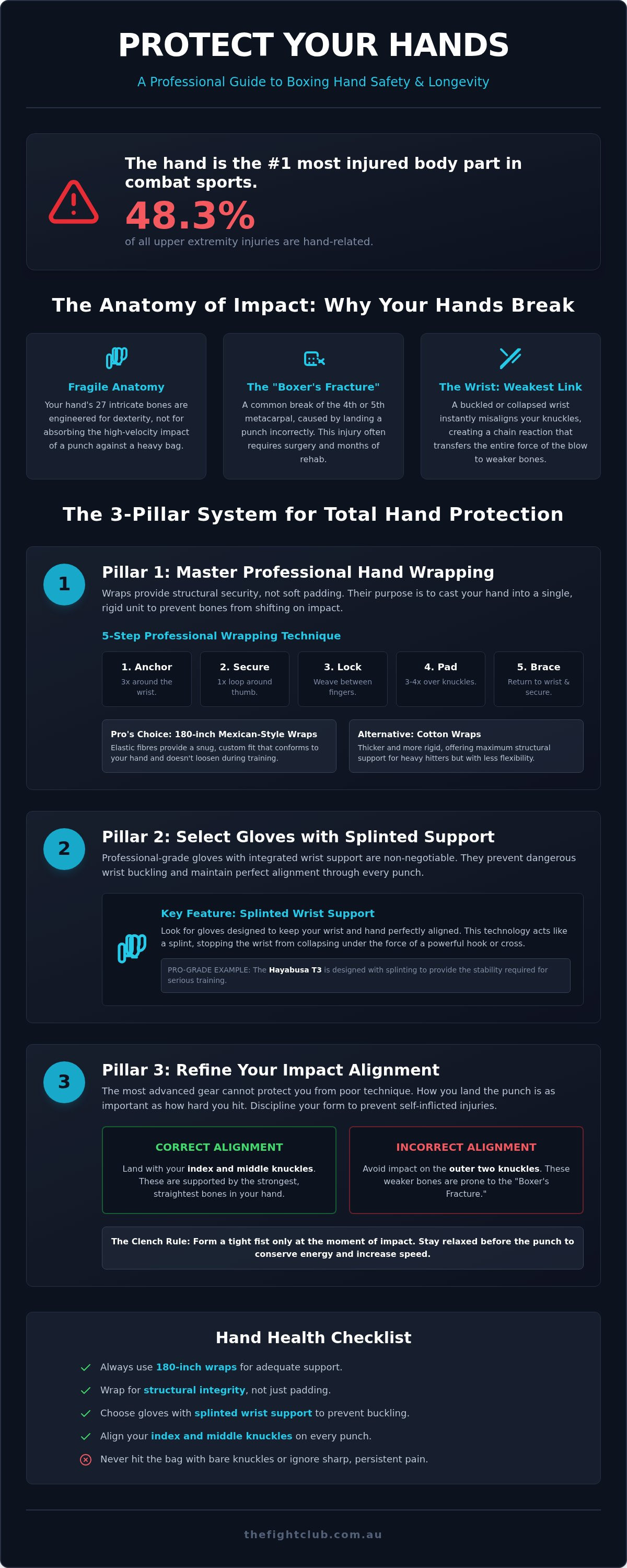
Your hand is a precision instrument. It houses 27 small, intricate bones. Evolution designed these for grip and fine motor skills; it did not design them for high-velocity impact against a 40kg heavy bag. When you throw a punch, you are essentially launching a series of fragile levers into a solid object. Understanding this mechanical vulnerability is the foundation of learning how to protect hands when boxing. Mastering the physics of the strike is just as important as the strength behind it.
The most common casualty in the gym is the "Boxer's Fracture." This occurs when you land a punch with the fourth or fifth metacarpal instead of the stronger index and middle fingers. A slight tilt in your fist at the moment of impact sends the entire force of your body weight through these thinner, outer bones. They snap. It is a sudden, sharp reality check that often requires surgery and months of rehabilitation. Mastering how to protect hands when boxing requires a deep respect for the anatomy of the strike.
While bones break, soft tissue damage often lingers much longer. Ligament tears in the hand are notoriously difficult to heal because the area receives limited blood flow compared to larger muscles. Every session on the heavy bag creates micro-trauma. These tiny stresses accumulate over time. If you don't provide structural support, those micro-cracks and fraying tissues eventually lead to chronic inflammation or catastrophic failure during a routine sparring session.
The Weakest Link: Your Wrist
Your wrist is the bridge between your power and the target. If the bridge fails, the cargo is destroyed. A collapsed wrist during a heavy hook doesn't just hurt; it creates a chain reaction of injury. When your wrist buckles, the alignment of your knuckles shifts instantly, exposing the weaker bones to the full force of the blow. Fatigue is your biggest enemy here. As your round count climbs, your forearm muscles tire, and your wrist loses its rigidity. Discipline your form or pay the price in the clinic.
Knuckle Trauma and Skin Protection
Stop hitting the bag with bare knuckles. It isn't "old school"; it's just reckless. Bare-knuckle impact leads to skin abrasions and "bag burn" that can sideline you for weeks due to infection risks. Beyond the skin, your joints are cushioned by synovial fluid. Excessive impact causes this fluid to inflame, leading to chronic stiffness and knuckle pain. A professional Hand wrap is non-negotiable. It provides the compression needed to keep your joints together and the skin protection required to keep you training daily. Respect your tools, and they will keep you in the fight.
The Foundation: How to Wrap Your Hands Like a Pro
Forget everything you think about "padding." Hand wraps aren't there to make your gloves feel softer. They exist to cast your hand into a single, rigid unit. When you hit the bag, the impact forces your bones to shift. Without wraps, those 27 bones we discussed earlier will grind together. Mastering how to protect hands when boxing starts with 180-inch wraps. Anything shorter is a compromise you can't afford. You need that extra length to secure the wrist and lock the thumb properly. It's the difference between a minor sting and a season-ending fracture. Knowing how to protect hands when boxing is the hallmark of a disciplined, professional fighter.
Tension is your next hurdle. Wrap too tight, and you'll lose circulation mid-round. Your fingers will go numb, and your power will vanish. Wrap too loose, and the fabric will bunch up inside your glove, causing the very abrasions you're trying to avoid. You want a "second skin" feel. Scientific reviews on Hand and wrist injury prevention confirm that consistent, structural support is the only way to mitigate the high-velocity forces of a punch. It's about stability, not softness. Every revolution of the cloth must serve a clear purpose.
Step-by-Step Professional Wrap Technique
Start with three revolutions around the wrist. This is your anchor. Move to the thumb and loop it once to prevent "hitchhiker" sprains. From there, weave the wrap between each finger. This is critical. It locks the metacarpals in place, preventing them from spreading upon impact. Fold the remaining fabric over your knuckles three or four times to create a custom impact zone. Finally, bring the wrap back down to the wrist. Secure the Velcro on the joint itself, not the forearm. If your wrist can bend easily after you're finished, you've done it wrong. Redo it until it's right.
Cotton vs. Mexican Style Wraps
Most pros prefer Mexican-style wraps. They contain elastic fibres that "stretch" to the contours of your hand. This provides a snugger, more custom fit that doesn't loosen during a long session. Traditional cotton wraps are thicker and more rigid. They offer maximum support for heavy hitters but lack the comfortable flex of elasticated versions. Whichever you choose, wash them after every single session. Sweat and bacteria will rot the fibres and irritate your skin. Hygiene is part of the discipline. If you need a fresh set of professional-grade gear, you can find high-quality wraps at The Fight Club. We offer free Australian shipping on orders of $180 or more, though this offer excludes bulky or heavy items. Get your kit sorted and protect your tools.
Selecting Gloves with Superior Structural Support
Most fighters think gloves are just pillows for their knuckles. They're wrong. Padding is only half the battle; structural integrity is the other. If your glove lacks a rigid internal architecture, the padding is useless. Cheap retail gloves often create a "pillowing" effect. The foam feels soft to the touch but collapses instantly under high-velocity force. This leaves your hand to absorb the full weight of the strike. Learning how to protect hands when boxing requires moving past basic retail gear and investing in tools designed for professional impact. Don't settle for equipment that fails when you need it most.
High-quality gloves utilise multi-layered foam systems. These layers have different densities to decelerate the shock of a punch progressively. Single-injection moulds, common in budget brands, lack this sophistication. They wear out quickly, creating "dead spots" where your knuckles hit the bag with almost zero protection. A study on Hand and Wrist Injuries in Elite Boxing highlights that gear failure is a primary driver of chronic joint damage. Your equipment should be your first line of defence, not your biggest liability. Discipline starts with the gear you choose to wear.
Thumb safety is another non-negotiable feature. Professional gloves feature a fully attached thumb. This prevents the thumb from catching on a target and hyperextending. It also protects your sparring partners from accidental eye pokes. It's a small detail that prevents massive setbacks. Mastering how to protect hands when boxing means looking at every component of the glove, from the lace-up or strap system to the internal lining. If it doesn't offer total security, it doesn't belong in your gym bag.
The Hayabusa T3 Advantage: Fusion Splinting
The Hayabusa T3 stands alone in its approach to wrist support. Most gloves rely on a single Velcro strap that provides minimal stability. The T3 uses a patented dual-strap system that mimics a medical splint. This "Fusion Splinting" technology ensures 99.7% perfect wrist alignment, even when your form gets lazy during the final rounds. It's the essential tool for anyone dealing with hand pain or recovering from a wrist injury. Check out our Boxing Gloves Australia guide for a deeper dive into professional gear selection.
Padding Distribution: Sparring vs. Bag Work
You need the right tool for the job. Sparring gloves use softer, more voluminous foam to protect your partner's face. Bag gloves are denser. They are built to withstand thousands of high-force repetitions against a heavy bag. Using your sparring gloves for bag work will ruin the foam in weeks. It becomes compressed and dangerous for your partners. Own two pairs. It's cheaper than surgery. At The Fight Club, we provide free Australian shipping on orders of $180 or more, though this excludes bulky or heavy items. Invest in your longevity and protect your tools with the respect they deserve.
Training Habits to Safeguard Your Fists
Gear is your armour, but technique is your shield. You can wear the best gloves on the market and still shatter a metacarpal if your mechanics are sloppy. Learning how to protect hands when boxing requires a shift in focus from how hard you hit to how correctly you land. Focus on the "Big Two." Your index and middle knuckles are the strongest points of your hand. They are backed by the thickest bones in your forearm. If you land on the ring or pinky knuckle, you are begging for a Boxer's Fracture. Precision beats power every single time.
Master the "clench" rule. Keep your hand relaxed while the punch is in flight to maintain speed and save energy. The millisecond before impact, you must contract every muscle in your hand and forearm. This creates a solid, reinforced structure that absorbs the shock. A loose fist allows the small bones to rattle and shift upon impact, leading to the ligament tears we discussed in section one. Also, audit your environment. Those ancient, rock-hard bags in the corner of the gym might look "hardcore," but they are joint killers. If the bag feels like concrete, find another one or use a softer double-end bag to refine your accuracy. Knowing how to protect hands when boxing means being smart enough to avoid unnecessary damage.
Finding a training facility that prioritises these technical details is essential for any athlete; for instance, you can discover Warriors Academy KC to see how professional academies integrate safety and proper form into their curriculum.
Punch Mechanics and Alignment
Turn the punch over. Your palm should face the floor at the point of impact for straight shots. This ensures your radius and ulna are aligned directly behind your fist. Avoid "slapping" with your hooks. This common mistake puts massive lateral stress on the wrist and often leads to skin tears and "bag burn." Use shadow boxing as a diagnostic tool. Move through your combinations in front of a mirror without impact. Focus on the alignment of your wrist and knuckles. If it doesn't look straight in the air, it won't be straight on the bag.
Recovery and Hand Care
Pain is information. You must distinguish between the dull ache of hard work and the sharp, localised sting of an injury. If a specific spot on your knuckle is tender to the touch, stop hitting the bag immediately. Stress fractures don't happen overnight; they are the result of ignoring micro-trauma. Use a rice bucket to strengthen the small stabilising muscles in your hands and forearms. After a heavy session, ice your knuckles for 10 minutes to kill inflammation before it starts. Consistent maintenance is the only way to stay in the gym long-term.
If you're serious about your craft, you need the right tools to back up your technique. Shop professional boxing gear at The Fight Club to ensure your hands are protected by the best in the business. We offer free Australian shipping on orders of $180 or more, excluding bulky or heavy items. Protect your tools and they will protect you.
Gear Up for Longevity at The Fight Club
Your hands are your livelihood in this sport. Every session on the heavy bag and every round of sparring puts a price on your knuckles. Don't treat your safety like a budget line item. Mastering how to protect hands when boxing requires a total commitment to professional-grade equipment. We have already covered the fragile anatomy of your hands and the necessity of 180-inch wraps. Now, you must ensure the gear you put over those wraps is built for the long haul. At The Fight Club, we don't stock retail-grade fluff. We only curate brands that pass the "pro" test on the gym floor.
Accessing elite gear in Australia shouldn't be a struggle. We've brought the world's leading combat sports brands, including Hayabusa and Venum, into one central hub. This means you can secure the splinted support of the Hayabusa T3 and the high-density protection of Venum Elite gloves in a single order. Knowing how to protect hands when boxing is only half the battle. Owning the tools that actually do the job is what keeps you training when others are sidelined with fractures. Respect your craft by investing in the best tools available.
Why Order from The Fight Club?
We are Australian-owned and operated, serving the local combat community since 2023. Our Sydney hub ensures fast national shipping. You aren't waiting weeks for international arrivals while your knuckles throb. We provide expert support because we actually train and fight. We know the difference between a glove that looks good and a glove that saves your wrist. Our mission is to provide a humble, ego-free environment where every fighter has access to authentic, top-tier training gear without the pretension.
Shipping and Value
Efficiency matters in training. We offer free Australian shipping on orders of $180 or more. It is essential to note that this offer excludes bulky or heavy items like punching bags. Whether you are restocking your wraps or upgrading to a full professional kit, we get your gear to you quickly and reliably. Explore our full MMA Fight Store for more essentials. Stop compromising on your safety. Gear up, stay protected, and keep hitting with full power.
Protect Your Tools, Own Your Power
Your hands are the only tools that matter in the ring. We have broken down the fragile anatomy of your 27 hand bones and the non-negotiable need for professional 180-inch wraps. You now know that mastering how to protect hands when boxing is a combination of disciplined technique and elite-level equipment. From the "clench" rule to the Fusion Splinting technology found in the Hayabusa T3, every detail serves a purpose. It keeps you on the bag and off the injury list. No excuses. No shortcuts.
Don't wait for a fracture to take your hand health seriously. As an official Hayabusa T3 stockist, we provide the gear required for world-class wrist support. We are Australian owned and operated, shipping fast from our Sydney hub to fighters across the country. Protect your hands with professional gear at The Fight Club today. We offer free Australian shipping on orders of $180 or more; this offer excludes bulky or heavy items. Respect the process. Trust your gear. Keep pushing your limits. The gym is waiting.
Frequently Asked Questions
Can I box without hand wraps if I have good gloves?
No, you should never box without wraps, regardless of the quality of your gloves. Wraps provide structural bone security that padding alone cannot offer. They cast the 27 small bones of your hand into a single, rigid unit to prevent them from grinding together upon impact. Skipping wraps increases your risk of wrist and knuckle injuries by three times, even when using professional gear.
How tight should my boxing hand wraps be?
Your wraps should feel like a firm second skin. They must be tight enough to provide a rigid structure when you clench your fist but loose enough to avoid cutting off your blood flow. If your fingers start to tingle or go numb mid-round, you've over-tightened them. Redo the wrap immediately; training with restricted circulation is a recipe for a disaster in the gym.
Why do my knuckles hurt even when I wear gloves?
Persistent knuckle pain usually stems from poor impact alignment or degraded gear. If you land on your ring or pinky knuckles instead of the index and middle knuckles, you're putting massive stress on fragile bones. Alternatively, your gloves might have "dead spots" where the internal foam has collapsed. Learning how to protect hands when boxing requires both technical precision and equipment that hasn't reached its expiry date.
What is the best type of boxing glove for hand protection?
The best gloves for protection feature multi-layered foam and professional wrist splinting. The Hayabusa T3 is the industry leader, offering a dual-strap system that keeps the wrist in 99.7% perfect alignment. You can find these at The Fight Club, where we offer free Australian shipping on orders of $180 or more, though this offer excludes bulky or heavy items. Invest in gear that prioritises your long-term hand health.
How often should I replace my boxing gloves to ensure protection?
You should replace your boxing gloves every 6 to 12 months if you train three or more times a week. Foam is a consumable material; it loses its ability to decelerate high-velocity impact over time. Once you feel your knuckles making "hard" contact with the bag through the padding, the glove is dead. Continuing to use compromised gear is the fastest way to a stress fracture.
Is it better to use 12oz or 16oz gloves for hand safety?
16oz gloves are the gold standard for hand safety during daily training and sparring. The extra weight comes from increased foam density, which provides a larger buffer between your knuckles and the target. Use 12oz or 10oz gloves only for competition or specific speed drills. For anyone serious about how to protect hands when boxing, the 16oz weight is non-negotiable for heavy bag work.
Should I use knuckle guards in addition to wraps?
Yes, you should use knuckle guards if you are a heavy hitter or have a history of joint inflammation. They provide an extra layer of impact-absorbing gel or foam directly over the impact zone. While a standard wrap is essential for bone security, a guard adds the specific padding needed to prevent "bag burn" and deep-tissue bruising during high-volume training sessions. It's a small investment for long-term knuckle health.
What are the first signs of a hand injury from boxing?
Sharp, localised pain and swelling are the immediate red flags that you cannot ignore. If a specific knuckle is tender to the touch or if you notice a significant loss in grip strength, you've likely sustained a stress injury. Dull aches are part of the game, but sharp stings indicate structural damage. Stop hitting the bag and ice the area immediately to prevent a minor tweak from becoming a season-ending break.