

How to Choose MMA Headgear: The Ultimate Fighter’s Guide (2026)
The wrong headgear is a liability. It is a blindfold that shifts the moment you shoot for a double-leg. You step into the gym to sharpen your skills, not to fight a piece of foam that blocks a high kick or turns into a slip-and-slide from your own sweat. You need gear that stays put when the clinch gets dirty. Learning how to choose MMA headgear is about finding that razor-thin balance between maximum shock absorption and a total field of vision.
We know the frustration of gear that fails under pressure. You want protection that does not compromise your peripheral vision or leave you overheating by the second round. This guide promises to help you master the technical specs and fit requirements to choose headgear that protects your brain without sacrificing your sight. We are breaking down the latest 2026 padding innovations, the impact of new safety certifications, and how to secure a fit that survives the most intense scrambles. Whether you are eyeing the Hayabusa T3 or a technical Venum model, it is time to gear up with discipline and purpose. No ego; just better protection for the work ahead.
Key Takeaways
- Understand the trade-offs between Open Face and Cheek Protector styles to balance facial protection with the visibility needed for takedown defence.
- Master how to choose MMA headgear by looking for multi-layered foam and engineered synthetics that withstand the grind of daily sparring.
- Eliminate equipment shifting during live rounds by using the "Nod Test" to ensure a secure, zero-slip fit before you step onto the mats.
- Prioritise high-density padding that absorbs impact without creating a bulky profile that leaves you vulnerable to hooks and head kicks.
- Learn why professional gear like the Hayabusa T3 Headgear is the gold standard for maintaining stability during high-intensity scrambles.
The Reality of MMA Sparring: Why Headgear is Non-Negotiable
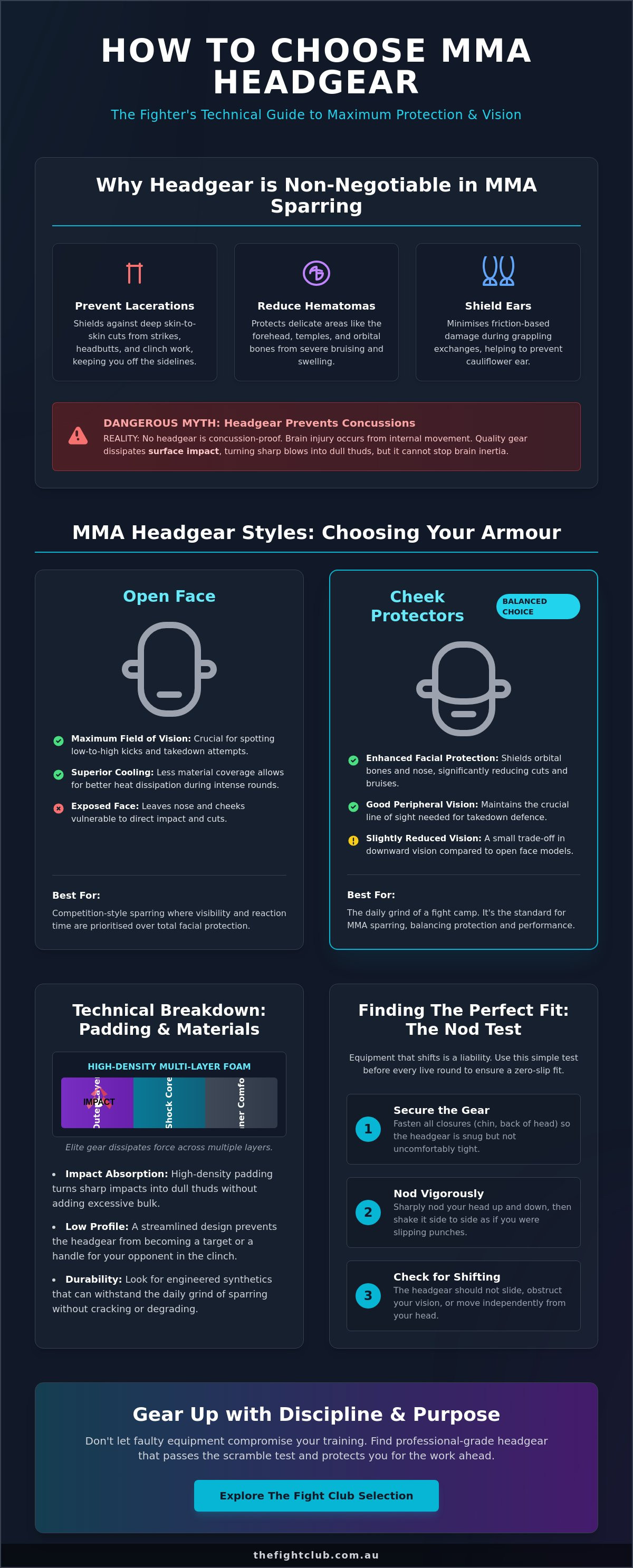
MMA is chaos. Every round is a calculated risk. MMA headgear is not just a piece of foam; it is specialised armour designed for the unpredictable nature of multi-discipline combat. Unlike boxing, where the threat is largely linear, MMA involves elbows in the clinch, knees in the scramble, and accidental clashes during level changes. Understanding how to choose MMA headgear starts with recognising that its primary job is to stop you from being sidelined by surface-level damage. It is a barrier between your skin and the grind of a hard training camp.
When you are learning how to choose MMA headgear, you must realise that high-quality protection focuses on three critical goals:
- Preventing deep skin-to-skin lacerations during clinch work and entries.
- Reducing the risk of hematomas on the forehead, temples, and orbital bones.
- Shielding the ears from friction-based injuries like cauliflower ear.
We need to debunk a dangerous myth. No headgear is concussion-proof. Brain injuries occur from the brain moving inside the skull. No amount of external padding can fully stop that inertia. What elite gear does is dissipate the initial surface impact. It turns a sharp, skin-splitting blow into a dull thud. In Australian gyms, coaches mandate headgear for hard sparring because they want you on the mats tomorrow. They value your longevity over your ego. If you want to stay active in this sport, you wear the kit.
Cuts, Bruises, and Longevity
Accidental headbutts are a reality when you are fighting for underhooks or shooting for a double-leg. One stray dome to the orbital bone can mean six weeks of no contact. Proper padding protects the delicate structures around your eyes. It also prevents your ears from being shredded during grappling transitions. Staying injury-free is the only way to ensure your progress is not reset by a preventable gash. Consistency is the only path to mastery. You cannot get better if you are sitting on the sidelines waiting for stitches to heal.
The Mental Edge in the Cage
There is a psychological shift when you are properly protected. When you are not worried about a superficial cut opening up, you can focus on your footwork and shot selection. It allows you to stay in the pocket and execute technique under fire. You should always train with the same MMA Headgear Styles you plan to wear in amateur competition. This ensures your timing and vision remain consistent. Building that confidence during high-volume exchanges is what separates technical fighters from brawlers. Respect the process. Protect your head. Put in the work.
MMA Headgear Styles: Choosing Your Armour
MMA is not a linear sport. You aren't just trading jabs; you're shooting for doubles, fighting for underhooks, and defending high kicks from the periphery. If you use headgear designed solely for boxing, you'll find it fails the "MMA Scramble Test" within the first round. This test is simple: if the gear shifts when your head hits the mat or when you're grinding in the clinch, it's a liability. When learning how to choose MMA headgear, you must prioritise a low-profile design that won't get snagged by your opponent's arms during a transition.
The construction of your gear often follows safety benchmarks like USA Boxing headgear regulations regarding padding density and closure systems, but the shape must adapt to the cage. Bulky gear is a target. It makes your head a larger object to hit and an easier handle to grab in the clinch. You want armour that feels like a second skin, not a bucket. If you're looking for gear that passes the scramble test, check out the technical range at The Fight Club to find a fit that actually stays put.
Open Face vs. Cheek Protectors
Open face models provide the maximum field of vision. This is critical for seeing "hidden" attacks, like low-to-high kicks or level changes for a takedown. They offer better cooling and are often the preferred choice for competition-style sparring. However, they leave your nose and cheeks exposed to direct impact. It's a choice of perception over total protection.
Cheek protectors are the standard for most MMA fighters. They provide a sightline that protects the orbital bones and the bridge of the nose without obstructing your view of your opponent's hips. This style helps prevent facial cuts and bruising while maintaining the peripheral vision needed for takedown defence. It is the balanced choice for the daily grind of a fight camp. It keeps the face intact without making you blind to the shot.
Full Face and Grills: When are they too much?
Full face headgear with nose bars or plastic "grills" offers maximum protection, but the trade-off is severe. These styles are often too bulky for the multi-discipline nature of MMA. A thick nose bar creates a massive blind spot right where you need to see incoming shots to your legs. In a five-minute round, the heat buildup and restricted breathing can sap your gas tank faster than a heavy clinch session. Unless you are recovering from a specific facial injury, these are usually too restrictive for authentic training. Stick to a low-profile cheek protector to keep your vision clear and your movement fluid.
Technical Breakdown: Padding, Materials, and Visibility
Technical specs define your safety. When you are looking at how to choose MMA headgear, you aren't just buying a brand; you are investing in impact science. Most entry-level gear uses single-layer injection-moulded foam. It feels soft in the shop but bottoms out the second a heavy hook lands. For authentic protection, you need multi-layered foam. This architecture uses different densities to catch, disperse, and dampen the energy of a strike before it reaches your skull. It is the difference between a dull thud and a flash of light.
The materials you choose must survive the Australian climate. In a humid, high-intensity gym, full-grain leather is the traditional gold standard for durability. However, high-performance engineered synthetics, like those used in the Hayabusa T3 Headgear, are specifically designed to resist the salt and moisture that degrade natural hide. These technical materials don't soak up sweat like a sponge, meaning your gear stays light and responsive even in the fifth round of a shark tank session. Research into the effectiveness of headgear in combat sports confirms that while it won't stop a concussion, it is your best line of defence against the lacerations and facial trauma that end training camps early.
Impact Distribution Technology
Top-tier equipment focuses on energy displacement. Brands like Hayabusa use layered foam to spread the force of a blow across a wider surface area. Firm foam is superior to soft foam. Soft padding compresses too easily, offering zero protection against heavy impact. You need firmness to maintain the structural integrity of the temple and ear guards. These areas are vulnerable during the chaotic scrambles of MMA. If the foam is too thin or too soft, a stray knee in the clinch can still do serious damage.
Lining and Grip
The inner lining is what keeps your vision clear. Smooth leather linings are easy to clean but become a slip-and-slide once you start sweating. Suede or specialized anti-slip linings are essential for MMA. They "grip" the skin, ensuring the gear doesn't spin mid-round when you are fighting off a takedown. If your headgear shifts, your peripheral vision is gone. You become a stationary target. Look for antimicrobial treatments in the lining too. It prevents the buildup of bacteria and that distinctive gym bag stink that ruins gear over time. Stay clean. Stay focused. Keep the gear locked in place.
Finding the Perfect Fit: Sizing and Stability
Shifting headgear is a death sentence in the cage. If you have to reset your vision every time you take a punch or hit the mat, you aren't fighting your opponent; you're fighting your equipment. Mastering how to choose MMA headgear requires a obsessive focus on the lockdown. Start with a flexible tape measure. Wrap it around the widest part of your skull, roughly one centimetre above your eyebrows and ears. This circumference is your roadmap. Don't guess. Most professional brands provide specific size charts, but never assume a 'Large' in one brand matches the dimensions of another.
The closure system is your primary line of defence against shifting. Hook-and-loop (Velcro) closures are the industry standard for MMA. They're fast. They allow for quick adjustments between rounds when your head is pumping with blood and heat. While lace-up systems offer a more customised "old school" lockdown, they're often too bulky for the back-of-the-head impact common in the clinch. A high-quality Velcro system provides a low-profile fit that won't snag on the fence or your partner's arms. If you want gear that actually stays put during a scramble, you can secure your professional headgear at The Fight Club to ensure you're training with authentic, high-stability kit.
The 4-Point Stability Check
Once the gear is on, run through these four checks. First, check your eyebrow alignment. The rim should sit just above the brow to protect the forehead without dipping into your sightline. Second, align the ear holes perfectly. This is critical for your equilibrium and for hearing your coach's instructions over the gym noise. Third, check the rear tension. You must eliminate the "dead zone" at the back of the skull to prevent the front from sliding down. Finally, the chin strap must be snug but ergonomic. It should keep the unit stable without restricting your breathing or your ability to shout "tap" during a grapple.
Visibility: The "Kick Check"
Peripheral vision is your life insurance. Perform the "Kick Check" before you commit to a piece of gear. Have a partner throw a slow high kick or a level-change shot. If you have to tilt your entire head to see the attack coming, the eye opening is either poorly designed or the gear has shifted. When learning how to choose MMA headgear, remember that zero-shift is more important than the literal size of the opening. A smaller, well-fitted opening is safer than a wide one that rotates and blinds you mid-round. Stay locked in. Keep your eyes on the target. Don't settle for a loose fit.
Professional Gear for Serious Fighters: The Fight Club Selection
Learning how to choose MMA headgear is the difference between a productive camp and a month on the sidelines. You have seen the specs. You understand the vision requirements. Now, you need to execute. Professional gear is not a luxury. It is a mandatory investment in your ability to show up to the gym every single day. We don't stock gear for hobbyists who quit when things get tough. We stock for the community that lives for the grind. Choosing authentic equipment ensures you are prepared for the reality of high-intensity combat.
The Hayabusa T3 Headgear stands as the absolute benchmark for stability. Its patented T-Cross closure system provides a level of lockdown that other brands cannot match. It eliminates shifting during the most violent scrambles. This is the gear you choose when you want zero distractions. If you are serious about your defence, this is your armour. It is designed to stay put when you shoot for a double-leg or fight for position in the clinch. It turns impact into a whisper.
Why We Back Hayabusa and Venum
We only carry brands that survive the cage. Venum Elite and Challenger models are authentic, fight-tested units used by the world's top UFC athletes. These aren't generic sporting goods found in a department store. They are specialised tools built with multi-layered foam and reinforced stitching. While entry-level gear bottoms out after a few months, professional-grade equipment maintains its structural integrity for years. These brands prioritise your safety so you can prioritise your technique. They are built to outlast the hardest rounds you can throw at them.
Complete Your Kit
Headgear is only one part of the equation. Safe sparring requires a complete system of protection. You should always pair your headgear with a professional-grade mouth guard to secure your jaw and protect your teeth. Synergy matters. Match your headgear with 16oz Hayabusa T3 Boxing Gloves or Venum Elite Boxing Gloves to ensure both you and your partner stay in the fight. Using technical gear across your entire kit shows respect for the sport and your training partners.
Buy local. Support an Australian-owned store that understands the intensity of your training. You get fast shipping and the peace of mind that comes with local support. Don't wait weeks for overseas packages while your old gear falls apart. Gear up at The Fight Club. Train with confidence. Push your limits. Leave the ego at the door and put in the work with the best kit in the game.
Lock In Your Protection and Own the Scramble
Success in the gym is built on consistency. You can't stay consistent if you're sidelined by preventable cuts or gear that blinds you mid-round. We've broken down the essential balance between visibility and stability. You now understand that the Nod Test and multi-layered foam density are non-negotiable for serious sparring. Mastering how to choose MMA headgear is the final step in professionalising your training camp.
Stop fighting your equipment and start focusing on your technique. We are a 100% Australian owned and operated destination for fighters who value substance over flash. Our selection features premium brands like Hayabusa, Venum, and UFC. We provide fast national shipping to get you back on the mats without delay. Don't settle for "good enough" when your safety is on the line.
Upgrade Your Protection - Shop Professional MMA Headgear
Respect the process. Protect your head. Keep grinding.
Frequently Asked Questions
How tight should my MMA headgear be?
Your headgear must be snug enough to pass the "Nod Test" without restricting your breathing. If the unit rotates when you take a jab or shoot for a takedown, it is too loose. You want a secure lockdown that feels like a second skin. Ensure the chin strap is firm against the jaw but still allows you to speak and breathe during high-intensity rounds. A loose fit is a liability that will blind you mid-scramble.
Does headgear prevent concussions in MMA?
No, headgear does not prevent concussions. Its primary purpose is to stop lacerations, orbital hematomas, and cauliflower ear. Concussions occur from the brain moving inside the skull, which external padding cannot fully stop. Use professional gear to stay active and avoid stitches, but never rely on it as a shield against brain injury. Respect the impact and train with discipline to maintain your long-term health.
What is the best type of headgear for seeing takedowns?
Open face models offer the widest peripheral vision for spotting level changes and high kicks. However, a technical, low-profile cheek protector is often the superior choice for MMA. It protects the orbital bones while keeping your opponent's hips in sight. Avoid bulky nose bars at all costs. They create massive blind spots that make defending a double-leg shot nearly impossible in a live environment.
How do I clean and maintain my headgear so it doesn’t smell?
Wipe your gear down with a damp cloth and mild disinfectant immediately after every session. Never leave your kit in a closed gym bag overnight. Air dry it in a well-ventilated area away from direct sunlight to prevent the padding from cracking. Using an antimicrobial spray helps kill the bacteria that cause that distinctive gym stink. Proper maintenance ensures your gear outlasts the toughest fight camps of the year.
Can I use boxing headgear for MMA training?
You can use boxing gear, but it often fails during the wrestling transition. Boxing headgear is frequently too bulky for clinch work and can easily shift when your head hits the mat. When learning how to choose MMA headgear, look for designs that prioritise a low-profile fit. This prevents your opponent from using your gear as a handle during grappling exchanges or cage work. Authentic MMA gear is built for the scramble.
How often should I replace my sparring headgear?
Replace your gear when the padding feels soft or the internal structure begins to crumble. For most daily fighters, this happens every 12 to 24 months. If you notice the outer material cracking or the straps losing their elasticity, the lockdown is compromised. Training with degraded gear is a liability to your safety. Inspect your kit regularly to ensure the foam still disperses energy effectively during hard rounds.
What is the difference between leather and synthetic headgear?
Genuine leather offers traditional durability and a natural feel but can absorb sweat and become heavy over time. High-performance engineered synthetics are designed for the modern grind. They resist moisture and salt, making them easier to clean and lighter during long rounds. Your choice depends on your gym's climate and how much you prioritise moisture-wicking technology. Both materials offer professional protection if the internal foam density is correct.