

Gel Hand Wraps vs Traditional Wraps: Protect Your Weapons in 2026
That sixty-second shortcut to the heavy bag might be the very thing that sidelines your training for a month. You're here to work, not to spend ten minutes fumbling with five metres of fabric while the rest of the gym is already mid-round. It's a common frustration. You want speed, but your knuckles require survival. Knuckle bruising and wrist instability aren't just minor inconveniences. They are signs that your gear is failing your output.
We understand the grind. The choice between gel hand wraps vs traditional wraps often feels like a trade-off between your time and your safety. You need to know if those quick-fit sleeves actually protect your weapons or if they're just a dangerous shortcut. This guide settles the debate for 2026. We'll break down the critical differences between these two styles so you can stop guessing and start hitting with absolute confidence. We'll examine the structural integrity of traditional cotton against the impact-dampening tech of gel to ensure you maintain maximum wrist support. You'll discover exactly which gear keeps you in the fight and which one risks a season-ending injury during power shots.
Key Takeaways
- Protect the 27 vulnerable bones in your hand by understanding how proper wrapping transforms your fist into a unified, high-impact tool.
- Leverage the customisable tension of traditional fabric to provide the specific wrist and knuckle support that slip-on alternatives cannot match.
- Decide between gel hand wraps vs traditional wraps by identifying which sessions require maximum bone density and which allow for faster transitions.
- Utilise gel quick wraps for high-speed technical work where impact distribution matters more than rigid wrist stabilisation.
- Maximise your safety by ensuring your wrap choice complements the structural support of professional gear like Hayabusa T3 Boxing Gloves.
The Biomechanics of Impact: Why Hand Protection is Non-Negotiable
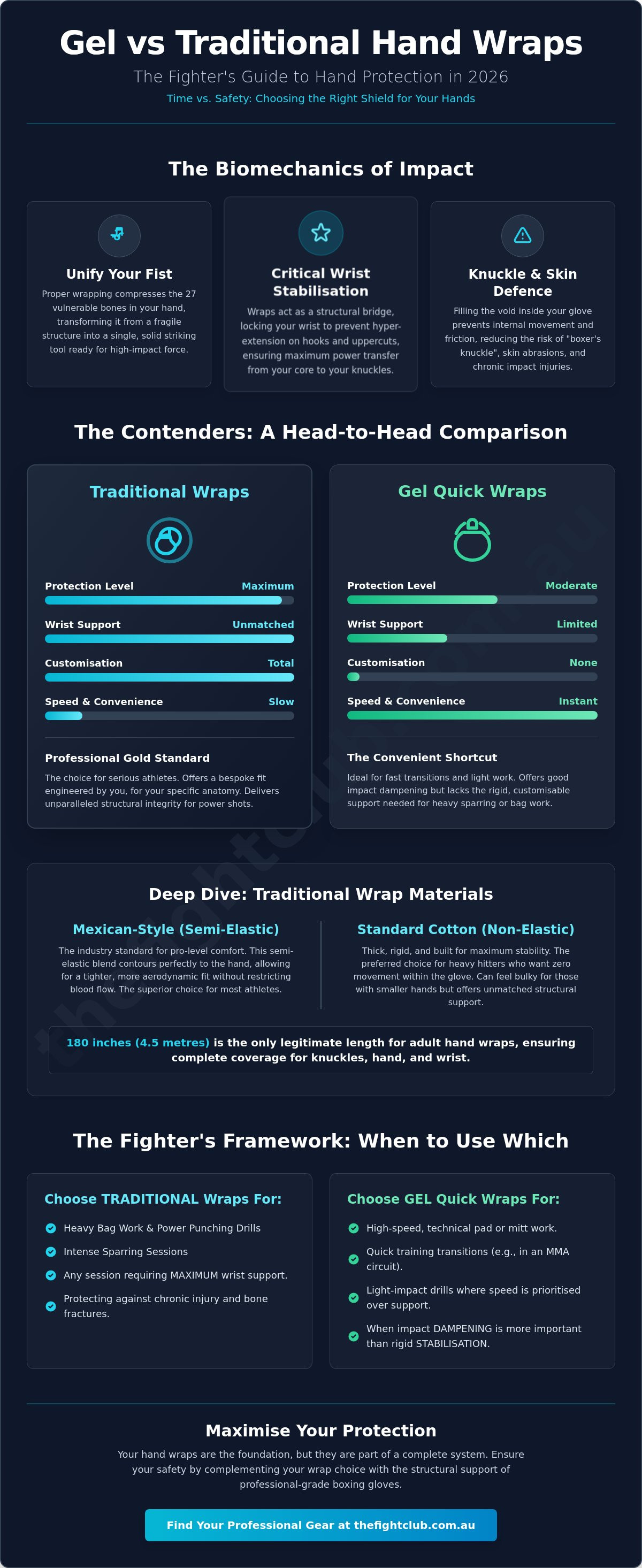
Your hand is a masterpiece of evolution. It is also incredibly fragile. Within that palm and wrist, you're carrying 27 small bones. Each one is a potential failure point when you're driving a power shot into a 50kg heavy bag. These bones aren't designed to absorb hundreds of kilograms of force in isolation. Without protection, the impact causes your metacarpals to "spread" or collapse inward. This isn't just about pain. It is about structural failure. You aren't just hitting a bag; you're testing the limits of your own anatomy.
Proper hand protection transforms your hand from a loose collection of bones and tendons into a single, rigid striking tool. A quality Hand wrap provides the necessary compression to keep everything in place. When debating gel hand wraps vs traditional wraps, you must realise that the primary goal isn't just comfort. It is about creating a solid fist that can withstand acute stress and chronic wear. The difference between a career-ending fracture and a decade of productive training often comes down to how you manage those 180 inches of fabric. Don't gamble with your weapons.
The Role of Wrist Stabilisation
Your wrist is the most common failure point. Beginners often learn this the hard way after a poorly landed hook. Think of your wrap as a structural bridge. It connects your hand to your forearm. This ensures they move as one cohesive unit. During high-velocity hooks or uppercuts, the wrist is prone to hyper-extension or hyper-flexion. If that joint buckles under the weight of your own power, the session is over. Wraps provide the external skeleton needed to lock that joint in place. This allows you to transfer energy from your legs and core directly through the knuckles without the energy leakage of a bending wrist. Secure the joint, or pay the price later.
Knuckle Protection and Skin Abrasions
We've all felt the sting of skin shearing against a glove's interior. It's a distraction you don't need during a high-intensity round. Wraps serve a dual purpose here. First, they fill the void inside your glove. A snug fit is a safe fit. If your hand moves independently inside the glove, you lose control. This increases the risk of "boxer's knuckle" and other chronic issues. Second, they act as a barrier against friction. However, don't confuse thickness with safety. More padding isn't always the answer to knuckle pain. In the ongoing discussion of gel hand wraps vs traditional wraps, remember that padding only dampens the blow. Structural tension is what prevents the bone from breaking. You need a solution that balances impact distribution with the rigidity required for heavy hitting.
Traditional Hand Wraps: The Professional Gold Standard
There is a reason why every world-class fighter starts their session with a roll of fabric. It is a ritual. It is the moment you switch from the outside world to the grind of the gym. Traditional wraps offer a level of customisable tension that no pre-fabricated sleeve can match. Your hand anatomy is unique; your protection should be too. By adjusting the pressure around your wrist and the spacing between your knuckles, you create a bespoke shield. This is the fundamental advantage in the gel hand wraps vs traditional wraps debate. One is a generic fit; the other is engineered by you, for you.
Durability is another pillar of the traditional choice. A pair of high-quality cotton or semi-elastic wraps can survive years of high-intensity training and hundreds of cycles through the wash. They don't lose their structural integrity like cheaper, synthetic alternatives. Whether you are training Boxing, MMA, or Muay Thai, these wraps provide the versatility required for different glove types. When you invest in your gear, you want equipment that works as hard as you do. You can find professional-grade equipment to pair with your wraps at The Fight Club to ensure your kit is ready for the rounds ahead.
Mexican-Style vs. Standard Cotton Wraps
Choosing your material is a matter of preference and hand size. Standard cotton wraps are thick and rigid. They are the preferred choice for heavy hitters who want zero movement within the glove. However, they can feel bulky for those with smaller hands. Mexican Style wraps are the industry standard for pro-level comfort because they contour to the hand without restricting blood flow. This semi-elastic blend allows for a tighter, more aerodynamic fit. Regardless of the material, the 180-inch length is the only legitimate choice for adults. Anything less is a compromise that leaves your wrist or knuckles exposed during power shots.
Mastering the Wrap: A Skill Every Fighter Needs
Stop viewing the wrapping process as a chore. It is a fundamental skill, just like your jab or your footwork. Mastering the "between the fingers" technique is essential for knuckle stability. It prevents the wrap from sliding up the hand during impact. This technique creates individual "anchors" for each finger, locking the padding over the striking surface. If you can't wrap your own hands, you aren't ready to hit the bag. Take the time to learn the craft. It builds a connection between you and your gear, ensuring that when the bell rings, your weapons are secure and your mind is focused on the target.
Gel Quick Wraps: Evaluating Speed vs Structural Integrity
Time is your most valuable asset. If you're squeezing a session into a lunch break, the "Slip-On" advantage of gel wraps is undeniable. You can transition from the street to the heavy bag in under 30 seconds. No fumbling. No re-wrapping mid-session. While traditionalists might scoff, these tools serve a specific purpose. When looking at gel hand wraps vs traditional wraps, the gel option excels at energy dissipation. The integrated gel layers spread the force of impact across a wider surface area than standard fabric. This is a game-changer for high-volume cardio boxing where you're throwing hundreds of light punches rather than focusing on singular, bone-shattering power shots.
However, speed often comes at a cost. The convenience of a quick wrap usually means sacrificing the rigid structural integrity found in a professional 180-inch wrap. If you're planning on sitting down on your punches or testing your limits against a heavy bag, you need to understand the trade-off. Gel wraps are an excellent entry point for beginners who haven't yet mastered the complex geometry of a manual wrap. They provide a baseline level of protection that ensures you don't destroy your knuckles on day one. But as your power grows, so must your gear. In the ongoing debate of gel hand wraps vs traditional wraps, you must decide if you're training for sweat or training for war.
Pros and Cons of the Gel Interior
- Consistent Padding: Unlike fabric that can shift or bunch during a 12-round session, the gel interior remains static. You get the same level of knuckle protection from the first bell to the last.
- The Bulk Factor: This is a significant drawback. Gel liners are notoriously thick. You might find it nearly impossible to squeeze your hands into 10oz or 12oz competition gloves. If your gloves have a narrow profile, these wraps will make them feel suffocatingly tight.
- Beginner Friendly: They remove the barrier to entry. Newcomers can focus on their form and footwork rather than spending their first ten minutes struggling with fabric.
Why Most Gel Wraps Fail at the Wrist
The wrist is where the compromise becomes dangerous. Most gel wraps rely on a short, flimsy velcro strap. This lacks the multiple layers of tension required to truly lock down the carpal bones. You cannot achieve the same level of customisation or "cinch" with a gel wrap as you can with a traditional one. This lack of support increases the risk of the joint buckling during a poorly landed hook. The added bulk of the gel can also lead to "glove slip." If your hand isn't firmly anchored inside the glove, the entire unit can shift upon impact. This instability is the primary reason why professional coaches often steer heavy hitters away from quick wraps and back toward the gold standard of fabric. Choose speed for the light bag, but choose fabric for the heavy hitter.
The Fighter’s Framework: When to Use Gel vs Traditional Wraps
Stop guessing. Your gear selection isn't a matter of mood; it's a matter of the work you've planned for the day. To win the gel hand wraps vs traditional wraps debate, you need a framework. High-impact power sessions demand a different level of structural integrity than a light cardio burn. If you're stepping up to the heavy bag for a power session, the choice is clear. Always reach for traditional 180-inch wraps. You need that maximum bone density to ensure your metacarpals don't shift under the load of a full-force cross. Fabric provides the tension necessary to keep the hand compact when the resistance is high.
Technical sparring requires more than just padding. It requires the ability to make a tight, natural fist and maintain a solid grip inside the glove. Traditional wraps provide a thinner, more customisable profile that allows for this precision. Conversely, gel wraps find their place during low-impact, high-heart-rate intervals. If you're hitting the light bag or focusing purely on aerobic conditioning, the speed of a quick wrap is a luxury you can afford. Just don't confuse a cardio session with a fight camp. Use the right tool for the specific job at hand.
Injury recovery introduces a third option: the "double-up" method. If you're nursing a bruised knuckle but can't stay away from the gym, layer gel padding over a traditional base wrap. This provides the rigid support of fabric with the impact-dampening properties of gel. It's a professional secret for staying in the game without compromising your long-term health. It allows you to maintain your rhythm while your weapons heal. This hybrid approach is the only time the gel hand wraps vs traditional wraps choice becomes a partnership rather than a competition.
Intensity-Based Selection
We define "High Intensity" as any session involving 80% or more of your maximum power. On these days, convenience is your enemy. Never let the thirty seconds you save with a slip-on wrap lead to a six-week layoff. A disciplined fighter keeps both options in their gym bag. Use the tool that matches the intensity of the drill. If you're ready to upgrade your protection, explore our range of professional fight gear today and ensure you're equipped for every round.
The Beginner’s Progression
If you're new to the mats, start with gel wraps to get moving. But don't get comfortable. You should aim to master traditional wrapping within your first month of training. This isn't just about tradition; it's about the "feel" of the strike. Using boxing wraps correctly allows you to feel the connection between your fist and the target. It builds the tactile feedback necessary for elite-level punch mechanics. Move past the shortcuts. Embrace the authentic methods that have protected fighters for decades. Hard work has no substitutes.
Maximising Protection with Professional Grade Gear
Your wraps are a foundation. They are not the entire structure. Even the most precise wrap job is compromised if your gloves are soft or poorly designed. In the battle of gel hand wraps vs traditional wraps, remember that your outer shell does the heavy lifting. Cheap, generic gloves lack the internal architecture to support your joints under pressure. They make even the best wraps feel useless. Protect your tools. Investing in professional gear isn't a luxury. It's a necessity for anyone serious about the sport. The cost of a premium glove is nothing compared to the cost of a hand surgeon and months of rehabilitation.
Think of your gear as a system. Your choice between gel hand wraps vs traditional wraps should be dictated by how they interact with your gloves. If you're using high-end equipment, you'll find that the glove's design actually enhances the wrap's effectiveness. High-quality materials and technical engineering create a synergy that keeps you in the gym and out of the clinic. Don't let a bargain pair of gloves become the reason your career ends early. You get what you pay for. In combat sports, you pay with your health. Hard work requires the right equipment.
The Synergy of the Hayabusa T3
The Hayabusa T3 Boxing Gloves are a masterclass in hand protection. They feature four interlocking splints that provide world-class wrist alignment. This structural support complements your wrap by locking the wrist in a neutral position. It eliminates the buckle that leads to injury. The T3’s interior fabric is specifically designed to work with boxing gloves technology to wick moisture away from your skin. Whether you prefer the bulk of gel or the custom fit of fabric, the T3’s dual-strap system ensures a secure, non-slip fit every time. It is the perfect partner for any wrap style.
Gear Maintenance for Longevity
Respect your gear. If you don't maintain your kit, it won't maintain you. Always wash your wraps after every single session. No excuses. Sweat and bacteria lead to glove rot. This destroys the internal padding of your gloves from the inside out. It's a disgusting, avoidable mistake. Air-dry your wraps to maintain the elasticity of your Mexican-style fabric. High heat in a dryer will kill the stretch and leave you with useless rags. Treat your equipment with the same discipline you bring to your training. Level up your hand protection with The Fight Club’s premium range and secure your future in the ring.
Secure Your Weapons and Stay in the Fight
Your hands are your livelihood. Don't let a poor gear choice dictate the length of your career. We've settled the debate on gel hand wraps vs traditional wraps. Traditional fabric remains the gold standard for structural integrity during power sessions. Gel offers the speed you need for high-volume cardio days. The key is knowing which tool to pull from your bag before the bell rings. Always prioritise the synergy between your wraps and your gloves. A unified fist is a safe fist.
Success requires the right equipment. Upgrade your hand protection with pro-grade wraps and Hayabusa T3 gloves. We stock Australia’s leading range of Hayabusa and Venum gear. Every item is tested by fighters, for fighters. Benefit from fast national shipping across Australia to get your kit sorted before your next session. Stop compromising on your safety. Respect the grind. Push your limits with the confidence that your weapons are secure.
Frequently Asked Questions
Can I wear gel wraps under my boxing gloves for sparring?
You can, but you must check the fit of your 16oz gloves first. Gel wraps add significant bulk that can cramp your hand inside a standard sparring glove. If you can't make a proper fist because of the extra padding, you risk a hand injury. Many fighters prefer traditional wraps for sparring to maintain a better grip and natural fist-making ability.
How long should traditional hand wraps be for an adult male?
Standard 180-inch wraps are the only legitimate choice for adult training. This length, roughly 4.5 metres, provides enough material to secure the wrist and execute the essential between the fingers technique. Don't cut corners on your safety by using junior-sized fabric. You need the extra length to create a unified, rigid striking tool that protects all 27 bones in your hand.
Are gel hand wraps safe for heavy bag training?
Only use them for technical, low-impact work or high-volume cardio sessions. When comparing gel hand wraps vs traditional wraps for heavy bag sessions, the traditional option wins for safety. Gel lacks the rigid structural tension required to keep your metacarpals from spreading during 80% power shots. Use gel for cardio; use fabric for power days.
How often should I wash my traditional hand wraps?
Wash them after every single session without exception. Leaving damp, sweat-soaked wraps in your gym bag is a fast track to glove rot and skin infections. Use a mesh laundry bag to prevent tangling in the machine. Always air-dry them to preserve the elasticity of your Mexican-style wraps. High heat in a dryer will ruin the stretch and leave you with useless rags.
Do gel wraps provide enough wrist support for power punchers?
Generally, they do not. Most gel wraps rely on a short velcro strap that cannot provide the deep, multi-layered compression needed to lock the carpal bones in place. Power punchers require the customisable cinch of a 180-inch traditional wrap. If you're sitting down on your punches, you need the rigid support of fabric to prevent the joint from buckling.
What is the best material for traditional hand wraps?
Mexican-style semi-elastic cotton is the industry standard for a reason. It offers the perfect balance between thickness and flexibility. This material contours to the unique anatomy of your hand without restricting blood flow. In the gel hand wraps vs traditional wraps debate, this specific material provides the most authentic, locked-in feel for serious training and professional-level protection.