

Cloth vs Leather Shin Guards: Choosing Your Armour for the Grind
The wrong choice in equipment turns a technical sparring session into a painful lesson in anatomy. You are here to train like a fighter, not to nurse bone deep bruises because your padding failed during a routine check. Deciding on cloth vs leather shin guards isn't just about the price tag. It is about how much skin you are willing to lose to the mat. It's about how much impact your shins can actually take.
You want to go hard without checking your legs for cracks every five minutes. We understand the frustration of gear that shifts mid-kick or carries an embarrassing odour that clears the gym floor. You need protection that stays put. You need gear that survives the high-octane intensity of a real Muay Thai session. This guide helps you realise which armour fits your discipline, protection needs, and training intensity. We promise to help you find equipment that justifies the cost and keeps you in the fight.
We will break down the lightweight agility of cloth against the heavy-duty durability of leather options like the Venum Elite at $119.99 or Twins Special SGL10 at $80.70. You will discover which material stops the slip. You will find the padding required for the daily war of training in an ego-free environment.
Key Takeaways
- Identify the core design differences between lightweight sock-style agility and high-density foam shields for the daily grind.
- Navigate the cloth vs leather shin guards trade-off to balance maximum impact protection with the mobility needed for your discipline.
- Master sparring etiquette by choosing gear that protects your tribe and upholds the "No Egos" culture of the gym.
- Evaluate the long-term investment of premium armour versus the hygiene risks and odour of sweat-soaked cloth alternatives.
- Get a definitive verdict on which gear suits your specific training intensity, whether you are prepping for amateur MMA or Muay Thai wars.
Cloth vs Leather Shin Guards: The Core Differences
Choosing your gear is a ritual. It is the moment you decide how you intend to show up on the mats. Walk into any authentic gym and you will immediately notice the divide. The choice between cloth vs leather shin guards isn't just about aesthetics; it is about the fundamental construction of your protection. Understanding the History of shin guards shows how we moved from basic protection to the high-tech armour used in Melbourne's premier training centres today. You need to know what you are strapping on before the first bell rings.
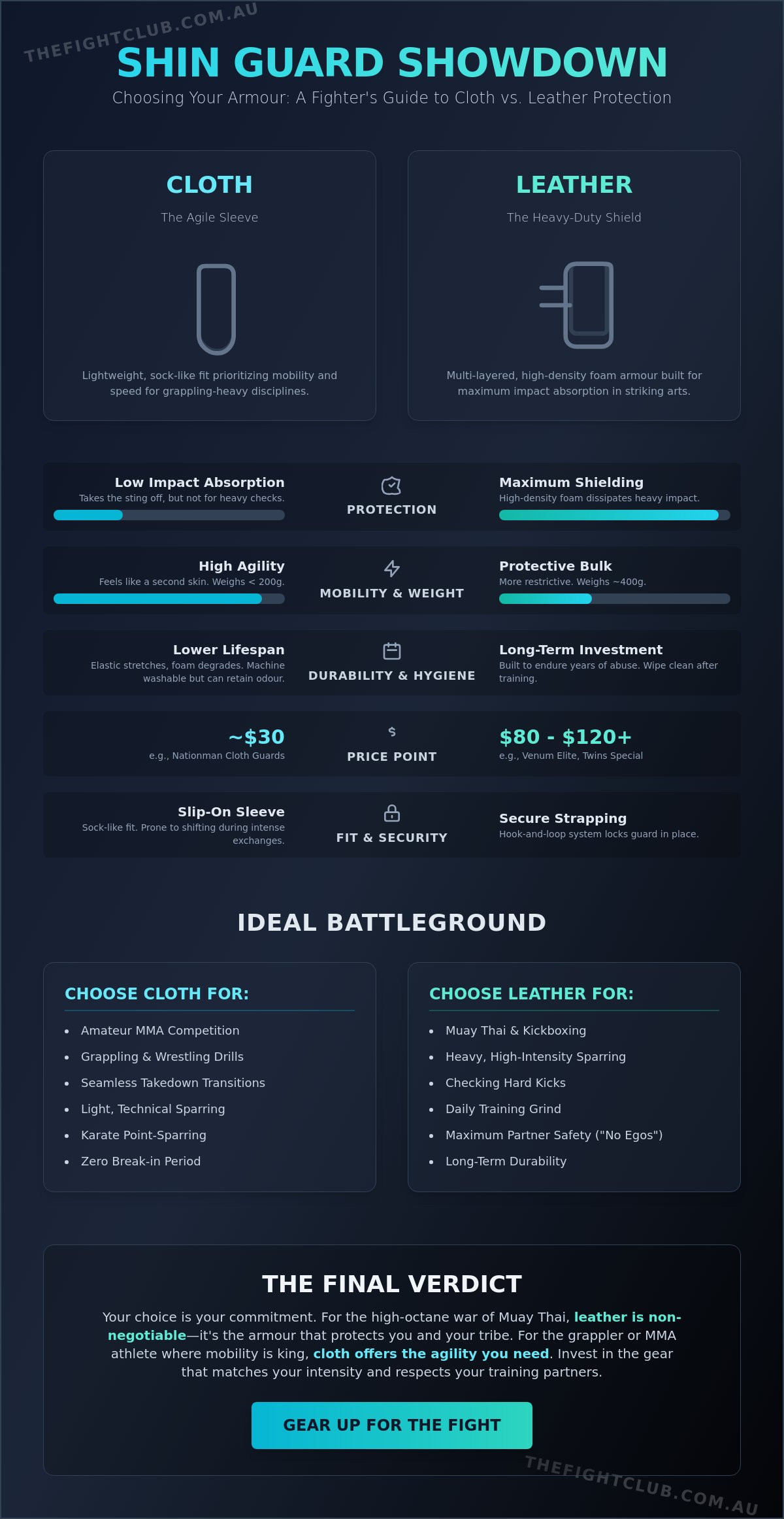
New fighters often look at the price tag first. A pair of Nationman cloth guards costs roughly $30.00, making them an accessible entry point. However, you must realise the performance trade-off. Leather guards are built for the heavy bag and high-intensity sparring, while cloth is designed for specific competition rules or light drills. Many professional gyms actually standardise their equipment requirements, mandating leather for anyone stepping into a sparring round. This is part of a "No Egos" policy that prioritises the safety of the entire family over individual gear preferences.
The Anatomy of a Cloth Shin Guard
Cloth guards use a heavy-duty cotton-elastic blend to create a snug, sock-like fit. You slide them on like a sleeve. They are low-profile by design, featuring a thin layer of foam padding that contours to the leg. This construction prioritises mobility and speed over raw impact absorption. You will most commonly see these in amateur MMA circuits or Karate point-sparring where grappling transitions require less bulk. They offer enough padding to take the sting out of a stray kick, but they are tools for agility, not total defence.
The Anatomy of a Leather Shin Guard
Leather guards are the heavy artillery. Whether they are crafted from genuine cowhide or premium synthetic materials like Skintex and microfibre, they are built to endure. These guards utilise multi-layered, high-density padding systems specifically engineered to handle the force of a checked kick. Unlike the slip-on cloth versions, leather armour uses a secure hook-and-loop strapping system. This keeps the guard locked in place during high-octane exchanges, ensuring the padding stays over the bone where it belongs. This is the gold standard for anyone serious about the grind of Muay Thai or Kickboxing.
Protection, Weight, and Mobility: The Trade-off
Every piece of gear you strap on is a trade-off. You give up speed for safety. You sacrifice mobility for impact absorption. In the battle of cloth vs leather shin guards, this balance defines how you move on the mats. Leather guards act like a shield, while cloth feels like a second skin. Choosing the right one depends on whether you are catching heavy kicks or shooting for a double-leg takedown.
One factor often ignored is the break-in period. Leather guards are notorious for being stiff out of the box. They require several rounds of sweat and movement to contour to the unique shape of your shin. Cloth guards require zero break-in. They are ready for the grind immediately. However, that instant comfort comes at the cost of structural integrity over time. Elastic stretches. Foam compresses. Eventually, that "second skin" provides as much protection as a pair of thick socks.
Maximum Shielding for Heavy Sparring
Leather is the undisputed gold standard for Muay Thai and Kickboxing. When you are checking a power kick, you need high-density foam to dissipate the energy before it hits the bone. Citing research on preventing tibia fracture shows that material density is the primary factor in injury prevention. Leather guards also offer superior instep protection, covering the small bones of the foot that are easily broken during a misplaced kick. High-density foam in leather guards is essential for checking kicks because it prevents the "bottoming out" effect where the impact travels straight through the padding.
Speed and Grappling: The Cloth Advantage
Cloth guards win on the scales. A standard leather guard like the Venum Elite weighs roughly 400 grams, while a cloth alternative might weigh less than half that. This weight difference is massive during high-volume kicking drills. In MMA, the bulk of leather can actually hinder your performance. It makes it harder to lock in a triangle choke or move through a tight clinch. Cloth is often the mandatory choice for amateur competition circuits to keep the playing field level and ensure fighters can grapple without being hindered by oversized gear. Grab some professional-grade Venum gear to ensure your shins survive the next session without sacrificing your technique.
The "shifting" problem is the final hurdle. Elastic cloth guards rely on friction to stay in place. As you sweat, they slip. Leather guards use secure hook-and-loop straps that lock the armour to your leg. You don't have to pause the round to fix your gear. You stay focused on the fight.
The Sparring Etiquette: Protecting Your Tribe
Sparring is a conversation. It's about rhythm, timing, and mutual growth, not feeding your ego. When you step onto the mats, your gear choice speaks before you do. In the debate of cloth vs leather shin guards, your decision impacts more than just your own comfort. It signals whether you respect your training partner's safety or if you're only focused on your own mobility. Choosing the right armour is a fundamental part of gym culture.
The "bone-on-bone" risk is a real threat when using inferior padding. Cloth guards often bottom out during a heavy exchange. This means the thin foam layer compresses completely under pressure, leaving nothing but hard bone to strike your partner's ribs or thigh. It's a fast way to lose training partners and gain a reputation as a dangerous sparring partner. Leather guards provide the density required to keep the session technical and safe for everyone involved.
There is a dangerous myth about shin conditioning that lingers in old-school circles. Some believe you need to bleed or bruise to harden your bones. This is nonsense. You harden your shins on the heavy bag and through consistent, controlled impact drills. Sparring is for sharpening your mind and your technique. You don't need to sacrifice your partner's health or your own longevity to prove you are tough. Real grit is shown through discipline and respect, not reckless gear choices.
Why Your Coach Prefers Leather
A coach's primary job is keeping the tribe healthy and on the mats. High-quality equipment from leading MMA fight stores is the standard for a reason. It reduces injury downtime for the whole team. When everyone wears proper leather protection, the intensity can stay high without the risk of tibia fractures or severe deep-tissue bruising. This fits perfectly with a "No Egos" policy. We are here to build each other up, not break each other down. Protective gear is an investment in the collective progress of the gym.
When Cloth is Acceptable
Cloth isn't useless, but it has a very specific role in your kit bag. Use it for light technical drills where the focus is on movement and placement rather than power. It is also excellent for beginners who are just starting to find their rhythm and aren't yet throwing with full force. For conditioning drills, the lower profile allows you to feel the contact without the massive shield of leather, helping you build a baseline tolerance. Just realise when the intensity is climbing. If the round is moving past 50 percent power, it is time to strap on the leather.
Durability and Maintenance: The Long Game
Quality gear is not a luxury. It is a necessity for the long game. When comparing cloth vs leather shin guards, you must look past the initial receipt. A $40 pair of cloth guards might last six months of heavy training before the elastic gives out. A $150 pair of premium leather guards can easily survive two years of daily wars. You are choosing between a recurring expense and a long-term investment in your performance. Real grit means respecting your equipment as much as you respect the grind.
Leather is designed for punishment. It resists tearing and handles the high-octane friction of the heavy bag without shredding. Cloth is different. It is a temporary solution. The more you sweat, the more the fabric degrades. Eventually, you realise that "saving money" on cheap gear actually costs you more in the long run. Invest once. Train forever.
Longevity of Materials
Leather outers provide a structural integrity that fabric simply cannot match. While the straps on premium gear are reinforced to prevent failure, the elastic on cloth guards inevitably stretches. Once that snug fit is gone, the guard becomes a liability on the mats. Synthetic leather typically lasts three times longer than cotton elastic when subjected to the same sweat and impact levels. You need gear that stays as disciplined as your technique, not something that sags after a few rounds of sparring.
Fight the Funk: Hygiene Tips
The "odour factor" is where cloth guards lose the battle. Fabric absorbs sweat like a sponge. It becomes a petri dish for bacteria and gym-borne infections if you are not careful. You can throw cloth guards in the wash, but you must use a mesh bag and a cold cycle to prevent the foam from disintegrating. Never use a dryer. The heat will ruin the elastic faster than a heavy leg kick.
Leather requires a different approach. Wipe your guards down after every session with a damp cloth and a mild disinfectant. Air them out in a cool, dry place. Whatever you do, never leave your gear in a gymnasium bag overnight. The lack of airflow invites the kind of funk that no amount of spray can fix. Keep the leather supple with occasional conditioning to avoid cracking. If you want gear that survives the sweat and stays professional, shop the pro range and upgrade your armour today.
The Final Verdict: Which One Should You Buy?
The debate ends here. You've seen the data. You know the trade-offs between protection and mobility. Now you need to decide which armour will carry you through the next thousand rounds. In the final showdown of cloth vs leather shin guards, the answer depends on your commitment to the grind. If you are stepping into the ring twice a week or more, don't settle for the bare minimum. Your longevity on the mats is worth the investment.
Choose leather if you value your shins and your training partners. If your goal is high-intensity Muay Thai or kickboxing, high-density foam is your only real defence against bone-on-bone trauma. It is the "buy once, cry once" philosophy. You might pay more upfront. You won't be sidelined with an avoidable injury. For those training daily, this is the only logical choice to maintain professional standards in an ego-free environment.
Choose cloth if you are deep in the amateur MMA circuit or focusing purely on light technical drills. The low profile is essential for grappling transitions where bulk is your enemy. Some fighters opt for a hybrid solution. They keep a pair of cloth guards for light days and leather shields for heavy sparring. This strategy extends the life of both sets. It ensures you are always prepared for the specific intensity of the session. Realise that your gear is a tool. Use the right tool for the job.
Top Recommendations for Serious Fighters
The Hayabusa T3 stands as the gold standard for a reason. It offers an ergonomic fit that contours to your leg, preventing the shifting issues common in lesser gear. For those seeking versatility, Venum Australia provides a range of options that balance weight and protection perfectly. When finding your fit, measure from the top of your ankle to the bottom of your knee. Most Australian fighters find that a snug fit is better than a loose one that rotates mid-kick. Don't guess your size. Measure it.
Ready to Level Up Your Gear?
Safety is a package deal. Pairing high-quality shin guards with professional-grade boxing gloves ensures you are protected from head to toe. This isn't about vanity. It is about respect for the sport and your tribe. Train like a fighter. Protect like a pro. Leave the ego at the door and invest in gear that works as hard as you do. You've put in the work. Now wear the armour that reflects your discipline.
Shop the full range of Shin Guards at The Fight Club and get back to the grind.
Gear Up for the Long Game
Your journey on the mats is defined by the choices you make before the timer starts. Deciding between cloth vs leather shin guards is a commitment to your craft and your community. You now know that leather is the shield for the daily war. It provides the high-density protection your shins and your partners deserve. Cloth remains your specialist tool for the agility required in amateur MMA circuits or technical light-touch drills. Don't let inferior gear dictate your progress or lead to avoidable downtime.
We are an authorised Australian retailer stocking the premium armour you need to maintain professional standards. Whether you are chasing the ergonomic perfection of Hayabusa or the battle-tested durability of Venum and UFC gear, we ensure you get the best. We provide fast shipping across Australia so you can get back to the heavy bag without delay. Real grit is about being prepared for every exchange with gear that stays put and survives the sweat.
Upgrade Your Armour: Shop Professional Shin Guards Now
Respect the technique. Respect the family. Train like a fighter and protect your future in the sport.
Frequently Asked Questions
Can I use cloth shin guards for Muay Thai sparring?
You should not use cloth guards for live Muay Thai sparring because they lack the high-density padding required to absorb heavy leg kicks. While they are fine for technical drills, live sparring involves checking kicks that can cause bone-on-bone trauma through thin fabric. Most reputable gyms require leather guards for the safety of both partners. Stick to leather to ensure you are protecting your tribe and staying on the mats.
How do I know if my shin guards are the right size?
Your shin guards are the right size when they cover the area from just above your ankle to just below your kneecap without restricting movement. If the guard is too long, it will dig into your knee when you bend your leg; too short, and your instep or upper shin remains exposed. Most brands provide a size chart based on your height or shin length. Always check the fit while wearing your usual training gear.
Are leather shin guards worth the extra money?
Leather shin guards are absolutely worth the extra investment because they offer superior impact absorption and last significantly longer than cloth alternatives. When comparing cloth vs leather shin guards, the leather options provide high-density foam that doesn't bottom out over time. They handle the grit of daily training without shredding or losing their shape. You are paying for longevity and the safety of your shins during the grind.
Do cloth shin guards slip more than leather ones?
Cloth shin guards slip more than leather ones because they rely on elastic tension which loosens as you sweat. Leather guards use secure hook-and-loop strapping systems that lock the armour to your leg. During high-octane sessions, cloth fabric absorbs moisture and becomes heavy, causing it to rotate or slide down during kicks. This constant shifting is a distraction that can compromise your technique and focus during a round.
How do I stop my shin guards from smelling?
Stop the odour by wiping your guards down with a disinfectant spray after every session and allowing them to air dry completely. Never leave your gear in a gymnasium bag overnight as the lack of airflow breeds bacteria. For cloth guards, use a cold machine wash in a mesh bag once a week. For leather, focus on keeping the interior dry and using charcoal inserts to absorb moisture and neutralise gym funk.
Can I wear shin guards over my leggings or spats?
You can wear shin guards over leggings or spats to prevent skin irritation and improve hygiene. This layer helps absorb sweat before it reaches your gear, which can actually help reduce the "odour factor" over time. Ensure the guards are strapped tightly so they don't slide against the slick material of the spats. Many fighters prefer this setup for MMA training to protect their skin from mat burn during grappling transitions.
What is the difference between Muay Thai and MMA shin guards?
The main difference lies in the padding density and the closure system. Muay Thai guards are bulkier with thick foam and heavy straps designed for maximum protection against power kicks. MMA guards are often lower profile, sometimes using a sock-style sleeve, to allow for better mobility during grappling and submissions. While Muay Thai gear prioritises defence, MMA gear focuses on the transition between striking and groundwork without the bulk hindering movement.
Is it better to get genuine leather or synthetic leather?
Modern synthetic leathers like Skintex or microfibre are often better for combat sports because they are specifically engineered to resist sweat and cracking. While genuine leather is traditional and durable, it can absorb moisture if not conditioned regularly. High-quality synthetic options from brands like Venum offer the same high-density protection with less maintenance. Both will survive the grind, but synthetic often holds up better against the heavy sweat of Australian training environments.