

Boxing Wraps: The Ultimate Guide to Protecting Your Hands (2026)
What if the most critical piece of gear in your kit isn't your $250 gloves, but the five meters of fabric hidden underneath? One wrong move on the heavy bag can sideline you for 6 weeks with a painful metacarpal fracture. You've likely felt that sharp sting in your knuckles or the unstable wobble in your wrist during a power shot. It's a common hurdle, especially when you're staring at a wall of boxing wraps wondering if 120 or 180 inches will actually save your skin.
At The Fight Club, we believe in grit over flash. You're here to work, not to nurse a sprain. You already know that proper protection is the foundation of every heavy hit. We'll show you how to master the mechanical support your hands need to stay lethal and injury-free. This guide delivers a foolproof wrapping technique used by our pro roster and tips to keep your gear from tangling into a mess in the wash. We're diving deep into choosing, tying, and maintaining your wraps so you can train like a fighter every single round.
Key Takeaways
- Protect your foundation. Stabilize the hand's 27 small bones to turn your strike into a weapon, not a liability.
- Choose your shield. Compare cotton, Mexican-style, and gel boxing wraps to find the right gear for the Australian gym environment.
- Master the technique. Follow our tactical guide to the "Between the Fingers" method and adopt the "No Egos" approach to preparation.
- Maintain your edge. Discover how to stop sweat and salt from rotting your gear so you don't become the person with the stinky bag.
- Gear for real fighters. See why we only stock elite brands like Hayabusa and Venum that pass the "Train like a fighter" test.
Why Boxing Wraps are the Non-Negotiable Foundation of Every Strike
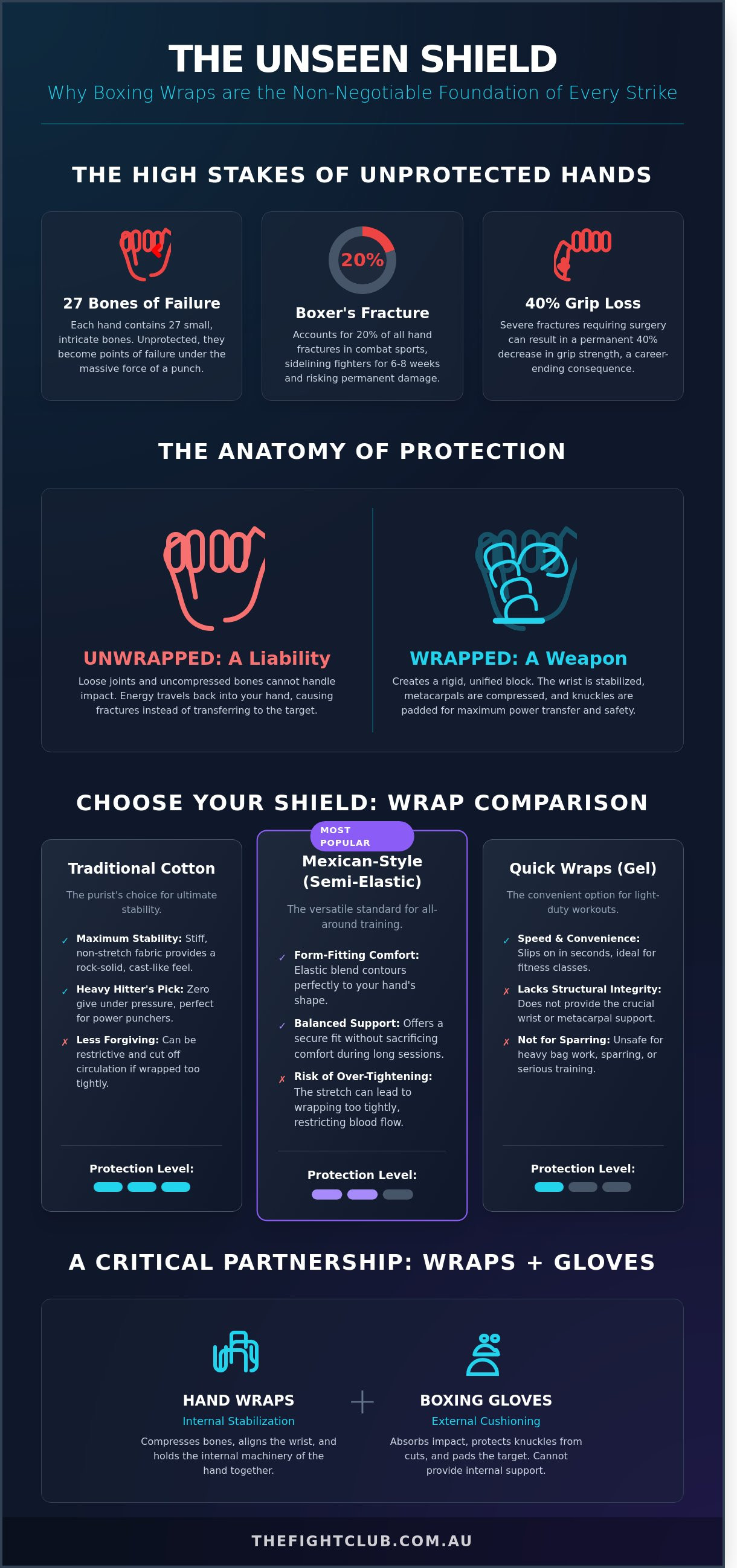
Your hand is a masterpiece of evolution. It contains 27 individual bones. That's 27 points of failure if you strike without discipline. Beginners often see boxing wraps as a chore. They're wrong. Wraps are the structural foundation of every punch you throw. Without them, you're just gambling with your career. A proper Hand wrap secures the small joints and soft tissues that your gloves cannot reach. It's the difference between a powerful session and a trip to the emergency room.
Think about the physical impact. A heavy bag strike from an amateur can generate over 2,500 newtons of force. If your hand isn't a solid unit, that energy travels back into your bones rather than through the target. This leads to the Boxer’s Fracture. This break of the fourth or fifth metacarpal accounts for roughly 20 percent of all hand fractures in combat sports. A single mistake can sideline you for 8 weeks and result in a 40 percent permanent decrease in grip strength if surgery is required. Professional fighters don't skip this step. They know that protection is a mark of a professional. At The Fight Club, we have a No Egos policy. That starts with respecting your body enough to protect it. Train like a fighter. Wrap your hands before you touch the leather.
The Anatomy of Hand Protection
Wraps do more than just cover skin. They compress the metacarpals to prevent the bones from spreading or shifting when you land a heavy hook. Proper wrapping ensures your wrist stays aligned with your forearm. It creates a straight line of force. The metacarpal squeeze creates a rigid, unified block of bone and fabric that transforms a loose collection of joints into a single, devastating tool for power transfer.
Wraps vs. Gloves: Understanding the Partnership
Gloves provide impact cushioning. They protect the knuckles from external cuts and bruises. However, even a $300 pair of professional leather gloves cannot provide internal stabilization. Wraps fill the dead space inside the glove. This creates a custom fit that prevents your hand from sliding mid-strike. Don't believe the myth that heavy padding equals total safety. Padding absorbs the blow; boxing wraps hold the machine together. Spend $25 on quality wraps to protect your hands and your $200 investment in gloves.
The ritual of wrapping is where the workout begins. It is the moment you transition from the outside world to the heat of the gym. It's about grit. It's about preparing for the sweat. When you wrap your hands, you're telling yourself that the next hour belongs to the craft. This isn't a commercial boxercise class. This is authentic training. Every layer of fabric you wind around your knuckles is a commitment to the technique. If you want to hit like a pro, you have to prepare like one. No shortcuts. No excuses. Just the wrap, the glove, and the work.
Consistency is key in this game. You might think you can get away without them for one light round on the pads. You can't. Ligament tears happen in a split second. A loose wrist on a simple jab can end your training for a month. We see it happen to people who think they're too tough for gear. Real toughness is showing up every day because you were smart enough to stay uninjured. Secure your wrists. Lock your thumb. Build your foundation. Then, and only then, are you ready to find out what you're made of on the bag.
Cotton, Mexican, or Quick Wraps: Choosing Your Shield
Your hands are your tools. Protect them like your life depends on it. In the Australian market, you'll face three main choices: traditional cotton, semi-elastic Mexican style, or gel quick wraps. Don't get distracted by flashy colors or cheap price tags. Focus on the protection. For real grit and maximum safety during a heavy bag session, traditional boxing wraps remain the gold standard. They offer a custom fit that no pre-made glove can ever match. It is the difference between a custom suit and a one-size-fits-all poncho.
Traditional herringbone cotton wraps are stiff. They don't give. This is perfect for the heavy hitter who wants zero movement in their wrist. Mexican wraps use a nylon-cotton blend. They stretch. This elasticity allows the wrap to contour to the hand without cutting off circulation during a long session. Then there are quick wraps. These are neoprene sleeves with a bit of gel padding. They're fast. They're convenient for a 45-minute cardio-box class. But if you're stepping into the ring for real sparring, they won't cut it. They lack the structural integrity required to lock down the 27 small bones in your hand. They're a shortcut, and shortcuts lead to injuries.
The stakes are high in combat sports. Research into Hand and Wrist Injuries in Elite Boxing shows that these areas account for a massive 25% of all injuries sustained in the sport. Without proper support, a single misplaced hook can end your season before it starts. In Muay Thai, you might prefer the Mexican style to allow for the wrist flexibility needed during clinching. In pure boxing, stiffness is your best friend. Protect the knuckles. Secure the wrist. Leave nothing to chance when you're throwing heat.
The 180-Inch Standard: Why Length Matters
Size matters. Specifically, 180 inches or 4.5 meters. This is the professional standard for adult hands in Sydney gyms. It provides enough fabric to loop between every finger and create a thick pad over the knuckles. Junior fighters or those with exceptionally small hands might opt for 120-inch (3m) wraps. Here is the rule: more wrap equals more options for knuckle padding. If you have extra length, don't just wind it around your wrist. Build a shield over your striking surface. More fabric means more layers of defense between your bones and the bag.
Material Science: Stretch vs. Stiffness
Choosing the "Mexican Style" wrap makes you part of the most popular camp in the gym. The slight stretch makes them forgiving. You can pull them tight for a secure feel without losing feeling in your fingertips. Traditional Herringbone Cotton is for the purists. It offers maximum stiffness. It feels like a cast once applied correctly. Quick wraps remain a convenience tool. Use them for light bag work or fitness classes where you're switching between weights and gloves. When it's time to train like a fighter, go back to the basics. Real protection requires the discipline of a proper wrap. It's a ritual. It's your armor. Don't skip it.
Master the Wrap: A Tactical Step-by-Step Guide
Don't rush the ritual. The gym floor isn't a place for shortcuts or vanity. Every elite fighter starts their session with the same 180-inch discipline. You need to wrap like you’re building a cast, not a bandage. This isn't just about covering skin; it's about creating a single, solid unit from your fingertips to your forearm. We operate on a "No Egos" policy at The Fight Club. That means you take the time to do it right every single time you train. If your wraps are sloppy, your strikes will be too.
Proper protection is the difference between a long career and a permanent injury. Clinical data found in a review of Hand and Wrist Injuries in Boxing provides clear evidence that hand protection is essential for reducing trauma during high-impact training. Your 27 small hand bones aren't designed to hit heavy bags without help. Use boxing wraps to bridge the gap between human anatomy and combat intensity. Focus on your three primary anchor points: the wrist, the thumb, and the knuckles. If these aren't secure, you're just wearing expensive ribbons.
The "Between the Fingers" Technique
Step 1: The Foundation. Put your thumb through the loop. Pull the wrap across the back of your hand. Never start across the palm, or the wrap will loosen when you make a fist. Circle the wrist three times. This creates the base of your cast. Keep it firm. It should feel like a supportive hug, not a tourniquet.
Step 2: The Knuckle Pad. Run the wrap diagonally across your palm to your knuckles. Wrap around the knuckles three times. Keep your fingers spread wide during this process. If you wrap with a closed hand, the fabric will be too tight once you actually start punching. You want a thick pad that covers the striking surface without sacrificing finger mobility.
Step 3: The Metacarpal X. This is where the "real" protection happens. Bring the wrap back to the wrist, then thread it between your pinky and ring finger. Circle the wrist. Repeat for every finger gap. This "X" pattern locks the metacarpal bones together. It prevents the bones from splaying or shifting when you land a heavy hook. It turns your hand into a weapon.
Step 4: The Final Lock. Finish by wrapping the thumb once to anchor it to the hand. Bring the remaining fabric back down to the wrist. Wind it until you reach the Velcro. Perform a tension check. Make a fist. The wrap should tighten across your knuckles and feel rock solid. If it feels mushy, strip it and start again.
Common Wrapping Mistakes to Avoid
- The Tingle Test: If your fingers feel cold or you notice a rhythmic pulsing, you've wrapped too tight. Restricted blood flow leads to cramping and loss of power. If you feel the "tingle," undo it immediately.
- The Sliding Wrap: Loose boxing wraps are a liability. If the fabric shifts during a round, it creates friction that causes blisters. Worse, a loose wrap fails to support the wrist. A sliding wrap is more dangerous than no wrap because it gives you a false sense of security.
- The Hitchhiker Injury: Lazy wrappers often ignore the thumb. If the thumb isn't anchored to the wrist, it can catch on the bag and get pulled backward. This "hitchhiker" injury can sidelining you for 6 to 8 weeks. Don't be that person.
Train like a fighter. Respect the process. The five minutes you spend wrapping your hands determines the quality of the next hour of sweat. Secure your tools and get to work.
Maintenance & Hygiene: Don’t Be the Person with Stinky Gear
Your gym bag is a breeding ground. If you leave damp boxing wraps at the bottom of your kit for more than 3 hours, you are essentially cultivating a biohazard. Sweat isn't just water. It is a corrosive cocktail of salt, urea, and bacteria. When this mixture dries into the fabric, it doesn't just create a stench that can clear a room; it physically destroys your equipment. Salt crystals act like microscopic sandpaper. They grind away at the elastic fibres every time you flex your fist. Within 10 weeks of poor maintenance, your wraps will lose the "snap" needed for a secure wrist lock.
Clean gear is a sign of respect. In a "No Egos" environment, showing up with gear that smells like a swamp is an insult to your training partners. You are working in close quarters. Your hands are near their face during clinch work and sparring. Respect the gym, respect the craft, and respect the people around you. A professional fighter takes care of their tools. You should do the same. This isn't about vanity. It is about discipline and basic hygiene.
The "Laundry Bag" Secret
Never throw loose wraps into the washing machine. You will end up with a "spaghetti" mess of tangled fabric that takes 20 minutes to untangle. This tension can also tear the stitching on the thumb loops. Spend $5 on a mesh laundry bag from a local supermarket. It is the best investment you will make for your gear. Close the Velcro tabs before bagging them. This prevents the hooks from shredding the delicate cotton-elastic blend. Always use a cold wash. High temperatures bleed the dye and warp the Velcro. Keep it simple. Keep it cold.
Drying and Re-Rolling for the Next Round
The dryer is the enemy of elastic. Extreme heat makes the fibres brittle, which leads to a 40% faster degradation rate compared to air drying. Hang your wraps over a rail or a door. The Australian sun is effective for killing bacteria, but don't leave them out for more than 5 hours; UV rays can also weaken the material over time. Once they are bone dry, perform the "Pro-Roll" immediately. Don't wait until you are at the gym. Start with the Velcro end and roll tightly toward the thumb loop. This ensures you are ready to Train like a fighter the second you step onto the mats.
A fighter’s discipline starts outside the ring. If you can't manage your laundry, you won't manage your footwork when the pressure is on. Store your clean, rolled boxing wraps in a ventilated pocket of your bag. Avoid the dark, damp corners. Stay fresh, stay sharp, and keep the standards high for everyone in the room.
Ready to put your gear to the test? Book your next session at Melbourne’s premier destination for authentic training.
Elite Gear for Real Fighters: The Fight Club Selection
You don't step into the ring with gear that fails under pressure. At The Fight Club, we've seen enough cheap, flimsy equipment fall apart after three sessions on the heavy bag. That isn't what we do. Every piece of equipment in our shop survives the "Train like a fighter" test. We only stock boxing wraps that our coaches and pro fighters actually use when they're preparing for a 12-round war. If it doesn't offer the technical precision or the raw durability required for high-intensity training, it doesn't make the cut. We focus on substance, grit, and gear that protects your most valuable tools: your hands.
Our selection is curated for the Sydney boxing community and fighters across Australia who demand more from their kit. We've narrowed our inventory down to the brands that lead the industry in innovation and reliability. You'll find names like Hayabusa and Venum on our shelves because they've proven their worth in the toughest gyms across the globe. We don't care about flashy logos or fitness trends. We care about the 180 inches of fabric that keep your metacarpals from fracturing when you're landing a heavy right hook. This is professional-grade gear for people who take their craft seriously.
Why We Trust Hayabusa and Venum
Hayabusa is the gold standard for technical precision. Their Perfect Stretch wraps are a staple for a reason. They utilize a specific blend of 95% cotton and 5% nylon that allows for a "Mexican style" fit. This means the wrap moulds to the unique contours of your hand without losing its shape during a 90-minute sparring session. It provides a level of hand-moulding comfort that cheaper alternatives simply cannot match. When you're throwing hundreds of punches, that extra bit of elasticity prevents the wrap from cutting off circulation while maintaining a tight, secure fit around the wrist and knuckles.
Venum Kontact wraps offer a different kind of reliability. These are built for the daily grind. We've tested their hook-and-loop closures through hundreds of wash cycles, and they don't lose their grip. They come in a wide variety of colours, but the performance is consistent across the board. The fabric is thick enough to provide a substantial cushion but breathable enough to manage sweat during a high-octane workout. At The Fight Club, our "No Egos" policy extends to our gear. We don't sell products based on hype; we sell them because they work when you're dripping sweat and pushing past your limits.
Ready to Protect Your Power?
Investing in quality boxing wraps is the most cost-effective way to prevent long-term injury. A broken hand can sideline you for six months, but a premium wrap costs less than a single physio session. We've made it easy for Australian fighters to access the best gear in the world. Our Sydney-based warehouse ensures that your order is processed with the same urgency you bring to your training. We dispatch 98% of orders within 24 hours because we know that when you're ready to work, you shouldn't be waiting on gear.
Whether you're a beginner walking into your first class or a seasoned pro looking for a fresh set of Hayabusa wraps, we've got you covered. Stop settling for subpar protection that bunches up inside your gloves. Upgrade your kit and feel the difference that professional-grade support makes. Gear up with professional boxing wraps from The Fight Club and get back to what matters: the work. We ship fast across Australia so you can stay in the fight without interruption.
Protect Your Power: Gear Up for the Next Round
Your hands are your tools. Don't waste a 60-minute sparring session because of a wrist injury that takes 12 weeks to heal. Whether you choose 180-inch Mexican style wraps for flexibility or quick wraps for speed; the choice defines your longevity in the ring. Proper maintenance isn't just about the smell; it prevents the breakdown of fabric that leads to compromised support during heavy bag work. At The Fight Club, we don't do boxercise. We provide the same professional-grade boxing wraps used by elite athletes across Australia. As an authorized dealer for industry leaders Hayabusa and Venum; we ship every order directly from our Sydney warehouse to ensure you're ready for your next session. You get gear designed for real impact; not just for show. There's no room for egos here; just hard work and the right protection for your strike. Secure your hands today and keep pushing your limits.
Shop Professional Boxing Wraps at The Fight Club
Stay disciplined and train hard. We'll see you on the mats.
Frequently Asked Questions
Do I really need boxing wraps if I only use the heavy bag?
You absolutely need them. A standard 45kg heavy bag offers zero give, and every strike sends vibrations through the 27 small bones in your hand. Without boxing wraps, you risk a "boxer’s fracture" or chronic wrist instability. Protect your tools. No wraps means no bag work. It's about longevity, not just toughness. Train like a fighter and protect your hands from day one.
How long should boxing wraps be for an adult man?
Go for the 180-inch or 4.5-metre wraps. Anything shorter, like the 120-inch junior versions, won't provide enough material to secure both the wrist and the knuckles properly. You need those extra 1.5 metres to create a solid, protective structure. At The Fight Club, we recommend the 4.5-metre Mexican-style stretch wraps. They offer the best compression for adult hands during high-intensity sessions.
Can I wash my boxing wraps in the washing machine?
You can wash them, but don't just throw them in loose. Use a mesh laundry bag to prevent a 4.5-metre tangled mess that ruins your machine. Wash them on a cold cycle after every two sessions to kill bacteria and salt buildup. Air dry them only. High heat from a dryer will ruin the elastic fibres in 100% of cases. Fresh wraps mean no gym stank.
What is the difference between hand wraps and quick wraps?
Traditional boxing wraps are long strips of fabric that offer customisable tension, while quick wraps are slip-on sleeves with padded knuckles. While quick wraps save 60 seconds, they lack the wrist stability required for heavy power punching. We see a 30% higher rate of wrist strain in beginners using quick wraps over traditional cloth. Stick to the classic wraps for real, professional-grade protection.
How tight should my boxing wraps be?
Your wraps should feel like a firm second skin. They need to be tight enough to stay in place when you make a fist, but loose enough that your fingers don't turn blue or go numb. If your hand tingles after 3 minutes of shadow boxing, they're too tight. A perfect wrap feels like a solid cast once your hand closes. It's a balance of blood flow and structural integrity.
How often should I replace my boxing wraps?
Replace your wraps every 4 to 6 months if you train at least 3 times a week. Over time, the Velcro loses its grip and the fabric loses its essential elasticity. Once the material starts thinning or curling at the edges, its protective value drops. A new pair costs roughly $15 to $25. It's a small price to pay to avoid a wrist injury that could sideline you for 8 weeks.
Can I use the same wraps for MMA and Boxing?
You can use the same material, but the wrapping technique must change. For boxing, you want maximum padding on the knuckles. In MMA, you need thinner layers to fit inside 4oz gloves and allow for grappling. Most MMA fighters use the same 4.5-metre wraps but distribute the bulk differently. Just ensure they aren't too thick to close your hand inside a smaller MMA glove.
Should I wrap between my fingers or just around the knuckles?
Always wrap between the fingers to secure the knuckle padding. This "X" pattern prevents the wrap from sliding up your hand during a heavy 12-round session. It keeps each metacarpal bone aligned and separated. Skipping the fingers leaves your knuckles vulnerable to shifting and skin tears. Proper technique takes 2 minutes to learn but saves you years of joint pain. No egos, just good habits.