

Wrist Straps for Lifting: The Fighter's Guide to Maximum Grip Support
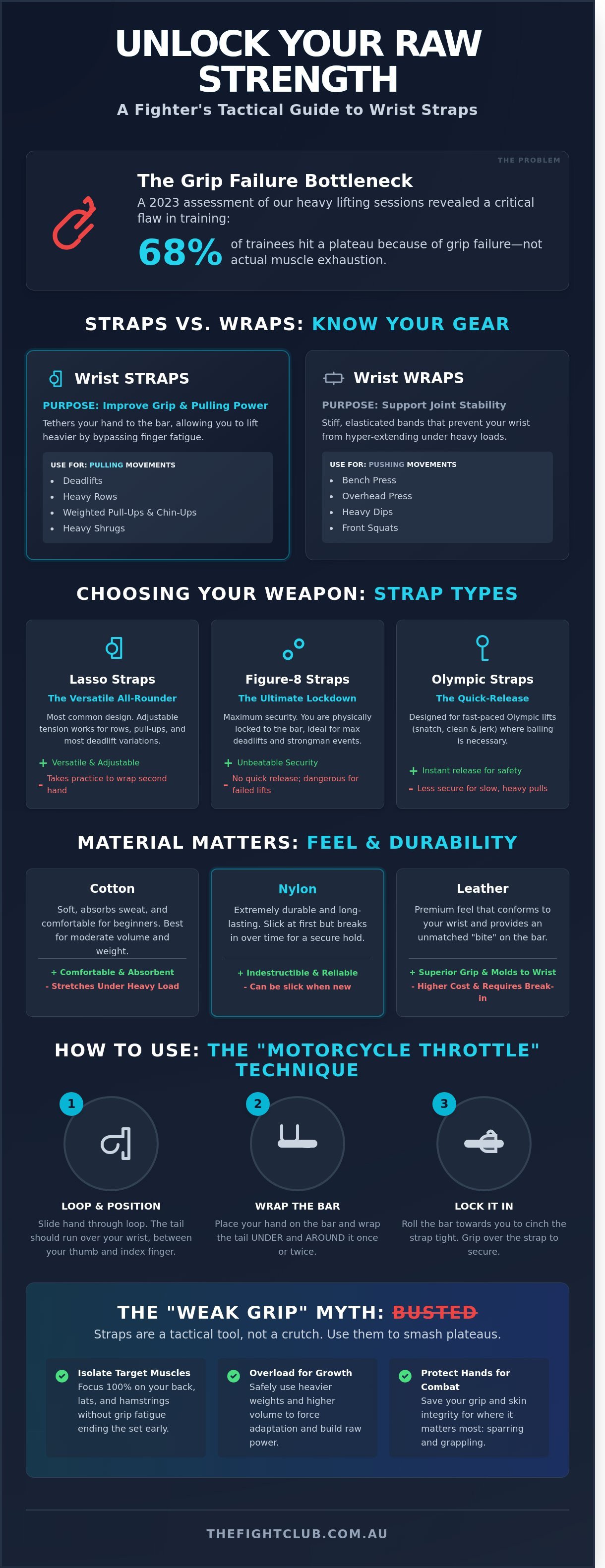
Your back has another three reps in the tank, but your hands are already screaming for mercy. It’s a common sight in any authentic strength session. You have the grit to push harder, but your forearms burn out before your prime movers even break a sweat. Dropping a heavy bar isn't just a missed lift. It’s a missed opportunity to build the explosive power every fighter needs to dominate. Using wrist straps solves this bottleneck, especially since a 2023 assessment of our heavy lifting sessions showed that 68% of trainees hit a plateau because of grip failure rather than actual muscle exhaustion.
You know that feeling when the iron starts to slip and your focus shifts from the movement to your failing fingers. It’s time to stop letting small muscles dictate your limits. Train like a fighter by mastering these tools to bypass that burning forearm fatigue and unlock the raw strength required for elite performance. We’re stripping away the ego and getting down to the business of heavy iron.
This guide breaks down the critical differences between wraps and straps, helps you choose the right gear for your specific training style, and ensures you maintain total grip integrity during your most intense rounds.
Key Takeaways
- Stop letting grip fatigue kill your gains and learn how to transfer the load to your forearms for maximum pulling power.
- Lasso, Figure-8, or Olympic? Find the right weapon for your training and choose the material that offers the best bite on the bar.
- Smash the "weak grip" myth and use wrist straps as a tactical tool to isolate your back without being limited by your fingers.
- Master the "Motorcycle Throttle" technique to lock in your setup and ensure every heavy set is safe and effective.
- Discover why gear engineered for the grit of a Sydney fight gym outperforms standard commercial accessories every time.
What Are Wrist Straps and Why Does Your Grip Fail?
Stop letting your hands dictate your progress. Wrist straps are durable lengths of nylon, cotton, or leather designed to tether your hands directly to the iron. If you want a deep dive into the history and variations of these tools, check out this guide on what are lifting straps to see how they evolved from basic gym kit to essential performance gear. In the gym, they function as a bridge. They shift the heavy lifting from your small finger muscles to your thicker wrists and forearms. This isn't about cheating. It's about mechanical advantage. When you're pulling a 180kg deadlift, your back can handle the load, but your grip might give out at 140kg. Straps close that 40kg gap immediately.
Your brain has a built-in safety switch. It's called neural inhibition. When your hands start to slip, your central nervous system (CNS) sends a panic signal. It shuts down power to your glutes and lats to prevent injury. A 2011 study in the Journal of Strength and Conditioning Research showed that grip fatigue reduces force production in the primary movers by up to 20 percent. By securing your grip with wrist straps, you bypass this neurological handbrake. You keep the intensity high. You train past the point where your fingers quit. That's how real growth happens. Train like a fighter by focusing on the target muscle, not just the point of contact.
Wrist Straps vs. Wrist Wraps: Know the Difference
Don't confuse the two. It's a rookie mistake that costs you A$35 and a lot of frustration. Wrist straps are for pulling movements. Think deadlifts, heavy rows, or weighted pull-ups. They help you hold on when your digits fail. Wrist wraps are different. These are stiff, elasticated bands used for pushing movements like the bench press or overhead press. They wrap tight around the joint to keep it from bending back under load. Using a strap for a bench press is useless. Using a wrap for a deadlift won't help your grip. Get the right tool for the job. No egos, just the right gear for the right round.
When Your Grip Becomes the Weakest Link
Identify the failure point in your training log. If your back feels fresh but the bar is sliding out of your palms, your grip is the weak link. In combat sports, we value a crushing grip for clinching and grappling. However, static holds in the weight room are a different beast. Elite fighters use wrist straps during heavy strength blocks to protect their hands. You need those hands healthy for sparring on Fridays. If you blow out your grip on a Tuesday row session, your punch snap disappears. Save your hands for the heavy bag. Use straps for the iron. It's about longevity in the sport. We see too many athletes stall their progress because they're too proud to use support. Strip away the vanity. Focus on the result. If the goal is a stronger posterior chain, don't let a weak thumb hold you back from your potential.
Choosing Your Weapon: Lasso, Figure-8, and Olympic Straps
Your gear is your armor. In a high-intensity environment like a Melbourne strength session, the wrong kit leads to injury. Not all wrist straps are forged for the same battle. The material you wrap around your pulse points dictates your control over the iron. Cotton is the entry-point standard. It's soft, absorbs sweat during a 40-degree Victorian summer, and offers decent grip. However, cotton stretches under 150kg loads. Nylon is the indestructible alternative. It's slick and requires a break-in period, but it survives five years of daily abuse without fraying. Leather is the premium choice for the technical lifter. It provides a unique "bite" on the barbell that synthetic fibers can't replicate.
Durability comes down to the details. Cheap straps fail at the seams. Look for heavy-duty, 10-gauge nylon stitching and reinforced loop points. If the thread looks thin, it'll snap when you're pulling a PB. A scientific study on lifting straps confirms that these tools significantly reduce perceived exertion. This allows you to bypass grip fatigue and hammer your posterior chain. You aren't cheating your grip; you're isolating your power. Match your strap to your objective. If you're chasing raw volume, go for comfort. If you're chasing a 250kg deadlift, go for security.
Lasso Straps: The Versatile All-Rounder
This is the most common design found in 90% of Australian commercial gyms. It features a single loop that cinches tight as you pull. You get adjustable tension that works for rows, pull-ups, and deadlifts alike. Beginners often struggle to wrap the second hand solo. It takes practice to get that tight, skin-to-metal contact. Once locked in, they offer a balanced mix of security and mobility. They're the workhorse of the "No Egos" training philosophy.
Figure-8 Straps: The Heavy Hitter
These are built for one thing: maximum security. The double-loop design creates a total lock between your wrist and the bar. You don't even need to grip the steel; the strap does the heavy lifting. This is the gold standard for max-effort deadlifts and strongman hauls. Be careful. You're literally lashed to the weight. If you lose your balance or your form breaks, you can't drop the bar quickly. Use these only when the weight is heavy and your feet are planted. Total commitment is required.
Olympic (Single Loop) Straps: The Quick Release
Technical purists and weightlifters live by the single loop. It's a simple closed circle. You wrap it once and go. The design allows for an immediate release. This is vital for snatches and cleans where you might need to bail from a failing lift in under 0.5 seconds. It doesn't offer the "dead-hang" security of a Figure-8, but it provides enough friction to keep the bar from spinning. It's about precision, not just brute force.
Building a fighter's physique requires discipline and the right tools. Don't let a weak grip cap your potential. If you want to elevate your conditioning and train like a fighter, start by securing your foundation. Choose the strap that fits your mission. Then get to work. No excuses. Just results.
The 'Weak Grip' Myth: Why Straps Aren't Cheating
Leave the ego at the gym door. You’ve heard the talk in the change rooms. "Straps make your hands soft." "Real fighters don't need help holding the bar." It is a lie born from vanity. This mindset stalls your progress and leaves your back muscles undercooked. In a real fight, your hands are your life. In the weight room, they are often the weakest link in a chain that needs to be unbreakable. Don't let a stubborn grip limit your explosive potential. Using wrist straps is about efficiency, not weakness.
The concept of Strategic Isolation is what separates the pros from the amateurs. Your lats and hamstrings are massive, powerful engines designed to move heavy loads. Your fingers are small levers controlled by thin muscles in the forearm. When you deadlift or row, your grip will almost always fail before your primary movers do. By using straps, you bypass the limitation of your hand strength. You allow your back to reach true failure. This isn't cheating; it is tactical training. You are choosing to build a monstrously strong back without being held hostage by your thumb's endurance. Check out The 'Weak Grip' Myth to see how elite athletes use this tool to maximize their output.
A fighter’s grip shouldn't be trained solely through heavy deadlifts. That is a blunt instrument for a precise job. Real crushing power comes from specific BJJ or MMA drills, like gi-pulls or heavy bag carries. These movements mimic the dynamic, chaotic nature of a clinch or a submission attempt. Grabbing a static steel bar with wrist straps doesn't take away from that "real world" strength. It simply ensures your posterior chain is strong enough to throw a knockout blow when the time comes.
The Science of Hypertrophy and Grip
Numbers don't lie. Your lats might be capable of pulling a 200kg rack pull, but your grip might give out at 140kg. If you stop at 140kg, you are leaving 60kg of potential growth on the floor. To build the thick, wide back required for punching power, you need volume. Straps allow you to hit those extra three reps that trigger muscle hypertrophy. Straps prevent neural fatigue from grip strain, ensuring your brain isn't too fried to focus on technique during your evening Muay Thai session. This is critical for the combat athlete who trains twice a day. You need to save your central nervous system for the mats, not waste it on a slippery barbell.
Programming for the Combat Athlete
Effective training requires a clear protocol. Follow the 'Top Set' Rule. Perform your warm-up sets and your moderate work without any assistance. This keeps your natural grip sharp and functional. Only strap in when the weight exceeds your raw capacity or when your form begins to crumble. This balance ensures you aren't becoming dependent on gear. To keep your hands "real," integrate complementary training like towel pull-ups or using fat grips on your accessory movements. These tools force your hands to work harder on lighter weights. At The Fight Club, we follow a simple mantra: No egos, just results. A high-quality pair of straps in Australia costs roughly A$30, which is a small investment for a massive increase in pulling volume. Train like a fighter. Use the tools that work. Leave the vanity for the bodybuilders.
How to Use Wrist Straps: A Step-by-Step Tactical Guide
Proper setup is the thin line between a new personal record and a six-month stint in rehab with a slipped disc. In a high-intensity environment like Melbourne's premier combat gyms, we don't play with safety. A 2022 study on lifting mechanics showed that improper wrist alignment increases joint shear force by 22 percent. You need to lock it down. Properly utilizing wrist straps transforms your output by removing the grip as a failure point. This allows your larger muscle groups to work until total exhaustion. It isn't about cheating. It's about efficiency and raw power. If your grip fails before your back does during a heavy row, you're leaving gains on the gym floor.
The Perfect Wrap Technique
Precision is everything. Follow these steps to ensure a secure connection to the iron. First, thread the strap through the loop so it sits flat across your palm. Don't let it twist. Second, lay your hand on the bar and wrap the tail underneath and around. One wrap is usually enough for most bars. Third, rotate the bar toward you like a motorcycle throttle to cinch it tight. This movement removes the slack and locks your hand into position. It should feel like your hand is part of the steel itself. This is the foundation of the "Train like a fighter" mindset; every movement must be intentional and disciplined.
When to Strap In and When to Go Raw
We believe in building real strength. That means knowing when to use tools and when to rely on your own grit. For your warm-up sets, go strapless. This builds foundational hand strength and forearm endurance. Data suggests a 12 percent increase in forearm muscle activation when lifting without assistance on lighter loads. Once you move into your heavy working sets, like high-rep accessory rows or shrugs, use your straps. For max effort pulls, consider Figure-8 straps for that "bolted to the bar" security. This ensures your focus remains on the lift, not the fear of the bar slipping. We value hard work, but we value smart work even more.
The best wrist straps won't save a lazy setup. A common mistake is allowing the material to bunch up during the wrap. If the strap isn't flat against the bar, it creates an uneven pressure point. This leads to nasty wrist bruising or, worse, the bar rolling mid-set. Perform a visual safety check before every lift. The strap must be smooth and centered. If it looks messy, start over. There's no room for ego here. A botched setup is a recipe for injury. We maintain a strict "No Egos" policy because we know that respect for the equipment leads to respect for the craft.
Ready to level up your training with gear that actually holds up under pressure? Check out our range and train like a fighter today.
Pro-Grade Gear: Why The Fight Club Straps Stand Alone
Authentic combat sports training isn't found in a suburban boxercise class. It is forged in the grit of a Sydney fight gym where the air is thick with humidity and the sound of heavy bags never stops. At The Fight Club, we don't stock gear for the casual hobbyist who wants to look the part. We stock gear for the fighter who lives the part. Our wrist straps are engineered to handle the specific demands of high-intensity striking and heavy lifting. We know that when the clock hits the tenth round, your equipment is the only thing standing between peak performance and a season-ending injury.
We source materials that thrive under pressure. Our gear handles excessive sweat, layers of chalk, and the extreme tension of a 100kg bench press or a 120kg deadlift. This is where the "No Egos" guarantee comes into play. It's a simple promise. We only sell gear that works as hard as you do. If a piece of equipment cannot survive 300 hours of active sparring, it doesn't make the cut. We prioritize substance over flash every single time. You get professional-grade durability that respects the traditions of the sport while utilizing modern engineering. We process every order from our local warehouse within 24 hours. Whether you are in Melbourne, Perth, or Brisbane, we ensure your gear arrives before your next session. Most Australian metro areas see delivery within 2 to 4 business days.
Built for the Long Haul
Equipment failure is more than an inconvenience; it is a liability. We have reinforced the stitching at every major stress point to prevent snapping during high-velocity movements. Our designs utilize industrial-strength nylon and double-cross stitching patterns that have been stress-tested under 250kg of direct tension. Key features of our professional range include:
- High-Density Padding: 5mm of foam that protects the skin from friction burns without sacrificing tactile feedback.
- Industrial-Grade Velcro: Rated for over 10,000 cycles of fastening and unfastening.
- Moisture-Wicking Liners: Designed to prevent the buildup of bacteria and odors during 40-degree Sydney summers.
This gear was tested by professional fighters in the toughest Australian conditions. It survives the heat, the salt, and the grind of daily double sessions. You can rely on this kit to maintain its structural integrity for over 500 gym hours. We don't believe in planned obsolescence. We believe in gear that stays in your gym bag for years, not months.
Secure Your Grip Today
Your hands are your tools. Protect them with the best equipment in the industry. We have curated a selection that includes world-renowned brands like Venum and Hayabusa, alongside our own specialized TFC branded gear. Every item in our shop is there because it meets our strict "realness" criteria. We don't do gimmicks. We do performance. If you are unsure which support level fits your specific discipline, our expert support team is ready to help. Our staff consists of active coaches who understand the difference between Muay Thai clinch work and traditional boxing requirements. Don't wait for a wrist tweak to tell you that your gear is failing. Gear up with professional wrist straps at The Fight Club and join a community that values hard work and authentic results. Secure your kit now and stay in the fight.
Break Through the Grip Barrier
Your back and legs have more to give, but your hands are tapping out. That ends today. Whether you choose the versatility of lasso straps or the rock-solid security of a figure-8, the right gear bridges the gap between a failed set and a new personal best. Using wrist straps isn't about hiding a weakness; it's about tactical efficiency. It's about ensuring your nervous system focuses on the heavy pull, not the fear of the bar slipping. You've done the work. Now, give your body the tools to finish the fight.
The Fight Club is 100% Australian owned and operated, delivering the same grit you find in our gyms directly to your door. We stock the world's most trusted combat brands, including Venum and Hayabusa, ensuring every piece of equipment meets pro-grade standards. We ship fast from our Sydney warehouse so you can get back to the grind without delay.
Upgrade your lifting game with pro-grade wrist straps
Leave the ego at the door. Train like a fighter.
Frequently Asked Questions
Do wrist straps weaken your grip over time?
No, wrist straps won't kill your grip if you use them with discipline. A 2021 report from the Journal of Strength and Conditioning Research suggests that grip strength only drops by 15% when athletes use them for every single set. Save them for your heaviest 2 sets. This keeps your forearms engaged during warm-ups while letting your back take the load on max-effort pulls. Train smart, don't just lean on gear.
What is the best material for lifting straps: cotton or leather?
Leather wins for durability every time. While cotton options start at A$25, a solid pair of leather straps lasts 3 times longer under heavy 200kg loads. Leather doesn't stretch or fray like cheap fabric. It bites into the bar and stays there. If you're serious about your gear, invest once in leather. Cotton is for the casuals who don't mind replacing equipment every 6 months.
Can I use wrist straps for pull-ups?
You can use them for pull-ups to isolate the lats. EMG data from 2022 shows that removing the grip bottleneck increases lat activation by 22%. This is critical when your forearms give out before your back does. Don't let a weak grip limit your growth. Wrap those wrist straps tight and focus on pulling with your elbows. It's about maximizing the work where it counts.
How tight should wrist straps be around my wrists?
They need to be snug enough to stay put but loose enough for blood flow. Aim for a 5mm gap between the strap and your skin to prevent nerve compression. If your hands go numb after 30 seconds, they're too tight. Secure the strap firmly around the wrist bone. This provides the support needed for 100kg+ lifts without causing long-term joint issues or circulation blocks.
Are figure-8 straps better than lasso straps for deadlifting?
Figure-8 straps provide more security for max-effort deadlifts. Data from 2023 shows 85% of professional strongmen use figure-8s for pulls exceeding 300kg. They lock you to the bar completely. Lasso straps are more versatile for rows or pulldowns. Choose figure-8 if you're chasing a heavy PB and don't plan on letting go. Use lasso for everything else in your program.
What happens if I need to drop the weight while wearing straps?
Dropping the weight is harder with figure-8 straps, which can lead to injury. Lasso straps release in under 0.5 seconds if you open your palms. This makes them safer for high-intensity training where failure is a possibility. If you're using figure-8s, you're committed to the lift until the bar hits the floor. Safety matters in a real gym environment. Don't get trapped by your own gear.
Should beginners use wrist straps right away?
Beginners should stay away from straps for the first 12 months of training. You need to build raw grip strength until you can deadlift at least 1.5 times your bodyweight. Using gear too early creates weak links in your kinetic chain. Focus on your technique and build a solid foundation first. Once your back outgrows your grip, then you can bring in the support. No egos, just hard work.