

The Ultimate Rash Guard Guide: Protect Your Skin and Train Like a Fighter
You are midway through a three-minute round at a Sydney gym, sweat stinging your eyes, when you feel it. It is the raw, burning friction of the mat against your neck. By the time you hit the showers, that small abrasion is an open invitation for a A$185 trip to the GP for staph treatment. A low-quality rash guard isn't just a bad look; it is a direct threat to your training consistency and your skin health.
We know the drill. You want to push your limits without worrying about ringworm or gear that rides up your ribs during a heavy roll. You deserve equipment that works as hard as you do. This guide delivers the technical specs, hygiene benefits, and performance secrets you need to dominate the mats in 2026. We are stripping away the fluff to focus on skin protection, muscle recovery, and durability that survives a full season of hard sparring. It is time to drop the ego, gear up properly, and train like a fighter.
Key Takeaways
- Shield your skin. Learn why technical compression is non-negotiable for blocking bacteria and preventing mat burn.
- Master the specs. Identify the 80/20 fabric ratio and GSM thickness that separates a pro rash guard from cheap gym wear.
- Forget the surf shop. Understand the engineering differences between ocean gear and the high-tension fabric required for the cage.
- Kill the funk. Follow the fighter’s maintenance protocol to protect your investment and keep your kit in peak condition.
- Gear up for 2026. Explore the elite Venum and Hayabusa picks designed for maximum recovery and uncompromising durability.
What is a Rash Guard and Why is it Non-Negotiable for Combat?
Step onto the mats at any serious Melbourne gym and you will see it immediately. The rash guard is the uniform of the disciplined. It is a specialized, high-performance compression garment engineered specifically for the high-friction environment of Brazilian Jiu-Jitsu and MMA. If you are wondering what is a rash guard exactly, think of it as a technical layer designed to survive 100 rounds of intense sparring. It isn't a fashion statement. It is a piece of essential safety equipment. In 2024, over 85% of competitive BJJ athletes in Australia prioritize gear that offers both physical and biological protection. Showing up to a session in a baggy cotton T-shirt isn't just a style error; it's a safety hazard. Loose fabric catches fingers and toes. It leads to snapped tendons and preventable breaks. We maintain a strict "No Egos" policy. That means respecting the craft and the safety of your training partners. Investing A$80 to A$120 in a professional garment is a small price for long-term health. By 2026, the industry is shifting toward eco-friendly, recycled high-density polymers that offer 25% more tensile strength than traditional spandex blends. This is the future of combat. Train like a fighter. Gear up like one.
The Shield Against Mat Burn and Abrasions
Grappling is a game of inches and intense friction. When two bodies collide at high velocity, the heat generated by skin hitting the mat can reach temperatures high enough to cause instant abrasions. We call it mat burn. It's a literal tear in your skin. A quality rash guard acts as a second skin. It reduces drag and allows you to slide through transitions without leaving your epidermis on the floor. Focus on the high-wear zones. Your elbows, shoulders, and the back of your neck take the most punishment during a double-leg takedown or a tight clinch. The compression fit keeps your joints warm and supported. It prevents the "mat drag" that slows your movement. You need gear that moves with you, not against you. These garments are tested to withstand 500+ Newtons of force, ensuring they don't rip when the pressure is on. This is about grit and resilience. Protect your body so you can show up for the next round.
Biological Defense: Staph, Ringworm, and Hygiene
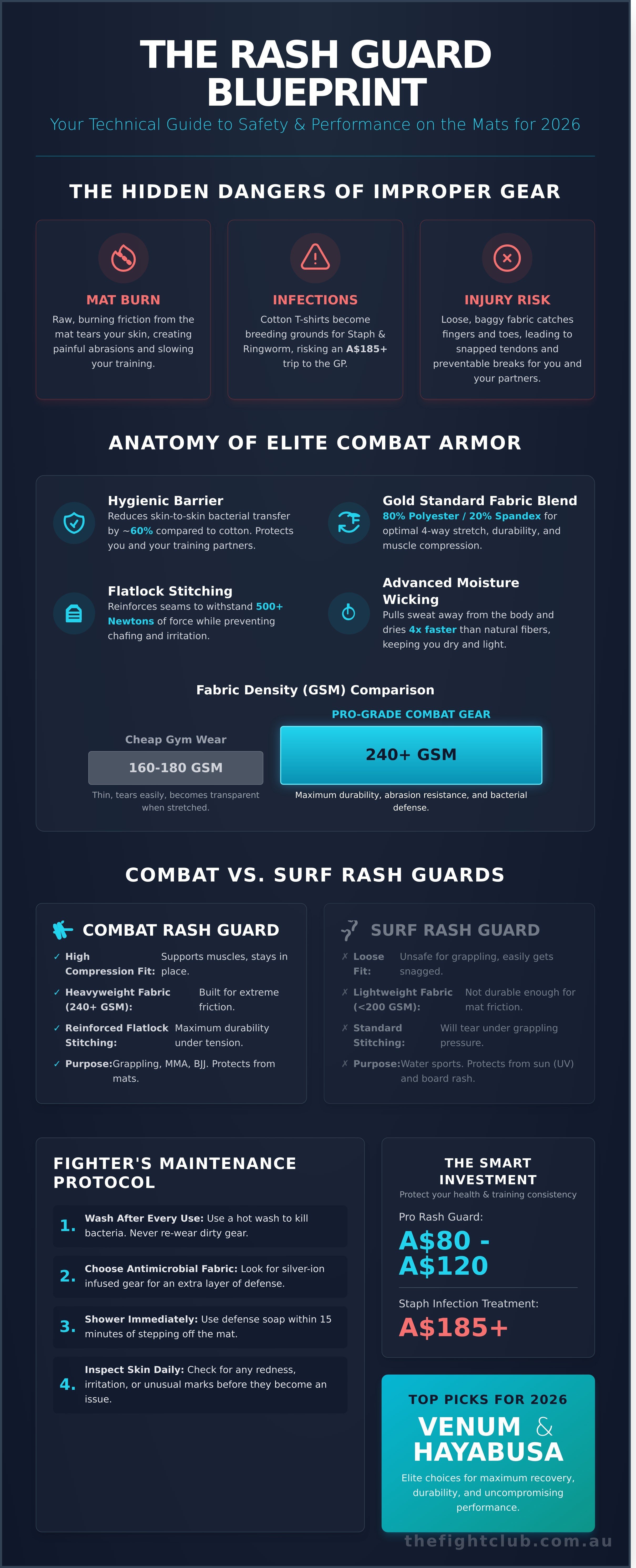
The mats are a battlefield, but the real enemy is often invisible. Cotton is a sponge for bacteria. It holds moisture, stays heavy, and becomes a breeding ground for infections like Staph and Ringworm. Research from 2023 shows that synthetic compression gear reduces the risk of skin-to-skin bacterial transfer by approximately 60% compared to traditional athletic wear. The tight weave of high-density polymers creates a physical barrier. It stops pathogens from finding a home in your pores. Hygiene is respect. You owe it to your team to stay clean. Synthetic fibers pull sweat away from your body and dry 4 times faster than natural fibers. Moisture-wicking technology ensures your gear doesn't become a saturated petri dish that compromises the health of the entire gym. Don't be the person who brings a staph infection into the family. Buy the right gear. Protect the tribe. Follow these hygiene standards to keep the mats safe:
- Wear a clean rash guard every session: Never reuse gear without a hot wash.
- Choose antimicrobial treatments: Look for silver-ion infused fabrics.
- Shower immediately: Use defense soap within 15 minutes of stepping off the mat.
- Inspect your skin: Check for redness or circular patterns daily.
Real combat requires real preparation. If you aren't protected, you aren't ready. This is the foundation of your BJJ journey.
Anatomy of a Pro-Grade Rash Guard: Technical Specs That Matter
Your gear is your armor. In the high-pressure environment of a BJJ roll, a standard t-shirt is a liability. It holds moisture, stretches out, and tears. A professional rash guard is engineered to survive the grind. The industry gold standard for 2026 remains the 80/20 Polyester-Spandex blend. This specific ratio provides the necessary 4-way stretch to handle explosive movements while maintaining enough tension to compress the muscles. This compression reduces small muscle vibrations and helps prevent the "pump" that can kill your grip strength mid-round.
Durability is measured in GSM, or Grams per Square Meter. Cheap department store gear usually sits around 160 to 180 GSM. It feels thin because it is thin. For daily training, you need heavyweight fabric. Look for a GSM of 240 or higher. This density ensures the material won't become transparent when stretched or pill after ten sessions on the mats. High-density fabrics also provide better defense against mat-borne bacteria. They act as a tighter barrier between your skin and the environment. This technical construction is similar to the standards found in high-performance sun-protective clothing, offering a layer of defense that lightweight alternatives simply cannot match.
The "Ride-Up" is a common distraction that breaks your focus. You're fighting for a cross-face, not tugging at your hem. Pro-grade gear solves this with two features: an elongated torso cut and a silicone waistband. A 2.5cm internal silicone strip grips your fight shorts or spats. It keeps the rash guard locked in place during inverted guards or heavy scrambles. If a brand skips the silicone, they're cutting corners on your performance.
Flatlock Stitching vs. Standard Seams
Standard overlock seams create a ridge. Under the weight of a 100kg training partner, that ridge becomes a blade. It chafes and causes "mat burn" across your shoulders and lats. Pro gear utilizes the 6-thread flatlock stitch. This method joins two pieces of fabric edge-to-edge without overlapping. The result is a seam that lies perfectly flat against your skin. It is virtually unbreakable under the tension of a double-leg takedown. This level of comfort is vital when using a rashie as a base layer, as we explain in our BJJ Gi Guide for under-gi protection.
Sublimated Prints: Why Your Graphics Should Never Peel
Screen printing is for band shirts, not fightwear. Ink sitting on top of the fabric eventually cracks, peels, and scratches your training partners. Premium brands like Venum and Hayabusa pioneered the use of sublimation. This process uses heat to turn ink into gas, which then bonds with the polyester fibers. The design becomes part of the fabric itself. It won't fade or peel, no matter how much you sweat. It also keeps the material breathable. The pores of the fabric remain open instead of being clogged by a layer of plastic ink.
In the Australian market, the price gap reflects this tech. You might find a generic top for A$35, but a pro-grade investment usually sits between A$85 and A$110. The cheaper option will lose its shape within 3 months of hard training. The investment gear will last years. When you're ready to test your gear in a real environment, come find your limit at The Fight Club. Choose quality. Train without distractions. Focus on the technique, not your equipment.
Combat Rash Guards vs. Surf Rashies: Know the Difference
Don't make the rookie mistake of grabbing a cheap surf shop "rashie" for your first BJJ class. It's a different beast entirely. Surfing gear is built for the ocean; combat gear is built for the grind. A surf shirt protects you from UV rays and board wax. It's designed for linear movement. A rash guard for grappling is engineered to survive 100kg of pressure and constant shearing force. When you're stuck in a tight side control, that surf gear will stretch, bunch, and eventually fail.
The "Transparency Test" is where cheap gear dies. Most surf shirts use thin, lightweight polyester. Once you hit the 20-minute mark in a humid Melbourne gym, you'll be drenched in sweat. That thin fabric becomes a window. It turns transparent, loses its shape, and clings to your partner in a way that's uncomfortable for everyone. Professional combat gear uses a higher thread count and opaque blends. It keeps your dignity intact while you're fighting for a sweep. It stays thick, stays dark, and stays in place.
Look at the construction of the sleeves. Combat gear utilizes a Raglan sleeve. This diagonal seam runs from the underarm straight to the collarbone. It's a mandatory feature for overhead mobility. You need to reach for underhooks or defend armbars without the fabric pulling at your shoulders. Surf gear often uses a standard T-shirt cut. In a live roll, that traditional seam will restrict your movement or dig into your skin. Real fighters need gear that moves like a second skin, not a straightjacket.
Durability and Tensile Strength
A surfboard leash applies linear tension, but a collar tie applies 80kg of sudden, violent torque. Combat gear features a weave density of 300 GSM (grams per square metre) or higher. This prevents the fabric from over-stretching or tearing during heavy sparring. Most surf gear lacks the triple-stitched flatlock seams required for grappling. Without this reinforcement, your seams will pop during the first heavy scramble. Check out our MMA Gear Essentials for the full kit breakdown. Professional gear provides the benefits of compression garments by supporting major muscle groups and reducing the vibration that leads to muscle fatigue.
The IBJJF Factor: Competition Legal Requirements
If you plan to step onto the competition mats in 2024, "looking cool" takes a backseat to the rulebook. The International Brazilian Jiu-Jitsu Federation (IBJJF) enforces a strict 10% color rule for No-Gi divisions. Your rash guard must display the color of your current belt rank. A blue belt cannot wear a red-themed shirt. It's about clarity for the referees and respect for the hierarchy. Don't waste A$90 on a flashy design only to be disqualified at the bullpen. Buy for the rank you've earned. Focus on the technique, not the vanity. At The Fight Club, we value the work over the wardrobe. Wear the right gear, show up, and let your game do the talking. No egos, just results.
The Fighter’s Maintenance Protocol: Making Your Gear Last
You finished the final round. You're drenched. Your lungs are burning. The temptation to toss your kit into the boot of the car and forget it until tomorrow is real. Don't do it. The gym bag is a graveyard for performance gear. A damp rash guard trapped in a dark, unventilated space becomes a breeding ground for microbes. Bacteria like Staphylococcus aureus can double every 20 minutes in these humid conditions. If you leave your gear overnight, you aren't just dealing with a smell; you're inviting skin infections to your next roll. Get it out of the bag the moment you get home. No excuses.
Washing is where most fighters fail. Treat your gear with the same discipline you bring to the mats. Use cold water only, ideally under 30 degrees Celsius. High temperatures break down the synthetic bonds in the polyester-spandex blend. Turn the garment inside out before it hits the machine. This simple move protects the sublimated graphics from friction and prevents the "cracking" look common in cheap gear. Never use bleach. It is a corrosive agent that eats through the elastic fibers, turning your tight compression top into a loose, shapeless rag within 5 washes.
The dryer is the number one killer of elasticity. It is a heat trap that melts the micro-strands of spandex. A single high-heat cycle can reduce the "snap" of your gear by 15% instantly. Hang your kit up. Let the air do the work. If you want your gear to survive a year of heavy sparring, keep it away from the tumble dryer entirely. Professional maintenance isn't about being precious; it's about making sure your equipment performs when the pressure is on.
Sometimes, standard detergent isn't enough to kill the "permastink." This happens when body oils and sweat become trapped in the tight weave of the fabric. Biofilm builds up, creating a scent that returns the moment you start to sweat. Fight back with a cup of white distilled vinegar in the rinse cycle. The acetic acid breaks down the oils without damaging the kit. For heavy-duty sessions, use a specialized combat sports detergent. These formulas are designed to target the specific bacteria found on BJJ mats, ensuring your gear stays as clean as your technique.
Post-Training Decontamination
Step off the mat and head straight to the sink. Give your gear an immediate cold rinse to flush out 70% of the salt and surface sweat before the deep wash happens. This prevents salt crystals from drying and abrading the fibers. If you train 4 or more days a week, you need at least three sets of gear in your rotation to allow for proper drying times and fiber recovery. Fabric softeners coat the fibers in a waxy film that kills the moisture-wicking technology.
Storage and Inspection
Check your gear weekly for pilling or micro-tears. If you see "fuzz" on the surface, your gear is rubbing against harsh Velcro or unfiled toenails. When air-drying in Australia, avoid direct Sydney sun; UV levels topping 11 will bake the life out of synthetic fabrics and make them brittle. Retire the gear when the compression dies. If the waist or cuffs don't snap back to their original shape after a stretch, the structural integrity is gone. It's time to upgrade your training kit and get back to work.
Train Like a Fighter: Top Rash Guard Picks for 2026
The mats don't lie. Your gear shouldn't either. In 2026, the gap between professional equipment and entry-level kits has widened. You need a rash guard that survives the grind of a five-round shark tank without losing its shape or its grip. We’ve curated the top picks that balance raw durability with the technical precision required for elite performance.
Venum’s Pro Line remains the undisputed heavyweight champion of aesthetics and function. Since the 2024 UFC kit overhaul, Venum has refined its dry-tech integration to handle extreme perspiration levels. These pieces utilize a 4-way stretch fabric that mirrors your natural range of motion. You get the authentic walkout feel combined with reinforced flatlock stitching that prevents chafing during high-intensity scrambles. It’s gear built for the Octagon but optimized for your daily sessions at the gym.
If you prioritize technical recovery, Hayabusa is the definitive choice. Their 2026 collection features advanced AG compression technology. This specific fabric blend is engineered to improve blood circulation and reduce muscle oscillation by 12% during explosive movements. This isn't just about looking sharp; it’s about tactical muscle support. Hayabusa’s fabric also includes an anti-microbial treatment that lasts for over 100 wash cycles. It provides a consistent barrier against the bacteria found on shared mats.
Beyond the combat-specific brands, athletes often turn to leaders in compression technology for their base layers. Brands like 2XU, for instance, are renowned for their advanced fabrics and engineering that supports muscle recovery and performance across various disciplines, making their gear a solid choice for under-gi wear or no-gi training.
For those who value local Sydney grit, The Fight Club’s own 'No Egos' collection is the gold standard. We designed this range with a heavy-duty 220 GSM polyester and spandex blend. Most commercial brands stop at 180 GSM. Our gear is thicker, tougher, and built for the Australian climate. It’s a no-nonsense kit for people who show up to work. There’s no flash, just high-performance gear that honours the discipline of the sport.
Best for No-Gi Grappling
Protection is your first line of defense in No-Gi. Long-sleeve options are the professional standard for maximizing skin coverage. This reduces the risk of staph infections and painful mat burns during deep half-guard entries. Look for brands featuring integrated silicone waistbands. This 5mm grip strip ensures your gear stays locked in place while you work through complex transitions. If you're debating between different lower-body gear, check out our guide on BJJ Rash Guards vs Spats to complete your kit.
Best for MMA and Striking
Striking requires heat management. Short-sleeve picks allow for better heat dissipation during 30-minute heavy bag rounds or clinch work. The Venum x UFC collections are perfect here. They offer the breathability needed to keep your core temperature stable under the lights. These designs focus on shoulder mobility, ensuring your hooks and crosses aren't restricted by tight seams. Ready to upgrade your training rotation? Shop the full Rash Guard collection at The Fight Club and get the gear the pros use.
Don't settle for "boxercise" quality when you're doing real work. We stock the world's leading brands right here in Australia. Whether you're in Sydney, Melbourne, or Perth, we offer fast domestic shipping that gets your gear to your door in 2 to 4 business days. Stop making excuses for worn-out gear. Access premium brands, embrace the "No Egos" lifestyle, and start training like the fighter you intend to become. The fight is personal. Your gear should be professional.
Step Into the Cage with Zero Excuses
Your armor dictates your performance. A technical rash guard is a non-negotiable tool for skin protection and muscle recovery. You've learned the difference between professional combat gear and cheap alternatives. You know how to maintain your kit for hundreds of sessions. Now it's time to execute. We don't stock gear for the sake of fashion. We're a Sydney-based team delivering fast national shipping on equipment that actually works. We are proud authorized dealers for Venum, Hayabusa, and UFC. Every product we sell is tested by real fighters who value discipline over ego. We've cut the fluff so you can focus on the sweat. Grab your kit and get back to work.
Gear up and train like a fighter. Shop our 2026 Rash Guard collection now.
The mat is waiting. Respect the process and the results will follow.
BJJ Rash Guard Frequently Asked Questions
Can I wear a regular compression shirt for BJJ?
Avoid standard gym shirts for high-intensity grappling. While they look similar, a dedicated rash guard uses 200 to 300 GSM polyester blends and reinforced flatlock stitching to survive heavy sparring. Standard compression gear often tears during the first 10 minutes of a live roll. Invest in gear built for the grind. No shortcuts. No excuses.
Should I get a long sleeve or short sleeve rash guard?
Choose based on your environment and skin protection needs. Long sleeves provide 100% coverage against mat burn and skin infections like staph or ringworm. Short sleeves offer better heat regulation when the gym hits 30 degrees Celsius. Most fighters keep three of each in their kit bag to stay ready for any session. Train like a fighter and protect your skin.
How tight should a rash guard actually fit?
Your gear must fit like a second skin with zero loose fabric. If a training partner can grab a handful of material, it's too big. Loose fabric leads to 15% more finger injuries during clinches and scrambles. It should be snug enough to stay put but flexible enough to allow a full range of motion during a triangle choke. Tight gear equals safe rolling.
Do rash guards help with muscle recovery?
Compression technology improves blood flow and reduces muscle oscillation during explosive movements. Studies show targeted compression can increase oxygen delivery to muscles by 10% during a 60 minute session. This means less soreness the next morning. You recover faster. You train harder. That's how you win the long game and stay on the mats.
Why does my rash guard smell even after washing?
Synthetic fibers trap 95% of skin bacteria within the weave if not cleaned properly. Standard detergents often fail to reach deep into the fabric pores. Add 120ml of white vinegar to your wash to kill the funk. Never leave damp gear in your gym bag for more than 30 minutes. Sweat is earned; the smell is optional. Maintain your kit with discipline.
What is an IBJJF approved rash guard?
Competition gear must meet specific ranking requirements set by the International Brazilian Jiu-Jitsu Federation. At least 10% of the rash guard must match your current belt rank color. The rest should be black or white. Check the 2024 rulebook before you step on the scale. Show up prepared. Respect the standards of the game.
How often should I replace my training rash guard?
Replace your gear every 6 to 12 months if you train 3 times a week. Watch for pilling, thinning fabric, or compromised seams. Once the elasticity drops by 20%, the protection vanishes. We operate on a No Egos policy, but showing up in tattered, transparent gear is a sign of disrespect to your training partners. Keep your gear sharp.
Are more expensive rash guards actually better?
Quality costs more because it lasts longer under pressure. A premium A$95 option uses 4-way stretch fabric and sublimated prints that won't peel after 50 washes. Cheap A$30 alternatives usually lose their shape within 8 weeks of hard sparring. Pay for the durability now or pay for a replacement later. Real gear stands the test of time.