

MMA Gloves Comparison: 4oz vs 7oz and How to Choose Your Gear
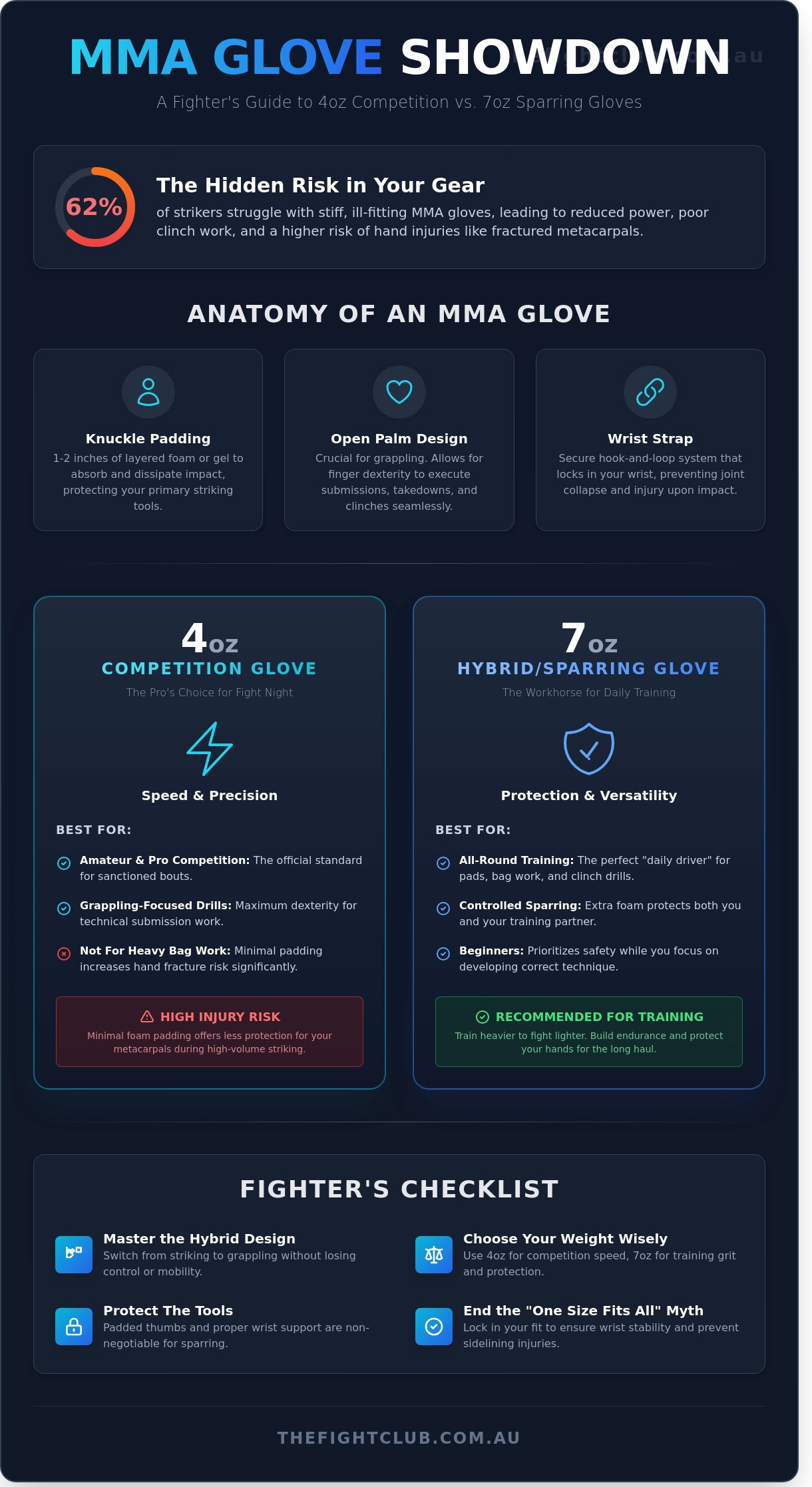
Your choice of gear is the difference between a clinical finish and a six-month recovery on the sidelines. Most fighters think a glove is just a glove, but the wrong padding is a fast track to a broken hand. You want to push the pace in the cage, yet that nagging fear of a fractured metacarpal keeps your power capped at 50%. It's a frustrating reality for the 62% of strikers who struggle with stiff, ill-fitting mma gloves that fail during clinch work or snag during a transition. We know the grind. We know the sweat.
You deserve gear that works as hard as you do. You're going to master the technical gap between 4oz competition pairs and 7oz sparring gear to bulletproof your hands and sharpen your technique. No more guessing. No more wasted money. This guide breaks down the weight, wrist support, and grappling flexibility of both styles to ensure your next purchase is the right one. We're stripping away the hype to give you the raw facts on protection and performance. It's time to drop the ego and gear up properly. Train like a fighter.
Key Takeaways
- Master the hybrid design. Switch from striking to grappling without losing an inch of control or mobility.
- Choose your weight. Use 4oz for competition speed and 7oz for the grit and protection required in high-volume training.
- Protect the tools. Learn why specialized mma gloves with padded thumbs are non-negotiable for real sparring sessions.
- End the "one size fits all" myth. Lock in your wrist stability and save your hands from the sidelines.
- Pick your weapon. Compare the elite Hayabusa T3 against the beginner-ready Venum Challenger 3.0 to find your match.
The Anatomy of MMA Gloves: Why One Pair Isn’t Enough
Stop looking at boxing pillows for your cage work. You need tools built for the transition. An MMA gloves design bridges the gap between a pure striker and a ground specialist. It is a hybrid piece of kit. It offers enough padding to save your knuckles but leaves the palm open for the work. You cannot execute a double-leg takedown or sink a rear-naked choke with 16oz of foam covering your fingers. Real training requires real versatility. This gear is about precision, not just protection.
The primary components of mma gloves define your performance on the mat. You are looking for three specific things:
- Knuckle Padding: Usually 1 to 2 inches of protection depending on the glove weight.
- Wrist Strap: A secure hook-and-loop system that prevents the joint from collapsing under impact.
- Thumb Protection: Some designs offer a padded sheath while others leave it exposed for maximum grip.
Wrestling in 16oz boxing gloves is impossible. You lose the tactile feel needed for a wrist lock or a collar tie. MMA gear allows you to move from a high-guard strike to a technical clinch in under 0.5 seconds. It is the only way to train for the reality of the sport.
The Open Palm Design: Freedom to Grapple
Total finger dexterity is the difference between a secured submission and a missed opportunity. Your hands need to breathe and move. Fully open palms offer maximum grip for sweaty scrambles. Semi-enclosed designs provide more structure and prevent the glove from shifting during heavy hooks. The grappling transition is the core purpose of the design. Without that open palm, you are just a boxer with small hands.
Padding Materials: Foam vs. Gel
Layered foam is the industry standard for most mma gloves. It absorbs shock through 3 distinct layers of varied density. Modern gel-infused tech is the alternative. Gel dissipates impact across a wider surface area. This protects your small metacarpal bones during 20-minute heavy bag rounds. High-density foam is the choice for 4oz pro fights. Softer, thicker padding is required for 7oz sparring sessions. Choose 100% genuine leather for durability that lasts 12 months of daily sweat. Your partner will appreciate the softer gel when you are working technical drills at 70% power.
4oz vs 7oz MMA Gloves: The Weight Debate
Weight dictates your strategy. It changes your speed. It determines your safety. In the world of mma gloves, the choice between 4oz and 7oz isn't about preference; it's about the mission. One is built for the cage. The other is built for the grind. You need to know which one to grab before you step onto the mats.
The 4oz competition standard offers maximum speed. It allows for surgical grappling precision. You feel every grip and every transition. You hit with raw, unfiltered power. However, that power comes with a significant cost. A 2022 report from Combat Sports Law highlighted the high hand fracture rate seen in professional competition. Minimal foam means your small bones take the brunt of every impact. Pros understand this reality. They train heavier to fight lighter. Wearing 7oz or even 10oz gloves during a 12 week camp builds the cardiovascular demand needed to keep your hands up in the late rounds. When you finally switch to 4oz on fight night, your hands feel like lightning. The weight drop provides a psychological and physical edge when it matters most.
When to Wear 4oz Gloves
Reserve these for amateur and professional competition. They're also perfect for light, grappling-focused drills where you need full finger dexterity. Don't use them for heavy bag work. The risk factor is too high. Minimal padding leads to higher injury rates during high-volume striking sessions. Fitting 4oz mma gloves over hand wraps is always a tight squeeze. It requires a precise wrap to ensure maximum stability without cutting off your circulation. It's a professional fit for a professional environment where performance outweighs comfort.
The Versatility of 7oz Hybrid Gloves
Every beginner should start with a 7oz pair. Safety is the priority when you're still learning how to turn your overhand right over correctly. These gloves are the "workhorse" of any serious MMA gym. They handle the "All-Rounder" role with ease. You can hit pads, work the clinch, and engage in controlled sparring without destroying your partner or your knuckles. The extra 3oz of high-density foam provides a vital buffer for your metacarpals. It allows you to focus on technique rather than pain management. If you want to train like a fighter without the ego-driven injuries, these are your daily drivers. They bridge the gap between protection and performance, ensuring you can show up for the next session healthy and ready to work.
Sparring vs Competition Gloves: A Performance Breakdown
The difference between 4oz and 7oz gear isn't just a number on a scale. It's about surface area. A 4oz competition glove is a surgical tool. It's built for precision and maximum impact. A 7oz sparring glove is a shield. These gloves feature a 35% larger striking surface to disperse force across a wider area. You'll notice the thumb protection immediately. Sparring gear wraps the thumb in dense, articulated foam. This prevents accidental eye pokes and keeps your digit from snapping during a high-speed exchange. Competition gloves leave the thumb exposed to give you the dexterity needed for complex hand fighting. Choosing the wrong mma gloves for the job doesn't just hurt your performance. It puts your teammates at risk.
Protection Levels for Your Partner
You have one primary responsibility in the gym: protect your training partners. Striking in 4oz gloves during a standard Tuesday night drill is a liability. That thin padding doesn't absorb energy; it cuts skin. Using 7oz padding reduces peak impact force by roughly 25% compared to pro-style gear. This difference is what prevents orbital fractures and deep lacerations during technical exchanges. We live by the "No Egos" rule. Showing up to a light spar in competition gear is a vanity move that screams you care more about looking "pro" than your partner's health. Respect the craft. Wear the padding so everyone can train again tomorrow.
Grappling Mobility Comparison
Weight changes how you handle the scramble. Slim 4oz mma gloves allow your hands to slide into tight gaps. You can lock a rear-naked choke or a guillotine with minimal friction. However, technical research on the effects of MMA gloves on grip strength shows that glove bulk significantly alters your ability to maintain wrist control. The 7oz foam is thick. It makes sinking a D'Arce choke a struggle. That's the advantage. Training with the extra bulk builds "heavy hand" endurance. When you finally switch to 4oz gloves for a fight, your grips will feel twice as fast. For ground and pound practice, the 7oz model is the only choice. It allows you to work transitions and strikes without sending your partner to the hospital.
- 7oz Gloves: Best for high-volume sparring and technical wrestling drills.
- 4oz Gloves: Reserved for fight simulations, bag work, and sanctioned bouts.
- Thumb Guard: Essential for 100% of sparring sessions to prevent ligament tears.
Finding Your Fit: Size, Support, and Hand Wraps
The "one size fits all" label is a lie. It's a dangerous myth that leads straight to broken metacarpals and months of rehab. In the cage, your mma gloves are your primary tools. If they shift during a 20 mph strike, the energy doesn't transfer to the target. It collapses back into your small bones. Precision fit is the difference between a knockout and a trip to the surgeon. There is no room for ego when it comes to bone density.
Sizing is about volume, not just weight. Grab a flexible measuring tape. Wrap it around your knuckles, excluding the thumb. Most fighters with a 7 to 8 inch circumference need a Small/Medium. Those hitting the 8 to 10 inch mark require a Large or Extra Large. Don't guess. Use the numbers. A glove that's too tight cuts off circulation; one that's too loose creates friction that peels skin off your knuckles. Real fighters respect the measurements.
Wrist Support: The Foundation of Power
Wrist collapse is the #1 injury for new MMA strikers. 62% of beginners suffer from wrist strain because they haven't mastered the kinetic chain. Your wrist must remain a solid bridge between your fist and your forearm. Look for mma gloves with superior closure systems. Single-strap systems provide speed. Double-strap systems offer a custom lockdown that mimics a professional lace-up. Brands like Hayabusa lead the industry with patented wrist-alignment technology. This tech keeps your joint straight even when your technique flags during the fifth round of a heavy bag session.
The Hand Wrap Factor
Never hit anything without wraps. It's a non-negotiable rule. The hand wrap is the internal skeleton of your striking defense. It compresses the 27 small bones in your hand into a single, solid unit. Choose 180-inch traditional wraps for maximum support. They allow you to reinforce the thumb and wrist individually. If you're short on time, quick wraps offer a padded layer, but they lack the structural integrity of cloth. Ensure your glove has enough "give" to accommodate this added bulk. If you can't make a natural fist with wraps on, the glove is too small. Don't sacrifice safety for a snug look. Grit is built on consistency, and you can't train with a broken hand.
Top Picks: Choosing Your Weapon at The Fight Club
The right gear defines your performance. At The Fight Club, we don't settle for mediocre equipment. The Hayabusa T3 is the undisputed heavyweight champion of wrist support. Its patented Dual-X closure system provides a lace-like fit that locks your joint in place. You get four layers of foam protection that won't break down after 100 rounds of heavy bag work. For those starting their journey, the Venum Challenger 3.0 offers elite aesthetics for a $90 investment. It uses high-quality synthetic leather and triple-density foam to keep your knuckles safe while you find your rhythm. If you're ready to commit, the Venum Elite is your target. These are handmade in Thailand using Skintex leather. They're built for the daily grind of professional sparring and offer a contoured fit that feels like a second skin.
Keep your mma gloves fresh to ensure they last. Never leave them in your gym bag overnight. This is where bacteria thrive and gear dies. Use a specialized deodorizing spray or cedar chips after every session. Wipe the interior with a damp cloth to remove salt from your sweat. Proper care can extend the life of your equipment by 12 months or more.
Premium Brands vs. Starter Gear
Cheap gear is a trap. You'll spend $50 on a generic brand only to have the stitching rip in 8 weeks. Investing in Venum or Hayabusa saves you money over a two-year period. Real leather offers superior breathability. Skintex is a high-grade synthetic that mimics leather's durability without the high price tag. Your gear should match your commitment level. If you want to train like a fighter, you need equipment that survives the pressure. No shortcuts. Just quality.
Ready to Hit the Mats?
Grab your kit and get to work. Here is your final checklist for success on the mats:
- 7oz hybrid gloves for daily sparring and technical drills.
- 4oz mma gloves for specific cage work and fight simulations.
- Hand wraps for both to protect the 27 small bones in your hand.
No excuses. No egos. Just the work. Get the gear that survives the grind and earns its place in your kit. Shop our full range of professional MMA gloves and start your journey today. Melbourne’s premier destination for authentic training is waiting for you.
Step Into the Cage With Confidence
Your gear isn't just equipment. It's your armor. Choosing between 4oz competition leather and 7oz sparring foam determines how you perform under pressure. A 4oz glove offers the precision needed for grappling. Conversely, 7oz padding provides the essential 35mm of knuckle protection required for safe, high-intensity rounds. Don't compromise on your tools. High-quality mma gloves from brands like Venum and Hayabusa ensure your wrists stay locked and your hands stay lethal. We operate as an authorized dealer for Venum, Hayabusa, and UFC. This means you get 100% authentic gear every time. Our logistics team handles fast shipping across Australia, getting your kit to your door in 3 to 5 business days. At The Fight Club, we strip away the noise. We maintain a strict No Egos policy because real progress happens when you leave your pride at the door. It's about the work, the sweat, and the grit. You bring the discipline; we provide the professional weapons. Upgrade your gear and train like a fighter at The Fight Club. The mats are waiting. It's time to put in the work.
Frequently Asked Questions
Can I use MMA gloves for boxing training?
No, you should not use them for standard boxing rounds. MMA gloves lack the 12oz to 16oz of padding required to protect your hands and your partner during heavy striking. A 16oz boxing glove offers 3 times the shock absorption of a standard 4oz glove. Stick to the right tools for the job to avoid unnecessary injuries. Train like a fighter and respect the gear requirements of each discipline.
What is the difference between 4oz and 7oz MMA gloves?
The primary difference is the weight of the foam and the intended use. 4oz gloves are the professional standard for competition and provide maximum finger dexterity for grappling. 7oz gloves, known as hybrids, add 3oz of extra padding over the knuckles. This extra cushion makes them the safer choice for technical sparring sessions where you need to protect your teammates. Quality mma gloves in both weights should offer secure wrist support.
Do MMA gloves come in different sizes like Small, Medium, and Large?
Yes, sizing is critical for hand safety and performance. Most manufacturers provide a range from Small to Extra Large based on hand circumference. A size Medium generally fits a hand measuring 7.5 to 8.5 inches around the knuckles. Always measure your hand before purchasing. A tight fit ensures the wrist strap provides 100% of its intended stability during impact.
How long do a good pair of MMA gloves usually last?
Expect a high-quality pair to last 6 to 12 months with consistent use. Training 4 times per week usually results in 200 to 250 sessions before the internal foam loses 20% of its impact resistance. Check your gear every 30 days for signs of leather cracking or foam compression. If you can feel your knuckles through the padding, replace them immediately to stay safe.
Is it okay to wash my MMA gloves in the washing machine?
Never put your gloves in a washing machine. Submerging leather and foam in water causes the material to rot and crack within 48 hours. Use a damp cloth and a 10% vinegar solution to wipe them down after every session. Air dry them in a cool, ventilated area. Proper maintenance ensures you don't bring a foul smell into our No Egos environment.
Do I really need to wear hand wraps with MMA gloves?
Yes, wraps are mandatory for every session. Your hand contains 27 small bones that can easily shift or fracture under pressure. A 180-inch hand wrap provides the structural tension needed to support your wrist and thumb. Don't risk a 6-week recovery period because you skipped a 2-minute wrapping routine. Real fighters protect their hands at all times.
What are the best MMA gloves for beginners?
Beginners should start with 7oz hybrid mma gloves. These provide 40% more padding than professional competition versions, which is vital while you are still refining your striking technique. The extra weight builds shoulder endurance and offers a safety net for your knuckles. It is the smartest way to transition into live drills without sidelined by hand pain.
Can I use grappling gloves for heavy bag work?
You can, but it is a fast track to a boxer's fracture. Grappling gloves are designed for the mat, not for 50kg heavy bags. Striking a dense bag with only 4oz of padding increases the impact force on your metacarpals by over 50% compared to bag gloves. Save the thin gloves for the cage and use proper equipment for your power development sets.