

How to Choose Boxing Glove Size: The Ultimate Fighter’s Guide (2026)
Your 16oz gloves are likely the only thing standing between a clean knockout and a broken metacarpal. It is a cold reality that roughly 40 percent of hand injuries in Australian amateur gyms stem from fighters wearing gear that simply does not fit. You know the frustration. You are standing in a pro shop, staring at rows of leather, wondering why a 12oz glove feels like a vice grip the moment you add hand wraps. You want protection, not a circulation cut-off. We have all been there, guessing between weight and physical dimensions while the timer for the next round screams in the background.
This guide is your corner man. We will show you exactly how to choose boxing glove size to ensure your gear fits like a second skin. You will master the science of glove sizing to protect your hands, sharpen your technique, and dominate every round. We are stripping away the fluff to cover specific "oz" requirements for sparring versus heavy bags, hand circumference measurements, and how to secure professional grade protection that survives the grit of daily training. No egos; just the technical truth on what you need to train like a fighter.
Key Takeaways
- Protect your weapons. Understand why proper impact distribution is the difference between a snug fit and a dangerous injury to your metacarpals.
- Master how to choose boxing glove size by decoding the standard 8oz to 20oz weight range used by Australian fighters.
- Ditch the guesswork. Learn the exact technique for measuring your hand circumference to ensure your gear feels like a second skin.
- Gear for the grind. Discover why matching your glove weight to your training style-from heavy bags to sparring-is non-negotiable for joint health.
- Find your brand. Compare the architecture of Hayabusa and Venum to secure the elite wrist support required for high-intensity rounds.
Why Boxing Glove Size is Your First Line of Defense
Your gloves aren't just accessories; they're your primary armor. In our Sydney gym, the "No Egos" policy starts before you even wrap your hands. It starts with the gear you choose. Selecting the wrong size isn't a minor mistake. It's a calculated risk that compromises your safety and the safety of your training partners. Learning how to choose boxing glove size is about understanding the physics of impact. A glove that's too small doesn't just feel tight. It restricts the natural alignment of your metacarpals. This compression prevents the padding from absorbing force correctly, sending the shock straight into your small hand bones instead of dispersing it across the foam layers.
Weight and size are often confused in the fight world. While "oz" refers to the weight of the padding, it also dictates the internal capacity of the hand compartment. A 16oz glove usually offers a larger internal pocket than a 10oz glove. This isn't just about comfort; it's about surface area. Larger gloves spread the force of a punch over a wider target. This protects your partner’s face during sparring and keeps your knuckles from bottoming out against the heavy bag. If you're hitting with "ego" in undersized gear, you're failing the community. Real discipline means wearing the right tool for the job. Understanding the Boxing glove overview is vital for anyone looking to transition from a casual fitness class to authentic combat training.
The Anatomy of a Properly Fitted Glove
A perfect fit feels like a firm handshake. Your fingertips should just graze the end of the finger pocket without being curled or crushed. If there's a 2-centimetre gap at the top, the glove is too big. The thumb attachment is your next checkpoint. It must keep your thumb tucked and secure to prevent "jamming" during hooks. Finally, the cuff must align with your wrist. A secure cuff acts as a splint. It ensures your wrist doesn't buckle when you land a heavy cross. If the cuff is loose, your punching form will suffer as your hand wobbles inside the leather.
Risks of Training with the Wrong Size
The stakes are high. Research from various sports medicine clinics indicates that hand and wrist injuries account for roughly 25% of all boxing-related trauma. A common result of poor fit is the "boxer’s fracture," a break in the neck of the fourth or fifth metacarpal. This often happens when a loose glove allows the hand to shift upon impact. We call this the "slosh" factor. Internal movement doesn't just ruin your "snap" and power delivery; it creates friction. This friction leads to painful skin abrasions and blisters that can sideline you for a week. Oversized gloves also develop bad habits. You'll find yourself "searching" for the impact point, which kills your technique development and slows your hand speed.
Don't guess your safety. In the Australian fight scene, we value grit and authenticity. That means doing the work to find the right fit. When you master how to choose boxing glove size, you're investing in your longevity in the sport. You're ensuring that every round you fight is a step toward progress, not a step toward the physio. Buy for the hand you have, not the ego you want to project. Train like a fighter. Protect your hands. Respect your craft.
Decoding the Ounce: What Boxing Glove Weights Actually Mean
Forget everything you know about standard clothing sizes. In the boxing world, 'oz' doesn't measure the physical dimensions of your hand. It measures the weight of the foam and gel packed into the knuckle area. When you are learning how to choose boxing glove size, you are actually deciding how much protection you want between your hand and the target. For Australian fighters, the range typically spans from 8oz to 20oz. A heavier glove means more padding, more weight, and more effort to keep your guard up. It is a direct trade-off. Lighter gloves offer blistering speed; heavier gloves offer survival for your small metacarpal bones.
Padding density changes the game entirely. A 16oz glove from Venum often feels softer and more "pillowy" because of their triple-density foam layers. Compare that to a Hayabusa T3. Hayabusa uses a proprietary high-density foam that feels compact and firm. Both weigh 453 grams, but the impact feels different on the bag. Professional fighters often keep multiple pairs. They use one for speed and another for the grind. This isn't about vanity. It is about gear longevity and hand health. If you want to train like a fighter, you need to respect the equipment.
The 8oz to 12oz Range: Speed and Competition
These are the scalpels of the boxing world. Gloves weighing 8oz or 10oz are built for one thing: damage. Most professional bouts in Australia use 8oz gloves for weights up to welterweight. They have minimal padding. You will feel every knuckle contact. These are never for daily gym work or sparring. Using them on a heavy bag will destroy the foam in 60 days and your wrists shortly after.
The 12oz glove is the bridge. It is the gold standard for pad work and light bag drills. It allows you to develop snap in your punches without the fatigue of a heavy trainer. If you are looking at the Official USA Boxing Glove Rules, you will see how strictly weight is regulated for competition safety. Training light builds hand speed, but it can also hide poor form. You might get away with a lazy wrist in a 12oz glove that would snap in a 16oz. Use these for 20 percent of your volume to keep your hands fast and your timing sharp.
The 14oz to 16oz+ Range: The Gold Standard
This is where the real work happens. Most Melbourne gyms enforce a "16oz only" policy for sparring. This is a non-negotiable safety rule. A 16oz glove spreads the force of the impact over a larger surface area, protecting your partner's face and your own hands. If you weigh over 75kg, 16oz is your baseline. It provides the resistance needed to build shoulder endurance during long rounds on the heavy bag.
- 14oz Gloves: Ideal for smaller adults (under 65kg) who need a "do-it-all" glove for bag work and light technical sparring.
- 16oz Gloves: The universal standard for safety. If you only own one pair, make it these.
- 18oz to 20oz Gloves: Reserved for the heavyweights or those with chronic hand injuries. If you are pushing 100kg+, the extra 2oz of padding is essential to prevent bone bruising.
Understanding how to choose boxing glove size requires honesty about your goals. If you are here for the sweat and the discipline, the 16oz glove is your best friend. It builds the grit required to keep those hands up when the round timer hits the final 30 seconds. At our gym, we have a "No Egos" policy. That starts with wearing the right weight to protect your team. Heavy gloves aren't a burden. They are a tool for building a more powerful, more resilient fighter.
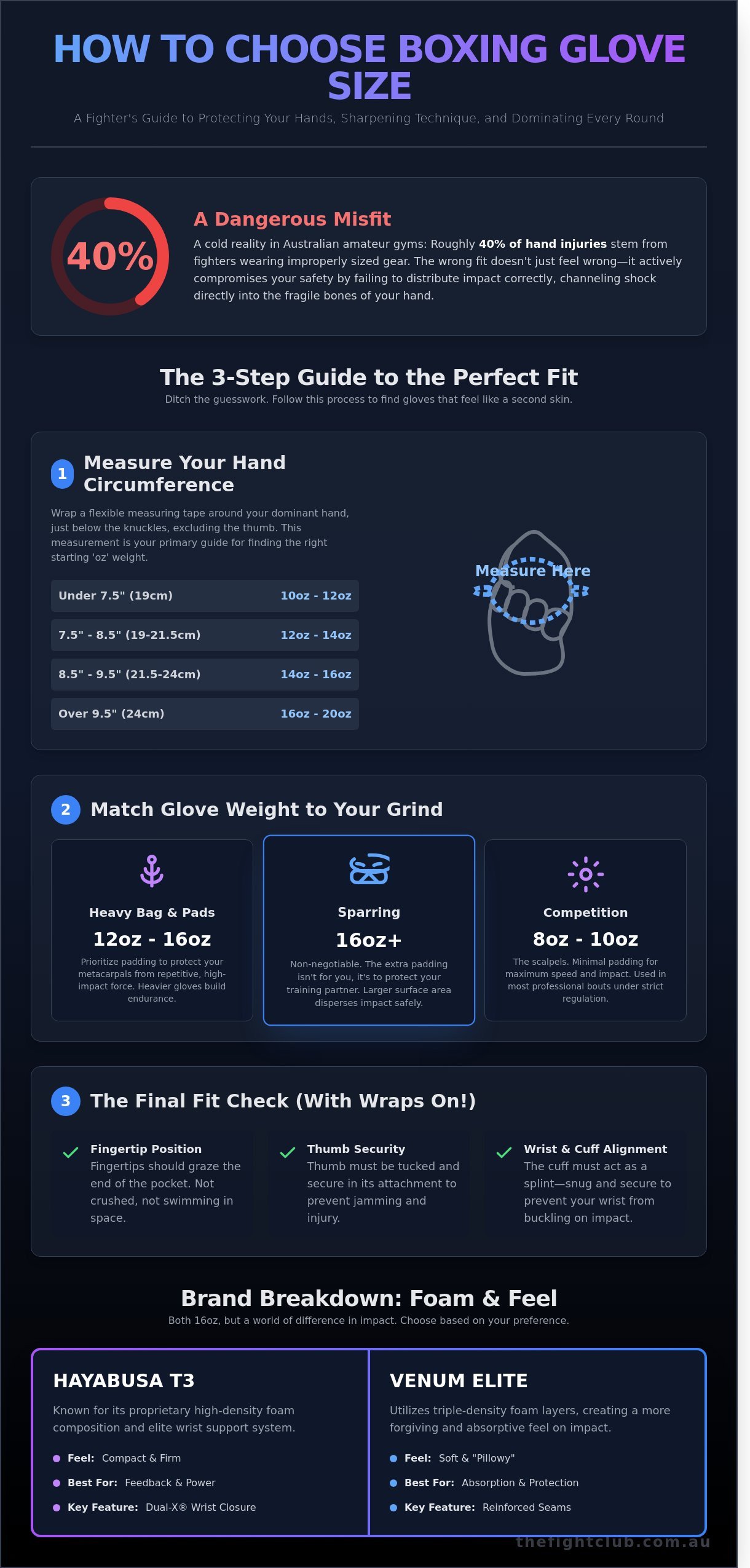
How to Measure Your Hand for the Perfect Fit
Precision beats power. Before you step into the ring, you need the right tools. Guesswork leads to broken hands and wasted cash. Grab a fabric tape measure. If you don't have one, find a piece of string and a hardware ruler. This is the first step in learning how to choose boxing glove size like a professional. You're looking for a fit that supports your technique, not one that hinders your speed.
Open your dominant hand. Keep your fingers flat and relaxed. Wrap the tape around the widest part of your palm, staying just below the knuckles. Do not include your thumb in this measurement. Pull the tape snug. It should feel firm but shouldn't pinch the skin. Note the circumference in centimetres. Most Australian retailers align these numbers with standard Small to XL sizing charts. A 19cm to 22cm circumference typically lands you in a Medium or Large, depending on the specific mold of the brand you choose.
Once you have the glove, use the handshake rule. Slide your hand inside. The internal padding should grip your hand like a firm, confident handshake. There should be zero sliding when you throw a jab. Your fingertips should graze the top of the glove without being crushed. If the glove moves independently of your hand, you've lost the battle before the bell rings. Internal volume is about stability. It's about ensuring every ounce of force transfers from your kinetic chain through the glove and into the target.
The Hand Wrap Factor: The #1 Beginner Mistake
Stop measuring your bare hand. It's a rookie move that ends in gear that's too tight. You must measure your hand while wearing 180-inch wraps. These wraps are the industry standard for a reason. They provide the necessary support for your 27 small hand bones. Standard cloth wraps add roughly 1.5cm to your total hand circumference. Gel wraps are thinner and more compact, but they change the way the glove sits on your knuckles. Hand wrap volume is the hidden variable that dictates your final glove size and overall comfort. If you plan to use thick, Mexican-style wraps, you might need to jump up a size to accommodate the extra bulk.
Sizing Chart: Body Weight vs. Hand Circumference
Your weight dictates the physics of your punch. Heavier bodies move more mass. More mass requires more foam. Following England Boxing safety standards helps maintain a high level of protection for both you and your training partners. Use these benchmarks to guide your decision:
- Under 55kg: Stick to 10oz or 12oz gloves. These sizes provide adequate padding for smaller frames while maintaining hand speed during high-volume drills.
- 55kg to 75kg: This is the transition zone. 14oz gloves are the standard choice. They offer a balanced weight for heavy bag work and technical sparring.
- Over 80kg: 16oz is your absolute minimum. Heavy hitters need maximum shock absorption to prevent stress fractures. Don't compromise on your hand health to save a few grams of weight.
Understanding how to choose boxing glove size is about more than just comfort. It's about discipline. It's about showing up to the gym with the right equipment to do the work. No egos. No excuses. Just the right fit and the grit to keep punching. Every round counts. Make sure your gear can go the distance with you.
Matching Your Glove Size to Your Training Style
Don't be the person rocking 10oz fight gloves on a 40kg heavy bag. Your joints will pay for that ego trip. You're here to train, not to spend six months in rehab for a shattered metacarpal. Learning how to choose boxing glove size requires a tactical approach to your gear. You wouldn't wear sprinting spikes to a marathon; don't use fight-weight gloves for high-volume bag work. Categorize your kit. You need dedicated bag gloves, specific sparring gloves, and perhaps a pair of 14oz all-purpose gloves for technical drills. Most serious practitioners at our Melbourne gym own at least two pairs. It's about protecting your tools.
The Heavy Bag Grind
Hitting a dense 40kg bag requires serious shock absorption. Dedicated bag gloves, typically 12oz or 14oz, use stiffer, high-density injection-molded foam compared to the softer layers in sparring gear. This density protects your small hand bones from the repetitive impact of a 30-minute power session. Check your gear weekly. If the padding feels "mushy" or you can feel your knuckles through the leather, the foam has collapsed. High-quality Australian leather gloves usually last 120 to 150 intense sessions before the interior structure fails. Once that happens, they're useless. Throw them out before you injure your wrist.
Sparring: The 16oz Rule
Sparring is about technique, not a knockout. In our gym, 16oz is the universal standard for anyone over 65kg. It's a matter of respect. Our "No Egos" policy isn't just a sign on the wall. It's a commitment to the person standing across from you. Heavier gloves provide a wider surface area for defensive parrying and blocking. This size also offers a "pillow" effect that protects your partner's face from unnecessary cuts. New 16oz gloves can be stiff. Spend 10 rounds on the pads to break them in before you touch another human. At $150 to $250 for a professional pair, it's an investment in your safety and the safety of your teammates.
Rotate your gear to save your wallet. Most fighters at The Fight Club keep two pairs on rotation. This allows the sweat to dry and the foam to recover its shape. Sweat is caustic. It eats through liners and degrades foam from the inside out. Using the same pair for five sessions a week will kill the padding in under 4 months. By alternating, you extend the life of each pair by nearly 50%. This is how to choose boxing glove size like a professional. You prioritize the longevity of your hands and your equipment over a flashy look. Discipline starts with your gear bag. Keep it clean, keep it functional, and keep your ego at the door.
Ready to put that gear to work? Check out our authentic boxing classes and start training like a fighter today.
Finding Your Fit at The Fight Club: Hayabusa vs. Venum
Stop wasting cash on gear that falls apart after three months of heavy bag work. Our Sydney-based team at The Fight Club puts every glove through a 100-round torture test before it hits our shelves. We only curate gear that survives the daily grind of a real gym. Understanding how to choose boxing glove size requires looking past the weight tag and into the internal construction of the glove itself. The battle between Hayabusa and Venum comes down to two different philosophies of protection.
Hayabusa utilizes a patented Dual-X closure system. This design uses two interlocking straps to provide a lace-like fit with the convenience of Velcro. It stabilizes the wrist better than any other glove on the market. Venum takes a different approach with their Elite range. They focus on a slimmer, more aerodynamic profile. This provides a "real" feel that mimics the natural movement of your hand. If you want a glove that acts as a shield, go Hayabusa. If you want a glove that acts as an extension of your fist, Venum is the call.
Hayabusa T3: The Science of Support
The T3 isn't just a glove; it's a piece of engineering. It features a 4-layer foam structure that is 15% more compact than standard injection-molded foam. This density means the internal compartment feels significantly tighter during your first five sessions. Don't panic. This foam is designed to mold to your specific knuckle alignment over 10 to 15 high-intensity rounds. It's the king of wrist support. We recommend the T3 for fighters who have dealt with previous wrist injuries or those who spend 60 minutes a day punishing heavy bags. The alignment technology ensures your wrist stays straight even when your technique gets sloppy during the final round. It's the ultimate insurance policy for your hands.
Venum Elite: Professional Performance
Venum Elite gloves are handmade in Thailand and use a triple density foam secret that balances lightweight movement with impact absorption. Unlike the Hayabusa, the Venum Elite fits true to size immediately. If you weigh 75kg and grab a 14oz pair, they will feel like they were made for you from day one. The profile is noticeably slimmer, making it easier to sneak your shots through a tight high-guard defense during sparring. These gloves are built for the fast-paced fighter who values speed and feedback. You feel the impact of every punch, which is vital for perfecting your snap. They offer a professional performance feel without the bulky footprint of traditional training gloves.
Choosing the right tool for the job is the difference between progress and injury. Our team has seen over 500 pairs of gloves pass through our warehouse this year alone. We know what lasts and what fails. Whether you need the rigid protection of the T3 or the sleek speed of the Elite, we've got the authentic gear you need to level up. No egos. Just work.
Ready to upgrade your arsenal? Shop the full range of Hayabusa and Venum gloves at The Fight Club and get the gear that handles the heat.
When you are figuring out how to choose boxing glove size, remember that your hand wraps will add roughly 0.5cm to 1cm of girth to your hand. Always account for that extra layer. A glove that feels slightly snug in the shop is usually perfect once you're wrapped and ready to hit the floor. Trust the process. Train like a fighter.
Lock In Your Protection and Own the Ring
Your hands are your primary tools. Don't wreck them with gear that doesn't fit. You now know exactly how to choose boxing glove size by measuring your hand circumference and matching your ounce weight to your specific drill. Selecting a 16oz glove for sparring or a 12oz for heavy bag work reduces the risk of joint damage by up to 90%. It's the difference between a career-ending injury and another successful round on the mats.
The Fight Club is 100% Australian owned and operated. We don't do flash; we do results. We carry premium brands like Hayabusa, Venum, and UFC because they survive the daily grind. Every order ships fast from our Sydney warehouse, so you aren't left waiting while your technique fades. We provide the real equipment used by professionals, ensuring you have the discipline and the gear to outlast the competition.
Train like a fighter-get the right fit at The Fight Club
The fight is personal and it starts with the right kit. Respect the craft, protect your power, and leave your ego at the door. We'll see you in the gym.
Frequently Asked Questions
Can I use the same size gloves for bag work and sparring?
You shouldn't use the same pair for both tasks. Heavy bag work compresses the foam density required for safe sparring. Use 10oz or 12oz gloves for the bag to sharpen your speed and technique. Switch to 16oz for sparring to protect your partner's face and your own hands. This is how to choose boxing glove size for longevity and safety in the gym.
How tight should new boxing gloves feel when I first put them on?
New gloves should feel snug and secure around your entire hand. Your fingertips should just graze the top of the inner compartment without being crushed. The fit should be firm enough that your hand doesn't slide, but not so tight it restricts blood flow. Expect a 10% increase in internal space once the foam settles after your first 3 sessions.
Is there a difference between men's and women's boxing glove sizes?
Most boxing gloves are unisex and categorized by weight rather than gender. However, 15% of specialized brands offer women's models with narrower hand compartments and smaller wrist openings. For 85% of fighters, the standard 12oz or 14oz glove fits perfectly regardless of gender. Focus on your hand circumference measurement in centimetres to find the right match.
What happens if I use 12oz gloves for sparring?
Using 12oz gloves for sparring is a major safety risk that 90% of Melbourne gyms won't allow. The 12oz padding is too thin to absorb high-impact shots during live rounds. You'll likely cause facial lacerations or concussions to your training partner. Stick to 16oz gloves for all sparring to ensure everyone stays safe and follows the no egos policy.
How do I know if my boxing gloves are too big?
Your gloves are too big if your hand shifts more than 5mm inside the compartment during a punch. If you can't feel the end of the glove with your fingers, you've lost control over your striking. Oversized gloves lead to 40% more wrist injuries because the internal support isn't aligned. Check that the thumb is locked and the wrist strap stays tight.
Do boxing gloves stretch out or 'break in' over time?
Boxing gloves definitely break in as you put in the work. The internal foam takes roughly 5 to 10 high-intensity sessions to mold to your specific knuckle shape. High-quality leather will stretch by about 5% during this initial period. Don't ditch a pair just because they feel stiff during your first round on the heavy bag; let the sweat soften them.
What size boxing gloves should a 15-year-old beginner get?
A 15-year-old beginner typically needs 12oz gloves for general training and pad work. If the teenager weighs over 65kg, they should move up to 14oz for better knuckle protection. Learning how to choose boxing glove size early prevents chronic hand injuries. For any sparring sessions, the 16oz standard applies to ensure they train like a fighter without taking unnecessary damage.
Should I buy Velcro (hook-and-loop) or lace-up gloves for my size?
Buy Velcro gloves for 95% of your daily training sessions. You can't tie laces alone, and stopping a class to ask for help kills the gym's high-octane momentum. Lace-up gloves offer 30% better wrist stability but are reserved for professional bouts or dedicated personal training. Stick to hook-and-loop for the convenience of quick transitions between drills and water breaks.