

Hook & Loop vs Lace Boxing Gloves: Pro Gear Comparison
The most expensive pro gear in the shop might be the very thing sabotaging your session. While lace-ups are the gold standard for a televised title fight, they are often a liability for the solo athlete grinding through a midweek bag circuit at your local gym. Choosing between boxing gloves: Hook & Loop vs lace isn't just about aesthetics. It's about whether you spend your round working on your lead hook or fumbling with a loose string while your coach counts down the clock. No egos. Just work.
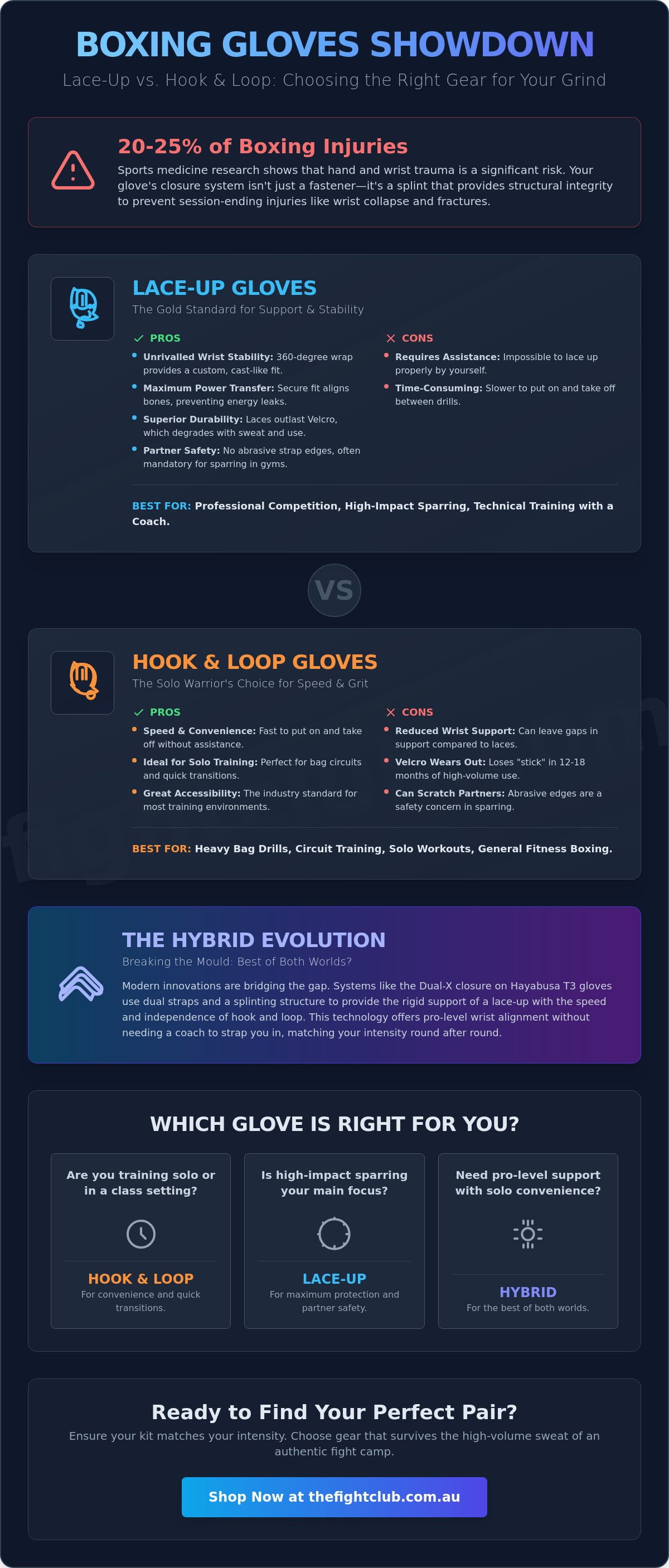
Sports medicine research shows that hand and wrist injuries account for approximately 20-25% of all boxing-related trauma. You already know that a secure fit is non-negotiable for high-volume training, yet many fighters still settle for gear that doesn't support their specific style. You're here to train like a fighter, not waste time on equipment that fails under pressure. This guide will help you master the technical differences between closure systems to ensure your kit matches your intensity. We will compare traditional wrist stability against modern innovations like 3D-printed padding and hybrid straps to find the perfect balance of speed and grit for your next session.
Key Takeaways
- Lace-up gloves provide a tailored, custom fit that maximises wrist stability for high-impact sparring and professional competition.
- Hook and loop systems offer the speed and independence required to dominate solo heavy bag drills and quick transitions between rounds.
- Discover why many Australian gyms mandate laces for sparring to protect your partners from the abrasive edges of standard velcro straps.
- Modern hybrid technology, like the Dual-X closure on Hayabusa T3 gloves, delivers pro-level wrist splinting without the need for a second pair of hands.
- Master the technical trade-offs of boxing gloves: Hook & Loop vs lace to ensure your gear survives the high-volume sweat of an authentic fight camp.
The Battle of the Wrist: Hook & Loop vs Lace-Up Explained
Your wrist is the weakest link in your kinetic chain. When you're throwing a cross at a 50kg heavy bag, that joint takes the brunt of the impact. The debate over boxing gloves: Hook & Loop vs lace isn't just gear talk; it's about structural integrity. Hook and loop systems, commonly known as "velcro," are the industry standard for accessibility and convenience. In contrast, lace-up gloves remain the professional benchmark for high-stakes competition and elite sparring. Understanding the history and types of boxing gloves reveals that while laces came first, both have a place in a modern fighter's kit. Think of the closure as a splint for your wrist rather than a simple fastener. Essentially, lace-ups provide the lockdown required for heavy sparring, while hook and loop serves as the workhorse for solo bag drills.
Why Your Choice Matters for Injury Prevention
Wrist collapse is a session-ender. It happens when the joint buckles under the force of a power shot, often leading to sprains or fractures. Sports medicine data confirms that hand and wrist issues account for 20-25% of boxing injuries. A proper closure system ensures the alignment of your metacarpals, keeping the bones of your hand stacked behind your knuckles. This alignment prevents the "boxer's fracture" and reduces hand fatigue. When your wrist is secure, you don't have to over-grip to maintain a tight fist. You save that energy for the final round. No egos here; just the raw physics of impact. If your glove doesn't act as an extension of your forearm, you're fighting your own equipment before you even hit the target.
The Anatomy of a Professional Closure
A professional lace closure uses eyelets to create a 360-degree, uniform wrap around the forearm. It pulls the leather tight from every angle, mimicking a custom-moulded cast. This tension is distributed evenly, which is why pros refuse to step into the ring with anything else. Velcro straps rely on surface area and the grip of the hooks. While faster, they often leave gaps in support where the strap meets the cuff. In the gritty Australian fight scene, durability is king. Fighters in Melbourne and across the country demand gear that survives high-volume sweat and humidity without the adhesive failing. For those who want the support of laces with the speed of a strap, the Hayabusa T3 Boxing Gloves use a dual-strap system to bridge the gap. This "splinting" technology provides the rigidity of a lace-up with the independence of hook and loop, ensuring your technique stays sharp through every round. Choosing between boxing gloves: Hook & Loop vs lace depends on whether you have a corner person available or you're grinding out a solo session on the bags.
Lace-Up Boxing Gloves: The Gold Standard for Support
Lace-up gloves aren't just a throwback to the old school. They are the pinnacle of hand protection. When you compare boxing gloves: Hook & Loop vs lace, the difference in the "locked-in" feel is immediate. Laces allow for a 360-degree uniform wrap that velcro simply can't match. This creates a custom, tailored fit that stabilises the small bones in your hand. According to a detailed breakdown of Lace-Up vs. Hook & Loop options, this tension distribution is what prevents the glove from shifting mid-punch. It's about precision. It's about power.
Respect in the gym matters. At Melbourne's premier training grounds, you'll often find a strict "laces only" rule for sparring. Velcro has a nasty habit of scratching your partner's face during a clinch or a parry. It's a sign of a disciplined fighter to choose gear that protects the team. Beyond the safety aspect, there is the psychological ritual. Being laced in by a coach or a teammate signals a shift in mindset. You're no longer just working out; you're preparing for battle. This commitment to the craft is what defines a "No Egos" culture.
Durability is where the investment pays off. Velcro loses its "stick" after about 12 to 18 months of high-volume sweat and grit. Laces don't. They remain secure until the leather itself fails. If you're serious about your gear, brands like Cleto Reyes offer that authentic, professional feel that lasts through years of hard rounds. You want gear that survives the grind as long as you do.
The Pros and Cons of Going Traditional
Laces offer unrivalled wrist stability. This allows for maximum power transfer through the knuckles. The profile is also slimmer, making it easier to slip through a tight guard. However, the "Solo Problem" is real. You can't tie them yourself. While some online forums suggest you always need a partner, smart fighters use lace converters or "lace-and-loop" adapters to bridge the gap. It's a small price to pay for a superior fit.
When to Choose Laces
Choose laces for hard sparring where safety is non-negotiable. If you're stepping into a competitive bout, most sanctioning bodies will require them. They are also the best choice for fighters with a history of wrist injuries. The cast-like feel provides the confidence to throw full-power shots without hesitation. Train like a fighter. Protect your tools.
Hook & Loop Gloves: Speed, Convenience, and Solo Grit
If you're training solo, independence is your greatest asset. Laces offer a premium lock, but they're useless if you're alone in a garage or hitting the heavy bags during a lunch break. In the debate of boxing gloves: Hook & Loop vs lace, the hook and loop system wins on sheer efficiency. You can strip your gear and grab a water bottle in three seconds flat. Most professionals don't just own one pair; they keep a velcro set as their "everyday workhorse" for high-volume drills. It's about getting the work done without a second pair of hands. Brands like Venum have pushed the tech forward, reinforcing their straps to ensure they don't lose grip after a few months of Melbourne humidity. High-quality hook and loop should be firm enough to hold, yet smooth enough that it doesn't shred your expensive hand wraps every time you adjust the fit.
The Reality of Solo Training
The clock is your only enemy during high-intensity interval training. When the buzzer sounds for a 30-second rest, you don't have time to mess with strings. You need to breathe, hydrate, and maybe tighten your cuff. The Venum Elite Boxing Gloves excel here, offering a secure fit that you can adjust on the fly between rounds. This flexibility allows you to maintain the intensity required for a real fight camp. You're in control of the tension. You're in control of the pace. No egos. Just output.
Where Hook & Loop Falls Short
Convenience has a cost. The "velcro burn" is a real risk in the clinch, where exposed hooks can slice a sparring partner's skin. This is why many high-level gyms in Australia mandate laces for live rounds. Beyond the skin abrasions, single-strap models often lack the structural rigidity needed for heavy hitters. Understanding the science of boxing wrist injuries is vital; a loose strap leads to joint instability and wasted power. Over time, even the best velcro can loosen during a 12-round heavy bag session. If you're deciding on boxing gloves: Hook & Loop vs lace, realise that hook and loop is for speed, but it requires constant vigilance to stay tight. If the strap starts to flag, the support fails. Stay sharp. Check your gear often.
Breaking the Mould: The Rise of Hybrid Support Systems
The old guard will tell you that you have to choose between convenience and safety. They're wrong. Modern engineering has rendered that binary obsolete. The choice between boxing gloves: Hook & Loop vs lace used to be a massive compromise for the solo athlete. In the current landscape of 2026, hybrid systems have emerged as the dominant force. These designs utilise a Dual-X closure that acts as a bridge. It provides the structural integrity of a lace-up but keeps the rapid-fire speed of a velcro strap. For the athlete grinding in Melbourne's premier gyms, this means no more "wrist flop" during the final rounds of a heavy bag session. You get the stability of a splint without needing a coach to tie your laces every time you want to hit the floor for push-ups.
The Engineering of the Hayabusa T3
The Hayabusa T3 Boxing Gloves represent the peak of this hybrid movement. They don't just secure the glove; they "splint" the wrist using an interlocking strap system. This design works in tandem with a 4-layer foam complex to ensure perfect impact alignment. If you've struggled with wrist pain after high-volume sessions, this is your solution. The T3 provides a level of lockdown that rivals traditional 16oz lace-up gloves, yet remains accessible for solo training. In 2026, brands are even integrating 3D-printed mesh lattice technology to enhance energy dispersion. It's about protecting your tools so you can keep showing up. Realness in training means having gear that survives the grit of every round. No egos. Just superior engineering.
Is a Hybrid Right for You?
Choosing a hybrid glove is a strategic move for the serious hobbyist. If you train in a commercial environment where partners are scarce, you need gear that functions independently. You are investing in engineering that protects your long-term hand health. It's a value analysis. Do you buy cheap gear that fails, or do you pay for the tech that keeps you in the fight? Our Boxing Gloves Australia guide breaks down how these systems compare to entry-level models that often cost between $30 and $55 but lack essential support. Don't settle for superficial fitness gear. Secure your professional hybrid gloves today and train like a fighter with the support your power deserves.
The Verdict: How to Choose Your Next Pair at The Fight Club
Settling the debate between boxing gloves: Hook & Loop vs lace requires an honest assessment of your daily grind. Your gear is a reflection of your commitment to the craft. If you are fortunate enough to train in an environment with a dedicated coach or a consistent sparring partner, the lace-up system is your best ally. It provides a level of customisation and wrist lockdown that ensures your power is transferred directly into the target without risking joint collapse. In Melbourne's premier gyms, showing up with the right kit is a mark of respect for the sport and your training partners. No Egos. Just the pursuit of perfection.
However, the reality of solo training cannot be ignored. If your session involves hitting the heavy bag alone or transitioning quickly between conditioning drills, the hook and loop system is the pragmatic choice. You need to be able to hydrate, check the clock, and tighten your gear without needing assistance. Modern advancements in strap technology mean you no longer have to settle for sub-par support. Prioritise hand health by choosing high-quality leather and multi-layer foam that can withstand high-volume sweat and grit. Your tools should be as resilient as your mindset. Don't let your equipment be the bottleneck in your progression.
The Fight Club Recommendation
To simplify your decision, follow this framework based on the current 2026 gear landscape. Your kit must match your intensity to ensure you stay in the fight:
- Choose Laces if: You are sparring multiple times a week or preparing for a sanctioned bout. The cast-like fit is the only way to ensure maximum protection during high-velocity exchanges.
- Choose Hook & Loop if: You are a solo specialist or a beginner focused on the heavy bag. Speed and independence are your priorities, allowing you to focus on technique rather than equipment.
- Choose Hybrid if: You refuse to compromise. Hybrid systems like the Dual-X closure offer the best of both worlds, providing professional-grade splinting with the convenience of a strap.
Gear Up and Train Hard
The fight is won in the gear you trust. You've mastered the technical differences; now it's time to put that knowledge into practice. Before you step back into the gym, ensure your kit is up to the standard of a real fighter. For a comprehensive look at how to select your full kit, explore our ultimate guide to professional combat gear to stay ahead of the curve. We are committed to providing the authentic tools required for an ego-free, high-intensity experience across Australia. Shop the latest Boxing Gloves at The Fight Club today. Train like a fighter. Protect your tools. Own the round.
Master Your Equipment, Own the Round
You've seen the technical breakdown. You know the stakes. Whether you choose the custom lockdown of a lace-up or the rapid-fire efficiency of a strap, your choice dictates your performance. Hand and wrist injuries account for 20-25% of all boxing trauma; don't let your gear be the reason you're sidelined. The debate over boxing gloves: Hook & Loop vs lace isn't about which is "better" but which serves your specific grind. If you're hitting the bags solo, grab the velcro. If you're stepping into the ring for hard rounds, get laced in. No Egos. Just real gear for real fighters who respect the craft.
We are Australia’s premier destination for elite Hayabusa and Venum equipment, ensuring your tools are as sharp as your technique. We provide fast shipping across Australia so you can get back to the gym without delay. Your progress depends on the trust you place in your kit. It's time to stop settling for superficial fitness gear and start investing in your longevity. Upgrade your gear and shop the full Boxing Glove collection at The Fight Club. Train like a fighter. The work starts now.
Frequently Asked Questions
Can I tie lace-up boxing gloves by myself?
You cannot tie traditional lace-up gloves alone without sacrificing the fit. It's a two-person job that requires a coach or training partner to pull the tension tight across the wrist. This ritual is part of the discipline in an authentic fight gym. If you're grinding solo in Melbourne, you'll find it impossible to get the cast-like lock required for heavy rounds. Some athletes use their teeth, but it's a desperate move that ruins the laces.
Do lace-up gloves provide better wrist support than velcro?
Lace-up gloves provide superior wrist support because they offer a uniform 360-degree wrap around the joint. When comparing boxing gloves: Hook & Loop vs lace, the laces pull the leather tight from the forearm to the palm. This creates a structural splint that prevents the wrist from buckling during high-impact power shots. Velcro straps often leave gaps in tension. Laces ensure every bone in your hand stays stacked behind your knuckles.
What are lace converters, and do they actually work?
Lace converters are elasticated adapters that turn a lace-up glove into a slip-on. They work well for solo bag work but won't match the lockdown of a partner-tied knot. These tools allow you to enjoy the slim profile of a pro glove without the "Solo Problem." It's a solid compromise for fighters who want the feel of a Cleto Reyes but train alone. They don't replace a real tie for hard sparring sessions.
Why do some boxing gyms ban velcro gloves for sparring?
Many elite gyms ban velcro for sparring to prevent "velcro burn" on training partners. The abrasive hooks on a strap can easily slice a partner's face during a clinch or a parry. Choosing laces is a sign of respect for your gym family. It ensures that the only thing hitting your partner is the padded knuckle. No egos; just safe, technical work that keeps everyone in the fight camp healthy and ready for the next round.
How long does the velcro last on high-end boxing gloves?
High-quality velcro typically maintains its grip for 12 to 18 months of intense training. Over time, the accumulation of sweat, salt, and grit wears down the plastic hooks. You'll notice the strap starting to flag or pop open during heavy bag rounds. Laces don't have this expiration date. As long as the leather is intact, the laces will hold. If you want gear that survives years of punishment, laces are the more durable investment.
Are lace-up gloves only for professional fighters?
Lace-up gloves are for anyone who prioritises hand health, not just professionals. If you have a history of wrist injuries, the extra stabilisation is non-negotiable for your long-term safety. Amateur fighters and serious hobbyists often use them for sparring to replicate the feel of a real bout. You don't need a pro contract to value your tools. Train like a fighter by using the gear that offers the highest level of protection available.
Which closure is better for heavy bag training?
Hook and loop is the superior choice for heavy bag training due to its sheer convenience. You can strip your gloves for water breaks or adjust your hand wraps in seconds. Solo grit requires gear that doesn't slow you down between drills. While laces offer more support, the constant on-and-off nature of a bag circuit makes velcro the practical workhorse. It keeps the intensity high and the clock moving during your session.
Is the Hayabusa T3 dual-strap system better than traditional laces?
The Hayabusa T3 dual-strap system is a modern hybrid that rivals traditional laces for stability. It uses interlocking straps to splint the wrist, providing a level of rigidity that standard velcro cannot reach. For solo athletes who want pro-level protection without needing a coach, it's the 2026 industry standard. It isn't necessarily "better" than laces, but it's the most effective solution for fighters who demand independence and maximum joint safety.