

Boxing Headgear: The Ultimate Guide to Protection and Visibility in 2026
Your boxing headgear isn't a safety net; it's a tactical tool for longevity in a sport that demands your best every single round. If you've ever eaten a hook you didn't see coming because your padding blocked your peripheral vision, you know the frustration. It's a common battle. You want the protection to stop facial lacerations, but you can't afford to be blind in the pocket. We agree that gear shifting mid-exchange or sweat stinging your eyes is more than a nuisance. It's a liability that breaks your focus when you need it most.
This guide cuts through the noise to help you master the technical trade-offs between maximum coverage and elite-level visibility. You'll learn how to find a fit that feels like a second skin, ensuring you stay cool and protected through the heaviest sparring sessions. We'll analyse the latest 2026 regulations from World Boxing and Boxing Australia, review top-tier options from brands like Cleto Reyes and Hayabusa, and show you how to choose a rig that builds real confidence under fire. It's time to stop guessing and start training with gear that works as hard as you do.
Key Takeaways
- Realise that boxing headgear is built to mitigate cuts and superficial trauma, not to serve as a concussion-proof shield.
- Master the trade-off between peripheral vision and facial coverage by selecting the right style for your specific training needs.
- Learn to evaluate high-density foam and shell materials like Vylar to ensure your gear absorbs impact without breaking down.
- Use professional sizing techniques and the "shake test" to ensure your equipment stays locked in place during heavy exchanges.
- Discover why the Hayabusa T3 is our top recommendation for fighters who demand elite cranial protection and long-term durability.
The Reality of Impact: Why Boxing Headgear is Essential for Sparring
Stop treating your face like a punching bag. If you're stepping into the pocket without the right kit, you're not being tough; you're being reckless. High-quality boxing headgear is a tool for tactical longevity. It preserves your structural integrity so you can show up for the next session. We need to kill the myth right now: gear is not a 'concussion-proof' helmet. It's a specialised piece of equipment designed to mitigate superficial trauma and keep you in the fight. In Australia, specifically within Masters Boxing, head guards are mandatory for all bouts. This isn't a suggestion. It's a requirement for anyone serious about the sport.
Choosing professional-grade equipment over 'toy' brands found in big-box retailers is the first step toward real discipline. Cheap gear shifts. It obscures your vision. It fails when the pressure mounts. Realise that your technical development depends on your psychological state. When you feel secure, you're more likely to work on your head movement and counter-punching. You stop flinching. You start thinking. That shift in mindset is where champions are forged.
Surface Protection vs. Brain Safety
The primary job of martial arts headgear is to disperse kinetic energy across a larger surface area. High-density foam systems are engineered to absorb the sting of a glove, preventing the lacerations and hematomas that stop tournaments. While it protects your skin and eardrums, it doesn't eliminate the risk of concussion. No gear can stop your brain from moving inside your skull. Instead, the focus is on reducing the cumulative sub-concussive impact and preventing the deep cuts that lead to permanent scarring. It's about managing the damage so you can keep your eyes on the target.
The 'Tough Love' Approach to Training Longevity
Showing up to work on Monday with a massive black eye isn't a badge of honour. It's a sign of poor preparation and a lack of respect for your own career. Quality gear keeps you on the mats more days per year. If you're constantly sidelined by stitches or facial bruising, you aren't training. You're recovering. Investing in something like the Hayabusa T3 Headgear ensures your gear feels like a second skin rather than a bulky distraction. This is a sustainable combat sports journey. We value hard work and humility, and that starts with protecting the tools you use to compete. Don't let an avoidable injury end your progress before you've reached your peak.
Decoding the Styles: From Open-Face to Full Face-Savers
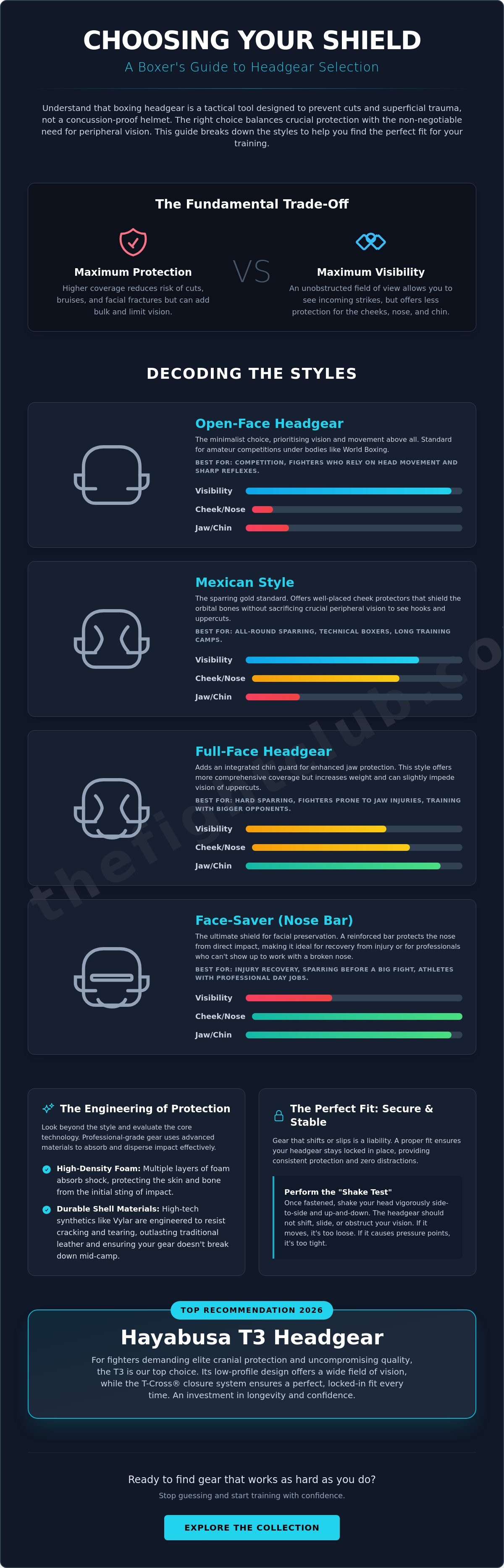
Every time you strap on a piece of boxing headgear, you're making a trade-off. You can't have it all. Maximum protection usually means minimum visibility. It's the fundamental dilemma of the pocket. If you wrap your head in a tank, you won't see the hook that puts you on the canvas. If you go too light, you'll be spending your weekends icing a hematoma. You need to match your rig to your discipline and your goals. Don't buy a face-saver for MMA sparring; you'll never see the head kick coming.
The spectrum of coverage moves from open-face competition guards to heavy-duty face-savers. For those in high-intensity camps, weight is a silent killer. Heavy gear leads to neck fatigue. When your neck gets tired, your chin stays up. That's when you get caught. A lighter, technical guard often provides better safety simply by keeping your head movement sharp. This balance is supported by the Association of Ringside Physicians' position statement, which provides a consensus on how headguards function in real-world combat environments. If you're looking to upgrade your protection without losing your edge, check out the curated range at The Fight Club to find a fit that doesn't compromise your game.
- Open-Face: Minimalist. Used for amateur competitions. Zero cheek protection but maximum visibility.
- Mexican Style: The sweet spot. Offers cheek protection while maintaining a wide field of view.
- Full-Face: Adds chin protection. Great for preventing jaw injuries but adds significant bulk.
- Face-Saver: Features a nose bar. The ultimate shield for facial preservation.
Cheek Protection and Mexican Style Guards
Mexican style guards are the gold standard for balanced sparring. Brands like Cleto Reyes perfected this design. It features slim cheek protectors that don't block your downward or peripheral vision. You can still see the low hooks and uppercuts. It's the choice for fighters who rely on head movement and slipping punches. If you value your technical development, this is the sweet spot. You get the protection you need without feeling like you're wearing a bucket. The only downside is the nose remains exposed to direct impact.
Face-Savers and Nose Bars: Maximum Security
Sometimes you can't show up to the office with a broken nose. That's where the face-saver comes in. It uses a rigid bar to keep leather away from your face. It's maximum security. Professional boxers often use these during high-volume sparring weeks to avoid cuts before a fight. The catch? You lose your 'sight line' for anything coming from below. Uppercuts become invisible. It's a calculated risk for specific training blocks where facial preservation is the priority over seeing every shot.
The Engineering of Protection: Padding and Materials
Protection is more than just stuffing foam into a leather shell. It's about engineering a system that manages energy before it reaches your skull. If you've ever felt a punch 'bottom out' through cheap padding, you know the difference. High-quality boxing headgear relies on multi-layered foam systems to decelerate impact. Each layer has a job. Realise that the outer layers are usually denser to break the initial force, while inner layers provide the comfort and contour needed for a secure fit. This structural integrity is what keeps you in the pocket when the pressure builds.
Lace-up systems remain the gold standard for a custom fit, but modern Velcro has closed the gap. The key is lockdown. If your gear rotates when you take a jab, it's a liability. You need a closure that anchors the unit to your head without cutting off circulation. Whether you choose the traditional feel of genuine leather or the durability of engineered synthetics like Syntek, your gear must be built to survive the grind. Substance always beats flash in a real training environment.
Shock Absorption Technology
Force dissipation is the goal. Soft foam might feel comfortable during a light touch, but it fails under heavy fire. Firm, high-density foam is what actually protects your structural integrity. Recent research on headguard materials highlights how specific polymers outperform traditional fillers in absorbing peak impact. This is why we recommend the Hayabusa T3 headgear. Its T-Cross closure system provides a level of stability that standard straps can't match, ensuring the padding stays exactly where it's supposed to be during explosive exchanges.
Lining and Hygiene Engineering
A slippery headguard is a dangerous headguard. If sweat causes your gear to slide, your vision is gone in an instant. Look for moisture-wicking liners that grip the skin. Engineered synthetics like Vylar are often superior to genuine leather in the harsh Australian climate because they don't crack or absorb salt from sweat. Hygiene isn't just about the smell; it's about skin health. Anti-microbial treatments prevent the bacteria buildup that leads to staph and other gym-borne infections. Don't let a lack of maintenance sideline your progress. Clean your gear, respect the craft, and it will keep you on the mats for the long haul.
Finding the Perfect Fit: Sizing and Maintenance
Fit isn't a suggestion. It's the difference between seeing the shot and waking up on the floor. Even the most expensive boxing headgear is a liability if it rotates during an exchange. You need a lockdown that feels like an extension of your own skull. If you're constantly adjusting your gear between rounds, you aren't focused on the fight. You're focused on your equipment. That's a weakness your opponent will exploit. Get the fit right before you step through the ropes.
The 'Shake Test' is your final exam. Secure the straps and shake your head vigorously as if you're slipping a high-volume combination. If the gear shifts even a fraction, it's too loose. Adjust the crown laces first to set the vertical height, then dial in the chin strap. Your eyes must be perfectly centred in the openings. If the guard sits too low, you'll be blinded by the brow padding when you tuck your chin. If it's too high, your jaw is a target. When you've found that perfect, immovable seal, secure your next piece of elite kit from our professional range.
Measuring for Success
Don't guess your size. Grab a flexible tape measure and wrap it around the widest part of your head, roughly one centimetre above your eyebrows and ears. This measurement is your baseline. Never 'size up' to account for long hair or head wraps. High-quality padding is designed to compress and contour to your shape over time. If you start with a loose fit, it will only get worse as the materials break in. Once it's on, perform a 180-degree check. You should be able to see a partner's hand held out to your side without turning your head. If your peripheral vision is cut off, the guard is either the wrong size or the wrong style for your face shape.
The Fighter’s Maintenance Routine
Sweat is a silent gear killer. It’s acidic and will eat through foam and stitching if left to sit. Wipe down the interior of your headgear after every single session. No exceptions. Use a damp cloth and a mild, natural soap. Avoid harsh chemicals that can degrade the padding or irritate your skin during the next sweat-heavy round. Use natural deodorisers or a simple bicarb soda solution to kill the 'gym funk' before it starts.
Storage matters as much as cleaning. Never leave your gear in a hot car or at the bottom of a closed gym bag. The heat in an Australian summer will bake the foam, making it brittle and useless. Air dry your gear in a cool, shaded spot with plenty of ventilation. Respect your tools, and they'll respect you when the leather starts flying. A disciplined maintenance routine ensures your gear stays in the fight as long as you do.
The Fight Club’s Top Picks for Australian Fighters in 2026
We don't stock gear based on social media hype or flashy neon colours. Every piece of boxing headgear we recommend has been through the wringer in real-world sparring sessions. We value durability, reputation, and the technical substance that keeps you safe when the pace picks up. In 2026, the market is flooded with commercial fitness brands that prioritise aesthetics over impact. We stick to the institutions that respect the craft. Whether you're a professional prospect or a dedicated hobbyist, your gear should be an investment in your future, not a disposable accessory.
Choosing the right rig comes down to your style of fighting. If you're a pressure fighter who lives in the pocket, you need maximum coverage. If you're a counter-puncher who relies on vision and movement, you need something that doesn't block your sight lines. We've curated these options because they represent the pinnacle of engineering and value for money in the current Australian market. Realise that a budget guard that packs out in months costs more in the long run than a premium investment that lasts years.
Hayabusa T3 Headgear: The Professional Standard
The Hayabusa T3 remains our #1 recommendation for overall cranial protection. It isn't just about the padding; it's about the architecture. The T-Cross closure system provides a level of customisable lockdown that prevents the unit from shifting during heavy exchanges. You get an ultra-wide field of view, which is critical for seeing those looping hooks that often come from your blind spot. For those looking for total kit synergy, this headgear pairs perfectly with Hayabusa T3 boxing gloves to ensure your wrist and head protection are on the same elite level. It's the choice for heavy hitters who prioritise maximum cheek coverage without sacrificing their ability to counter.
Venum Elite: Performance Meets Style
If you demand lightweight agility and a more traditional feel, the Venum Elite is the standard. Handmade in Thailand with 100% Skintex leather, it offers a refined finish that resists the degradation of salt and sweat. The triple density foam provides enhanced shock absorption without the massive bulk of a traditional face-saver. It's designed for the fighter who relies on speed and head movement. For a deeper look at how to integrate this into your training wardrobe, check out our Venum Australia guide. You get world-leading performance and a sleek aesthetic that actually stands up to the daily grind of a high-intensity camp. Stop settling for gear that fails when the pressure mounts. Invest in quality and focus on the work.
Master the Pocket and Protect Your Future
Your journey in combat sports is a marathon, not a sprint. Choosing the right boxing headgear is the ultimate commitment to your long-term technical growth. You've learned that the trade-off between visibility and protection is a tactical decision, not a guess. Whether you opt for the balanced sight lines of a Mexican style guard or the iron-clad security of a nose bar, your gear must feel like a second skin. Don't settle for equipment that shifts when the pressure mounts. Realise that a precise fit and a disciplined maintenance routine are what keep you on the mats more days per year.
We are here to ensure you have the best tools for the job. As an authorised reseller of industry giants like Hayabusa, Venum, and Cleto Reyes, we provide gear that has been tested in the heat of battle. Our team offers ego-free expert advice from real fighters who understand the grind. We provide fast shipping across Australia so you can get back to work without delay. Shop our full range of professional boxing headgear at The Fight Club and secure the protection you deserve. Stay humble. Work hard. Keep moving forward.
Frequently Asked Questions
Does boxing headgear actually prevent concussions?
No, boxing headgear does not prevent concussions. Its primary purpose is to stop lacerations, hematomas, and eardrum damage by dispersing surface impact across a wider area. While it manages the sting of the leather, your brain still moves inside the skull upon impact. Rely on defensive technique and head movement for brain safety rather than relying on padding alone.
How tight should my headgear be during a fight?
Your gear should be snug enough to remain immovable during a heavy exchange without cutting off your circulation. If the guard rotates even a few millimetres when you take a jab, it is too loose. A secure fit ensures your eye-line stays centred and your vision remains clear. Use the shake test to confirm the lockdown before the round starts.
Can I use the same headgear for Boxing and Muay Thai?
You can use the same gear, but realise that Muay Thai requires a wider field of vision to spot incoming low kicks and knees. Some boxing-specific guards have thick cheek padding that creates blind spots for lower-body attacks. If you cross-train, prioritise a Mexican style guard for better peripheral awareness. This ensures you can see the strikes coming from all angles.
What is the difference between a 'Mexican style' and a 'Face Saver'?
The difference lies in the level of facial coverage and visibility. A Mexican style guard features thick padding over the cheeks to protect the nose and eyes while keeping the face open. A Face Saver uses a rigid internal bar that sits across the front of the face to prevent any contact with the nose. Choose the bar for maximum safety or the Mexican style for better vision.
How do I stop my headgear from sliding up when I get hit?
Tighten the crown laces on the top of the unit to prevent it from sliding up or down. Most fighters focus only on the chin strap, but the crown adjustment determines the vertical anchor point. If the laces are loose, the impact will push the brow padding over your eyes. Proper lace tension creates a secure seal that resists vertical movement.
How long does a quality head guard typically last before it needs replacing?
Quality gear typically lasts between one and two years of regular use. You must replace it once the internal foam feels soft, brittle, or fails to spring back after compression. Using compromised padding is a gamble with your structural integrity that you should not take. Regular inspections of the stitching and inner liner will help you spot the early signs of material breakdown.
Is leather better than synthetic material for headgear?
High-end synthetic materials like Vylar are often better than leather for resisting the salt and sweat of the Australian climate. While genuine leather offers a classic feel and natural breathability, engineered synthetics don't crack or absorb moisture as easily. This makes them more durable for high-volume training. Choose based on your maintenance habits and how much you sweat during sessions.
Should I wear a mouth guard with my headgear?
Yes, you must always wear a mouth guard with your boxing headgear. Headgear does nothing to stabilise your jaw or protect your teeth from the shock of a chin shot. Pairing the two is the only way to manage the risk of dental injury and jaw fractures. It is a non-negotiable requirement for anyone stepping into a live sparring environment.