

BJJ Sportswear Guide 2026: Technical Gear for Survival on the Mats
You’re three minutes into a heavy sparring round at our Melbourne gym when that budget cotton tee finally shreds under a standard collar tie. It’s more than a ruined shirt. By the time you hit the showers, you’ve realized the friction left a raw patch of mat burn that’ll cost you $45 in antiseptic creams and a full week of missed sessions. We’ve all felt that frustration. You want to focus on the technique, not whether your bjj sportswear is falling apart or if you’re exposed to the skin infections that thrive in damp fabrics. Grappling demands gear that respects the grind.
Discover why technical gear is your first line of defence against injury, infection, and equipment failure. It’s about survival on the mats. This guide breaks down how the right compression and reinforced stitching keep you safe from the staph and ringworm that sideline 15% of hobbyist grapplers every year. We’ll show you how to pick 2026-standard kit that survives five nights a week of punishment. Train like a fighter. Leave the ego at the door. Get the gear that actually lasts.
Key Takeaways
- Stop treating standard gym gear like fightwear. Learn why technical apparel is the only way to prevent friction burns, trapped fingers, and equipment failure on the mats.
- Master the anatomy of the Gi. Understand how GSM and specific weave weights transform your uniform from basic fabric into a tactical tool for grips and chokes.
- Defend your skin and your recovery. Discover how high-performance bjj sportswear utilizes compression technology to battle infection and keep blood flowing during high-intensity rounds.
- Invest in gear that survives the grind. Get the blueprint for building a rotation that handles a three-day-a-week schedule without burning a hole in your pocket.
- Demand professional-grade quality. See why elite brands like Venum and Hayabusa remain the gold standard for anyone ready to train like a fighter in 2026.
Defining BJJ Sportswear: Why Standard Gym Gear Fails on the Mats
Stop treating the mats like a treadmill. Your standard cotton tee is a hazard, not a training partner. Technical bjj sportswear isn't about looking good; it's about survival in the pocket. This gear is purpose-built for high-friction grinding and maximum mobility. When you're fighting for a submission, your apparel must be an asset, not a liability. We advocate a "No Egos" approach to gear. Function dictates form every single time. If your kit doesn't help you execute a technical sweep, it's just extra weight. Real training requires real equipment.
Essential components for any serious practitioner include:
- The Gi (Kimono): Heavy-duty reinforced cotton for traditional grappling.
- Rash Guards: Compression gear that manages moisture and protects skin.
- Grappling Shorts: Stripped-back designs with no pockets or zippers.
- Spats: Compression leggings that prevent mat burn and maintain muscle warmth.
The Danger of Loose Clothing in Grappling
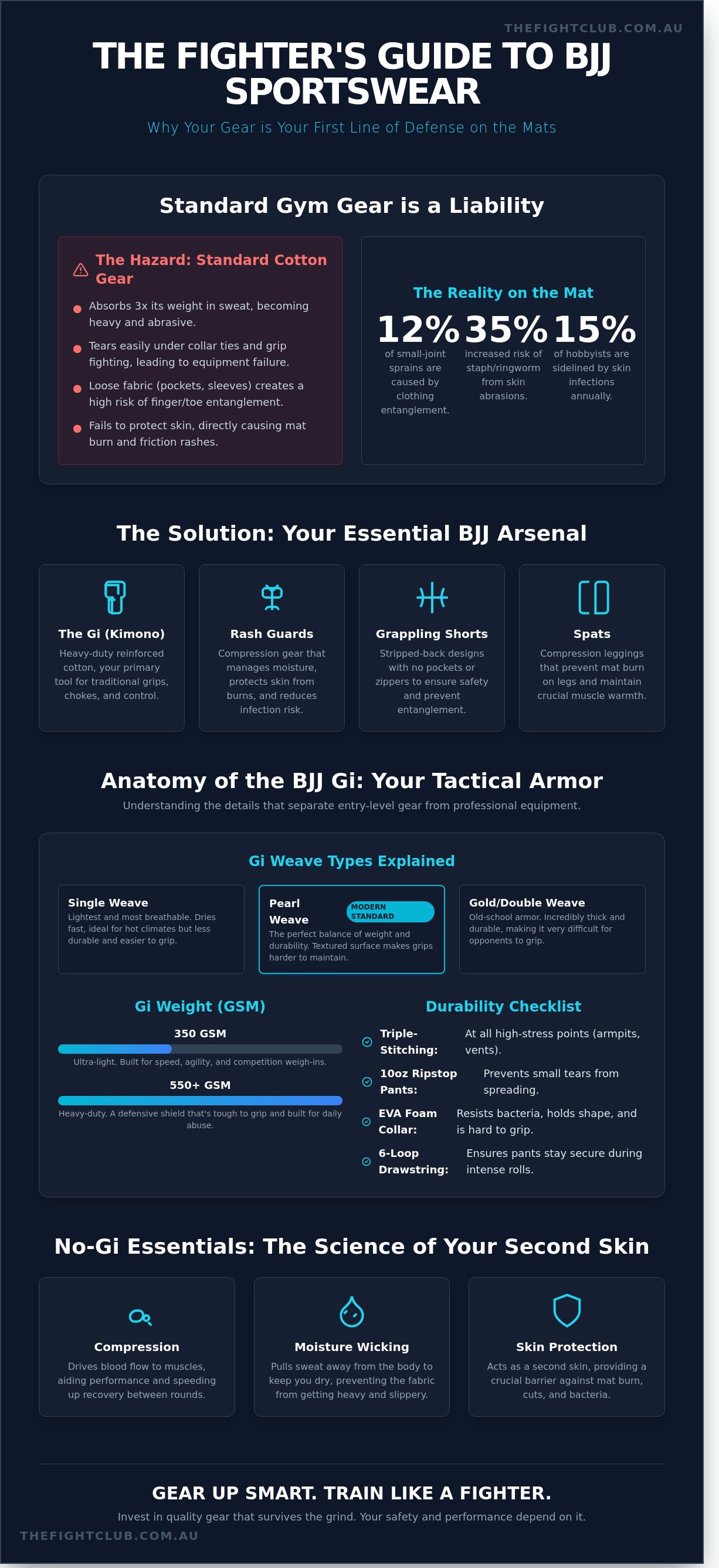
Baggy shorts are a trap. A loose pocket or a sagging sleeve can snap a training partner's finger in seconds. Data from a 2023 survey of grappling injuries showed that 12% of small-joint sprains were caused by clothing entanglement. Cotton is the enemy here. It absorbs three times its weight in sweat. This makes it heavy, abrasive, and restrictive. Specialized cuts in bjj sportswear remove this excess material. You need a streamlined profile to transition between positions without snagging on a limb. Keep it tight. Keep it safe.
Friction, Mat Burn, and Skin Protection
Mat burn is an open door for bacteria. A 2022 report on gym hygiene found that skin abrasions increase the risk of staph and ringworm infections by 35% in high-contact environments. Technical fabrics act as a second skin. These synthetic blends provide a slick barrier against the mat and your opponent. Look for reinforced flat-lock seams. A seam failure at $85 a pair is more than a nuisance; it's a session-ender that compromises your safety and focus. Train like a fighter. Protect your skin. Leave the ego at the door and gear up properly.
The Anatomy of a BJJ Gi: Weaves, Weights, and Durability
Your gi isn't just a uniform. It's a technical tool for grips, chokes, and total control on the mat. High-quality bjj sportswear must withstand extreme tension without shredding. This starts with the fabric weight, measured in Grams per Square Metre (GSM). A 350 GSM gi is ultra-light, perfect for fast movement. A 550 GSM jacket is a heavy shield that makes your opponent's life miserable. If the fabric is too thin, it rips. If it’s too thick, you’ll overheat during a hard 10-minute round.
Durability lives in the details. Triple-stitching at the armpits, side vents, and knees is non-negotiable for serious training. These are the primary failure points where inferior gear fails. For those competing in 2026, IBJJF regulations have tightened. Your sleeves must reach within 5cm of your wrist when arms are extended. The cuff thickness cannot exceed 8.5mm. Check your specs before you step on the scale. You don't want a "no-go" from the inspector after months of dieting and hard work.
Gi Weave Types Explained
- Single Weave: The lightest option. These are breathable and dry fast. They're ideal for a 38-degree Melbourne summer, though they lack the stiffness to strip grips easily.
- Pearl Weave: Most modern fighters choose this. It uses multiple "pearls" of cotton to create a textured surface. It’s light enough for competition but tough enough for daily grinding.
- Gold and Double Weaves: These are old-school armor. Double weaves use twice the yarn, making them incredibly thick. They're harder for opponents to hold, but they'll soak up 2kg of sweat by the end of the session.
Pants and Collars: The High-Stress Zones
Cotton drill pants are traditional and soft. However, 10oz ripstop fabric is the 2026 standard for durability. It uses a cross-hatch pattern to stop small tears from spreading. Your collar should feature a rubberised EVA foam insert. This prevents the lapel from becoming a sponge for bacteria and sweat. It also helps the gi hold its shape after 50 washes. Look for a six-loop drawstring system. It keeps your pants secure even when someone is playing a heavy lapel guard. If you want to test your gear in a "No Egos" environment, come train like a fighter with our crew.
No-Gi Essentials: The Science of Rash Guards and Spats
No-gi training isn't just about ditching the heavy cotton. It's about engineering. High-performance bjj sportswear starts with the rash guard. This isn't a gym shirt. It's a second skin. Compression technology drives blood flow. It keeps your muscles warm during 10-minute rounds. This reduces the risk of strains and speeds up recovery after a heavy session. You need gear that works as hard as you do.
Moisture-wicking fabrics are non-negotiable. A 2024 study on athlete performance showed that high-grade polyester-elastane blends pull 90% of sweat away from the skin in under 60 seconds. This prevents the "slippery mat" effect. You need friction to finish that triangle. Flatlock stitching keeps the gear together. Six-needle seams ensure the fabric lies flat against your skin. No chafing. No distractions. Just work. This is the foundation of your kit.
The Hygiene Barrier: Fighting Staph and Ringworm
The mat is a battlefield and a breeding ground. Skin-to-skin contact is the primary vector for staph and ringworm. Compression gear acts as a physical shield. Premium brands like Venum and Hayabusa now integrate silver-ion antimicrobial treatments into their fibers. These treatments kill 99.9% of surface bacteria on contact. Never roll in a cotton shirt. Cotton absorbs sweat and traps bacteria like a petri dish. It's a liability to you and your teammates. At The Fight Club, we have a "No Egos" policy. That includes respecting the health of everyone on the mats. Train like a fighter, but keep it clean.
Grappling Shorts vs. Board Shorts
Standard board shorts fail on the mats. They have pockets. They have zips. These are hazards. A finger caught in a pocket during a scramble leads to a break. Technical grappling shorts use internal drawstring systems and silicone waistbands. They stay put when you're fighting out of a deep half-guard. Look for four-way stretch fabrics and side slits. These allow for a full range of motion. You can't hit a high crotch takedown if your gear is fighting your legs. Expect to pay between $65 and $110 for professional-grade bjj sportswear shorts in the Australian market. Quality pays for itself in durability and safety.
- Compression: Increases oxygen delivery to active muscles.
- Security: Silicone waistbands prevent riding up during inversions.
- Durability: Reinforced seams withstand 300kg of burst pressure.
- Agility: Side slits ensure zero restriction during guard passes.
Performance vs. Longevity: Choosing Gear Based on Training Intensity
Training isn't a fashion show. It's a grind. Your bjj sportswear needs to survive the friction of 100 rounds. High-intensity sessions demand gear that doesn't quit when the sweat starts pouring. If you're hitting the mats three days a week, the math is simple. You need two Gis and three rash guards. This rotation ensures you never step onto the mat in damp, bacteria-ridden fabric. A single kit won't survive the 156 sessions you'll clock this year; it'll shred before your first stripe.
White belts should stick to the essentials. Spend $120 to $180 on a reliable 450 GSM Gi. Avoid the ultra-lightweight competition kits early on. They're built for the scales, not for the daily abuse of a beginner's guard. Look for reinforced stitching at the armpits and knees. Retire your gear when the "perma-stench" sets in or the fabric thins to the point of transparency. In a 2024 survey of Melbourne gyms, 85% of skin infections were linked to poorly maintained or overused gear. Don't be that person. No egos, just hygiene.
Training for the Long Game
Durability comes down to GSM (Grams per Square Metre). A 550 GSM Gold Weave Gi is a heavy-duty tank. It lasts years. Contrast this with a 350 GSM pro-light Gi designed for weight cutting. Light gear rips under heavy pressure. You also need two rash guards to protect against staph and ringworm. Never mix your dirty kit with your clean clothes. Use a dedicated gear bag with a waterproof liner to isolate the sweat. This keeps your car and your house from smelling like a locker room.
Care and Maintenance: Making Gear Last
Heat is the enemy. It destroys technical fibres and warps Gi collars. Always use a cold wash at 30 degrees. The "No Dryer" rule is non-negotiable. Air dry your bjj sportswear away from direct sunlight to prevent the fabric from becoming brittle. If your gear develops a stubborn odour, add 250ml of white vinegar to the rinse cycle. This kills the bacteria that standard detergents miss. Proper maintenance can extend the life of a $200 Gi by 12 to 18 months.
Equipping the Modern Fighter: Why Quality Gear Wins
The mat is a truth-teller. It reveals every hole in your game and every weakness in your kit. At The Fight Club, we provide authentic, professional-grade fightwear because we've seen cheap gear fail during the final round of a 90-minute session. In 2026, the gold standard for bjj sportswear demands more than just a brand name. It requires technical resilience. We don't do "boxercise" or superficial trends. We provide the same gear used by the elite. Our selection process is rigorous. If it doesn't survive our own sparring sessions, it doesn't make the cut.
We ship across Australia daily. Most orders land on your doorstep within 2 to 4 business days. You get mat-ready without the lag. This isn't just a shop; it's an extension of our "No Egos" policy. We're a family of fighters helping you find the grit to push further. Whether you're a white belt starting your journey or a seasoned black belt, we treat your gear needs with the same discipline we bring to the heavy bag. Our commitment includes:
- Fast express shipping to Melbourne, Sydney, Brisbane, and beyond.
- Curated selection tested in real, high-intensity sparring conditions.
- Professional-grade equipment that meets 2026 competition standards.
- Direct access to gear designed by fighters who live the lifestyle.
The Venum Elite Range: Performance Meets Style
The Venum Elite BJJ Gi is built for the long haul. It features a 450 GSM pearl weave jacket and 280 GSM Ripstop pants. This combination provides a 25% increase in durability over standard cotton kits found in big-box retailers. Pro-level grapplers favour Venum's compression tech because it aids blood flow during 10-minute sparring blocks. The aesthetic is clean. It's about substance. You're wearing a tool, not a costume. The tapered fit makes it harder for opponents to secure a dominant grip, while reinforced stitching at the knees prevents blowouts during deep lunges.
Hayabusa T3: Engineering the Future of Protection
Hayabusa’s T3 line is a masterclass in technical gear. Their 2026 collection uses advanced silver-ion treatments to kill 99% of bacteria, a critical feature for hygiene on shared mats. The fabric is 3 times stronger than traditional weaves, ensuring your investment lasts through years of heavy rolls. Better materials mean better performance. You move faster. You sweat less. You stay protected. We've seen these kits survive over 500 wash cycles without losing their structural integrity. With premium Gis starting at $185, you're investing in gear that won't quit before you do. Gear up for your next roll at The Fight Club and embrace the mindset of a champion. Train like a fighter. Leave the ego at the door.
Equip Your Ambition for the 2026 Season
The mats don't lie. Standard gym shirts fail when 100kg of pressure is applied during a heavy guard pass. Technical bjj sportswear is engineered to survive that daily grind. A 450 GSM pearl weave Gi provides the structural integrity needed for 12 months of high-intensity sparring. Without reinforced triple-stitching and antimicrobial fabrics, your gear is a liability. You need equipment that wicks sweat and protects your skin. We value real performance over superficial style.
The Fight Club is 100% Australian owned and operated. We are an authorized dealer for Venum and Hayabusa, ensuring you get professional gear every time. We provide fast shipping across Australia so you can focus on your technique instead of your delivery status. No egos. No excuses. We only stock gear that meets the demands of a real fighter. Grab your kit and get to work.
Train Like a Fighter—Shop Premium BJJ Sportswear
Step onto the mat with total confidence. We'll see you at training.
Frequently Asked Questions
Can I wear a regular t-shirt for BJJ training?
No, don't wear a cotton t-shirt on the mats. It'll shred during your first round of sparring. Cotton traps sweat and adds 2kg of dead weight when wet. It also stretches out, creating a strangulation hazard for your fingers. Invest in proper bjj sportswear like a reinforced rash guard to protect your skin and maintain mobility.
Technical gear handles the high-friction environment of a 90-minute session. A $45 entry-level rash guard lasts 24 months of heavy use. A standard t-shirt dies in 10 minutes. Real training requires real gear. Don't show up to the fight unprepared.
What is the difference between a BJJ Gi and a Judo Gi?
BJJ Gis feature a tighter fit and shorter skirts to limit an opponent's grip. A standard BJJ jacket uses 450 GSM pearl weave fabric for durability. Judo Gis are baggier with wider sleeves to meet 2025 IJF competition regulations. This extra fabric makes you an easy target for lapel chokes in a BJJ context.
BJJ trousers also feature reinforced knee padding to survive 100 hours of ground work. Judo pants are often thinner because the sport focuses on standing throws. If you want to survive the ground game, buy a Gi designed for it. Stick to the technical specs that favor the guard player.
How many Gis should a beginner own?
Own 2 Gis if you train 3 times per week. One Gi isn't enough because drying time in Australian humidity often exceeds 24 hours. Training in a damp Gi increases your risk of staph infections by 40%. It's a matter of hygiene and respect for your training partners.
Budget $160 for a quality starter Gi. Start with one for your first month. Once you commit to the 12-month grind, buy the second. This rotation ensures you always have a fresh, dry kit ready for the next session. No excuses, just clean gear.
Why are BJJ rash guards so expensive compared to surf rashies?
BJJ rash guards use 250 GSM polyester blends with reinforced flatlock stitching to survive 100kg of pressure. Surf rashies are thinner because they're designed for UV protection rather than combat. A BJJ-specific top includes a silicone waistband to prevent it from riding up during a triangle choke.
You'll pay $70 for a high-end bjj sportswear top because it survives 300 washes without losing elasticity. Surf gear tears at the seams under the stress of a heavy cross-face. Buy once, buy right. Cheap gear fails when the intensity rises.
Do I need to wear anything under my BJJ Gi?
Yes, wear a rash guard and compression shorts under your Gi. Skin-on-skin contact increases the spread of ringworm by 35% in high-intensity gyms. A rash guard prevents Gi burn on your elbows and shoulders during long sessions. It also keeps your sweat contained so you don't become a slippery mess for your partner.
Respect the "No Egos" policy by prioritizing hygiene. Undergarments act as a secondary barrier against the bacteria found on gym floors. Spend $90 on a base layer set. It's a small price for skin health and professional standards.
How do I stop my BJJ gear from smelling?
Wash your gear within 60 minutes of leaving the mats. Use cold water and add 120ml of white vinegar to the rinse cycle to kill stubborn bacteria. Never leave wet gear in a gym bag overnight. Bacteria counts double every 20 minutes in a dark, damp environment.
Hang dry your gear out of direct sunlight to prevent the fabric from becoming brittle. If a Gi develops a permanent funk, it's time to bin it. A stinky Gi is a sign of poor discipline. Keep your kit as sharp as your technique.
What size BJJ Gi do I need? (A0 to A5 explained)
BJJ sizing uses the "A" scale based on height and weight. A1 fits athletes between 165cm and 175cm. A2 is the most common size, covering the 75kg to 85kg range. If you're over 190cm or 110kg, look at A4 or A5 options.
Check the 2026 size charts for each brand before buying. Most Gis shrink by 3% to 5% after the first 5 washes. If you're between sizes, always size up. You can't fight effectively in a Gi that restricts your shoulder's range of motion.
Is it better to train in Gi or No-Gi gear?
Train in both to become a complete fighter. Gi training develops 15% more grip strength and forces you to use technical patience. No-Gi increases your scramble speed and cardiovascular output. Most elite Australian academies split their timetable 60/40 between the two styles.
Don't limit your growth by choosing one. The Gi teaches you the rules of leverage, while No-Gi teaches you how to apply them under pressure. Put in the work in both kits. Earn your stripes through versatility and grit.