

Best MMA Gloves for Heavy Bag Training: The 2026 Gear Guide
Your 4oz competition gloves are a tactical liability for high-volume bag work. Training with the wrong gear doesn't build grit; it just builds a fast track to a spiral fracture and shredded knuckles. You need the best MMA gloves for heavy bag training to bridge the gap between raw power and professional safety. You want that authentic fight-feel every time you square up to the leather, but your hands are your livelihood. You shouldn't have to choose between realistic striking and keeping your small bones intact.
We understand the drive to push past your limits, but doing it safely requires gear that can handle the grind. Recognising the difference between a competition glove and a training tool is vital for your longevity. This guide will help you master your striking and protect your weapons with the ultimate breakdown of 2026's top-tier equipment. We'll explore advanced multi-density foam, compare the protection of 7oz hybrids against standard weights, and identify the durable kits that withstand the most intense sessions. It's time to train hard and stay in the fight.
Key Takeaways
- Learn why replicating authentic "fight-feel" is critical for mastering transitions between striking and clinching on the bag.
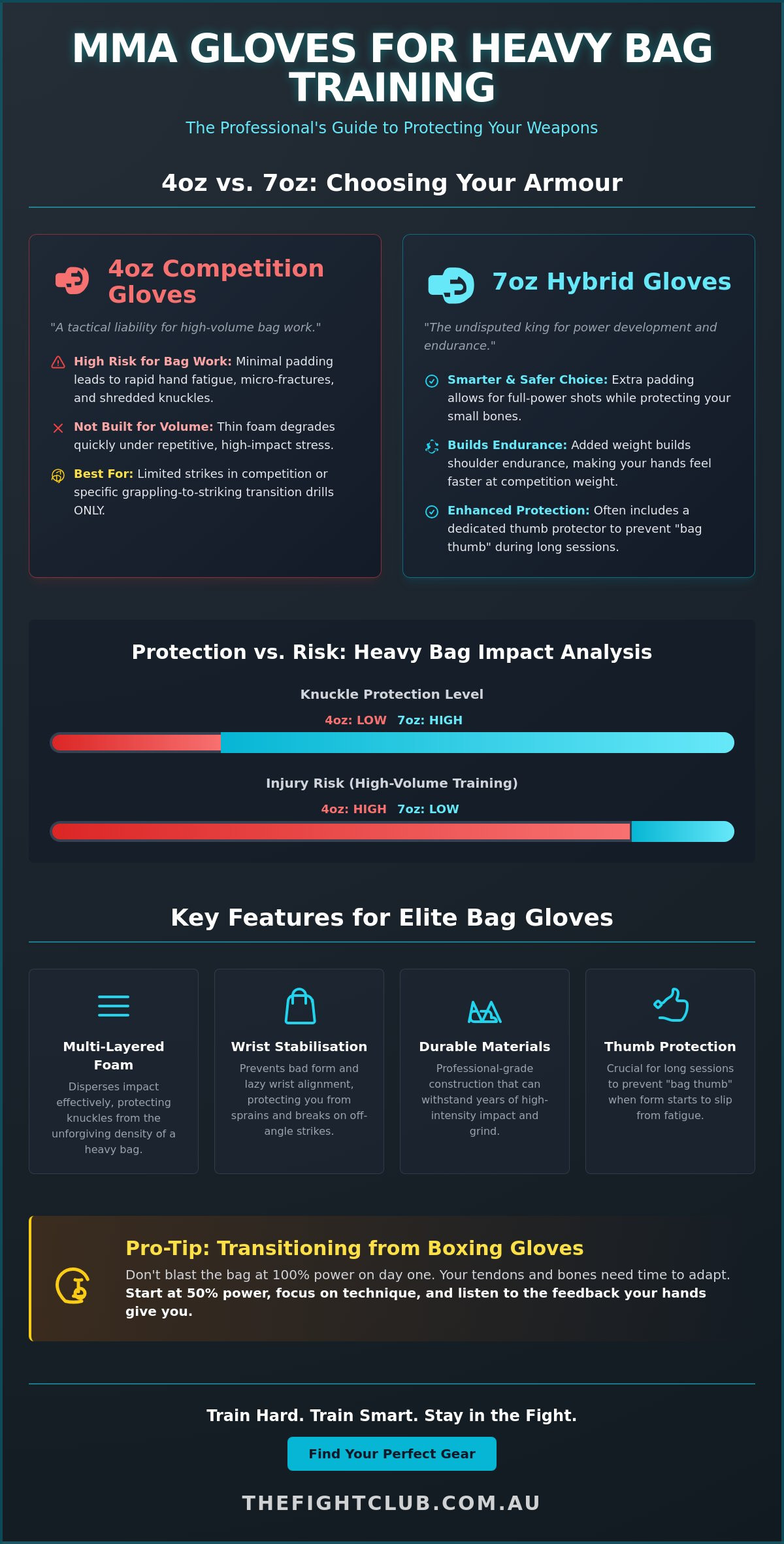
- Discover why 7oz hybrid gloves provide the necessary knuckle protection for heavy bag work compared to standard 4oz competition gear.
- Pinpoint the technical features, including multi-layered foam and wrist stabilisation, that make up the best MMA gloves for heavy bag training.
- Master the specific hand-wrapping methods required to protect your small bones while maintaining a clear palm for a perfect glove fit.
- Identify durable, professional-grade gear like the Hayabusa T3 and Venum Elite series that can withstand years of high-intensity impact.
Why Train with MMA Gloves on a Heavy Bag?
Boxing gloves are pillows for your mistakes. They cushion bad form and hide lazy wrist alignment. If you want to fight like a pro, you have to train like one. That means stripping away the 16oz security blanket and feeling the impact. Using the best MMA gloves for heavy bag training is about more than just hand protection; it's about tactical preparation. You can't shoot for a double leg or work a Thai clinch effectively when your hands are encased in massive foam blocks. Transitioning from a jab to a collar tie needs to be seamless. If your gear prevents you from closing your hand or grasping the bag, you're building bad habits that will fail you under the lights.
Bag work with smaller gloves forces you to respect the physics of every strike. You learn to turn your knuckles over and keep your wrist straight because the bag will punish you if you don't. This process builds the specific knuckle conditioning required for the cage. It encourages the bone density and skin toughness needed to survive high-volume rounds without your hands falling apart. Don't mistake this for reckless training. It is about disciplined conditioning that prepares your weapons for the reality of combat.
The Feedback Loop: Accuracy vs. Protection
Standard MMA gloves offer a brutal honesty that boxing gear lacks. When you land a hook slightly off-angle, you'll feel it immediately in your forearm and wrist. This instant feedback loop is your best coach. It identifies lazy punches that would snap a wrist or break a metacarpal in a real fight. You develop a genuine snap in your strikes, learning to generate power through technique rather than relying on the sheer mass of a weighted glove. Accuracy becomes your primary shield. You'll soon realise that hitting the target correctly is more important than hitting it with blind force.
Transitioning from Boxing Gloves
The jump from 16oz pillows to the best MMA gloves for heavy bag training requires a serious mindset shift. You can't just blast the bag with 100 percent power on day one. Your tendons and small bones need time to adapt to the reduced impact dispersion. If you carry over your heavy-hitting habits without adjusting, you're asking for a session-ending injury. Start at 50 percent power. Focus on the point of connection. There is a psychological shift when you see your hands more exposed; it makes the training feel more dangerous and more authentic. Embrace that intensity. It forces you to stay disciplined, keep your guard tight, and understand that every strike has a consequence.
4oz vs. 7oz: Choosing the Right Weight for Bag Work
You're standing in front of a 100kg heavy bag, deciding between the minimalist 4oz competition mitts and the reinforced 7oz hybrids. Most beginners pick the 4oz because they want to feel like they're already in the cage. That's an ego-driven mistake that leads straight to a physio's office. Finding the best MMA gloves for heavy bag training isn't about looking the part. It's about surviving the volume. A heavy bag is dense and unforgiving. It doesn't have the "give" of a human torso. If you plan on throwing high-velocity strikes for multiple rounds, you need to understand the physics of protection.
The decision comes down to a simple framework: volume versus specificity. If your session is focused on grappling-to-striking transitions, the 4oz glove is your tool. But for pure power development and endurance, the 7oz hybrid is the undisputed king. You have to protect your weapons today so you can use them tomorrow.
The Risk of 4oz Competition Gloves
Minimal padding equals maximum risk. Competition gear is designed for a limited number of strikes over three to five rounds. It isn't built for the repetitive, high-impact stress of a 45-minute bag session. The thin foam in these gloves degrades rapidly under heavy fire. Once that padding compresses, your knuckles are basically hitting a brick wall. This leads to rapid hand fatigue and micro-fractures that can sideline you for months. You aren't building toughness by destroying your joints; you're just being reckless with your career.
Why 7oz Hybrid Gloves are the Smarter Choice
Hybrid gloves are the workhorses of any serious gym. That extra "puff" over the knuckles allows you to throw full-power shots without the immediate sting of bone-on-leather. Most 7oz models also include a dedicated thumb protector. This is crucial for preventing "bag thumb" during long, exhausting rounds where your form might slip.
This added weight also serves a dual purpose. It builds significant shoulder endurance, making your hands feel lightning-fast when you eventually drop back down to competition weight. For any MMA fight store regular, the 7oz hybrid is the essential daily driver. It provides the perfect balance of protection and realistic feel. If you're looking to upgrade your training kit, browse the professional range at The Fight Club to find a pair that can actually handle your power.
Essential Features for Heavy Bag MMA Gloves
Aesthetics won't save your metacarpals. When you're scouting the best MMA gloves for heavy bag training, you have to look past the branding and into the architecture of the glove. A heavy bag is a dense, static object that doesn't absorb energy; it reflects it right back into your joints. You need gear engineered to handle that feedback. High-performance training requires specific technical benchmarks in foam density, wrist architecture, and moisture management. If a glove lacks these, it isn't a training tool; it's a liability.
Padding Density and Impact Dispersion
Not all foam is created equal. Soft, pillowy foam is designed for sparring to protect your partner's face, but it will "bottom out" instantly against a heavy bag. You need high-density, multi-layered systems that maintain their integrity under maximum force. These layers work together to ensure your knuckles never make "flat" contact with the bag's core. Impact dispersion is the mechanical redirection of kinetic energy away from a single point of contact to protect the underlying bone structure. Without this dispersion, every strike is a gamble with a stress fracture. Look for foam that feels firm and resilient rather than squishy.
Wrist Support: The Dual-Strap Advantage
Most MMA gloves are notoriously weak at the wrist. A single, thin velcro strap might keep the glove on your hand, but it won't stop your wrist from buckling under a heavy hook. This is where premium engineering separates itself from the pack. Brands like Hayabusa have revolutionised the category by introducing splinting systems and dual-strap closures. These features lock the wrist in place, aligning it with the forearm to prevent collapse. A secure, non-slip fit is mandatory during high-intensity intervals. If your glove shifts during a round, your alignment is compromised. Don't settle for a flimsy wrap when you can have a structural brace.
Palm Design and Moisture Management
The palm of your glove dictates your ability to transition. An open-palm design is essential for airflow and grappling realism, but some strikers prefer reinforced grip bars to help form a tighter fist. Whichever you choose, the inner lining is what determines the lifespan of the gear. You need moisture-wicking technology to manage the sweat that leads to "stinky glove" syndrome. High-grade linings don't just stop the smell; they prevent the salt in your sweat from breaking down the internal foam. Authentic training is gritty and sweat-soaked, but your gear shouldn't have to rot because of it. Choose materials that breathe and dry fast so you're ready for the next session.
How to Protect Your Hands During MMA Bag Sessions
You wouldn't step into the cage without a plan. Don't step to the bag without protection. Even the best MMA gloves for heavy bag training can't compensate for a lack of structural support. Your hands are a complex network of small bones and ligaments. They aren't designed to collide with a 100kg heavy bag repeatedly without help. Protection starts with the wrap. It's the foundation of every strike you throw. If the foundation is weak, the house will eventually collapse. Respect your weapons and they will stay sharp for the long haul.
The Role of Hand Wraps in Small Gloves
Boxing gloves have internal volume to accommodate thick wraps. MMA gloves do not. Using standard boxing wraps requires a tactical adjustment to your wrapping technique. You must prioritise the wrist and the knuckle line while keeping the palm relatively clear. If you bunch up too much fabric in your palm, you won't be able to close your hand properly. This creates a gap in your grip that leads to instability upon impact.
Mexican-style elastic wraps are often the superior choice here. They conform to the hand's contours without adding unnecessary bulk. Focus your layers on the wrist to create a structural splint. Then, build a solid pad over the knuckles. Avoid the between-the-fingers loops if they make the glove fit too tight. You need a secure, locked-in feel that allows for a natural fist. Grab a pair of professional hand wraps from our store to ensure your foundation is solid before your next round.
Volume Control and Technique
Ego is the enemy of longevity. Don't start your session by throwing haymakers. Small gloves require a snap rather than a push. If you push the bag, you're transferring the weight of the bag directly into your wrist joints. Focus on the touch. Hear the crack of the leather. Accuracy and speed are your goals during these rounds. Power is a byproduct of perfect form, not raw aggression.
A smart way to build conditioning is through 50/50 rounds. Spend the first half of your workout in 16oz boxing gloves to warm up the joints and build shoulder fatigue. Switch to your MMA gloves for the final rounds to sharpen your accuracy and transitions. This allows you to work hard without red-lining your hand health. Monitor the difference between muscle soreness and joint pain. Soreness is progress. Pain in the small bones is a signal to stop. Recognise the difference and adjust your output accordingly.
Top MMA Glove Recommendations from The Fight Club
Stop buying cheap gear that falls apart after a month of heavy hitting. If you want to protect your hands and optimise your training, you need equipment that mirrors your intensity. We have vetted the market to find the best MMA gloves for heavy bag training that actually hold up under pressure. These aren't just commercial trends. They are technical tools for serious strikers who realise that hand health is a non-negotiable part of the game. You need gear that can survive the Australian heat and the high-salt environment of a gritty gym session.
Hayabusa T3: Engineered Perfection
The Hayabusa T3 MMA glove is the undisputed leader for a reason. It features a sophisticated 4-layer foam system that absorbs impact rather than passing it through to your knuckles. This is the safest choice for anyone putting in high-volume rounds on a dense bag. The standout feature is the patented Dual-X closure system. This provides a level of wrist stabilisation that standard gloves simply cannot match. It essentially splints your wrist, keeping everything aligned when fatigue starts to set in. The Vylar synthetic leather used in the T3 line is proven to be more durable than traditional leather, resisting cracks and tears even after years of abuse. This is professional-grade protection for those who refuse to settle.
Venum Performance: Elite and Challenger
Venum has built a reputation on substance. The Venum Elite series represents their top-tier offering, featuring handmade construction that prioritises longevity. These gloves are designed to take a beating. The padding is distributed to allow for a natural fist, ensuring you don't have to fight the glove while you're fighting the bag. They provide a high-octane feel that gives you the feedback you need without the risk of micro-fractures.
If you're just starting your journey into MMA bag work, the Venum Challenger 3.0 is your ideal entry point. It offers high-performance features like triple-density foam and a reinforced palm at a mid-tier price point. It is a no-nonsense glove that gets the job done without unnecessary flash. Both models are built to handle the sweat and humidity of a real training hall, ensuring your gear doesn't rot from the inside out. Upgrade your striking gear at The Fight Club today!
Choosing the right gear is about respect. Respect for your craft and respect for your body. Whether you choose the structural brilliance of Hayabusa or the battle-tested durability of Venum, make sure your gear matches your ambition. Don't let a gear failure be the reason you're sitting on the sidelines. Get the right kit, wrap your hands properly, and get back to work.
Level Up Your Striking Arsenal
You have the technical blueprint. Now it's time to execute. Choosing the best MMA gloves for heavy bag training isn't a matter of style; it's a commitment to structural integrity and long-term performance. You now know that 7oz hybrids are the superior choice for high-volume power rounds. You understand that features like Hayabusa's splinting systems and Venum's multi-layered foam aren't luxuries. They are necessities. Your hands are your primary tools. Treat them with the respect they deserve so you can stay in the fight for years to come.
We are a proudly Australian owned and operated institution. As an official stockist of elite brands like Hayabusa and Venum, we only provide gear that survives the most intense, ego-free gym environments. Don't settle for commercial fluff that fails when the pressure is on. We offer fast national shipping on all combat gear to get you back on the bag with professional protection. Shop the full range of professional MMA gloves at The Fight Club and secure your weapons today. Push past your limits. Stay humble. Get to work.
Frequently Asked Questions
Is it okay to use 4oz MMA gloves on a heavy bag?
You can use 4oz gloves for technical drills, but they are a liability for power rounds. These gloves are built for the cage, not for the repetitive stress of a 100kg bag. If you choose to use them, limit your session to accuracy work and grappling transitions. For high-volume striking, you are better off with a hybrid glove that protects your small bones from micro-fractures.
Do I need to wear hand wraps with MMA gloves?
Professional-grade hand wraps are non-negotiable for every session. Small gloves provide almost zero structural support for your wrists and metacarpals. You need the internal bracing of a wrap to prevent your joints from buckling upon impact. Use a modified wrapping technique to keep your palm clear while prioritising the safety of your knuckles and wrist alignment.
What is the difference between MMA sparring gloves and competition gloves?
The primary difference is the weight and the volume of padding over the knuckles. Competition gloves are standard 4oz mitts with minimal foam designed for maximum offensive output. Sparring gloves, or hybrids, are typically 7oz. They feature extra "puff" to protect your training partner and your own hands during high-impact exchanges. For most, the 7oz hybrid is the best MMA gloves for heavy bag training.
How do I stop my knuckles from bleeding when using MMA gloves?
Bleeding usually occurs because your gloves are shifting or the padding has bottomed out. Ensure you are using high-quality wraps to create a protective barrier between your skin and the glove lining. If the foam in your gear feels soft or stays compressed after a strike, it is spent. Stop the round, fix your wraps, and invest in gear with multi-layered impact dispersion tech.
How long do MMA gloves last when used for bag training?
Premium gear typically lasts between 6 and 12 months of high-intensity use. High-quality microfiber and synthetic leather, like that found in the Hayabusa T3 line, can last 3 to 5 times longer than budget alternatives. You will know they are finished when the foam loses its resilience or the inner lining begins to tear. Never train in compromised gear.
Can I use MMA gloves for both the bag and grappling?
Yes, provided you choose an open-palm design. The best MMA gloves for heavy bag training allow your fingers to move freely for clinch work and shooting double legs. This versatility is exactly why we use them. Just ensure the knuckle padding is dense enough to handle the bag without bottoming out. If you can't close your hand for a grip, the glove is too bulky.
What size MMA glove should I buy for heavy bag work?
MMA glove sizing is based on hand circumference, not weight like boxing gloves. Measure around your knuckles, just below the fingers, to find your size. You need a snug fit that doesn't shift when you connect with the bag. A loose glove is a recipe for a wrist injury or shredded skin. Always check the specific brand's size chart before you commit.
How do I clean my MMA gloves to prevent odour?
Wipe your gloves down with a damp cloth immediately after every session and use glove dogs to absorb moisture. Never leave your gear sitting in a dark, damp gym bag. This is where bacteria thrive and begin to break down the internal foam. Air them out in a cool, dry place. Proper maintenance ensures your gear stays fresh and your padding remains effective for longer.