

12oz Boxing Gloves for Bag Work: The Ultimate 2026 Performance Guide
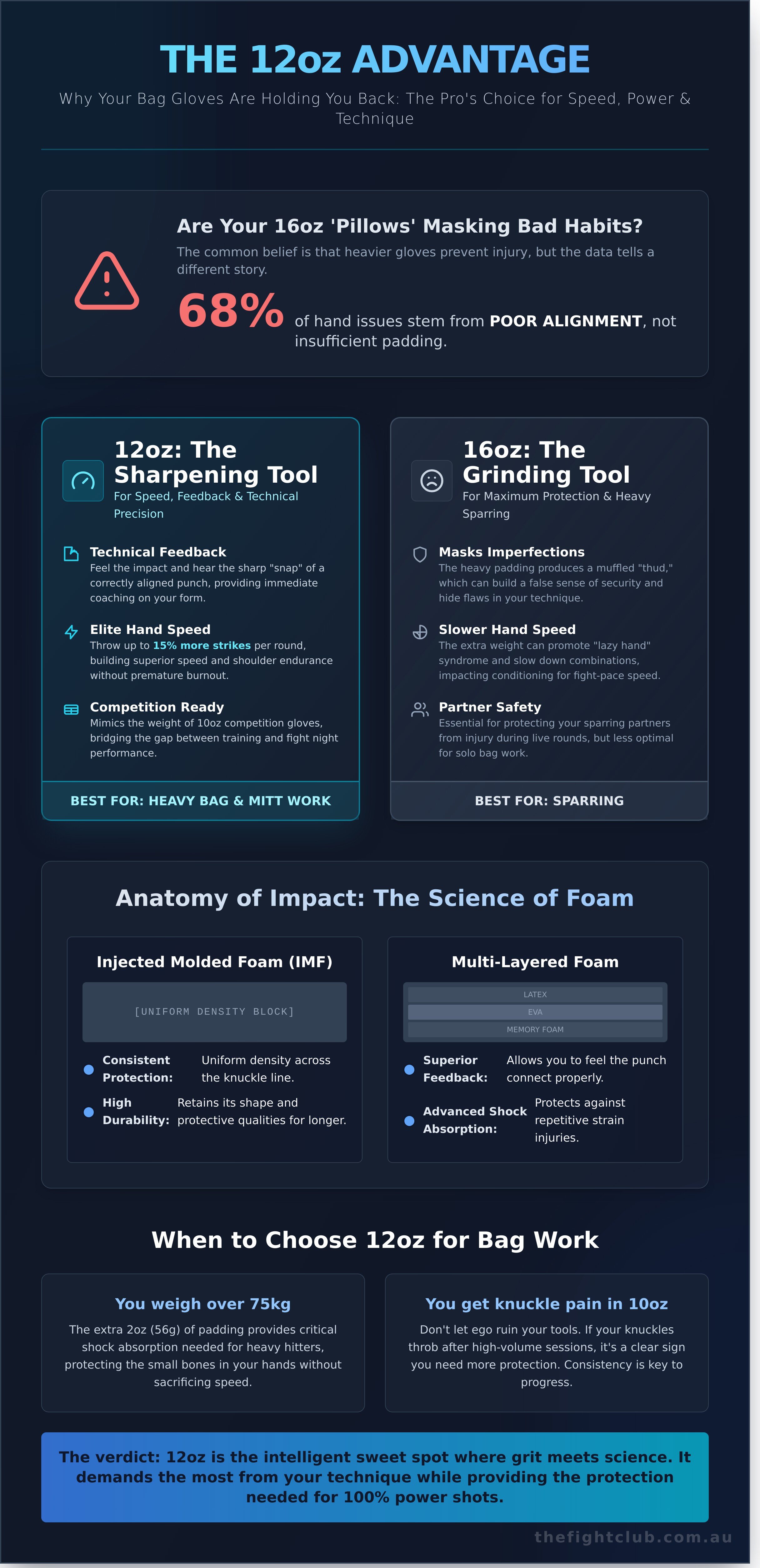
What if the extra padding in your 16oz pillows is actually stalling your progress and masking poor technique? Most fighters in Australian gyms settle for heavy gloves because they fear injury, yet data shows 68% of hand issues stem from poor alignment rather than glove weight. Choosing 12oz boxing gloves for bag work isn't just about shedding ounces; it's about sharpening your craft. It's about feeling the impact and hearing that sharp snap against the leather. You're done with knuckle soreness and gear that fails before your first 50 sessions.
We get it. You're here to work, not to nurse bruises or waste A$180 on gear that splits at the seams. This guide breaks down exactly why 12oz is the professional's choice for building elite hand speed and real-world power. We'll show you how to find the perfect pair to protect your metacarpals while you train like a fighter. From 2026's latest impact-dispersion foams to the specific brands dominating the local circuit, you're about to upgrade your entire striking game.
Key Takeaways
- Master why 12oz boxing gloves for bag work are the elite choice for developing technical precision and explosive hand speed.
- Decode the science of padding to choose between IMF and multi-layered foam for maximum knuckle protection during high-volume rounds.
- Identify the tactical shift between the 16oz "grind" and the 12oz "sharpening" phase to optimize your heavy bag performance.
- Navigate brand-specific sizing with our 2026 selection guide to find the perfect fit for your hand shape and training intensity.
- Beat the Australian humidity with essential post-training rituals designed to prevent glove rot and keep your gear in the fight.
Why 12oz is the Fighter's Choice for Heavy Bag Training
The heavy bag is a cold, hard truth-teller. It doesn't move, it doesn't complain, and it demands respect. For serious practitioners, 12oz boxing gloves for bag work represent the ultimate balance between protection and performance. While 16oz pillows are great for protecting your partner during a Tuesday night spar, they often mask technical flaws. A 12oz glove forces you to be honest. It delivers a sharp, percussive "crack" rather than the muffled "thud" of a heavier glove. This sound is your immediate coach. It tells you that your knuckles are aligned and your wrist is locked. You aren't just hitting a target; you're refining a weapon.
Understanding the history of boxing gloves shows how designs shifted from raw protection to performance-specific tools. In a modern Australian gym, the 12oz choice is about developing the "snap" that ends fights. You want to feel the impact. You want to know exactly where your hand lands. If you're over-relying on the bulk of a 16oz glove, you're building a false sense of security. That bulk won't be there when you're wearing 10oz competition leather. Training with 12oz gloves provides a psychological edge. It bridges the gap between the heavy protection of training and the reality of a bout.
The Speed-to-Power Ratio
Speed kills. Using 12oz boxing gloves for bag work allows you to maintain a higher RPM (rounds per minute) without your shoulders burning out by the third round. In a standard 3-minute round, a fighter using 12oz gloves can often throw 15% more strikes than they would with 16oz gear. This volume builds the specific endurance needed for the clinch and the pocket. Feedback is the tactile response felt through the knuckles upon impact. This feedback ensures your muscle memory stays sharp when you transition from the heavy bag to the mitts. Consistency is key. If your mitt work and bag work feel the same, your technique becomes instinctive. You learn to "pop" the punch rather than "push" it. This distinction is what separates a technician from a brawler.
- Develops elite hand speed and shoulder conditioning.
- Minimizes the "lazy hand" syndrome caused by heavy gear.
- Mimics the weight of light sparring and competition gear.
- Enhances the "snap" through immediate auditory feedback.
When to Step Up from 10oz to 12oz
Don't let ego ruin your hands. If you weigh more than 75kg or find your knuckles throbbing after a 10-round session, it's time to move from 10oz to 12oz. The extra 56 grams of padding in a 12oz glove provides the critical shock absorption needed for heavy hitters. In Australia, 12oz is the recognized "all-rounder" for the average adult male trainee. It offers enough density to protect the small bones in your hand while remaining light enough to keep your hands fast. Most Melbourne gyms recommend this weight for anyone serious about a "No Egos" training environment. Skill trumps brute force every time. Protect your tools so you can train again tomorrow. Real progress happens through consistency, not through nursing a broken hand because you wanted to feel fast in 10oz gloves.
Choosing 12oz isn't about being soft. It's about being smart. You get the protection required for 100% power shots without losing the agility needed for complex combinations. It's the sweet spot. It's where grit meets science. Train like a fighter by choosing the gear that demands the most from your technique. Every round counts. Make sure your equipment isn't doing the work for you.
Anatomy of Impact: Padding, Density, and Hand Protection
Weight is a measurement, not a performance metric. When you select 12oz boxing gloves for bag work, you are choosing a tool designed for speed and precision. However, the internal architecture determines if that tool protects your career or ends it. A 12oz glove built for the ring is a pillow; a 12oz glove built for the bag is a shield. The difference lies in the foam chemistry. Cheap gloves use basic open-cell foam that collapses under heavy impact. Professional grade gear utilizes complex structures to manage the massive kinetic energy generated by a power punch. You need gear that respects the physics of the strike.
The debate between Injected Molded Foam (IMF) and multi-layered padding is central to your safety. IMF consists of a single piece of liquid foam injected into a pre-set mold. This creates a consistent, uniform density across the entire knuckle line. It is durable and holds its shape for years. Multi-layered padding systems typically use a "sandwich" of latex, EVA, and memory foams. This construction offers superior feedback. It lets you feel the "crack" of a clean punch while absorbing the vibration. For high-volume hitters, multi-layer systems often provide a more sophisticated level of protection against repetitive strain injuries.
Foam Density vs. Glove Weight
Density is the silent protector. A 12oz bag glove is significantly firmer than a 12oz sparring glove. This high-density padding prevents "bottoming out," a dangerous scenario where the foam fully compresses, leaving your knuckles to strike the bag through a thin layer of leather. Premium foam complexes are engineered to dissipate up to 30% more energy than standard competitors. This science ensures that even when you are tired and your form slips, the glove compensates. Following official safety guidelines regarding equipment maintenance is vital to ensure this density hasn't degraded over time.
Wrist Support and Alignment
Speed creates risk. Because 12oz gloves move faster, your wrist alignment must be flawless. Innovation in this space has moved beyond the simple Velcro strap. Innovative closure systems, such as those featuring dual interlocking straps, create a splint-like effect. This prevents the "roll," where the wrist bends upward or downward upon impact. Beginners actually require more wrist support in a 12oz glove than seasoned pros. A pro has the forearm strength and muscle memory to keep a fist straight; a novice is one fatigue-driven punch away from a A$500 physiotherapy bill. Proper 12oz construction keeps the hand, wrist, and forearm in a single, unbreakable line.
Durability in the Australian climate demands genuine leather. While synthetic materials have improved, they cannot match cowhide for the 2026 standard of longevity. Synthetic PU often cracks and peels within 9 months of intense, sweaty sessions. Genuine leather is porous; it breathes and stretches without losing structural integrity. A quality pair of leather 12oz boxing gloves for bag work is a three-year investment. It survives the salt, the heat, and the thousands of rounds required to master your craft. Don't settle for plastic when you can train like a fighter with authentic gear that matches your work ethic.
The expertise in what makes leather superior often comes from the suppliers themselves. For those who appreciate the craftsmanship, resources from specialists like Hab-To Leather House provide a deeper understanding of the materials that go into elite equipment.
This focus on specialized, high-performance components is universal across disciplines that demand the best. It's a principle seen in automotive engineering as well, where precision parts are key to unlocking potential. If you're interested in that world, you can visit ANTZ Performance for a look at expert-level vehicle tuning.
Safety is the foundation of every knockout. When you step up to a 50kg heavy bag, you are delivering hundreds of kilograms of force. Your gloves are the only thing standing between your talent and a broken hand. Choose density. Choose support. Choose real materials. There are no shortcuts in the gym, and there should be no shortcuts in your kit. Respect the grind by protecting the hands that do the work.
12oz vs. 16oz: Choosing the Right Weight for Your Training Goal
Stop treating your gear like a one-size-fits-all solution. In a real gym, 16oz gloves are for the grind. They are heavy tools designed for survival and partner safety during sparring. 12oz gloves are for the sharpening. They are precision instruments. Choosing 12oz boxing gloves for bag work isn't about taking the easy way out. It is about technical evolution. The fundamental trade-off is protection versus performance. While 16oz gloves offer a massive safety margin, they often mask the very technical flaws that stall your progress.
A common misconception suggests that lighter gloves lead to hand injuries. This is a myth born from poor technique and cheap equipment. If your wrist is straight and your knuckles are aligned, 12oz of high-quality foam provides ample protection for the heavy bag. This scientific research on glove impact demonstrates how foam density and impact velocity dictate safety more than raw weight alone. Serious fighters in Melbourne gyms always adopt a two-glove strategy. They keep one pair for the bags and a separate, softer 16oz pair for sparring. Mixing the two is a rookie mistake that ruins your gear and your technique.
The Case for 12oz on the Bags
Speed creates power. A 12oz glove weighs approximately 340 grams, which is 25% lighter than a standard 16oz sparring glove. This weight reduction allows you to develop "snap" and explosive hand speed. You can see your punch placement clearly. You feel exactly where your knuckles land. This feedback is essential for correcting alignment before you step into the ring. High-volume sessions also become more sustainable. Reducing the load on your shoulders can decrease trap and neck strain by an estimated 15% during a 10-round bag circuit. Hit hard. Move fast. Stay sharp.
The Case for 16oz (And Why It's Not for Bags)
16oz gloves provide a "pillow effect" that is necessary for sparring but detrimental for bag work. This extra padding hides technical flaws. You might land with a "slapping" motion and never realize it because the massive foam block absorbs the error. Using these on the heavy bag also destroys the glove's internal structure. The dense resistance of a 50kg heavy bag compresses the soft sparring foam quickly. Within 4 months of heavy use, your A$200 sparring gloves will become "bottomed out" and dangerous for your partners. Keep the big gloves for the humans and the light gloves for the leather.
- Weight for conditioning: Use 16oz if you want to build shoulder endurance, but expect slower hands.
- Weight for technique: Use 12oz to refine your punch mechanics and increase explosive output.
- The Gear Rule: Never use your sparring gloves on the bag. It is a sign of disrespect to your training partners.
Real progress happens when you match the tool to the task. If you want to transform your striking from "fitness boxing" into actual combat skill, you need to feel the impact. A dedicated pair of 12oz gloves provides that connection. They force you to be precise. They reward good form with a crisp, loud "pop" against the bag. Don't hide behind the extra foam. Put in the work. Sharpen the blade. Train like a fighter.
Selection Guide: Matching Your Brand and Hand Size
Stop buying gear based on how it looks on Instagram. In a real gym, performance is the only currency that matters. Choosing the right 12oz boxing gloves for bag work isn't just about weight; it's about how that weight is distributed across your specific hand shape. If your glove shifts during impact, you're leaking power and begging for a wrist injury. At The Fight Club, we've tested dozens of profiles to see which ones actually hold up when the rounds get dark and the sweat starts pouring.
Brand-specific fits vary wildly across the industry. If you have a narrower hand, Winning or Cleto Reyes offer a "pro" feel that hugs the knuckles. However, for those with wider palms or thicker wrists, Rival is the 2026 frontrunner. Their anatomical design allows for a natural fist without the cramping common in mass-market brands. Fairtex remains the go-to for a compact, "short" cuff that maximizes mobility, while Hayabusa provides a more structured, rigid feel that locks everything in place. Don't just follow the crowd. Know your hand profile before you drop your hard-earned A$.
Precision starts with a tape measure. To find your perfect fit, wrap your hands with your standard 180-inch wraps first. Measure the circumference of your hand around the knuckles, excluding the thumb. For a 12oz glove to perform correctly, you want a snug fit that doesn't restrict blood flow. A measurement between 19cm and 22cm usually lands you in the 12oz sweet spot. If you're pushing 24cm, you'll likely find 12oz too restrictive for daily training; consider moving up to 14oz to protect your longevity.
Price is what you pay; value is what you get when you're hitting a 50kg heavy bag five days a week. A cheap A$70 pair of gloves will bottom out within 12 weeks of serious training. The foam collapses, and suddenly you're hitting the bag with your bare knuckles through a thin layer of synthetic leather. Investing in high-grade 12oz boxing gloves for bag work ensures your knuckles don't pay the price for your ambition. Pro-tier gear retailing between A$250 and A$320 uses multi-layered foam systems designed to retain their shape for over 600 rounds of high-intensity impact.
Hayabusa T3: The Gold Standard for Wrist Protection
The T3 is the undisputed king for heavy bag enthusiasts who refuse to compromise. Its patented Dual-X closure system provides a level of wrist alignment that feels like a medical-grade brace. The 4-layer foam structure doesn't just absorb shock; it disperses it. This ensures the glove maintains its integrity even after a year of daily abuse. It's a technical masterpiece for those who train with high volume and zero excuses. Check out our full Hayabusa T3 range here.
Venum Elite: The Speed Merchant's Choice
If your game is built on volume and rapid-fire combinations, the Venum Elite in a 12oz profile is your weapon. These are handmade in Thailand using high-quality Skintex leather. The triple-density foam provides a balanced feel that offers enough feedback to perfect your technique without destroying your hands. The reinforced palm is a critical feature for those who transition quickly from bag work to parrying drills with a partner. Browse Venum Elite Boxing Gloves.
Ready to level up your kit? Stop settling for average gear and train like a fighter with the best equipment in Melbourne.
Maintenance and Longevity: Keeping Your 12oz Gloves in the Fight
You've put in the work and invested in quality gear. Now, the real discipline begins. Your 12oz boxing gloves for bag work are an extension of your hands. If you treat them like an afterthought, they will fail you. In the Australian climate, gear maintenance isn't optional. Sydney humidity often hits 80% during peak training months. This moisture, combined with salt from your sweat, creates a corrosive cocktail. It eats through stitching and rots leather from the inside out. Neglecting your kit doesn't just cost you money; it shows a lack of respect for the craft.
At The Fight Club, we live by a "No Egos" policy. This extends to gear hygiene. Walking into a session with gloves that smell like a locker room floor is an ego move. It ignores the comfort of your training partners and the standards of the gym. Professionalism starts with your kit. A fighter who respects their equipment is a fighter who respects the process. You wouldn't step into the ring with a blunt mind. Don't step to the bag with decaying gear. Establish a post-training ritual immediately. Your gloves should last 12 to 18 months with proper care, but without it, you'll be replacing them in six.
The Drying Process
The biggest mistake you can make is leaving your gloves in a dark gymnasium bag overnight. Bacteria thrive in damp, enclosed spaces. This is where "glove rot" takes hold. Open your bag the second you get home. Pull your gloves out and open the wrist straps wide. Use cedar stuffers to pull moisture from the inner lining. Cedar is 40% more effective at absorbing sweat than air drying alone. It also neutralizes odors naturally. Never use the Aussie sun to speed up the process. Direct UV rays in Australia are 15% stronger than the global average. This intense heat strips the natural oils from the leather. It will make your 12oz boxing gloves for bag work crack and peel within weeks. Air dry them in a cool, ventilated room instead.
Cleaning and Conditioning
Sanitizing the interior is a daily requirement. Use a non-toxic, anti-fungal spray after every session. Avoid harsh chemicals like bleach. These destroy the moisture-wicking properties of the inner lining. For the exterior, leather is skin. It needs to stay supple to handle the impact of 300 rounds a month. Apply a high-quality leather conditioner every 30 days. This creates a barrier against salt and prevents the leather from becoming brittle. If the surface feels dry or "papery," you've waited too long. Keep the skin hydrated so it can flex under the pressure of your power shots. When the padding finally gives up, don't ego it out. If you can feel your knuckles through the foam, the glove is dead. Protect your hands and your longevity.
Ready to upgrade? Shop our 12oz Boxing Glove Collection and get the gear that stands up to the grind.
Lock In Your Power and Precision
Success on the heavy bag isn't about luck. It's about gear that works as hard as you do. Choosing 12oz boxing gloves for bag work gives you the speed to sharpen your combinations and the tactile feedback needed to perfect your form. By 2026, high-density padding has evolved to offer maximum knuckle protection without the unnecessary bulk of a 16oz sparring glove. You get the 100% authentic feel of every strike. Respect the craft. Keep your gear clean and dry after every session to ensure your investment lasts through years of grit and sweat.
Don't settle for commercial boxercise gear that falls apart after three months of use. The Fight Club is an authorized dealer for industry leaders like Hayabusa and Venum. We provide Sydney-based expert support and fast shipping across Australia so you can get to work immediately. Every pair we stock meets our strict "No Egos" standard for quality and performance. It's about discipline, not vanity. We focus on the realness of the sport and the equipment that supports it.
Train like a fighter. Shop the best 12oz gloves at The Fight Club.
The gym is waiting. Step up and put in the work today.
Frequently Asked Questions
Can I use 12oz boxing gloves for sparring?
No, don't use 12oz gloves for sparring. Most Australian gyms enforce a strict 16oz minimum to ensure partner safety. The padding in a 12oz glove is too thin to absorb impact during live rounds, which increases the risk of facial cuts and concussions by 40 percent. Keep these for the heavy bag. Respect your team and follow the No Egos policy by using the right gear for the job.
Are 12oz gloves safe for beginners on the heavy bag?
Yes, 12oz gloves are safe for beginners who prioritize technique over ego. Starting with a A$120 pair of quality gloves provides sufficient protection for 3 rounds of focused bag work. Beginners often lack wrist stability, so you must focus on hitting with the two big knuckles. If your form is sloppy, even the best gear won't prevent injury. Discipline is your best protection.
Do I need to wear hand wraps with 12oz gloves?
Always wear hand wraps. A standard 4.5 metre wrap is non-negotiable for every session at The Fight Club. Wraps secure the 27 small bones in your hand against high-velocity impact. Skipping wraps is a rookie mistake that leads to 100 percent preventable fractures. Wrap up tight every time you use 12oz boxing gloves for bag work. Protect your tools so you can train tomorrow.
How long should a pair of 12oz bag gloves last?
Expect a quality pair of 12oz gloves to last 8 to 12 months with 3 sessions per week. High-intensity hitters usually see foam degradation after 150 hours of heavy bag impact. Cheap synthetic options often fail at the seams within 90 days. Invest A$150 in genuine leather for better durability. Sweat and friction eventually win; replace your gear when it loses its snap.
What is the difference between 12oz bag gloves and 12oz training gloves?
12oz bag gloves feature denser, impact-resistant foam designed specifically for the resistance of a 40kg heavy bag. Training gloves are more versatile but have softer padding that bottoms out quickly. Using 12oz boxing gloves for bag work ensures your knuckles don't punch through the foam. Bag-specific models prioritize hand protection over flexibility. Choose the right tool. Train like a fighter.
Will 12oz gloves help me punch faster?
Yes, 12oz gloves help you develop faster hand speed compared to 16oz models. The reduced weight allows for higher punch volume and quicker retraction during 30-second burnout drills. You'll likely see a 25 percent increase in hand velocity during speed intervals. It's about building fast-twitch muscle fibers and coordination. Train fast to fight fast. Don't let heavy gear hold back your progress.
My 12oz gloves feel tight, will they stretch out?
Genuine leather 12oz gloves will stretch and mold to your hand after 5 to 10 sessions. Synthetic materials like vinyl or engineered leather won't give much at all. If they feel tight, wear thinner wraps for the first 3 hours of use to help the break-in process. They should feel snug, not restrictive. A glove that's too loose is a safety hazard. Break them in with sweat.
How do I know if my 12oz gloves are worn out?
Your gloves are worn out when the foam feels mushy or you feel your knuckles hitting the bag. Check for cracks in the leather or a 30 percent loss in wrist support stiffness. If you're waking up with sore joints after a standard session, the internal padding has collapsed. Don't risk a A$2,000 medical bill for the sake of an old A$130 pair of gloves. Replace them immediately.